
Introduction
Software development has become a race against time. Whether you're building a startup MVP, modernizing enterprise applications, or launching new digital products, delivering software faster often determines whether you lead the market or fall behind competitors. However, hiring experienced developers locally has become increasingly expensive and time-consuming, making it difficult for many organizations to scale engineering capacity at the speed modern businesses require.
This challenge has led many organizations to adopt Faster Agile Offshore Development—a software delivery approach that combines agile methodologies with globally distributed engineering teams. Rather than treating offshore developers as external vendors, businesses integrate them into their internal product teams, enabling continuous collaboration, iterative development, and faster software releases.
In this guide, you'll learn how agile offshore development works, why organizations across industries are embracing this model, its key benefits and challenges, the technologies that enable successful distributed teams, and how to select the right offshore development partner for sustainable business growth.
Key Takeaways
• Agile offshore development combines agile methodologies with dedicated offshore engineering teams to accelerate software delivery.
• Dedicated offshore teams help businesses scale engineering capacity without lengthy recruitment cycles.
• Scrum, Kanban, DevOps, and CI/CD enable continuous software delivery while improving product quality.
• Transparent communication and measurable KPIs are essential for successful distributed software development.
• Modern cloud platforms and collaboration tools help offshore and in-house teams work as a unified engineering organization.
• Choosing an experienced offshore development company reduces project risks while improving productivity, scalability, and long-term business outcomes.
What Is Faster Agile Offshore Development?
Faster Agile Offshore Development is a software delivery model that combines agile methodologies with dedicated offshore engineering teams to accelerate software development while maintaining quality, flexibility, and continuous collaboration. Instead of following traditional outsourcing models that rely on fixed project scopes and limited client involvement, agile offshore teams work collaboratively through short development cycles, frequent feedback, and continuous product improvements.
At its core, this approach extends your in-house engineering team with experienced software developers, quality assurance engineers, DevOps specialists, UI/UX designers, cloud architects, and business analysts. These professionals work together using agile frameworks such as Scrum and Kanban, ensuring software is delivered in incremental releases rather than waiting for a single final deployment.
For example, imagine a SaaS company developing a customer relationship management (CRM) platform. Instead of spending eight to ten months building the entire application before launch, an agile offshore team can release core functionality such as user authentication, customer management, and reporting dashboards within the first few sprints. Stakeholders review each release, provide feedback, and continuously refine the product based on real customer needs.
This iterative approach reduces development risks, shortens release cycles, and enables businesses to respond quickly to changing market demands.
Agile offshore development is a software delivery model that combines agile methodologies with distributed engineering teams to accelerate product development while maintaining quality, flexibility, and continuous collaboration.
Industry research continues to support this delivery model. According to the 17th State of Agile Report, organizations primarily adopt agile practices to improve collaboration, accelerate software delivery, and better manage changing business priorities.
Agile Offshore Development vs. Traditional Outsourcing
Although both approaches involve working with external development teams, their delivery models differ significantly.
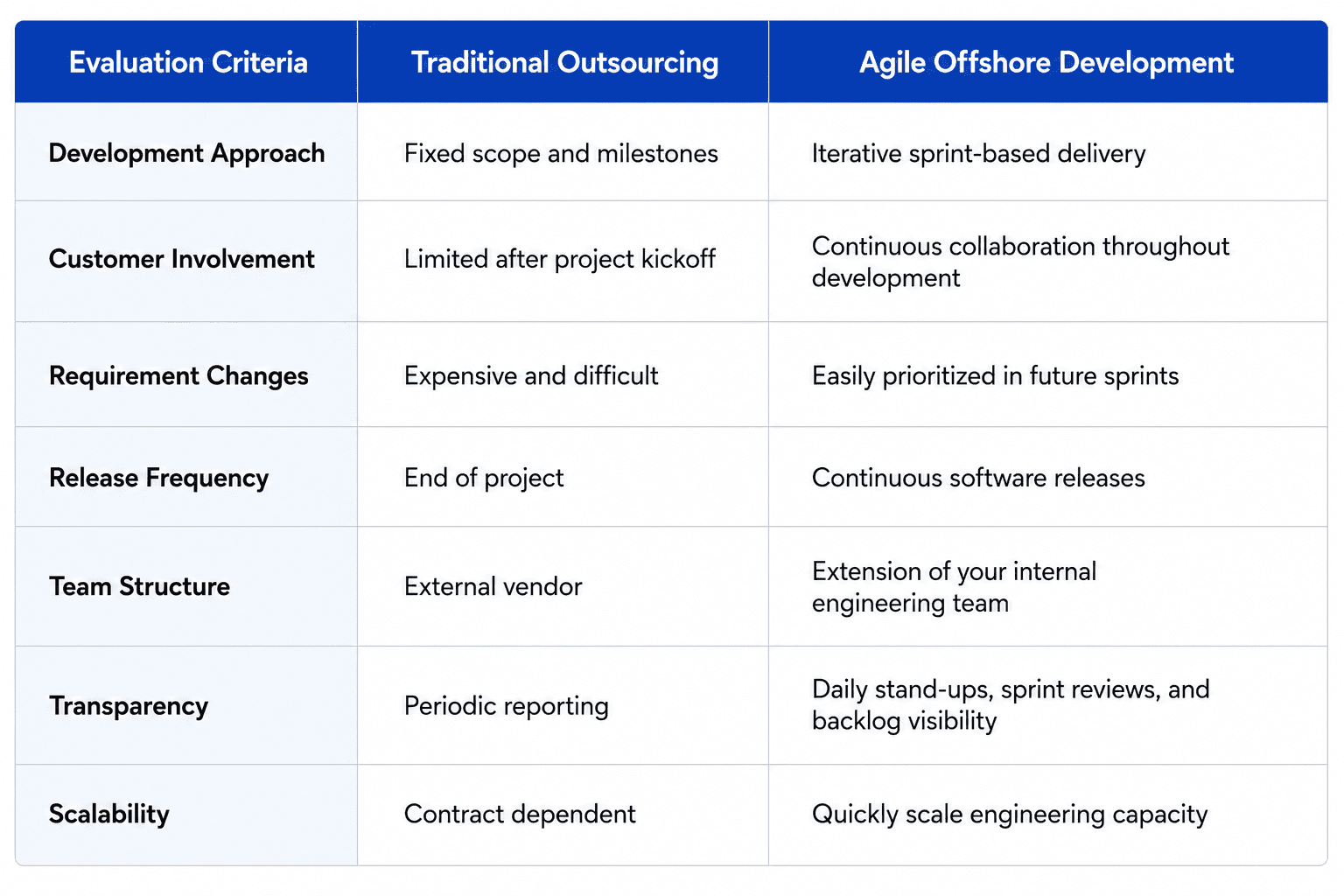
The biggest difference is collaboration. Traditional outsourcing focuses on completing predefined deliverables, while agile offshore development focuses on continuously delivering business value. Development teams become long-term partners who actively participate in product planning, sprint reviews, and continuous improvement rather than simply executing predefined tasks.
Why Agile Offshore Development Is Different
Modern software products rarely remain static. Customer expectations evolve, business priorities shift, and technology changes rapidly. Agile offshore development is designed to accommodate these changes without disrupting the overall delivery process.
Instead of treating change as a project risk, agile teams embrace it through:
• Sprint planning and backlog prioritization
• Continuous stakeholder feedback
• Automated testing and quality assurance
• DevOps-driven CI/CD pipelines
• Cross-functional collaboration
• Regular sprint reviews and retrospectives
For example, an e-commerce business preparing for a holiday shopping season may decide to prioritize personalized product recommendations instead of previously planned loyalty features. With agile offshore development, the Product Owner can simply reprioritize the backlog, allowing the engineering team to focus on features that create the greatest business impact.
This flexibility enables organizations to innovate faster while reducing costly rework later in the development lifecycle.
Why Businesses Prefer Dedicated Offshore Development Teams
Dedicated offshore development teams provide long-term engineering support rather than temporary project-based services. Team members become familiar with your business goals, technical architecture, coding standards, and development processes, resulting in higher productivity and better software quality over time.
A typical agile offshore team may include:
• Product Owner
• Scrum Master
• Software Developers
• QA Engineers
• DevOps Engineers
• UI/UX Designers
• Business Analysts
• Cloud Engineers
Rather than onboarding new contractors for every project, businesses retain a stable engineering team that continuously improves product knowledge and delivery efficiency. This long-term partnership leads to faster onboarding, reduced communication overhead, and more predictable software releases.
Why Are Businesses Adopting Faster Agile Offshore Development?
Businesses are adopting Faster Agile Offshore Development because it enables them to accelerate software delivery, access global engineering talent, improve scalability, and optimize development costs without sacrificing software quality. As digital transformation accelerates across industries, organizations need development models that allow them to innovate continuously while responding quickly to changing customer expectations.
According to the Google Cloud DORA 2024 State of DevOps Report, organizations with high-performing software delivery capabilities deploy code more frequently, recover from failures faster, and maintain greater software stability than lower-performing teams. These outcomes are closely associated with mature agile practices, continuous integration (CI), and continuous delivery (CD).
Similarly, McKinsey & Company reports that organizations adopting modern agile operating models can significantly improve productivity, reduce development bottlenecks, and accelerate time-to-market through cross-functional collaboration and iterative delivery.
These findings explain why enterprises, startups, and digital-first businesses increasingly combine agile methodologies with offshore engineering teams to build software faster and more efficiently.
Faster Time-to-Market Creates a Sustainable Competitive Advantage
Time-to-market is one of the most important business metrics in software development because releasing products earlier enables companies to acquire customers faster, validate ideas sooner, and respond quickly to changing market conditions.
Traditional software projects often follow sequential development cycles where design, development, testing, and deployment occur one after another. While this model may work for highly predictable projects, it slows innovation when requirements evolve.
Agile offshore development replaces this with iterative sprint-based delivery. Development teams release functional software every two to four weeks, allowing stakeholders to review progress and reprioritize features based on customer feedback.
A well-known example is Spotify, which scaled product development by organizing engineers into autonomous "Squads," "Tribes," and "Chapters." Although Spotify's model is not purely offshore, it demonstrates how distributed agile teams working independently can accelerate innovation while maintaining alignment across a large engineering organization.
Likewise, Microsoft has publicly shared how adopting DevOps practices, automated testing, and continuous delivery enabled faster release cycles across Azure and GitHub products.
Key business outcomes include:
• Earlier product launches
• Faster customer feedback
• Reduced development risk
• Continuous feature delivery
• Shorter release cycles
Agile offshore development improves software delivery speed through iterative sprint planning, continuous integration, automated testing, and frequent customer feedback.
Global Engineering Talent Solves the Software Skills Gap
Access to skilled software engineers has become one of the biggest challenges facing technology leaders worldwide. Recruiting experienced developers in specialized domains such as artificial intelligence, cloud computing, cybersecurity, and DevOps can take months in many markets.
According to the GitHub Octoverse Report 2024, GitHub now serves over 150 million developers, reflecting the rapid growth of the global software engineering community. This expansion allows organizations to build geographically distributed teams with expertise across virtually every modern technology stack.
Rather than limiting recruitment to a single city or country, agile offshore development enables businesses to access specialists in:
• Artificial Intelligence
• Machine Learning
• Cloud Architecture
• Kubernetes
• DevOps
• Mobile Development
• Enterprise Java
• .NET
• React
• Cybersecurity
For example, many global technology companies—including Atlassian, GitLab, and Automattic—operate successfully with highly distributed engineering teams. Their experience demonstrates that effective collaboration depends more on standardized processes, documentation, and communication than physical location.
Cost Optimization Without Compromising Quality
One of the biggest misconceptions about offshore development is that it focuses only on reducing costs. In reality, mature agile offshore development prioritizes engineering efficiency, delivery speed, and long-term business value.
Organizations save money by reducing:
• Recruitment expenses
• Infrastructure costs
• Employee onboarding time
• Administrative overhead
• Delayed product launches
However, the larger advantage comes from delivering valuable software earlier, allowing businesses to generate revenue sooner.
For example, if a SaaS company launches a subscription platform three months earlier than planned, the additional recurring revenue may outweigh the direct savings from offshore development. This demonstrates why many organizations evaluate offshore development based on Return on Investment (ROI) rather than hourly development rates.
According to Deloitte's Global Outsourcing Survey, organizations increasingly outsource technology functions to improve agility, access specialized capabilities, and accelerate innovation—not solely to reduce costs.
Agile Offshore Teams Scale Faster Than Traditional Hiring
Scaling an internal engineering team often requires months of recruitment, interviews, onboarding, and training. Agile offshore development enables organizations to expand engineering capacity much more quickly through dedicated teams that are already experienced with modern development practices.
Instead of hiring one developer at a time, businesses can onboard a complete cross-functional team that includes:
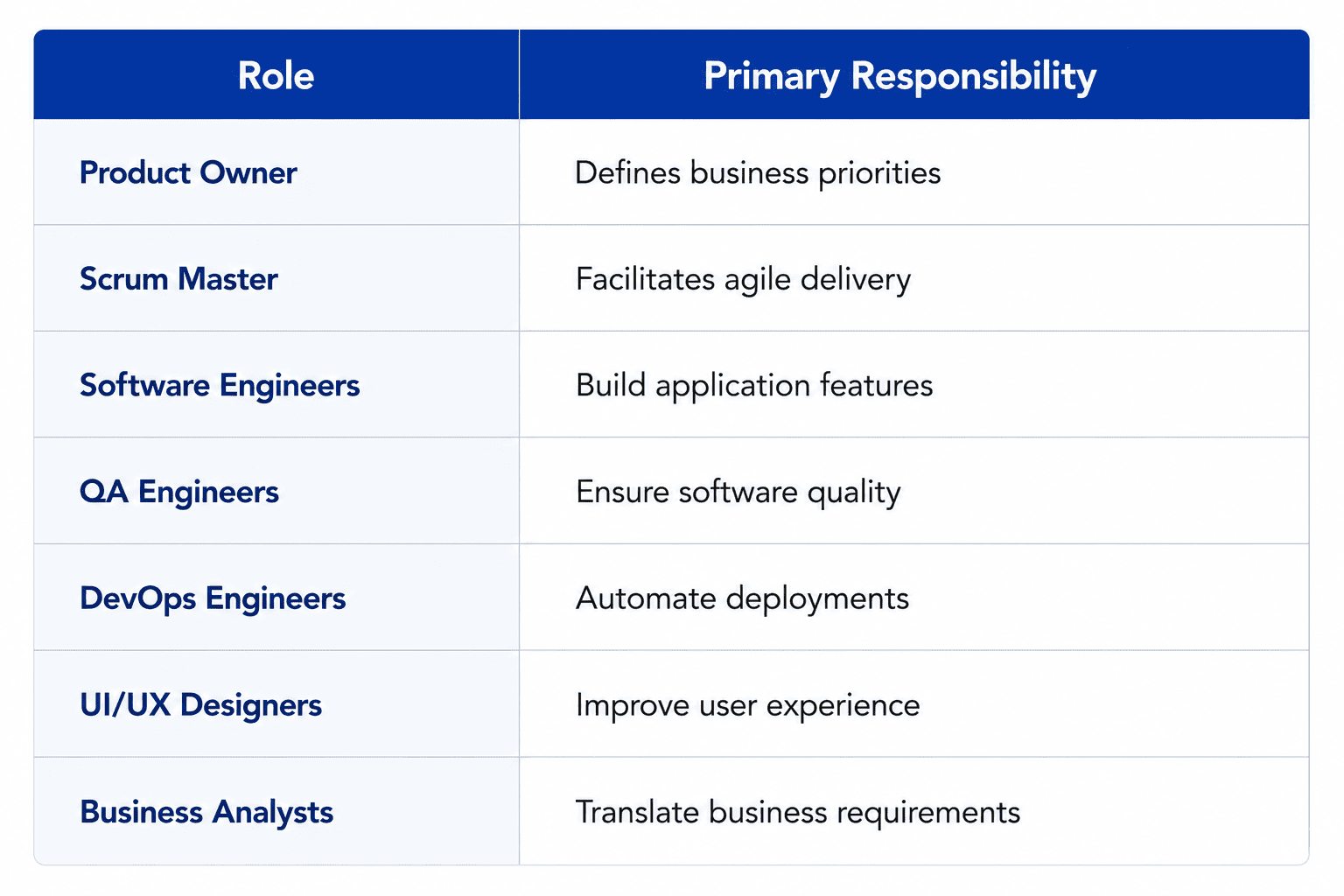
This model is particularly valuable for startups launching MVPs, enterprises modernizing legacy systems, and organizations experiencing rapid business growth.
Continuous Customer Feedback Improves Product Quality
One of agile development's greatest strengths is its ability to incorporate customer feedback throughout the software development lifecycle instead of waiting until the project is complete.
Every sprint ends with:
• Sprint Review
• Product Demonstration
• Stakeholder Feedback
• Backlog Refinement
This process allows organizations to validate assumptions before investing significant development effort.
A practical example is Amazon, whose product teams frequently use experimentation and iterative releases to improve customer experiences. Rather than relying solely on long-term planning, features are refined continuously using user behavior, analytics, and operational feedback.
Continuous feedback results in:
• Better product-market fit
• Higher customer satisfaction
• Fewer costly redesigns
• Reduced project risk
• Continuous innovation
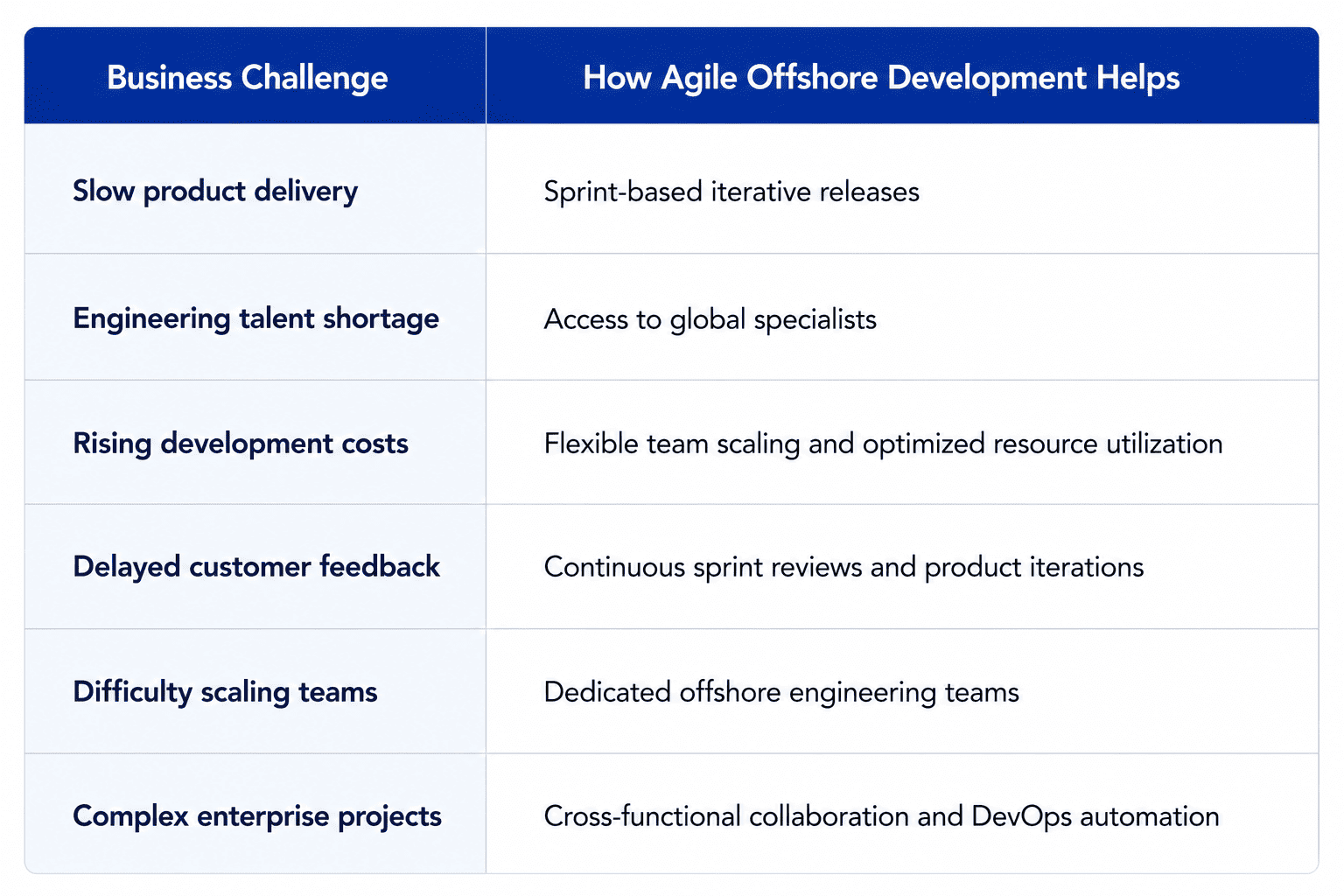
Key Business Drivers
What Are the Core Principles of Agile Offshore Development?
The core principles of agile offshore development are iterative delivery, continuous collaboration, customer-centric planning, transparency, and continuous improvement. These principles enable geographically distributed teams to deliver software quickly while adapting to changing business requirements without compromising quality.
Unlike traditional software development, where projects often follow rigid plans and long release cycles, agile offshore teams work in short iterations called sprints. Each sprint produces working software, allowing stakeholders to review progress, provide feedback, and reprioritize upcoming work. This iterative approach reduces project risk, shortens feedback loops, and ensures the final product aligns with business objectives.
According to the 17th State of Agile Report, improving collaboration, accelerating software delivery, and managing changing priorities remain among the primary reasons organizations adopt agile methodologies. Agile practices are increasingly combined with DevOps and cloud-native engineering to support continuous software delivery.
Scrum Provides Structure for Distributed Teams
Scrum is the most widely used agile framework for managing software development projects because it organizes work into short, time-boxed sprints with clearly defined responsibilities. Every sprint typically lasts between one and four weeks and concludes with a working software increment that stakeholders can review.
A Scrum team consists of three primary roles:
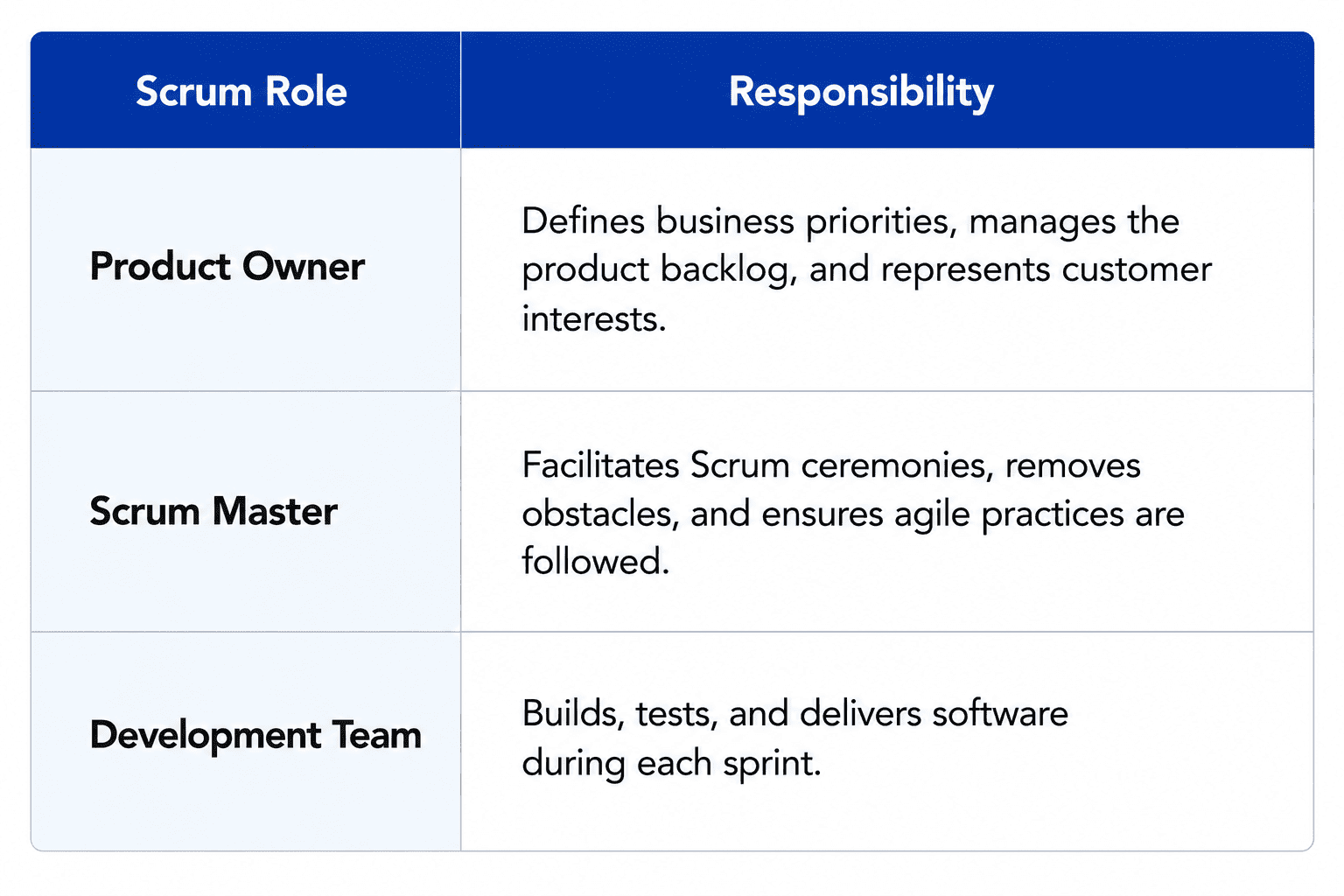
Each sprint follows a consistent sequence:
1. Sprint Planning
2. Daily Stand-ups
3. Development
4. Code Review
5. Testing
6. Sprint Review
7. Sprint Retrospective
For example, ING Bank adopted Scrum and cross-functional squads as part of its agile transformation. By reorganizing teams around products rather than departments, ING improved collaboration and significantly accelerated digital product delivery. Today, the bank's engineering organization operates through autonomous squads inspired by the Spotify model, enabling faster innovation across its digital banking platforms.
Kanban Optimizes Continuous Delivery
Kanban is an agile workflow management method that improves delivery speed by visualizing work, limiting work in progress (WIP), and continuously optimizing workflow. Unlike Scrum, which operates within fixed sprint cycles, Kanban allows teams to release completed work whenever it is ready.
A typical Kanban board includes stages such as:
• Product Backlog
• Ready for Development
• In Progress
• Code Review
• Testing
• Ready for Release
• Done
By visualizing every task, teams can quickly identify bottlenecks before they delay software delivery.
For example, Microsoft's Azure DevOps platform includes Kanban boards that help distributed engineering teams manage work across planning, development, testing, and deployment. Thousands of software organizations use Kanban boards to improve transparency and balance workloads across globally distributed teams.
Kanban works especially well for:
• Product maintenance
• DevOps operations
• Continuous deployment
• Cloud infrastructure management
• Bug fixing
• Support engineering
Many organizations combine Scrum planning with Kanban workflow visualization, creating a hybrid methodology commonly referred to as Scrumban.
Sprint Planning Aligns Engineering with Business Priorities
Sprint planning ensures that development teams work on the highest-value features during each iteration. Rather than attempting to complete every requested feature simultaneously, agile teams prioritize work based on business impact, customer needs, technical dependencies, and available engineering capacity.
Each sprint planning session typically answers four questions:
• What business value should this sprint deliver?
• Which user stories have the highest priority?
• How much work can the team realistically complete?
• What risks or dependencies must be addressed?
For example, a healthcare provider developing a telemedicine platform may prioritize secure patient authentication and video consultation capabilities before implementing advanced analytics. Delivering essential functionality first allows the organization to launch earlier while collecting real-world feedback for future improvements.
According to the Project Management Institute (PMI), organizations that align project execution closely with business strategy are more likely to achieve their intended outcomes and realize greater value from technology investments.
Daily Stand-ups Improve Communication Across Time Zones
Daily stand-up meetings keep distributed teams aligned by providing a structured forum for sharing progress, identifying blockers, and coordinating priorities. Although each meeting typically lasts no more than 15 minutes, it plays a crucial role in maintaining transparency across offshore and in-house teams.
During the stand-up, each team member answers three questions:
1. What did I complete yesterday?
2. What will I work on today?
3. What obstacles are preventing progress?
For offshore teams working across multiple time zones, asynchronous updates are often combined with scheduled stand-ups using collaboration platforms such as:
• Slack
• Microsoft Teams
• Zoom
• Google Meet
For example, GitLab, one of the world's largest fully remote companies, documents nearly every engineering process and relies heavily on asynchronous communication alongside scheduled collaboration. This documentation-first culture enables thousands of employees across more than 60 countries to collaborate efficiently without relying exclusively on live meetings.
GitLab's publicly available Remote Work Handbook has become one of the most referenced resources for managing distributed software teams.
Continuous Integration and DevOps Accelerate Delivery
Continuous Integration (CI) automatically merges, builds, and tests code whenever developers submit changes, reducing integration issues and improving software quality. Combined with Continuous Delivery (CD), it enables organizations to deploy software more frequently with greater confidence.
Modern CI/CD pipelines typically include:
• Automated builds
• Unit testing
• Integration testing
• Security scanning
• Code quality analysis
• Deployment automation
• Production monitoring
According to the Google Cloud DORA 2024 Report, elite software delivery teams achieve dramatically higher deployment frequency while maintaining lower change failure rates than lower-performing organizations. These capabilities are made possible through mature DevOps practices rather than simply increasing engineering headcount.
Popular CI/CD platforms include:
• GitHub Actions
• GitLab CI/CD
• Jenkins
• Azure DevOps Pipelines
• CircleCI
Organizations that combine agile offshore development with DevOps automation can release software continuously instead of waiting for infrequent, high-risk deployments.
Continuous Feedback Improves Product Quality
Continuous feedback enables teams to validate assumptions early, reduce costly rework, and deliver products that better meet customer expectations. Instead of waiting until project completion, agile offshore teams gather feedback throughout the development lifecycle.
Feedback comes from multiple sources:
• Product Owners
• End users
• QA engineers
• Customer support teams
• Product analytics
• Business stakeholders
For example, Netflix continuously experiments with user interface improvements through A/B testing. Rather than relying solely on internal assumptions, product teams analyze user behavior and release incremental improvements based on measurable customer outcomes.
This feedback-driven approach helps organizations:
• Improve customer satisfaction
• Reduce development waste
• Prioritize valuable features
• Identify usability issues early
• Increase product-market fit
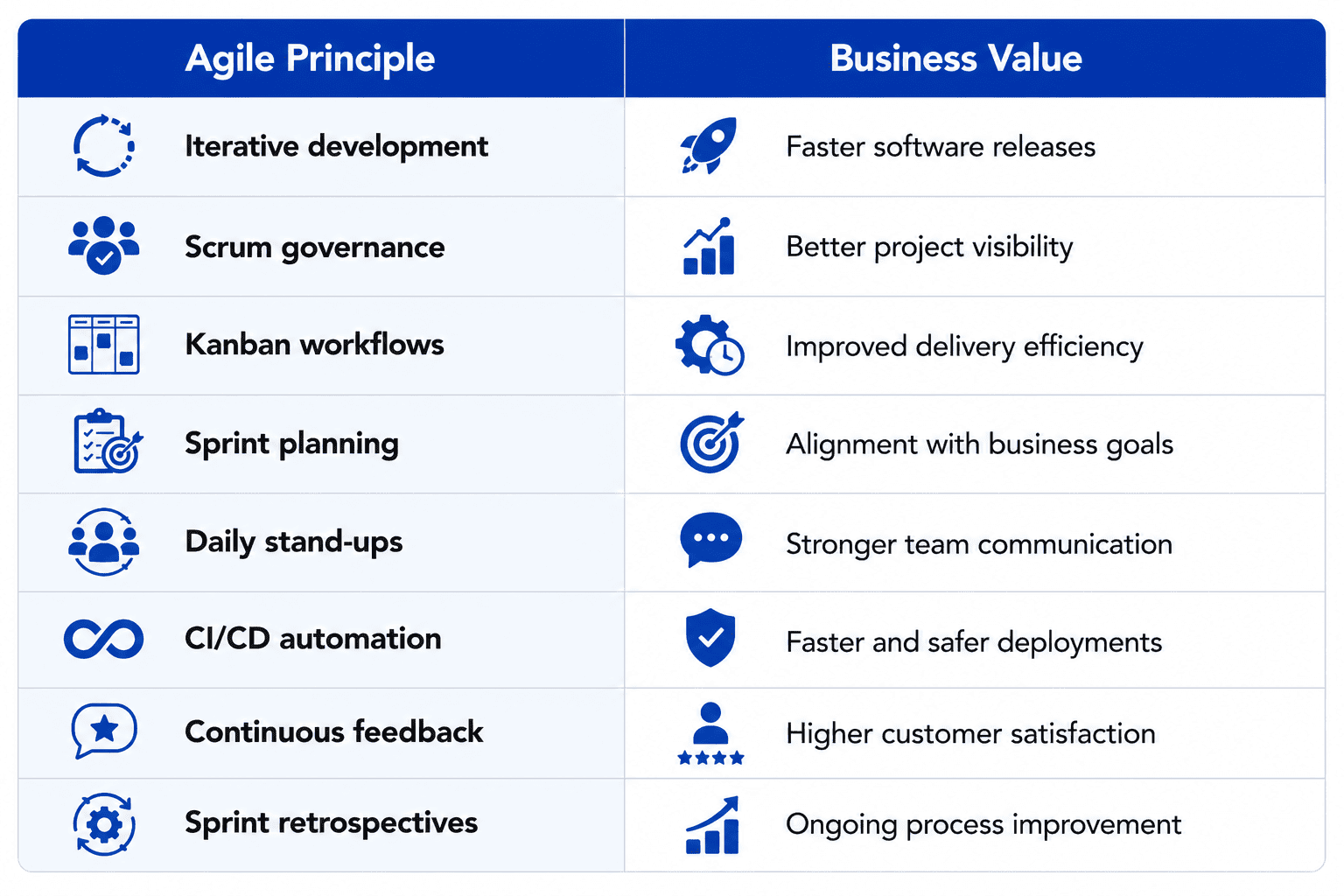
Agile Principles at a Glance
How to Choose the Right Agile Offshore Development Partner
Selecting the right offshore development partner is one of the most important decisions in any software project. While technical expertise matters, long-term success depends on finding a partner that aligns with your business goals, follows mature agile practices, and communicates transparently throughout the development lifecycle.
According to Deloitte's Global Outsourcing Survey, organizations increasingly choose outsourcing partners based on innovation capabilities, access to specialized talent, and business agility, rather than cost savings alone. This shift highlights the importance of evaluating strategic fit instead of focusing solely on hourly rates.
Evaluate Technical Expertise and Industry Experience
A reliable offshore partner should demonstrate expertise in the technologies your project requires, whether it's cloud-native development, AI, mobile applications, enterprise software, or DevOps. Beyond technical skills, look for experience in your industry, as domain knowledge can significantly reduce onboarding time and project risks.
When evaluating a vendor, review:
• Technology stack and certifications
• Similar projects and case studies
• Client testimonials
• Industry-specific experience
• Team composition and seniority
For example, if you're developing a healthcare platform, ensure the team understands compliance standards such as HIPAA and has experience building secure, scalable healthcare applications
Assess Agile Delivery Capabilities
An experienced offshore partner should have well-defined agile processes rather than simply claiming to "follow Scrum."
Ask questions such as:
• How are sprints planned and managed?
• How often are sprint reviews conducted?
• What KPIs are used to measure delivery?
• How is customer feedback incorporated?
• Is CI/CD part of the development process?
Companies with mature agile practices typically provide greater visibility into project progress and adapt more effectively to changing business requirements.
Prioritize Security and Compliance
Protecting intellectual property and customer data should be a non-negotiable requirement.
Look for partners that follow recognized security standards, including:
• ISO/IEC 27001
• GDPR compliance
• Secure SDLC practices
• NDA and IP protection agreements
• Role-based access controls (RBAC)
According to IBM's Cost of a Data Breach Report 2024, organizations with mature security processes and automation significantly reduce the financial impact of data breaches, making security a critical evaluation criterion.
Evaluate Communication and Transparency
Strong communication is often the defining factor between successful and unsuccessful offshore engagements. Choose a partner that provides regular updates, clear documentation, and dedicated points of contact.
Key indicators include:
• Dedicated Project Manager or Scrum Master
• Weekly sprint reviews
• Daily stand-ups
• Real-time project dashboards
• Collaboration through Jira, Slack, or Microsoft Teams
Transparent reporting ensures stakeholders remain informed and enables faster decision-making throughout the project.
Partner Evaluation Checklist
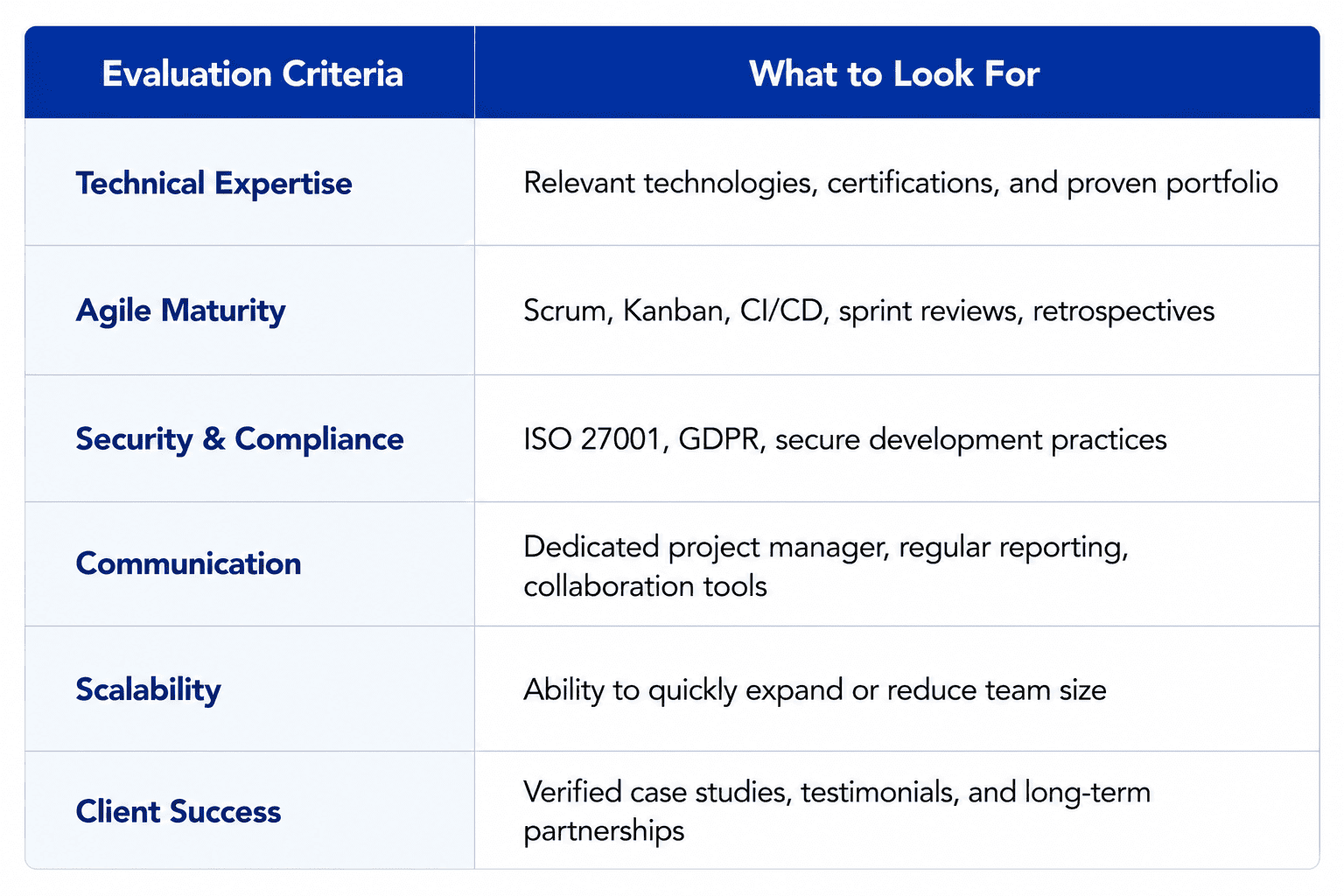
Choosing the right agile offshore development partner is about more than outsourcing development—it is about building a long-term engineering partnership that supports innovation, scalability, and sustainable business growth.
Why Choose Brilliantech for Faster Agile Offshore Development?
Choosing the right development partner is about more than expanding your engineering team—it's about finding a company that understands your business objectives and can consistently deliver high-quality software. At Brilliantech, we combine agile methodologies, experienced engineers, and modern DevOps practices to help businesses accelerate digital transformation with confidence.
Whether you're building an MVP, modernizing legacy applications, or scaling an enterprise platform, our dedicated offshore teams integrate seamlessly with your in-house engineers to deliver software faster without compromising quality or security.
Agile-First Development Approach
Our delivery model is built around agile principles, including Scrum, Kanban, continuous integration, and iterative development. Every sprint focuses on delivering measurable business value while maintaining transparency through regular stand-ups, sprint reviews, and progress reporting.
Experienced Cross-Functional Engineering Teams
Brilliantech provides dedicated teams tailored to your project requirements, including:
• Software Developers
• UI/UX Designers
• QA Engineers
• DevOps Specialists
• Cloud Engineers
• Business Analysts
• Project Managers
This cross-functional approach ensures faster collaboration and shorter development cycles.
Modern Technology Expertise
Our engineers work with today's leading technologies, including:
• Java & Spring Boot
• .NET
• React & Angular
• Flutter
• Node.js & Python
• AWS, Azure & Google Cloud
• Docker & Kubernetes
• AI and Generative AI Solutions
From cloud-native applications to enterprise software and AI-powered platforms, we help businesses adopt technologies that support long-term growth.
Transparent Collaboration and Enterprise Security
Successful offshore development depends on trust and communication. We provide dedicated project managers, regular sprint updates, and real-time project visibility using tools such as Jira, Slack, and Microsoft Teams.
Security is embedded throughout the development lifecycle with secure coding practices, role-based access controls, and compliance-focused processes to protect your intellectual property and business data.
Conclusion
In today's competitive digital landscape, delivering software quickly without compromising quality is essential for business success. Faster Agile Offshore Development combines agile methodologies, skilled global engineering talent, and modern DevOps practices to help organizations accelerate product delivery, reduce development risks, and scale efficiently.
Whether you're launching a startup MVP, modernizing enterprise systems, or expanding your engineering capacity, partnering with an experienced agile offshore development company can provide the flexibility and expertise needed to achieve your goals.
If you're looking for a trusted technology partner, Brilliantech offers dedicated agile development teams, modern technology expertise, and end-to-end software engineering services tailored to your business needs.
Ready to accelerate your next software project? Contact Brilliantech today to explore how our Agile Offshore Development services can help you innovate faster and stay ahead of the competition.