
01. Why Everyone Is Suddenly Talking About AI Agents
For about a decade, "automation" really meant rules. A form kicked off a workflow, a keyword routed a ticket, a script shoved data from one system into another. Useful stuff — but fragile. The second a process wandered off its scripted path, a human had to jump back in. Chatbots inherited the same ceiling: they answered questions, but they couldn't actually do anything.
That ceiling has lifted. Today's AI agents can take a goal, work out what they need to pursue it, reason through the options, call the tools that get the job done, act inside real business systems, and get better as they go. The jump from answering to acting is the whole story here — it's why this wave of AI agent business ideas is commercially interesting and not just a neat demo at a conference.
And the opportunity isn't landing in one place. Founders are building tightly focused SaaS products around a single painful workflow. Enterprises are pointing agents at the repetitive knowledge work that quietly eats their teams' weeks. Agencies are packaging their automation know-how into recurring service lines. Domain experts are building copilots that genuinely speak the language of one industry. And service firms are turning hard-won internal expertise into products they can sell or license.
If you want one mental model to carry through the rest of this piece, it's this: stop picturing agents as assistants and start picturing them as digital coworkers. AI agents for business can now pitch in across sales, support, operations, finance, HR, legal, engineering, marketing, logistics, healthcare, and education — not by replacing the people there, but by quickly absorbing the structured, repetitive slices of their day.
02. So What Actually Separates an Agent from a Chatbot?
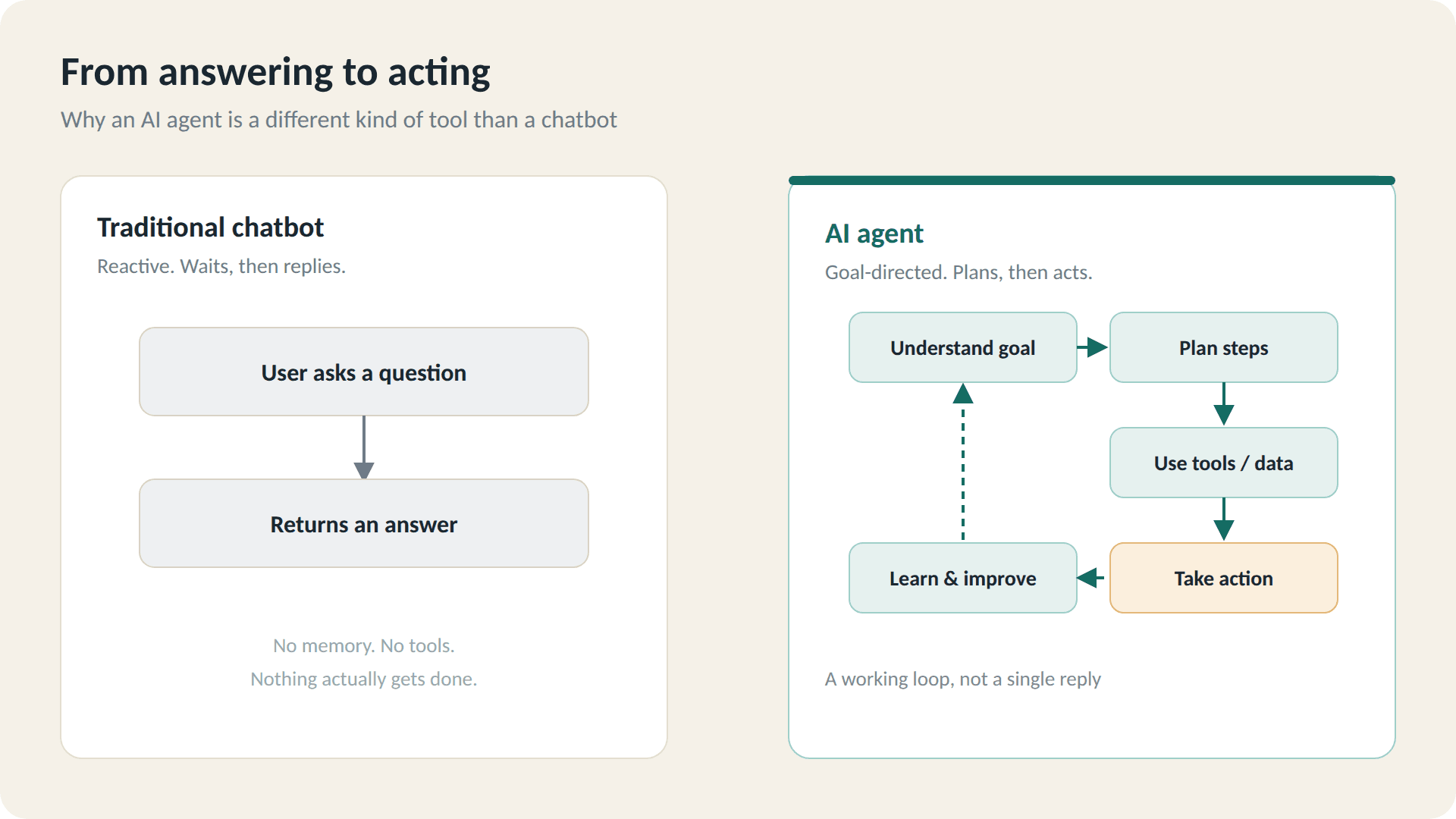
This distinction matters because it sets the bar for what you can build and charge for. A chatbot is reactive — it waits for a question and hands back text. An agent is goal-directed — it understands an objective, decides how to get there, pulls in whatever context it needs, runs the steps across your systems, and knows when to pass the wheel back to a person.
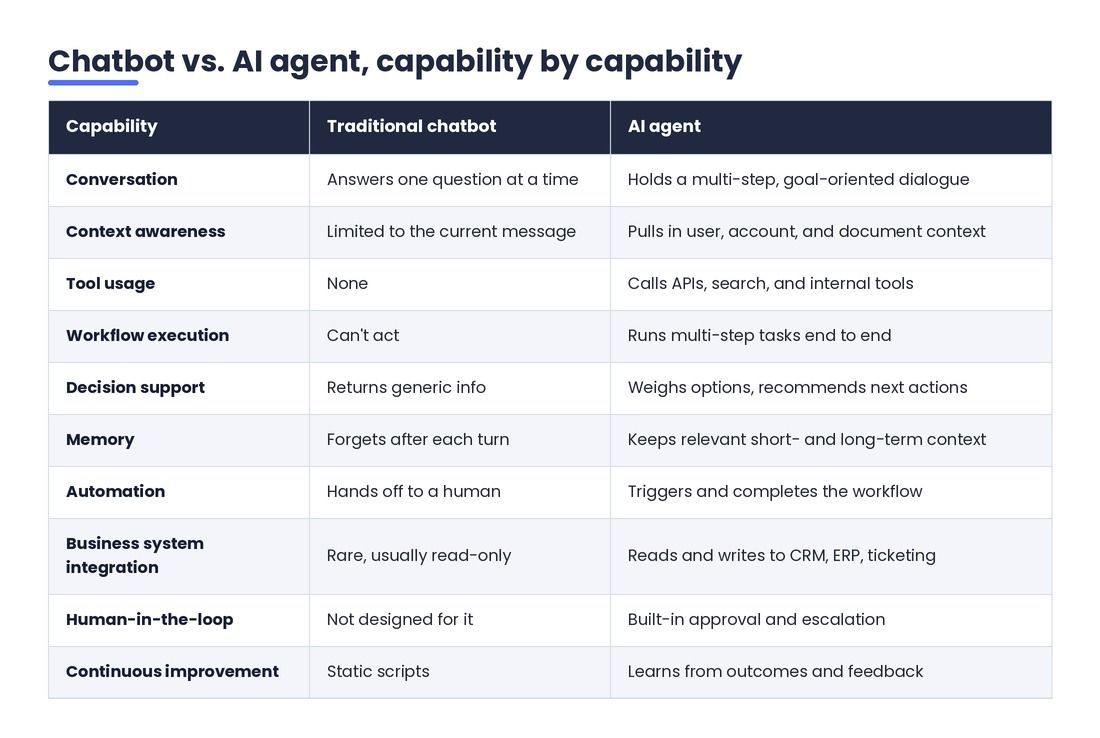
Here's the same idea laid out capability by capability. The right-hand column is where the value (and the defensibility) lives.
03. Why the timing is genuinely good right now
A few things lined up at once. Foundation models and GenAI agents got reliable enough to reason over messy, real-world inputs in production — not just in a sandbox. Cloud infrastructure and well-documented APIs dropped the cost of building. Meanwhile, businesses are under real pressure to do more without piling on headcount, and repetitive knowledge work is still one of the biggest, least-scrutinised line items on the books.
There's also a clearer demand signal than there was a year ago. Companies that played with generic chatbots have learned exactly what those tools can't do, and now they want agents built around their actual workflows. That preference is the whole game: the strongest AI agent startup ideas aren't broad do-everything assistants. They're narrow agents that nail one clear, painful, frequently repeated problem inside a specific function or industry. Vertical focus is what turns a clever prototype into something people will pay for.
04. How to tell a good idea from a fun one
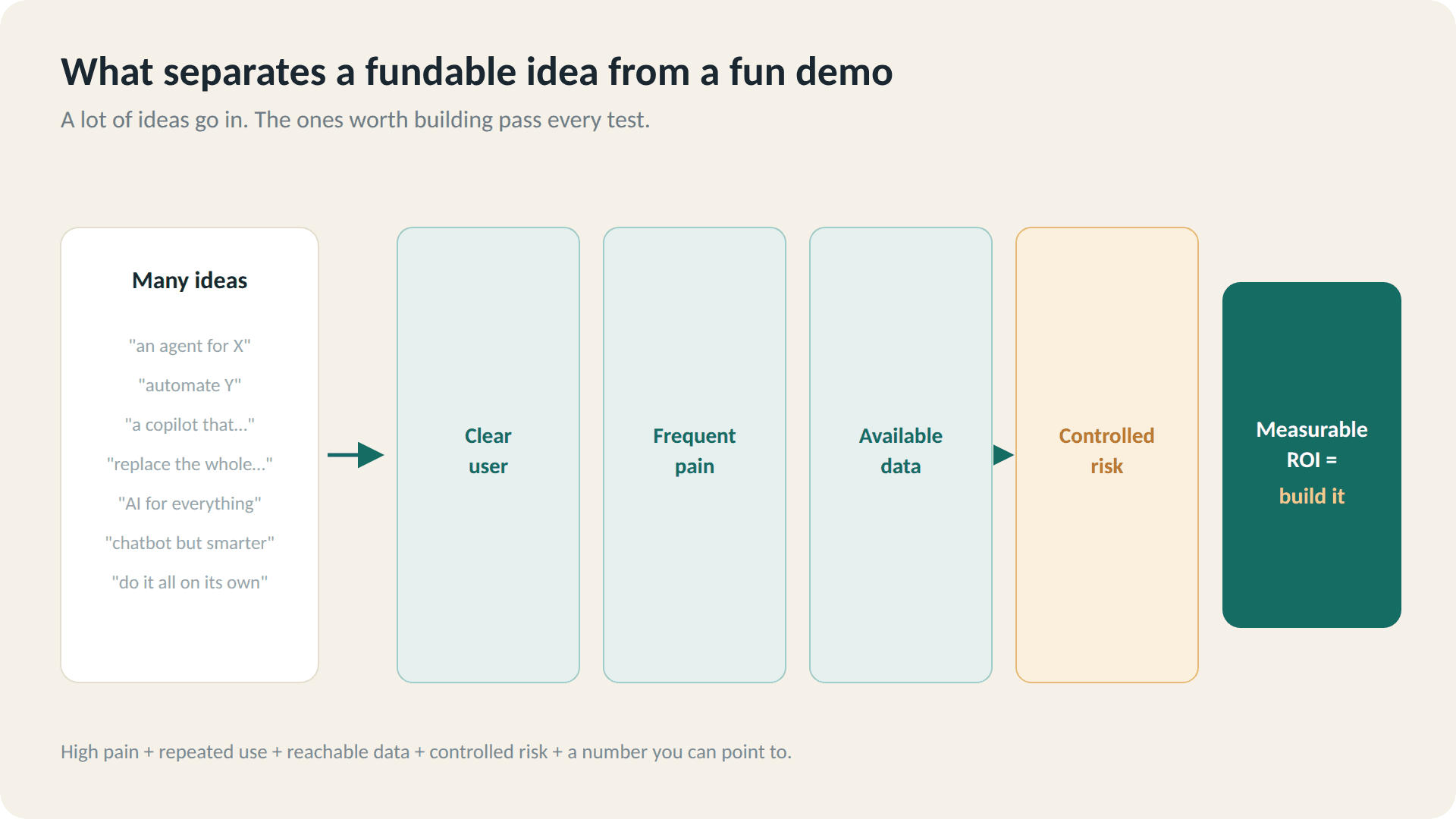
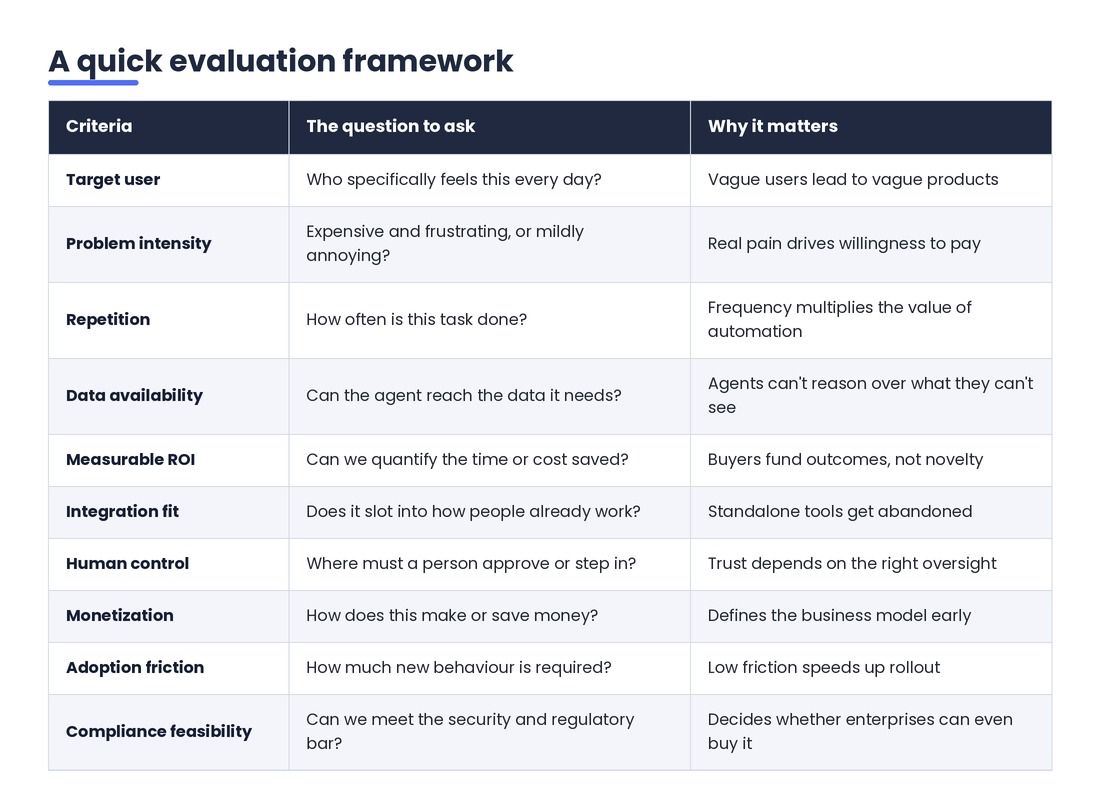
Before you write a line of code, run the idea through a few honest questions. A strong one has a clearly defined user, a frequent and genuinely painful problem, and a workflow that today burns real manual effort. It needs data or documents the agent can actually reach, a return you can measure, and a natural place to plug into existing systems. It should keep a human in control where the stakes are high, have an obvious route to revenue, ask for very little behaviour change, and be buildable within your security and compliance reality.
05. The most practical ideas, by business function
Here are sixteen AI agent use cases worth a serious look, grouped by the function they serve. For each, the short version: who hurts, what the agent does, and how you'd likely sell it.
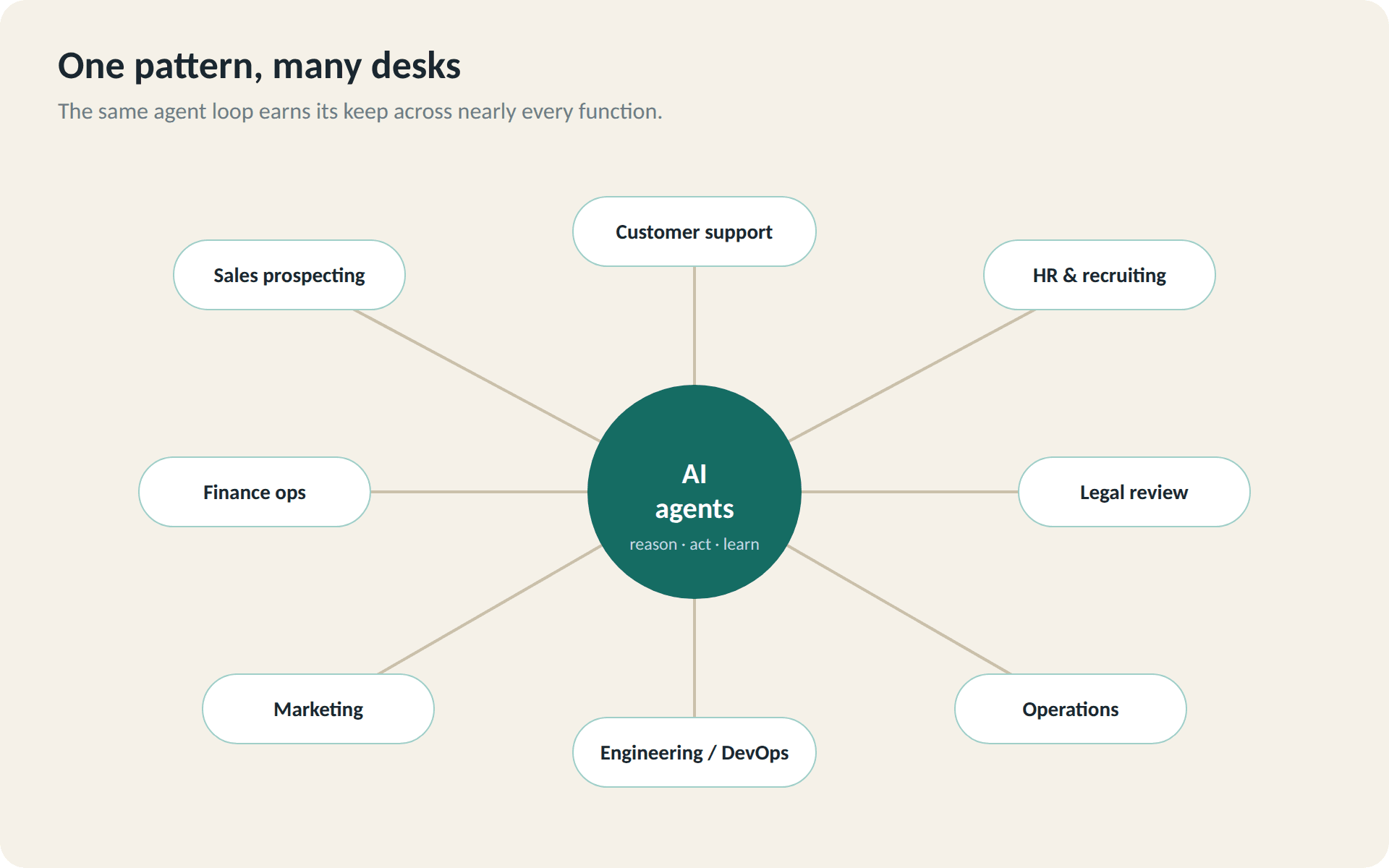
A. Sales prospecting agent. Reps lose hours researching accounts before they ever say hello. This agent profiles target accounts, finds the likely decision-makers, sums up company context, drafts personalised outreach, and suggests the next move. MODEL: per-seat SaaS.
B. Proposal and RFP response agent. Pre-sales teams lose days to dense RFPs. The agent pulls out requirements, maps them to compliance criteria, reuses approved content, and writes a first draft. MODEL: subscription plus usage.
C. Customer support resolution agent. Queues fill up with the same handful of issues. It reads the problem, fetches the right policy or product knowledge, drafts a resolution, and escalates the genuinely hard cases. MODEL: usage- or per-resolution pricing.
D. HR screening and scheduling agent. Recruiters drown in resumes. It screens applications, matches people to roles, summarises profiles, and sorts out interview scheduling. MODEL: per-seat or per-hire.
E. Finance reconciliation agent. Someone is still matching invoices, payments, and POs by hand. This agent compares records across systems and flags the mismatches. MODEL: enterprise license.
F. Meeting intelligence agent. Decisions made in meetings tend to evaporate by Friday. It captures notes, decisions, owners, and deadlines across Teams, Zoom, Slack, and email, then chases the follow-ups. MODEL: per-seat SaaS.
G. Legal document review agent. Review is a bottleneck. It reads contracts, flags risky clauses, compares against standard templates, and summarises obligations. MODEL: per-document or enterprise license.
H. Marketing content agent. Teams rework the same ideas across channels. It generates concepts, checks brand tone and compliance, and produces channel-specific copy. MODEL: subscription with usage tiers.
I. Software engineering PR review agent. Code review is slow and uneven. It reviews pull requests, surfaces likely risks, checks standards, and summarises changes for the reviewer. MODEL: per-developer pricing.
J. DevOps incident response agent. During an incident, engineers waste precious minutes spelunking through logs. It watches alerts, summarises logs, suggests probable root causes, and points to the right runbook. MODEL: enterprise license by scale.
K. Data analyst agent. Business users wait on analysts for simple answers. It takes a plain-language question, writes the SQL, explains the dashboard, and surfaces the insight. MODEL: per-seat SaaS.
L. Procurement negotiation agent. Vendors get compared in spreadsheets. It analyses quotes, summarises terms, tracks renewals, and suggests negotiation points. MODEL: enterprise subscription.
M. Compliance monitoring agent. Regulated teams chase evidence and control gaps. It tracks policies, audit requirements, exceptions, and missing controls. MODEL: enterprise license.
N. Healthcare care coordination agent. Care teams spend far too long on admin. It handles patient follow-ups, reminders, care instructions, and document summaries. MODEL: per-provider licensing.
O. Logistics dispatch agent. One delay cascades through the network. It watches for delays, recommends route changes, updates customers, and supports dispatch planning. MODEL: usage-based.
P. Learning coach agent. Generic training rarely sticks. It builds personalised learning paths, tracks progress, recommends content, and writes quizzes. MODEL: per-learner subscription.
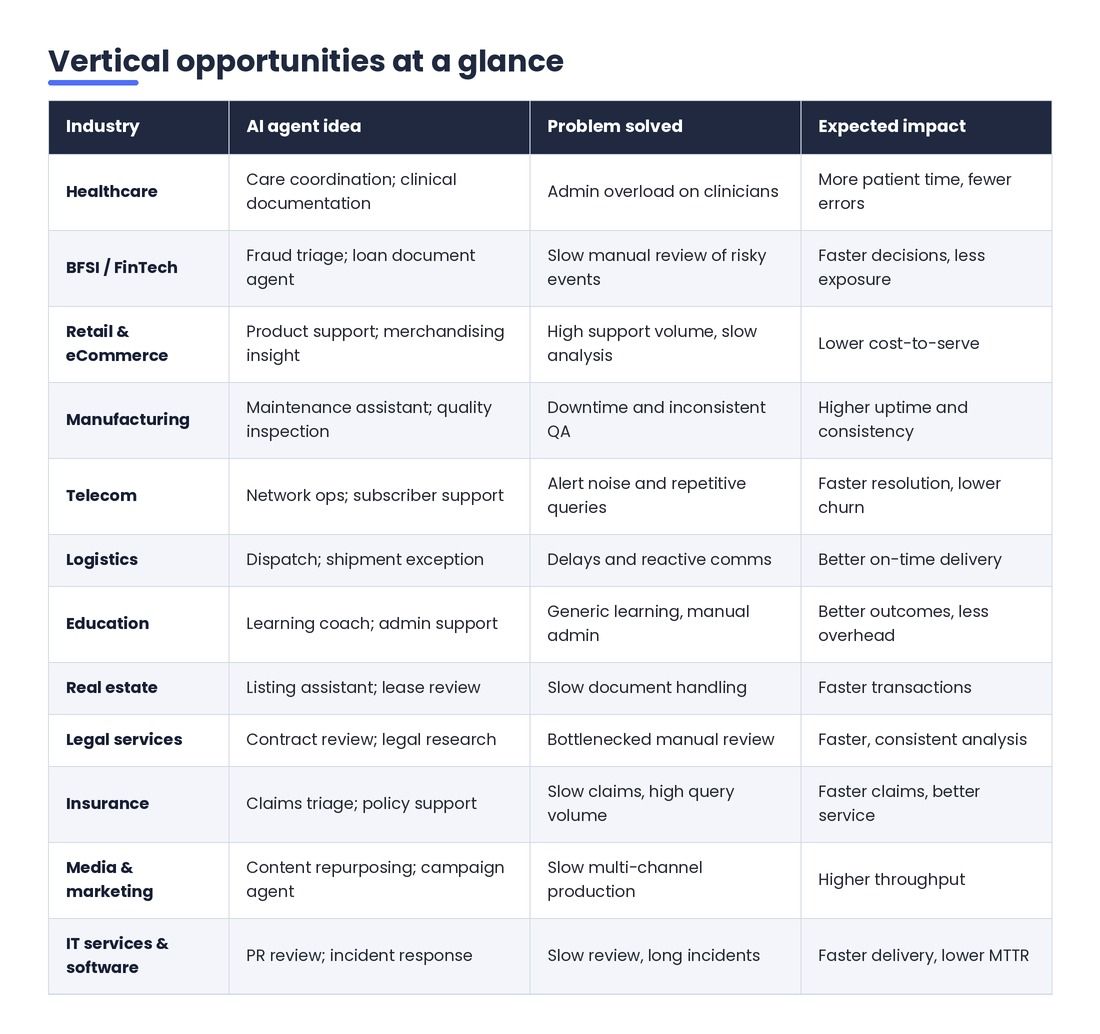
06. The same ideas, viewed by industry
Horizontal functions are a fine place to start, but **enterprise AI agents** often win on vertical depth — the agent that understands the quirks of one sector beats the one that sort of understands all of them.
07. Low-cost ideas for startups and small teams
Not every useful agent needs a heavyweight enterprise build. Plenty of the most practical AI automation agents for small teams can ship as a focused MVP on top of existing APIs and lightweight workflows: an email prioritisation agent, a calendar scheduling agent, a social-media planning agent, a lead research agent, an invoice follow-up agent, a customer FAQ agent, a personal productivity agent, a freelancer proposal agent, a resume improvement agent, and a small-business reporting agent.
The advantage is speed. Each one solves a single, well-bounded problem, so you can test demand quickly, keep build costs low, and only expand once someone is actually paying. For founders, that's usually the smartest way into AI agent development — prove value narrowly before you spend on scale.
08. Enterprise-grade ideas (and why they're harder)
Enterprises play a different game: sensitive data, strict access rules, and very little patience for unpredictable behaviour. The ideas that work here tend to be deeply integrated and tightly governed — an enterprise knowledge agent, an IT helpdesk agent, a contract intelligence agent, a sales intelligence agent, an audit evidence agent, a financial planning agent, a customer-service copilot, a supply-chain exception agent, a NOC / operations command-centre agent, and a risk and compliance agent.
What sets these apart is rarely the idea itself — it's the engineering around it. Enterprise deployments demand serious AI agent architecture: strong security, governance, observability, deep system integration, and role-based access control. A vendor who can deliver those non-functional requirements is selling something far more valuable than the model underneath. This is also where the term AI agent development company earns its keep, because most teams can't assemble that stack alone.
09. Which one should you build first?
When you've got a shortlist, score it — don't debate it in a meeting. A simple matrix forces an honest read on where each idea is strong and where it's weak.
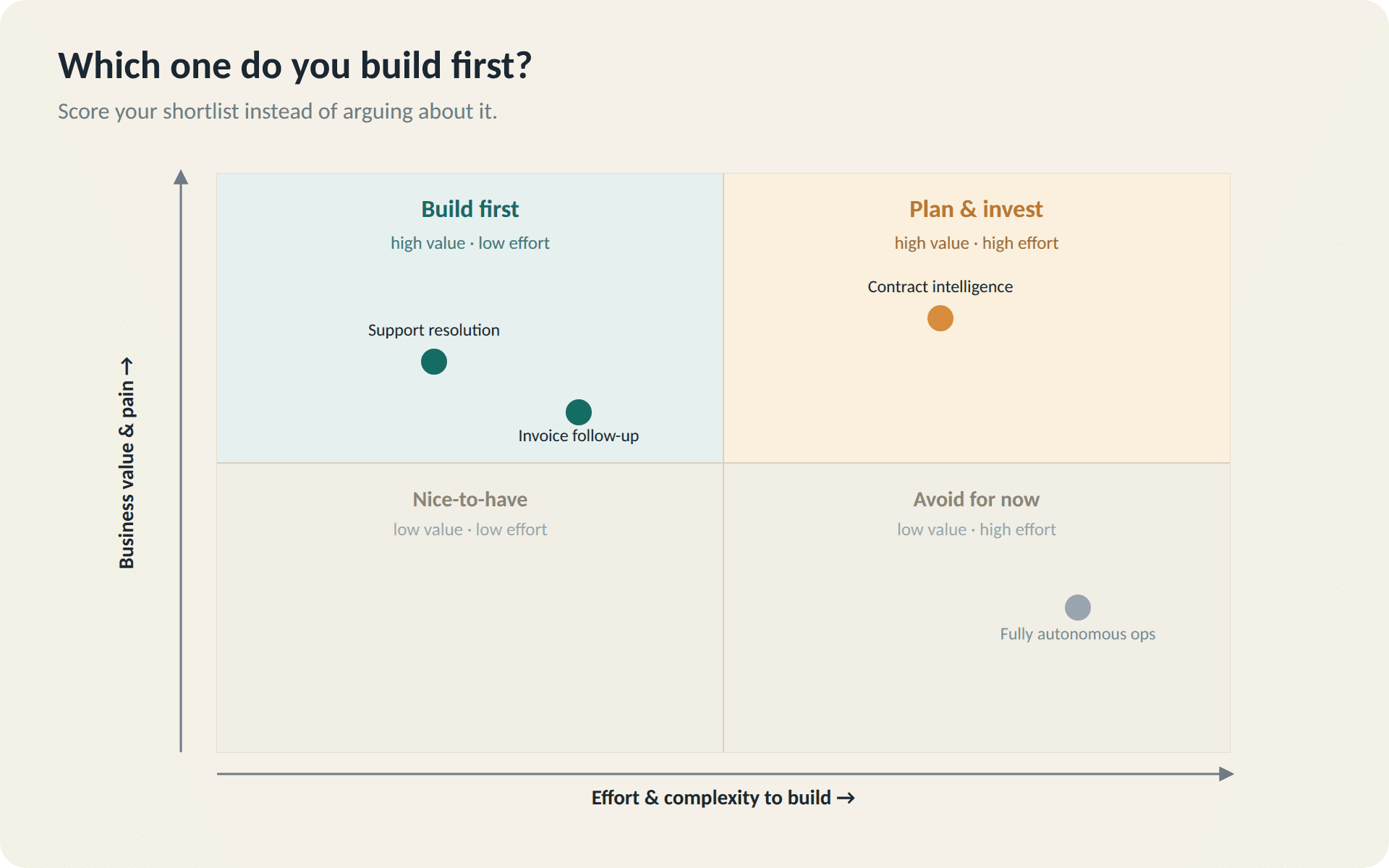
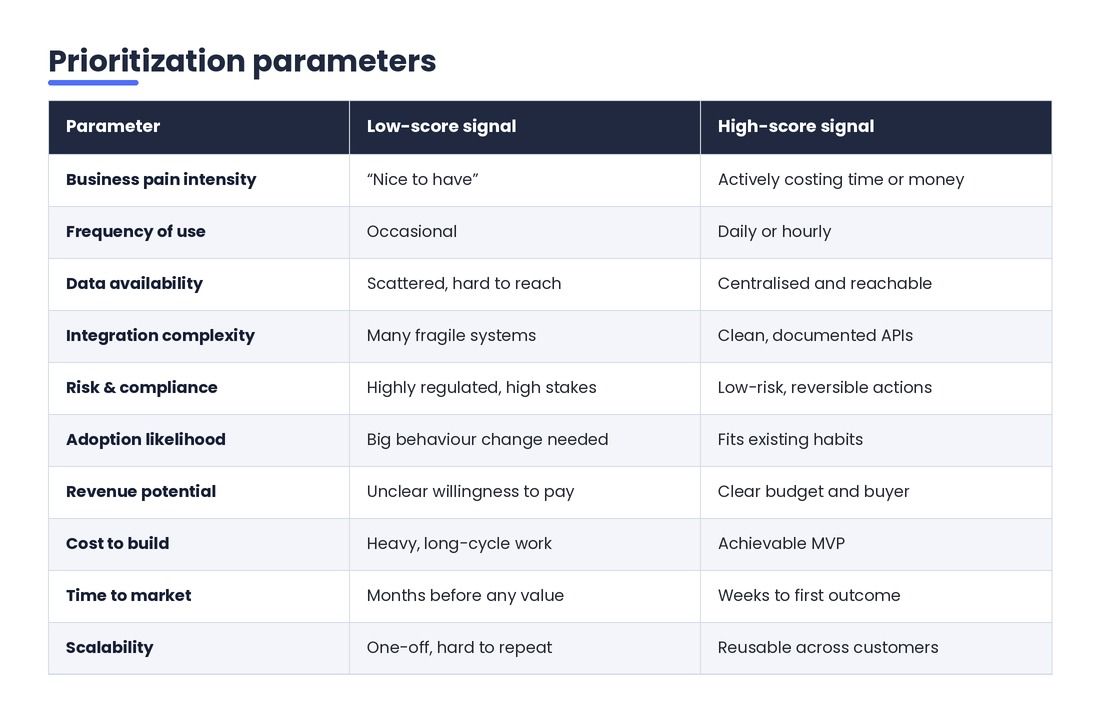
The best first agent almost always combines high business pain, frequent use, available data, controlled risk, and a measurable return. Those five together beat any idea that scores higher on novelty but lower on feasibility.
10. What it actually takes to build one
A reliable agent is a system, not a clever prompt. The core pieces: a user interface; an LLM or foundation model; a prompt and instruction layer; tool calling; workflow orchestration; retrieval-augmented generation (RAG) with knowledge retrieval; a vector database; integrations into your business systems; a memory layer; guardrails; human-in-the-loop controls; an evaluation framework; observability and logging; security and access control; and cost monitoring.
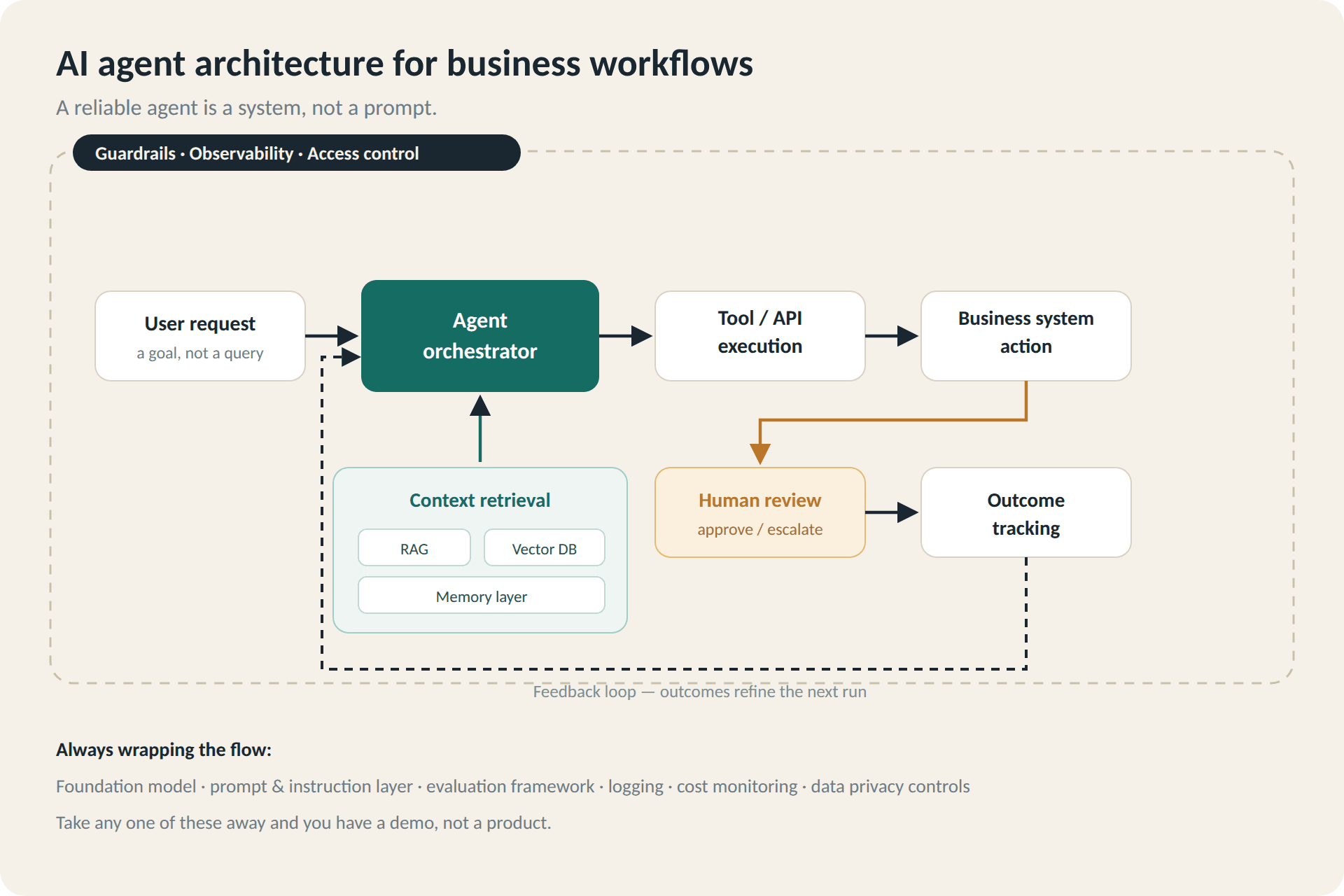
The orchestrator is the heart of it — it decides which tools to call, in what order, and when to pause for a human. Guardrails and observability wrap the whole flow so every action stays constrained, logged, and reviewable. That wrapper is exactly what lets agentic AI operate inside a business without becoming a liability. It's also the difference between something you can demo and something you can sell as part of AI workflow automation that a CIO will actually sign off on.
11. How these things make money
There's no single right way to charge for an agent. The model should follow the buyer and the value you deliver — that's the core of sensible AI agent monetization.
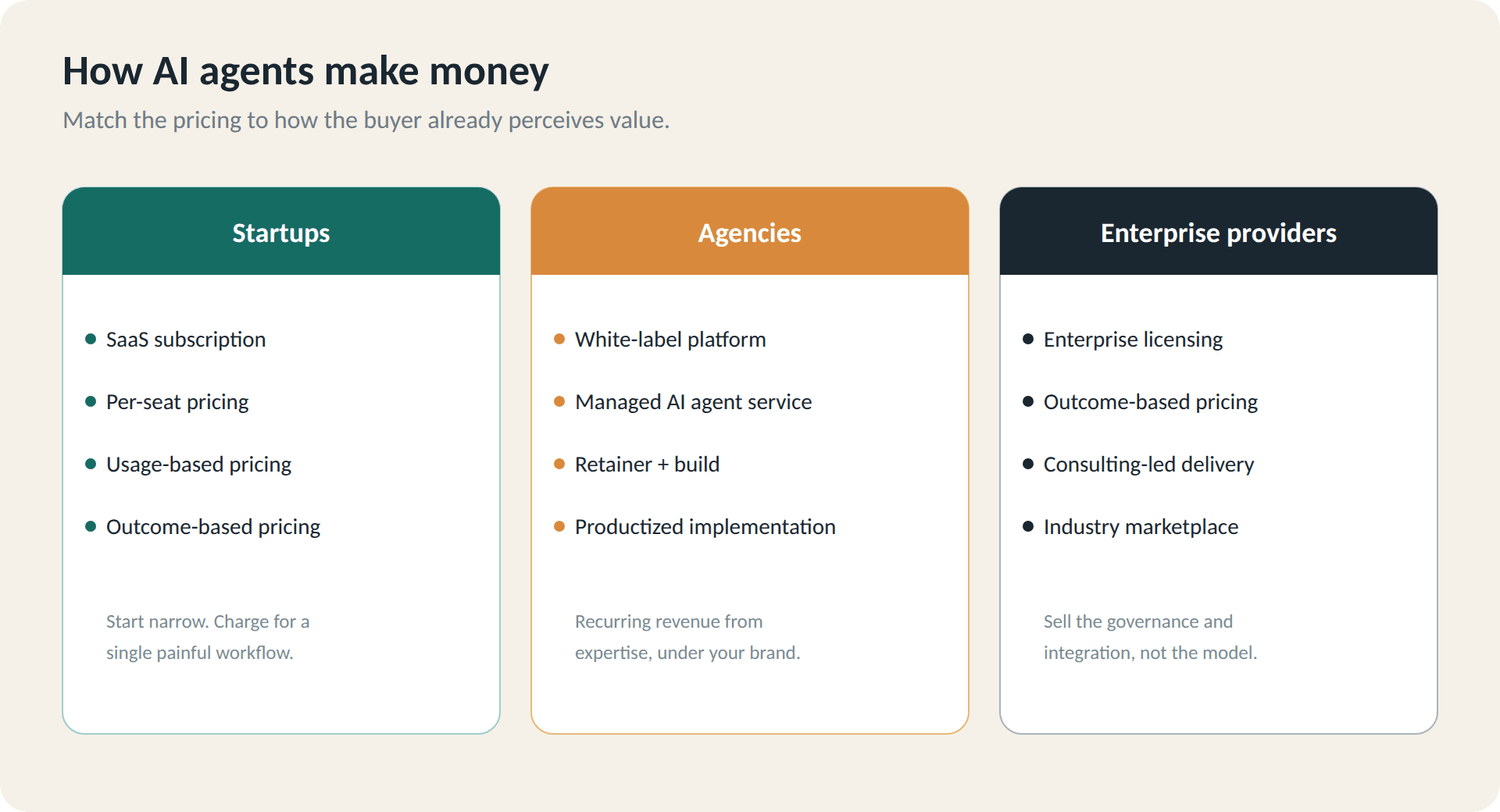
As a rough guide: startups tend to do well with SaaS, per-seat, and usage models; agencies thrive on white-label and managed-service models; and enterprise solution providers lean toward licensing, outcome-based pricing, and consulting-led implementation. Match the pricing mechanism to how the customer already thinks about value, and the conversation gets a lot easier.
12. The mistakes that sink most agent projects
The failures here are remarkably predictable. Teams build a generic agent with no clear user, or start from the technology instead of a real business pain. They skip workflow integration, so the thing lives in a corner and gets quietly abandoned. They never check whether the data they need is actually available. They under-invest in security and access control. They leave out human-in-the-loop design and then overpromise full autonomy. They never measure accuracy or business outcomes, wave away hallucination risk, and forget about monitoring and support. Most often of all, they ship an impressive demo instead of a usable product — and the gap between those two is precisely where most of the engineering effort should have gone.
13. What "production-ready" really means
Getting from prototype to production is a discipline, not a victory lap. Production-ready AI agents share a consistent checklist: a clear business objective; reliable context retrieval; dependable tool integration; explicitly defined permissions; audit logs; solid error handling; human approval flows for high-stakes actions; ongoing model evaluation; prompt and version management; a monitoring dashboard; cost controls; data-privacy controls; a feedback loop; and a real mechanism for continuous improvement. In an enterprise setting, none of those is optional — together they're what convince a buyer the agent will behave the same next quarter as it does in the demo.
14. Where this is all heading
The direction of travel is fairly clear. Single agents are giving way to multi-agent systems, where specialised agents collaborate on bigger workflows. Vertical agents and domain-specific AI copilots will keep outperforming generalists. Marketplaces will make distribution easier. Expect deeper agentic automation, voice-based and multimodal agents, agents embedded right in software delivery pipelines, and operations command-centre agents. Personal AI work assistants will become ordinary, human-AI team collaboration will mature, and — importantly — agent governance platforms will grow into a category of their own, because as agents take on more autonomy, the ability to watch and control them stops being an afterthought and becomes a feature people pay for.
15. The takeaway
The best AI agent business ideas are rarely the flashiest ones. They're the ones that target a repeated business pain, slot cleanly into real workflows, lean on trusted data, keep humans in charge of the decisions that matter, and produce outcomes you can actually measure.
Build for that, and the technology becomes a means to a clearly defined business end — rather than a solution wandering around looking for a problem.