
1. Why Oil and Gas Needs AI Now
Few industries carry as much operational complexity as oil and gas. Upstream operators manage remote drilling sites where equipment failure can halt production for days. Midstream and downstream businesses balance throughput, safety, and environmental compliance across vast pipeline and refinery networks — against a backdrop of price volatility, aging infrastructure, tightening ESG mandates, and increasing regulatory scrutiny.
AI in oil and gas is no longer an experimental technology. It is a practical intelligence layer helping energy companies move from reactive decision-making to predictive, automated, and data-driven operations. The companies gaining competitive advantage are connecting SCADA data, IoT telemetry, seismic records, production data, market signals, and compliance documentation into integrated workflows — enabling teams to sense problems earlier, respond faster, and plan more confidently.
2. The Real Business Problems in Oil and Gas
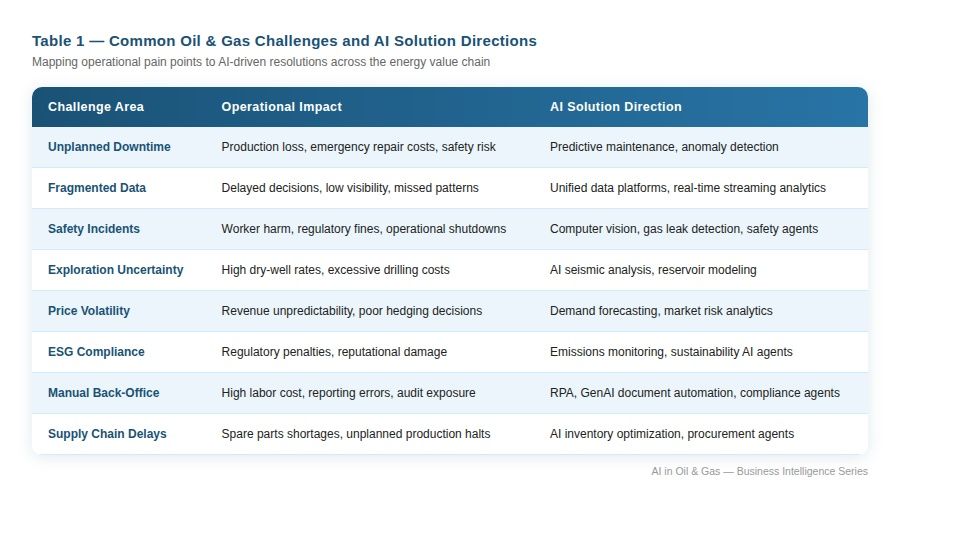
The core challenge is not a shortage of data — the industry generates enormous volumes across drilling systems, production wells, pipeline sensors, refinery instruments, and field inspection records. The problem is that most of this data is fragmented, delayed, or disconnected from the decisions that matter most.
- Unplanned equipment failures causing production losses and emergency repair costs
- High dry-well rates from inaccurate reservoir characterization
- Non-productive time (NPT) during drilling operations inflating project costs
- Production inefficiencies due to poor well performance visibility
- Safety incidents in hazardous environments with limited real-time monitoring
- Siloed OT and IT systems preventing integrated analysis
- Manual compliance and reporting workflows consuming excessive effort
- Price and demand uncertainty making production planning difficult
- Environmental risks including leaks, spills, and unmonitored emissions
3. How AI Is Transforming Oil and Gas Operations
Artificial intelligence in oil and gas is a combination of machine learning models, predictive analytics engines, computer vision systems, NLP tools, AI agents, digital twins, and edge computing platforms working together to create an intelligent operations layer.
Machine learning models learn from historical equipment behavior, drilling records, and reservoir data to identify patterns at scale. Predictive analytics engines process streaming sensor data to flag anomalies and forecast future equipment states. Computer vision systems analyze inspection images, drone footage, and live camera feeds. Natural language processing extracts insights from maintenance records, incident reports, and regulatory documents.
Generative AI accelerates engineering documentation, regulatory submissions, and field report generation. AI agents act as autonomous digital co-workers that monitor workflows and surface recommendations. Digital twins provide live simulations of assets and reservoirs. Edge AI enables real-time decision support in remote and offshore locations with limited connectivity.
4. AI Architecture: Reference Intelligence Layer
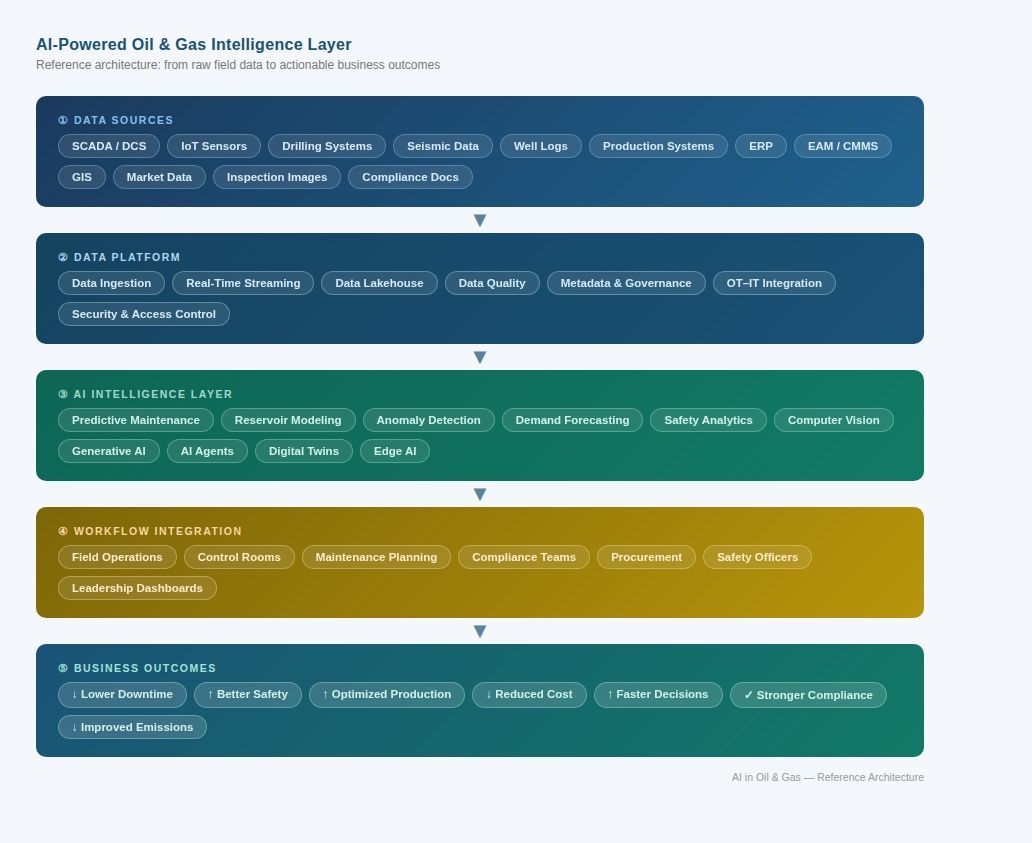
The architecture below shows how data flows from raw field sources through a governed data platform into the AI intelligence layer, then into operational workflows that produce measurable business outcomes.
5. Key Business Benefits of AI in Oil and Gas
A. Reduced Downtime and Maintenance Cost
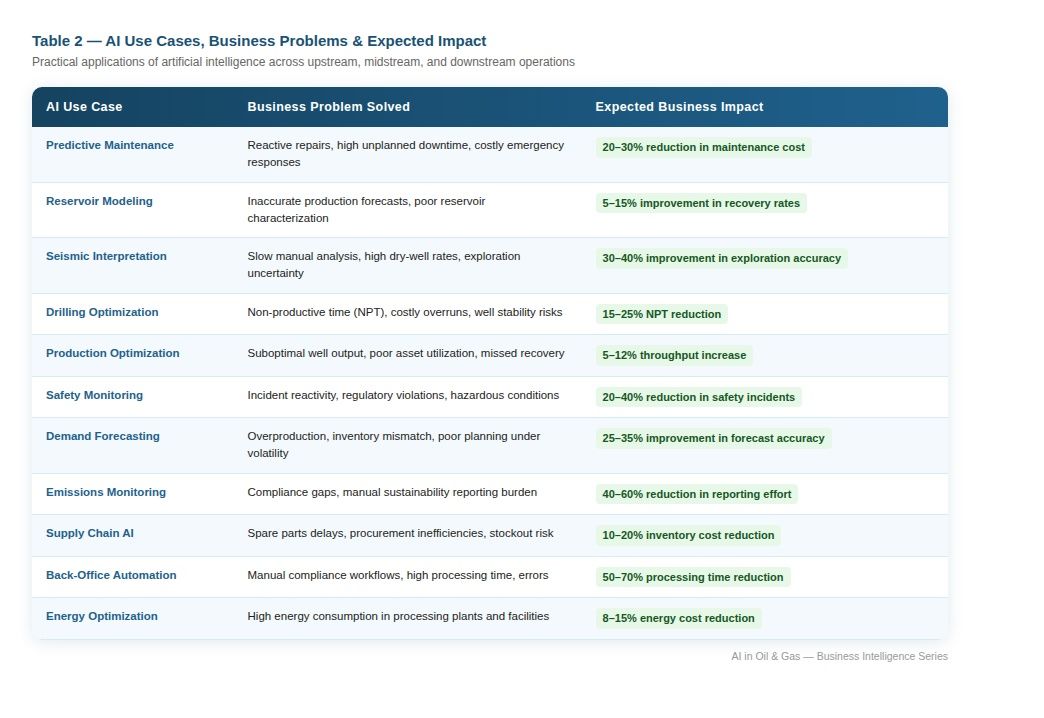
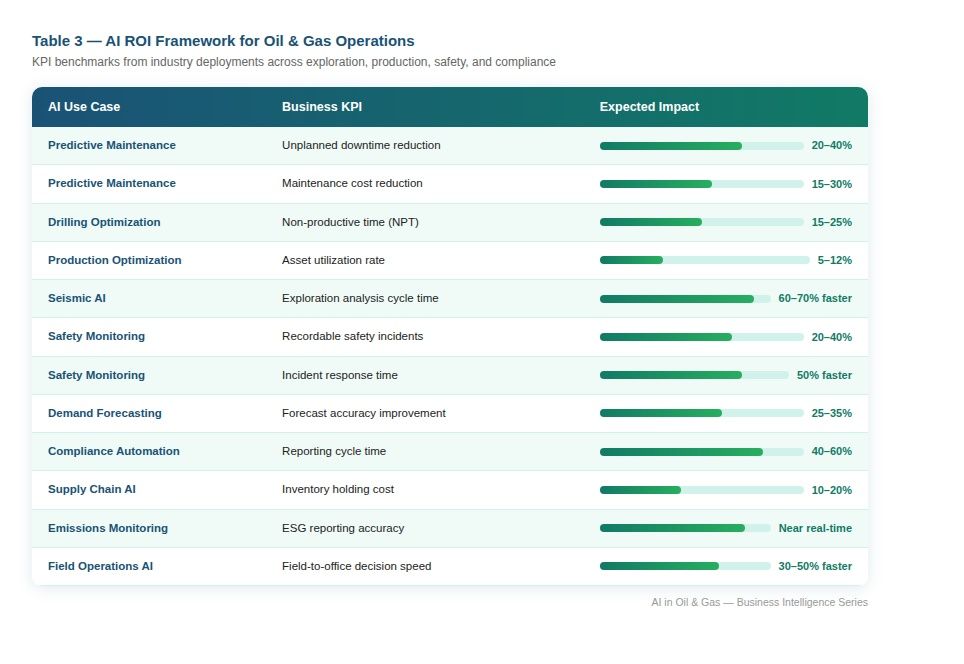
Predictive maintenance is the most widely deployed AI capability in oil and gas. By continuously analyzing vibration data, temperature, pressure trends, and runtime patterns, AI models identify early failure signatures days or weeks before breakdowns. Instead of waiting for a pump to fail during peak production, operations teams receive advance warnings with recommended actions. Companies deploying AI-powered asset management report 20-30% reductions in maintenance costs and significant decreases in unplanned production losses.
B. Improved Exploration and Drilling Accuracy
AI for reservoir modeling and seismic interpretation helps geoscience teams analyze subsurface data faster and more accurately. Models trained on drilling history, formation data, and geomechanical parameters recommend optimal drilling parameters, predict formation pressures, and flag well stability issues before they occur — resulting in fewer dry wells, reduced NPT, and lower cost per barrel discovered.
C. Better Production Optimization
AI continuously monitors well behavior, detects production anomalies, and recommends choke settings, injection rates, and lift strategies that maximize output while protecting reservoir health. Smart oilfield solutions built on AI and IoT have demonstrated measurable improvements in production rates, particularly in mature fields.
D. Improved Worker Safety
AI-powered safety monitoring systems analyze live camera feeds to detect workers entering exclusion zones, identify missing PPE, and flag unsafe behaviors in real time. Sensor-based models monitor air quality, gas concentrations, and structural integrity. Incident analysis tools identify near-miss patterns and systemic risk factors that manual reviews often miss.
E. Stronger Environmental Monitoring
Emissions monitoring platforms use IoT sensors and AI analytics to track hydrocarbon releases, flare events, and methane emissions against regulatory thresholds — enabling real-time corrective action and accurate ESG reporting. AI supports leak detection through acoustic sensor analytics and drone-based inspection systems that identify anomalies far faster than traditional cycles.
F. Better Demand and Price Forecasting
AI applies machine learning to historical price data, consumption trends, supply disruptions, and satellite intelligence to build forecasts that help planning, trading, and procurement teams make confident decisions under uncertainty. Companies using AI-driven market analytics have improved hedging strategies and reduced exposure to price swings.
6. Top AI Use Cases in Oil and Gas
The table below summarizes eleven high-value AI use cases, the business problem each addresses, and expected impact based on industry deployments.
7. AI Agents: Digital Co-Workers for Energy Operations
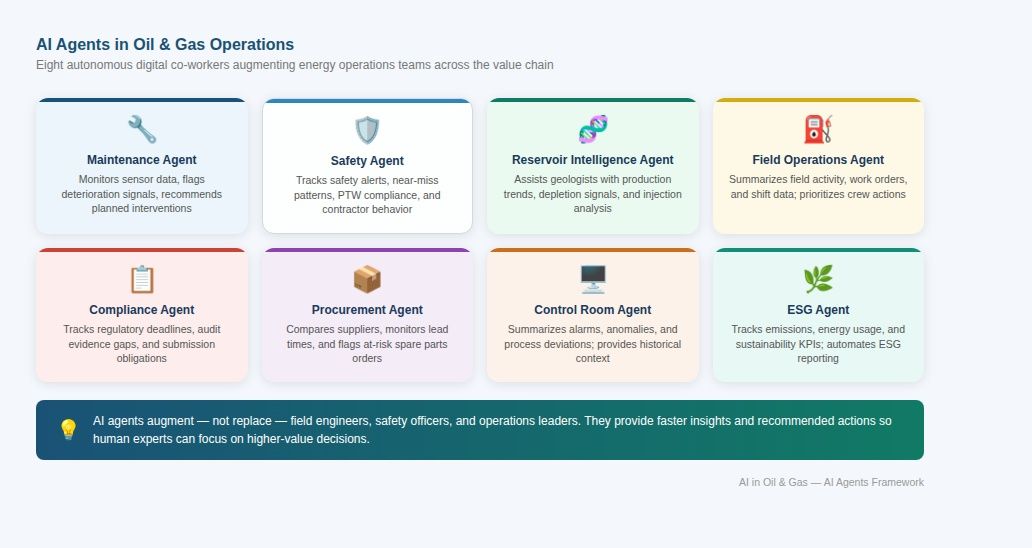
AI agents represent a significant evolution beyond dashboards and alerts. Rather than presenting data for humans to interpret, they continuously monitor operational domains, synthesize information, and surface recommended actions. In oil and gas, where teams manage hundreds of assets and alarms simultaneously, AI agents act as intelligent filters that prioritize what matters most.
Maintenance Agent
Monitors vibration, temperature, pressure, and runtime data across rotating equipment. Flags early deterioration signals, recommends inspection actions, and estimates remaining useful life to enable planned maintenance before failures occur.
Safety Agent
Tracks sensor alerts, incident reports, permit-to-work compliance, and safety audit findings. Surfaces unresolved safety actions, identifies near-miss patterns, and monitors contractor compliance in real time.
Reservoir Intelligence Agent
Assists geologists and reservoir engineers by analyzing well production data, injection patterns, and pressure histories. Surfaces reservoir depletion signals and recommends production strategy adjustments.
Field Operations Agent
Summarizes field activity reports, work orders, and shift handover data to give operations managers a real-time picture of distributed field sites. Recommends prioritization of crew activities and escalates issues requiring engineering input.
Compliance Agent
Tracks regulatory submission deadlines, monitors evidence collection against audit requirements, and flags documentation gaps across multiple regulatory jurisdictions.
ESG Agent
Monitors emissions data, energy consumption, water usage, and sustainability KPIs against company targets. Automates sustainability report preparation and triggers alerts when regulatory thresholds are approaching.
Control Room Agent
Summarizes alarm states, operational anomalies, and process deviations to help operators manage the most critical situations first. Provides historical context on why an alarm is occurring.
Procurement Agent
Compares supplier performance, monitors lead times, and flags at-risk orders before they cause operational delays. Optimizes inventory levels using predictive demand signals from maintenance schedules.
AI agents are designed to augment human expertise, not replace it. Field engineers, safety officers, reservoir specialists, and control room teams remain the decision-makers. AI agents give them the speed and analytical breadth that individuals cannot sustain across complex operations.
8. The Data Foundation AI Requires
The most common reason AI projects underdeliver in oil and gas is not model quality — it is data quality, completeness, and accessibility. AI models trained on incomplete or inconsistent data produce unreliable recommendations that erode trust and adoption.
A strong data foundation requires:
- Real-time and historical SCADA and DCS data from process control systems
- IoT sensor streams from equipment, pipelines, and facilities
- Well logs, seismic datasets, and reservoir simulation outputs
- Maintenance records, work orders, and inspection reports from CMMS and EAM systems
- Production data from wellheads, separators, and export terminals
- Safety incident logs and near-miss reports
- ERP data covering procurement, inventory, and financial records
- Environmental monitoring data including emissions, discharge, and spill records
- Market and price data from commodity exchanges and trading platforms
The data architecture must include ingestion pipelines for batch and real-time data, data quality validation, governance frameworks, and integration layers bridging the OT-IT divide. A data lakehouse architecture handles structured production data alongside unstructured images, documents, and sensor streams in a single governed environment.
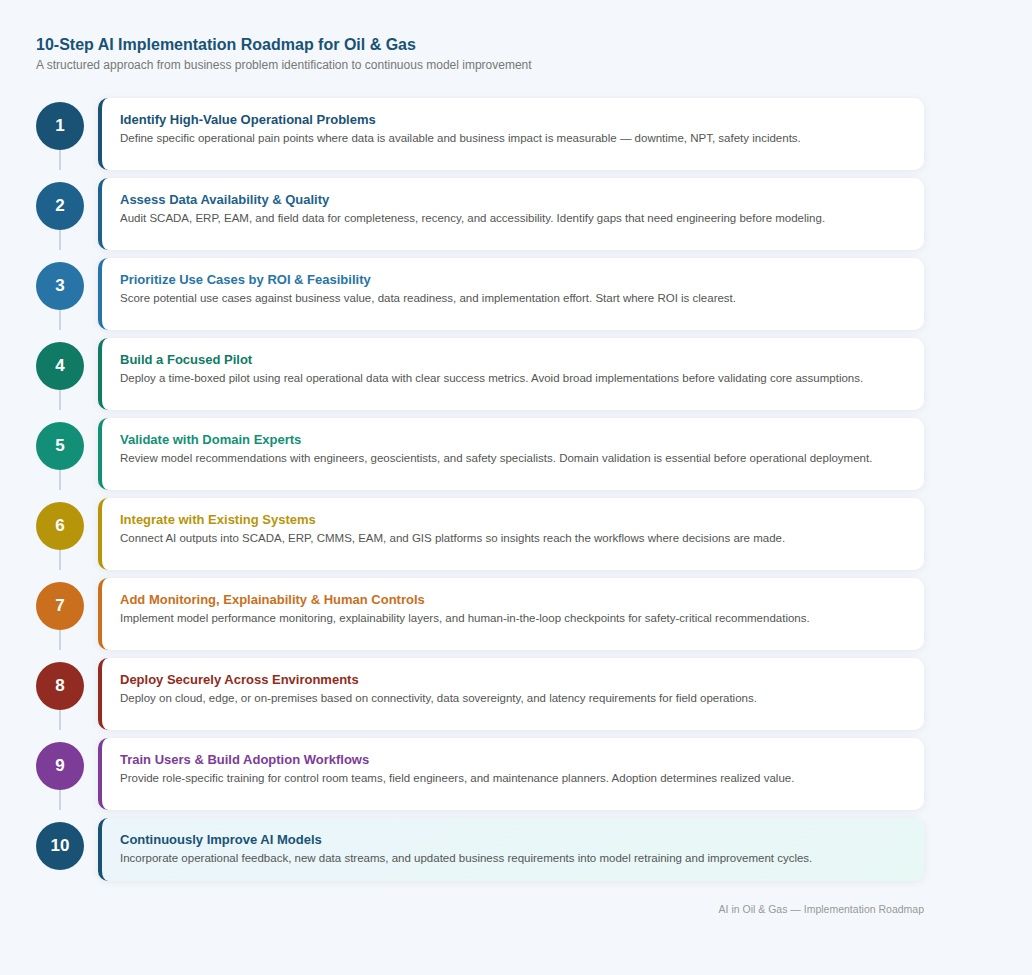
9. Implementation Roadmap: 10 Steps to AI in Oil and Gas
Successful AI deployment requires a structured approach combining domain expertise, data engineering, and operational integration. The roadmap below reflects how leading energy companies approach AI at scale.
10. Challenges in AI Adoption and How to Address Them
Oil and gas companies pursuing digital transformation must navigate challenges unique to the industry. Legacy OT systems were not designed for AI integration. Remote field environments create connectivity and ruggedness requirements that standard cloud architectures cannot always meet. Safety requirements demand very high model accuracy thresholds before operational deployment.
- Legacy systems and fragmented data — address through phased data integration and OT-IT bridging layers
- Poor data quality — invest in data engineering and validation pipelines before deploying models
- OT cybersecurity risks — apply zero-trust architecture and OT-specific security frameworks
- Lack of AI skills — build domain-AI hybrid teams pairing data scientists with engineers
- Resistance to change — demonstrate early wins through focused pilots and involve field teams in design
- Model explainability concerns — use interpretable AI techniques and provide clear reasoning behind recommendations
- Remote deployment constraints — deploy edge AI on ruggedized hardware with local inference capability
11. Measuring ROI from AI in Oil and Gas
Every AI investment in oil and gas should be tied to measurable business KPIs. The framework below provides benchmarks for major AI use cases based on industry deployment data.
12. The Future of AI in Oil and Gas
The trajectory of AI for energy operations points toward increasing autonomy, deeper integration, and closer human-AI collaboration across the full oil and gas value chain.
- Autonomous drilling operations adjusting parameters in real time based on formation feedback
- AI-powered control rooms managing process variables and surfacing only the most critical decisions
- Digital twins evolving from single-asset to full-field and refinery-level optimization models
- Generative AI accelerating engineering reports, well designs, and regulatory submissions
- Computer vision automating inspection workflows with continuous visual intelligence
- Carbon and emissions intelligence platforms providing real-time ESG performance visibility
- Integrated OT-IT intelligence platforms breaking down data silos across the value chain
- Human-AI collaboration becoming the standard operating model for control room and field teams
Conclusion
AI in oil and gas is not about replacing the expertise of engineers, geoscientists, safety professionals, and operations teams. It is about giving those professionals a faster, more accurate, and more comprehensive view of what is happening across their assets, reservoirs, supply chains, and field environments — so they can make better decisions, respond to problems earlier, and operate with greater confidence.
Companies that treat artificial intelligence as a strategic capability rather than a point technology will be better positioned to reduce operational risk, improve production efficiency, strengthen safety performance, meet ESG commitments, and build resilient energy operations. The combination of AI, robust data engineering, domain expertise, and integrated workflows is what separates energy companies that extract sustained value from those that run AI experiments without operational impact.