
1. Why Real Estate Needs AI Now
Real estate has long operated on relationships, instinct, and paperwork. Buying, selling, leasing, managing, and investing in property generates extraordinary volumes of fragmented data — spread across listing portals, CRM systems, lease agreements, maintenance logs, ERP platforms, and dozens of disconnected spreadsheets. For most organizations, that data accumulates without producing insight.
The result: decisions that should take hours take weeks. Property matches that should feel personalized feel generic. Maintenance requests that should be resolved in hours linger for days. Investment opportunities that should be visible in a dashboard require analysts to stitch together reports by hand.
Artificial intelligence in real estate is changing this equation. It is no longer experimental. AI is becoming a practical intelligence layer that connects property data, buyer preferences, market signals, legal documents, maintenance history, tenant behavior, and financial performance into a single, coherent stream of actionable business intelligence.
For real estate developers, property managers, brokers, PropTech startups, REITs, and asset managers, the shift is not optional — it is competitive. Organizations that deploy AI real estate solutions are already shortening sales cycles, improving valuation accuracy, reducing tenant churn, and making better investment decisions. Those still relying solely on manual workflows are leaving measurable value on the table.
Key insight: The opportunity in AI for real estate is not about replacing human judgment — it is about giving your teams faster, more accurate information so that judgment can operate at a higher level and at greater scale.
2. The Real Business Problems in Real Estate
Before exploring how AI helps, it is worth being precise about the problems it solves. Across property development, sales, leasing, management, and investment, organizations consistently face the same operational friction points:
- Slow property discovery: Buyers and tenants scroll through hundreds of irrelevant listings because search tools match on filters, not preferences.
- Inaccurate or delayed valuation: Static comparative models fail to capture real-time demand shifts, infrastructure changes, or neighborhood momentum.
- Long sales and leasing cycles: Manual lead qualification, scheduling friction, and slow documentation extend timelines unnecessarily.
- Fragmented customer data: Buyer intent signals sit in CRMs, email threads, portal interactions, and call logs — rarely synthesized into a single view.
- Poor tenant experience: Maintenance requests go unacknowledged for days. Lease queries require staff callbacks. Routine communication is reactive rather than proactive.
- Manual documentation burden: Creating listing descriptions, summarizing lease clauses, reviewing contracts, and generating reports consumes disproportionate staff hours.
- Limited investment visibility: Portfolio managers lack real-time data on occupancy trends, rental yield, asset depreciation, and market movement across their holdings.
- Fraud and compliance risk: Fake listings, inflated valuations, missing approvals, and risky contract clauses often go undetected until they become liabilities.
The core issue is not that real estate companies lack data. It is that the data they generate stays scattered and underused. A large residential developer may have transactional data going back two decades, a CRM with thousands of buyer profiles, and a tenant portal generating hundreds of interactions per day — and still make valuation and pricing decisions based on gut feel and manual market checks.
Smart real estate platforms powered by AI close this gap by turning raw, fragmented property data into structured, predictive, and immediately useful intelligence.
3. How AI Is Transforming Real Estate
Artificial intelligence in real estate encompasses a broad set of technologies, each suited to specific workflow problems. Understanding which AI capability maps to which business problem is essential for building a practical adoption roadmap.
- Machine learning powers property valuation models, lead scoring engines, and occupancy forecasting tools — finding patterns in historical data that no human analyst could process at scale.
- Predictive analytics enables demand forecasting, investment risk scoring, maintenance prediction, and rental price optimization by modeling future outcomes from current signals.
- Natural language processing (NLP) underpins lease document summarization, contract clause extraction, tenant query handling, and conversational search.
- Computer vision enables visual property search, automated quality inspection from listing images, virtual tour analysis, and damage detection in maintenance workflows.
- Generative AI automates listing descriptions, buyer email drafts, lease summaries, investor reports, and marketing content at a quality and speed that manual writing cannot match.
- AI agents act as autonomous digital co-workers — qualifying leads, scheduling visits, responding to tenant queries, processing maintenance tickets, and tracking compliance without human initiation.
- Recommendation engines match buyers and tenants to properties based on behavioral signals, stated preferences, commute patterns, and lifestyle data — not just checkbox filters.
- Document intelligence and OCR digitize, classify, and extract structured information from leases, sale agreements, title documents, inspection reports, and invoices.
- Geospatial analytics overlay location intelligence — school proximity, transit access, infrastructure development, neighborhood growth indices — onto property data to enrich valuation and buyer matching.
- Digital twins create virtual replicas of buildings and portfolios, enabling predictive maintenance, energy optimization, and operational simulation without physical intervention.
4. Key Business Benefits of AI in Real Estate
Faster Property Discovery
AI understands buyer intent — budget, lifestyle, commute, family needs — and surfaces the right properties before buyers know how to ask for them. Search time drops dramatically.
More Accurate Valuation
Dynamic AI valuation models incorporate comparable transactions, demand patterns, neighborhood momentum, and infrastructure signals in real time — far outperforming static appraisal methods.
Shorter Sales & Leasing Cycles
AI qualifies leads, recommends next best actions for brokers, automates follow-ups, and eliminates manual scheduling friction — compressing weeks-long cycles into days.
Better Tenant Experience
AI-powered portals handle maintenance requests, payment queries, and lease questions instantly — reducing call center load and raising tenant satisfaction scores measurably.
Smarter Property Management
Predictive maintenance models identify issues before they become emergencies. Occupancy dashboards surface underperforming assets. Vendor workflows are automated end-to-end.
Improved Investment Decisions
AI investment scoring combines rental yield, appreciation potential, occupancy trends, risk indicators, and infrastructure growth into portfolio-wide intelligence that no spreadsheet can replicate.
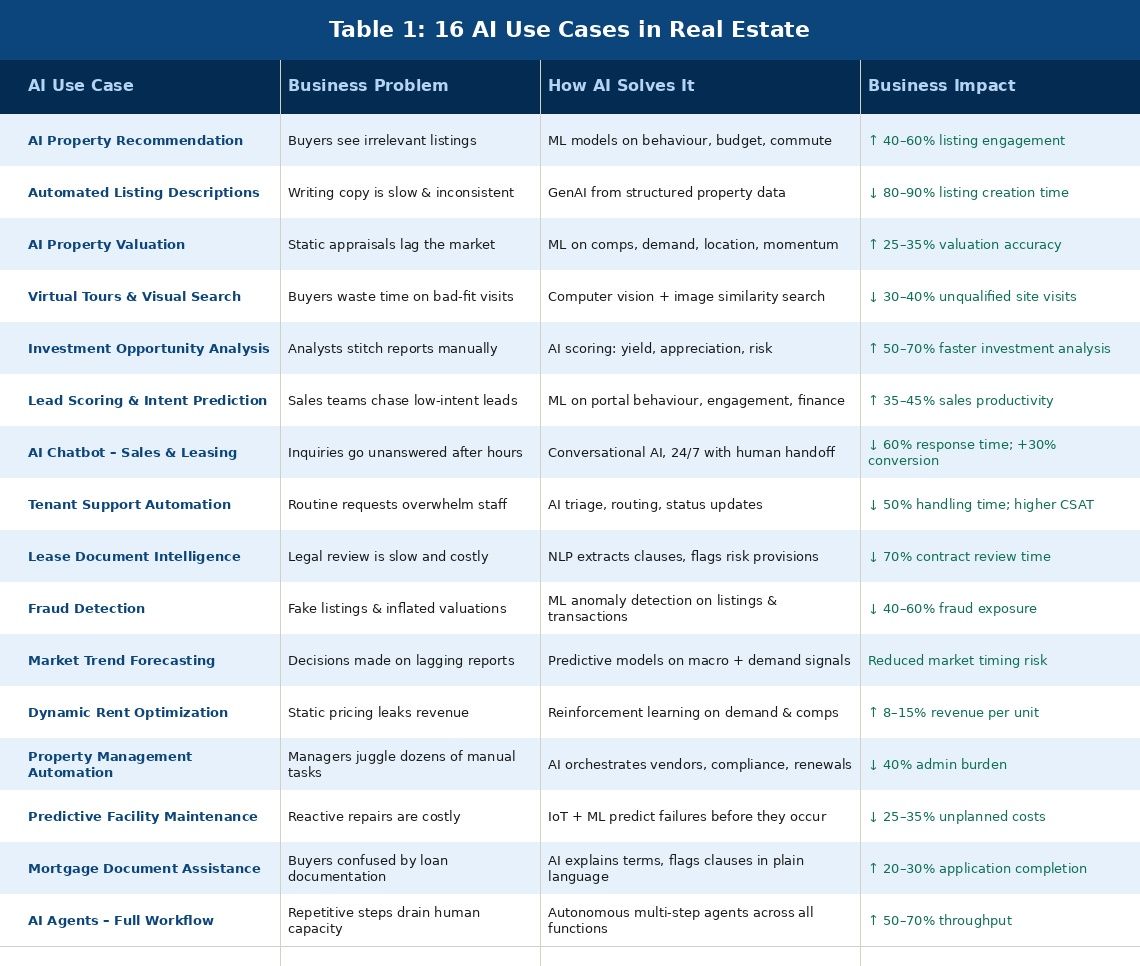
5. Top 16 AI Use Cases in Real Estate
Below are the most impactful AI use cases in real estate — each grounded in a specific business problem, with a clear description of how AI addresses it and what outcomes are achievable.
6. Generative AI in Real Estate
GenAI in real estate goes beyond automating repetitive writing. When connected to trusted property data, CRM systems, lease repositories, and compliance frameworks, generative AI becomes a strategic content and communication engine that operates at the speed of the market.
The most impactful GenAI applications in real estate include:
- Property listing generation: From structured property attributes — size, location, amenities, floor plan — GenAI produces compelling, differentiated listing descriptions tailored to the target buyer segment.
- Personalized buyer and tenant communication: GenAI drafts contextually relevant follow-up emails, reminders, and offer documents based on buyer history and preferences stored in the CRM.
- Sales scripts and negotiation briefs: Brokers receive AI-generated talking points, objection-handling scripts, and comparable property summaries before each buyer meeting.
- Lease summaries and clause explanations: Tenants and buyers receive plain-language summaries of complex legal documents — reducing legal queries and accelerating signing decisions.
- Investor report generation: Portfolio performance reports, asset summaries, and market commentary are generated from live data in minutes rather than days.
- Marketing content and campaigns: Property brochures, social media posts, email campaigns, and digital ads are drafted and personalized for specific buyer segments without manual copywriting effort.
Important caveat: GenAI is only as reliable as the data it draws from. Without clean, governed property data, accurate tenant records, and validated market information, GenAI models risk producing confident but incorrect content — a significant liability in legally sensitive real estate transactions. Data governance is not optional; it is the prerequisite for GenAI value.
7. AI Agents in Real Estate
The emergence of AI agents in real estate represents the most significant operational shift in how property businesses manage their workflows. Unlike standalone AI tools that respond to individual queries, AI agents execute multi-step tasks autonomously — making decisions, triggering actions, and escalating exceptions without constant human oversight.
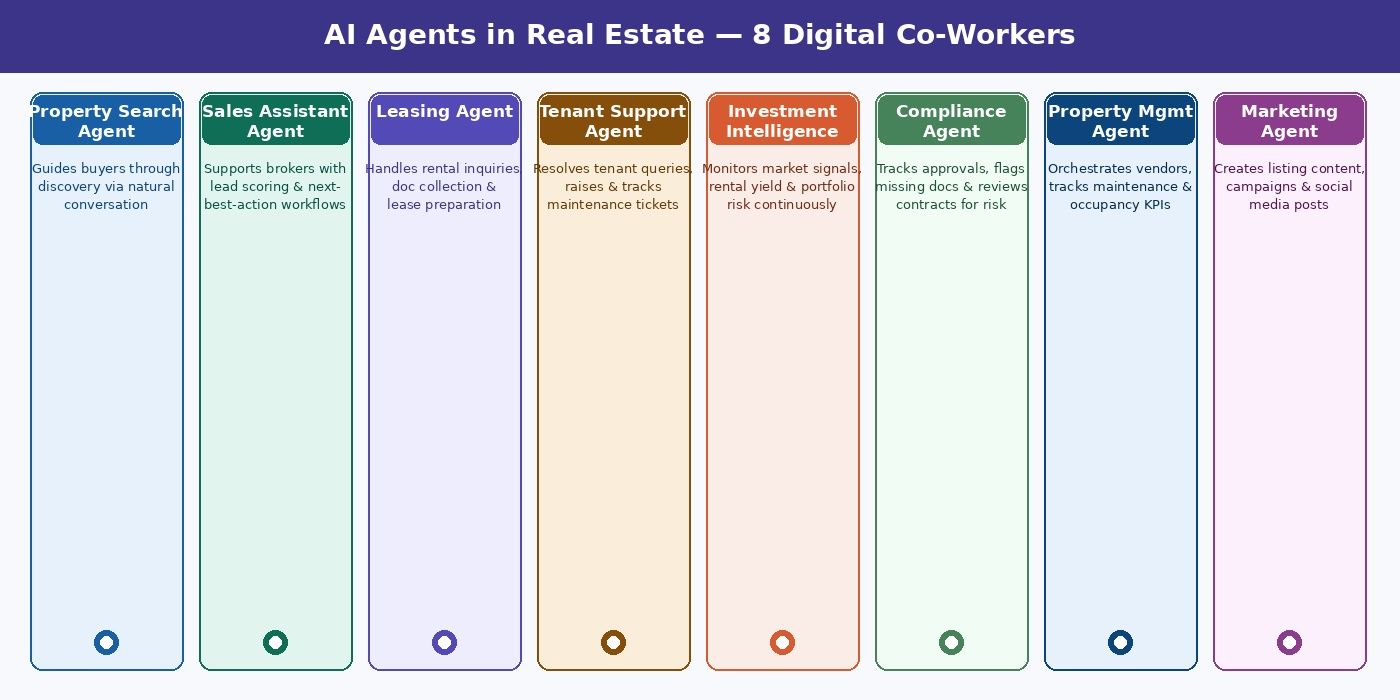
It is critical to emphasize that AI agents should not replace real estate professionals. They should augment brokers, leasing teams, property managers, and investor relations teams with faster information access, automated administrative execution, and proactive alerting — freeing human expertise to focus on relationship-building, judgment-dependent negotiation, and strategic decision-making.
8. Data Foundation Required for AI in Real Estate
Every AI model, recommendation engine, and AI agent is only as good as the data it operates on. In real estate, data quality and governance challenges are among the primary reasons AI initiatives underdeliver.
Building a robust data foundation is not a technical afterthought — it is the first prerequisite for reliable AI outcomes.
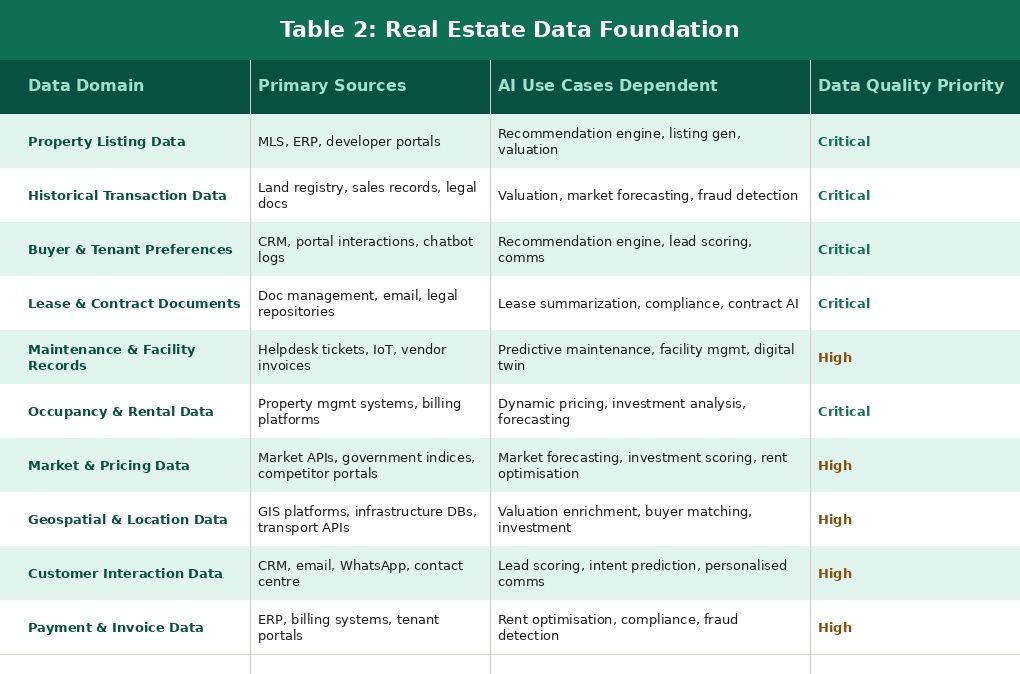
Without trusted, well-governed data, AI models produce wrong recommendations, inaccurate valuations, and unreliable insights — sometimes with high confidence. Investing in data ingestion pipelines, master data management, document digitization, and governance frameworks is not a cost center. It is the foundation upon which all AI ROI is built.
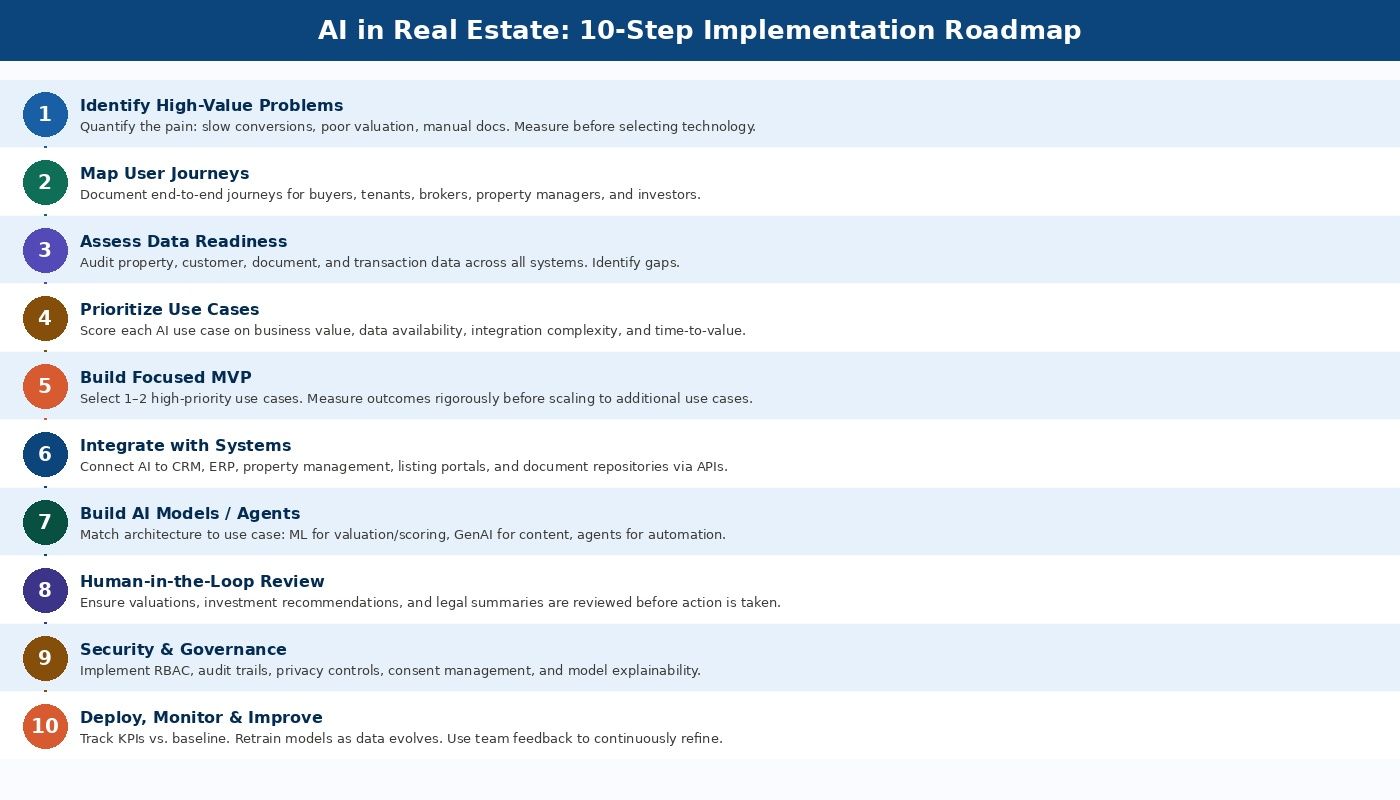
9. How to Build AI Solutions for Real Estate: A 10-Step Roadmap
10. Challenges in AI Adoption for Real Estate
Despite the clear value proposition, AI adoption in real estate faces real obstacles. Understanding and planning for these challenges is essential to a successful deployment:
- Fragmented and poor-quality data: Legacy property systems, disconnected portals, and paper-based documentation create data gaps that undermine model accuracy. Solution: Invest in data engineering, ETL pipelines, and document digitization before building models.
- Legacy system integration: Older CRM and property management platforms often lack APIs, making it difficult to feed real-time data into AI workflows. Solution: Use middleware integration layers and phased migration to modern platforms in parallel with AI deployment.
- Broker and team adoption: AI tools are only valuable if used. Brokers accustomed to relationship-driven workflows may resist AI-generated recommendations. Solution: Co-design tools with brokers, demonstrate clear personal productivity benefits, and implement change management programs.
- GenAI hallucination risk: Generative AI models can produce confident but factually incorrect content — a serious risk in legal, compliance, and financial contexts. Solution: Ground GenAI models in verified property data and implement mandatory human review gates for regulated outputs.
- Biased valuation models: AI valuation models trained on historical data can perpetuate historical pricing biases, particularly in underinvested neighborhoods. Solution: Audit models regularly for bias, diversify training data, and apply fairness constraints during model development.
- Privacy and consent compliance: AI models processing buyer preferences, behavioral signals, and tenant data must comply with data protection regulations. Solution: Embed privacy-by-design into AI architecture, implement consent management, and conduct regular compliance audits.
- ROI measurement: Without clear baseline metrics and a measurement framework, organizations struggle to quantify AI impact and justify continued investment. Solution: Define KPIs before deployment, establish baseline measurements, and report on AI-attributed outcomes quarterly.
11. How to Measure ROI from AI in Real Estate
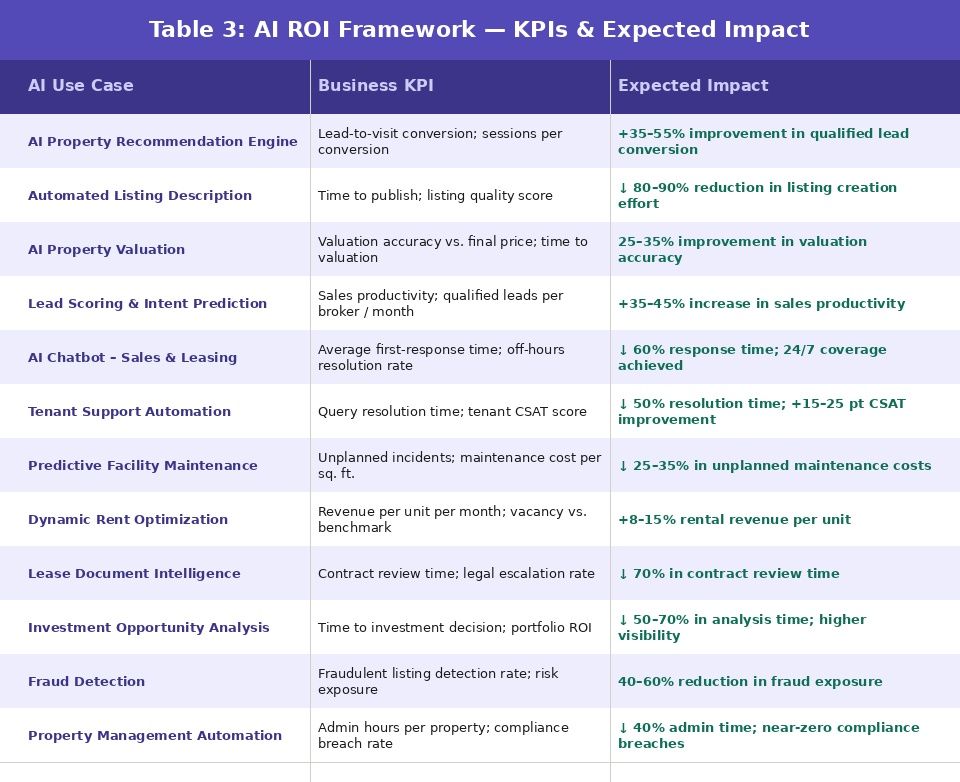
Measuring the business impact of AI requires moving beyond technical metrics like model accuracy to the KPIs that executive stakeholders actually track. The table below maps key AI use cases to business-level performance indicators and the realistic impact range organizations can target.
12. AI Architecture for Real Estate
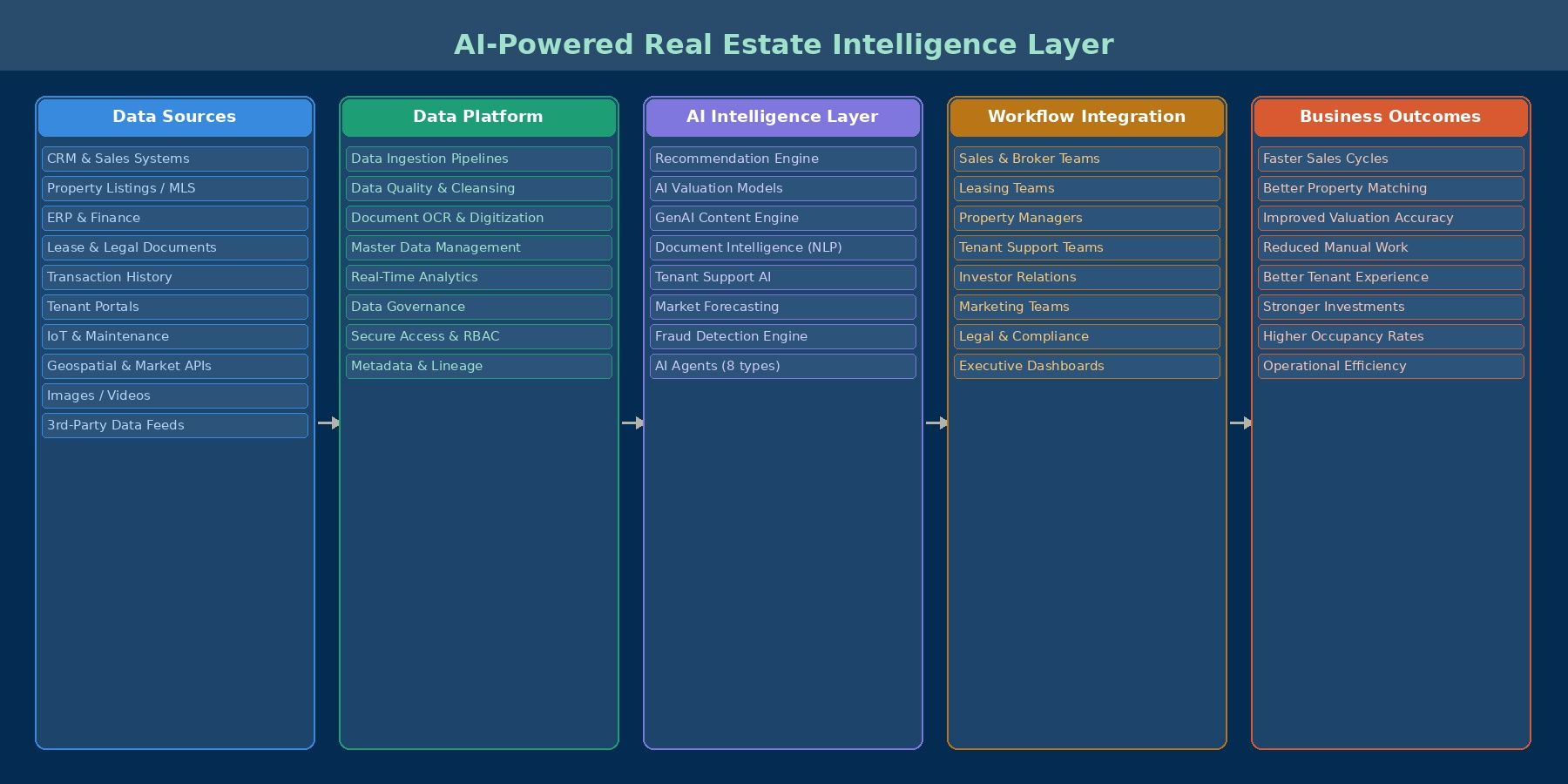
The architecture below illustrates how a modern AI-powered real estate intelligence platform is structured — from data ingestion through to business outcomes. Each layer builds on the one before it, and the integrity of each layer is essential to the quality of AI outputs.
13. The Future of AI in Real Estate
The trajectory of PropTech AI solutions over the next three to five years points toward increasingly integrated, autonomous, and personalized property experiences. The organizations that invest in AI infrastructure today will be positioned to capitalize on these emerging capabilities:
- Hyper-personalized property marketplaces where every buyer interaction is shaped by deep behavioral intelligence, with properties surfaced before buyers explicitly search for them.
- Voice-first real estate assistants enabling buyers and tenants to search, schedule, and transact through natural conversation on any device.
- Digital twins for smart buildings creating live virtual replicas of every physical asset — enabling predictive energy management, occupancy simulation, and maintenance planning at a building portfolio level.
- Fully automated lease intelligence where lease drafting, negotiation flagging, tenant onboarding, and renewal analysis are handled end-to-end by AI with minimal human intervention except at approval gates.
- Real-time investment intelligence platforms that surface acquisition opportunities, divestment triggers, and portfolio rebalancing recommendations continuously — integrating market data, portfolio analytics, and macroeconomic signals in a single dashboard.
- AI-powered tenant experience platforms that proactively predict and address tenant dissatisfaction, reducing churn before it manifests as vacancy.
- Autonomous AI agents for brokers that manage entire client engagement workflows — from first contact through closing — with brokers focused on relationship strategy rather than administrative execution.
14. Conclusion
AI in real estate is not a technology trend to observe from a distance. It is a practical, proven, and increasingly competitive capability that is reshaping how property businesses operate across every function — from the first touchpoint in a buyer's property search to the long-term management of income-producing assets.
The organizations seeing the most impact are not those that deployed the most AI tools. They are the ones that identified specific, high-value business problems, built trusted data foundations, integrated AI into existing workflows, and sustained governance discipline as they scaled. AI capability without data quality is noise. AI capability without workflow integration sits unused.
The full opportunity of artificial intelligence in real estate — across property discovery, valuation, sales, leasing, tenant experience, asset management, compliance, and investment intelligence — becomes accessible when the technology is deployed within a coherent data and operational strategy.