
1. Why Transportation Needs AI — Right Now
Transportation has always been one of the world's most operationally demanding industries. Logistics providers, fleet operators, public transit agencies, and mobility companies simultaneously manage thousands of moving variables — vehicles, drivers, routes, fuel, weather, customers, and regulations — often with systems designed for a very different era.
The pressure points have never been sharper. Fuel prices remain volatile. Customers expect real-time visibility and zero-delay delivery. Driver shortages strain capacity planning. Vehicle downtime cascades into missed SLAs. And every day, these businesses generate enormous volumes of operational data that sit unused in siloed systems, unable to inform faster or smarter decisions.
This is precisely where artificial intelligence is beginning to prove its value — not as a futuristic concept, but as a deployable, measurable capability that transforms raw operational data into actionable intelligence. AI in transportation is enabling companies to move from reactive firefighting to predictive, automated, and continuously improving operations.
2. The Real Business Problems in Transportation
Before exploring how AI helps, it is worth naming the operational problems it is designed to solve. Transportation companies consistently struggle with:
- Inefficient route planning that fails to account for real-time traffic, load priorities, and delivery windows
- Unplanned vehicle breakdowns that cause delays and inflate maintenance costs
- High fuel consumption driven by idle time, poor routing, and aggressive driving behaviour
- Limited fleet visibility — operators often lack real-time knowledge of vehicle location and health
- Manual dispatch and scheduling processes that are slow, inconsistent, and hard to scale
- Unpredictable delivery ETAs that erode customer trust and retention
- Driver safety risks from fatigue, distraction, and harsh driving habits
- Fragmented systems — TMS, ERP, WMS, GPS, and CRM platforms that rarely communicate
- Rising customer expectations for same-day delivery, live tracking, and instant support
- Pressure to reduce carbon footprint under tightening environmental regulations
The root cause behind most of these problems is the same: transportation generates enormous amounts of data, but most organisations have not yet built the infrastructure or intelligence layer needed to convert that data into real-time operational decisions.
3. How AI is Changing Transportation
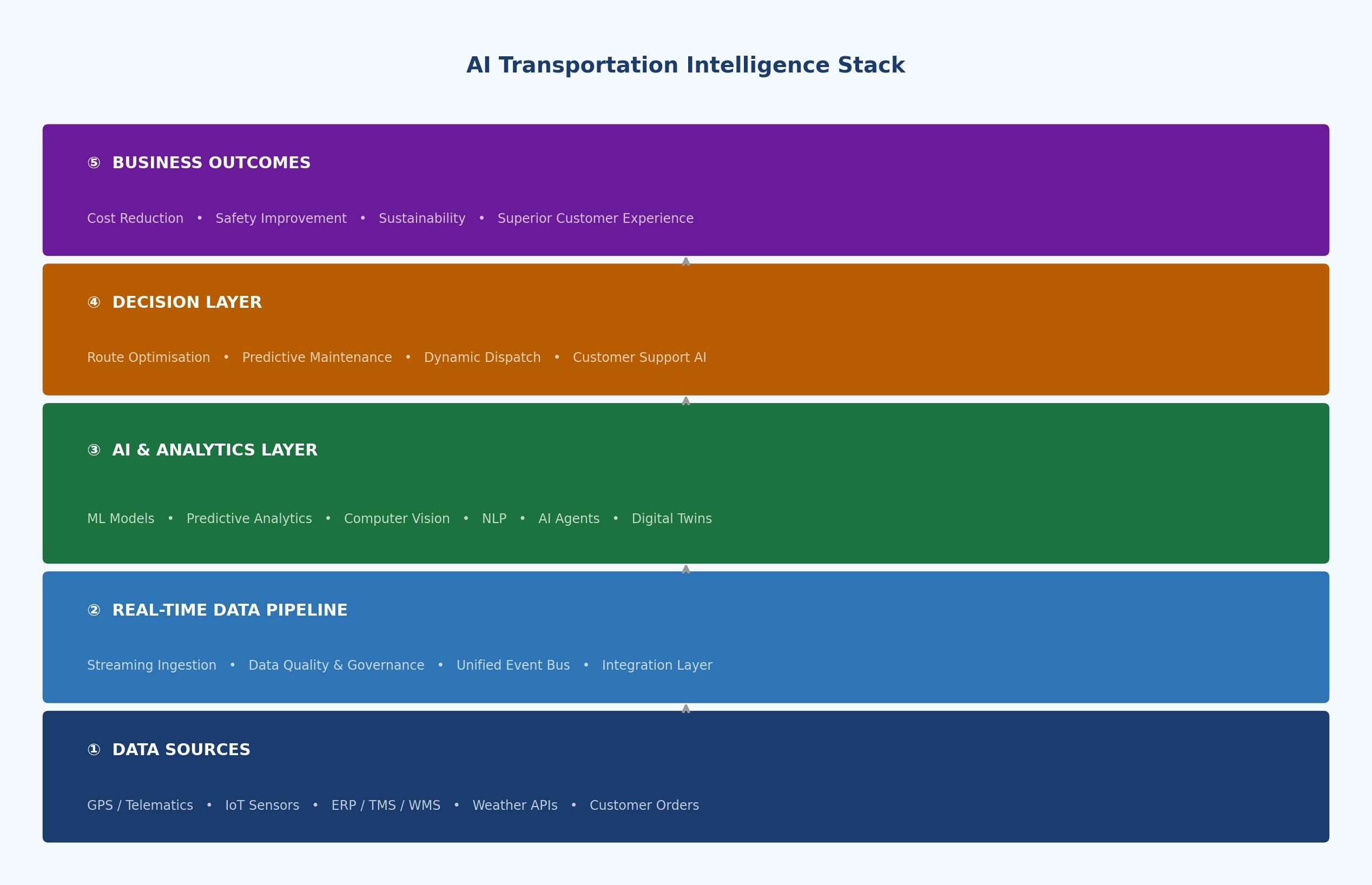
AI in transportation works across four operational dimensions: sensing, predicting, deciding, and acting. Together, these capabilities help companies shift from reactive to proactive, and from static to adaptive operations. The technologies that enable this shift include:
- Machine learning models that detect patterns in historical fleet, route, and demand data
- Predictive analytics that forecast failures, demand spikes, and delivery risks before they materialise
- Computer vision systems that monitor driver behaviour, road conditions, and cargo integrity
- Natural language processing enabling intelligent customer assistants and operations chatbots
- Route optimisation algorithms that compute the best path across thousands of variables in real time
- IoT and vehicle telemetry streaming engine health, fuel consumption, and location data continuously
- Generative AI supporting scenario planning, report generation, and decision summarisation
- AI agents that autonomously monitor KPIs, trigger alerts, and recommend actions without prompting
- Digital twins creating virtual replicas of transportation networks for simulation and planning
- Real-time data pipelines that unify data across vehicles, warehouses, customers, and carriers
What makes modern AI in transportation powerful is that these systems continuously learn. Every route completed, breakdown recorded, delivery made or missed feeds back into the models — making predictions sharper and decisions more reliable over time.
4. Key Business Benefits of AI in Transportation
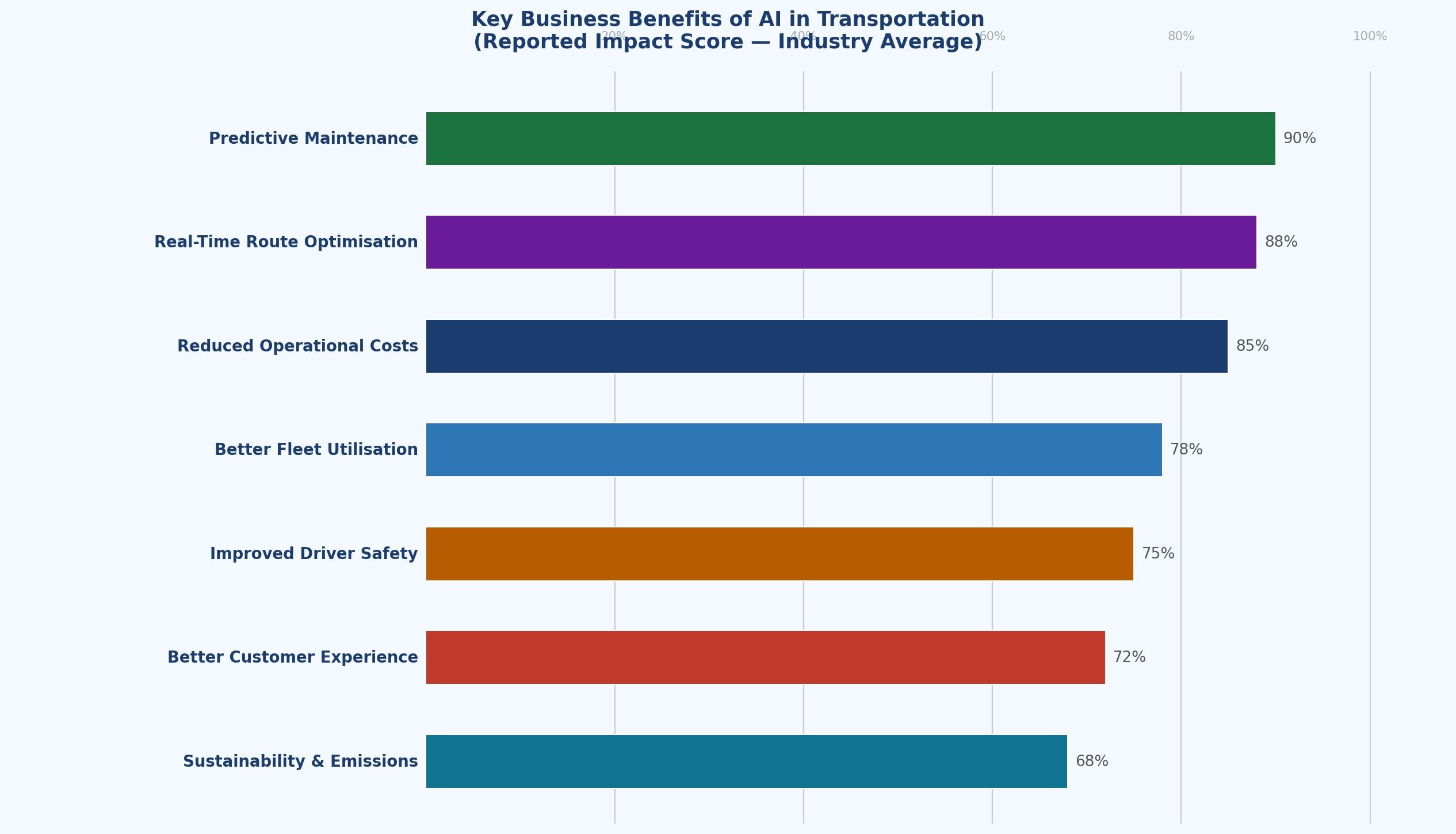
A. Reduced Operational Costs. AI-powered transportation software identifies and eliminates waste across fuel consumption, route inefficiencies, idle time, and emergency maintenance. A logistics company running 500 vehicles can reduce fuel expenditure by 10–20% simply by deploying AI-driven route planning and driver behaviour monitoring.
B. Better Fleet Utilisation. AI helps dispatchers allocate vehicles more intelligently based on load capacity, location, delivery priority, and driver availability. This means fewer empty miles, better load distribution, and higher throughput from the same asset base.
C. Predictive Maintenance in Transportation. Rather than relying on fixed maintenance schedules or waiting for breakdowns, AI systems analyse engine telemetry, vibration signals, temperature patterns, and historical failure data to predict component failures before they cause disruptions — shifting maintenance from reactive to preventive.
D. Improved Driver Safety. Computer vision and real-time sensor data enable AI systems to detect fatigue, distraction, speeding, harsh braking, and unsafe lane behaviour as they happen. Alerts are sent to drivers and managers instantly, and safety scores inform coaching and incentive programmes.
E. Real-Time Route Optimisation Using AI. Intelligent fleet management systems ingest traffic data, road incidents, weather conditions, delivery windows, vehicle load, and fuel levels to continuously recalculate optimal routes mid-journey — delivering faster deliveries, lower fuel use, and fewer SLA breaches.
F. Better Customer Experience. AI improves ETA accuracy, automates shipment status notifications, and enables intelligent customer support via chatbots and voice assistants. Customers receive proactive communication rather than chasing updates — directly improving satisfaction and reducing support overhead.
G. Sustainability and Emission Reduction. AI supports decarbonisation by optimising fuel consumption, planning EV charging schedules, tracking idle time, and modelling routes based on carbon impact. Companies with AI-powered carbon visibility will be better positioned to meet compliance targets and demonstrate ESG progress.
5. Top AI Use Cases in Transportation
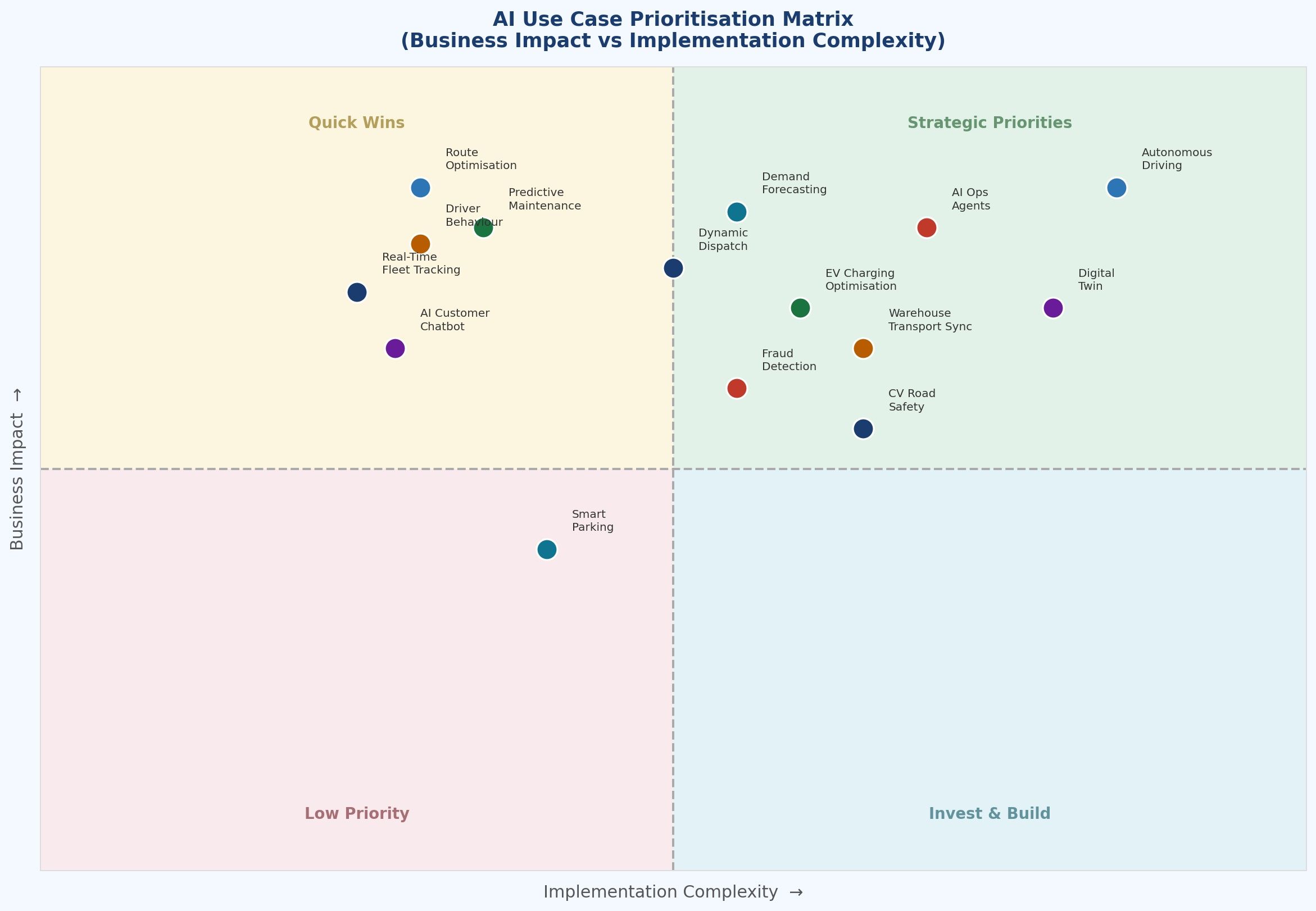
The quadrant above helps transportation leaders prioritise which AI initiatives to pursue first. Quick Wins (top-left) deliver high value with lower complexity; Strategic Priorities (top-right) require more investment but create the greatest long-term competitive advantage.
1. Predictive Fleet Maintenance
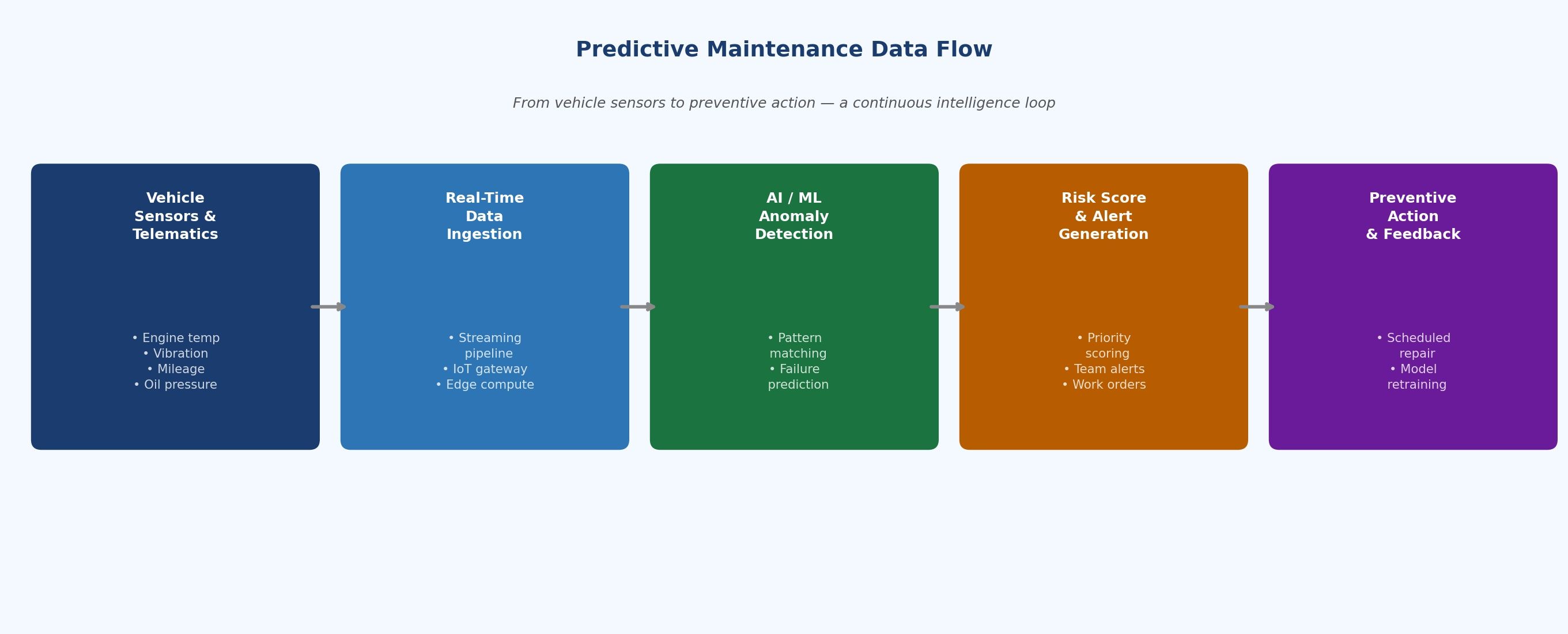
Business problem: Unplanned breakdowns halt operations, delay deliveries, and cause costly emergency repairs. How AI solves it: ML models analyse real-time sensor feeds — oil pressure, coolant temperature, brake wear, vibration — against historical failure patterns to generate maintenance alerts weeks in advance. Impact: 20–35% reduction in unplanned downtime.
2. AI-Powered Route Planning
Business problem: Static route plans cannot adapt to live traffic, weather, or changing delivery priorities. How AI solves it: Route optimisation algorithms continuously recalculate paths using real-time inputs, adjusting for congestion, driver hours, and load priorities. Impact: 15–25% improvement in on-time delivery; 10–20% fuel cost reduction.
3. Real-Time Vehicle Tracking and Fleet Intelligence
Business problem: Dispatchers lack real-time visibility into vehicle location, performance, and cargo status. How AI solves it: AI aggregates GPS, telematics, and IoT data into a unified intelligence layer, enabling live fleet dashboards and anomaly alerts. Impact: Significant reduction in manual check-ins and faster exception resolution.
4. Demand Forecasting
Business problem: Fleet capacity planning relies on historical averages rather than forward-looking signals. How AI solves it: ML models integrate order data, seasonal trends, market events, and economic indicators to forecast demand with precision. Impact: Fewer empty runs; improved load planning and procurement.
5. Dynamic Dispatch Planning
Business problem: Manual dispatch is slow, inconsistent, and unable to respond to real-time changes. How AI solves it: AI dispatch platforms automatically assign the right vehicle, driver, and route — optimising across cost, time, and capacity simultaneously. Impact: 40–60% reduction in dispatch planning time.
6. Driver Behaviour Monitoring
Business problem: Risky driving increases accident rates, insurance premiums, and fuel consumption. How AI solves it: Computer vision and telematics detect fatigue, harsh braking, phone usage, and speeding — providing real-time driver feedback and manager dashboards. Impact: 25–40% reduction in accident-related incidents.
7. AI-Powered Traffic Management
Business problem: Urban and last-mile delivery is severely impacted by traffic congestion. How AI solves it: AI integrates with city traffic management systems, signal APIs, and real-time incident databases to route vehicles dynamically. Impact: Reduced delivery windows; improved urban logistics efficiency.
8. Autonomous and Assisted Driving Systems
Business problem: Driver shortages and long-haul fatigue create safety and capacity risks. How AI solves it: Computer vision, LiDAR, and deep learning power lane-keeping, adaptive cruise control, and platooning systems that reduce driver strain. Impact: Improved safety; reduced fuel use; operational continuity despite driver shortages.
9. Smart Parking and Mobility Management
Business problem: Fleet vehicles waste significant time and fuel searching for available parking. How AI solves it: AI analyses historical patterns, sensor data, and real-time occupancy to recommend optimal parking spots and manage facility flow. Impact: Reduced idle time; improved turn-around for urban fleets.
10. AI Chatbots and Voice Assistants for Customer Support
Business problem: Customer support teams are overwhelmed with delivery status queries and complaints. How AI solves it: NLP-powered chatbots handle shipment tracking, ETA updates, issue escalation, and rescheduling around the clock. Impact: 30–50% reduction in support ticket volume; faster resolution; improved CSAT.
11. Computer Vision for Vehicle and Road Safety
Business problem: Physical inspections of vehicles and cargo are time-consuming and inconsistent. How AI solves it: Computer vision systems perform automated vehicle inspections, detect load anomalies, and identify road hazards from dash cameras in real time. Impact: Improved safety compliance; faster pre-trip inspection cycles.
12. Fraud Detection in Logistics and Transportation Billing
Business problem: Billing fraud, duplicate invoices, and mileage manipulation cost logistics companies millions annually. How AI solves it: ML anomaly detection flags irregular patterns in fuel consumption, mileage logs, toll claims, and invoicing data. Impact: Up to 30% reduction in billing fraud losses.
13. Warehouse-to-Transport Coordination
Business problem: Disconnected warehouse and transportation systems create handoff delays. How AI solves it: AI bridges WMS and TMS to synchronise pick, pack, and dispatch timelines — dynamically adjusting schedules based on real-time warehouse throughput. Impact: Faster order-to-ship cycles; fewer missed loading windows.
14. EV Charging Optimisation
Business problem: EV fleets face unpredictable charging times, range anxiety, and peak energy cost spikes. How AI solves it: AI models optimise charging schedules based on route demands, battery state, grid pricing, and depot capacity. Impact: 15–20% reduction in energy costs; improved EV fleet utilisation.
15. AI Agents for Transport Operations Command Centres
Business problem: Operations teams struggle to monitor everything simultaneously across large fleets. How AI solves it: Autonomous AI agents monitor KPIs, surface exceptions, recommend interventions, and log actions — acting as an always-on digital layer over the operations centre. Impact: Faster incident response; reduced cognitive load on operators.
6. AI Agents: The Next Layer of Transportation Intelligence
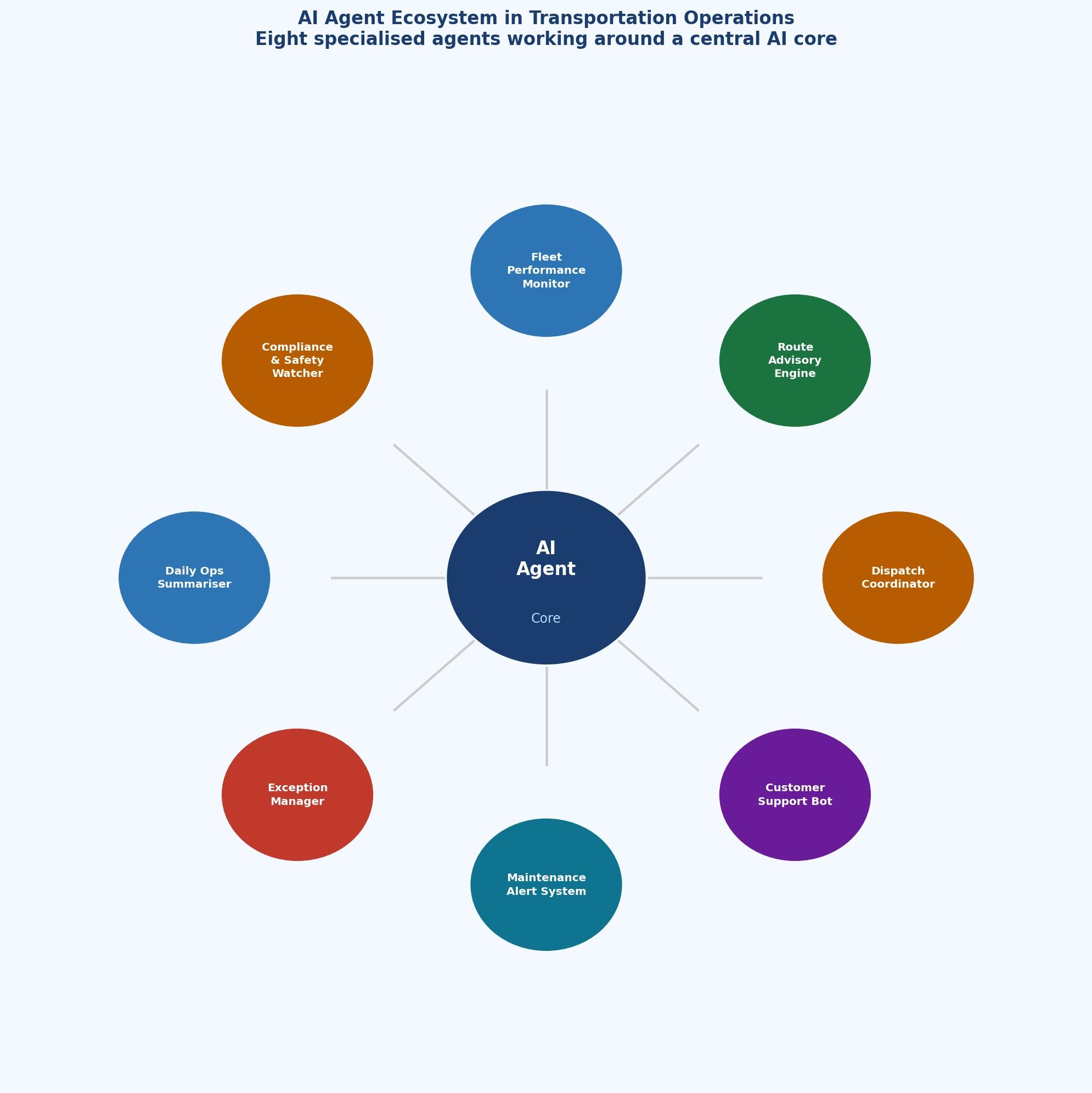
AI agents represent a meaningful step beyond static dashboards and alert systems. Rather than displaying information, AI agents in transportation actively monitor operational conditions, reason about data, and recommend or execute actions with minimal human intervention.
In a transportation operations context, AI agents can:
- Monitor fleet performance across hundreds of vehicles simultaneously and surface deviations in real time
- Alert dispatch teams when a vehicle is at risk of delay, breakdown, or SLA breach — before it happens
- Recommend route changes, driver reassignments, or maintenance interventions based on live conditions
- Coordinate dispatch by automatically balancing vehicle availability, driver hours, and delivery priority
- Answer customer queries about shipment status, ETAs, and exceptions through AI-powered chat and voice
- Generate daily performance summaries for fleet managers — KPIs, exceptions, and cost variances
- Support control room teams by surfacing the most critical decisions requiring human attention
- Automate repetitive planning tasks: route scheduling, capacity assignments, and compliance checks
Think of AI agents as digital co-workers for transport planners, dispatchers, and fleet managers — not replacing human judgement, but dramatically expanding what each person can monitor and act on within a single shift.
7. The Data Foundation AI Depends On
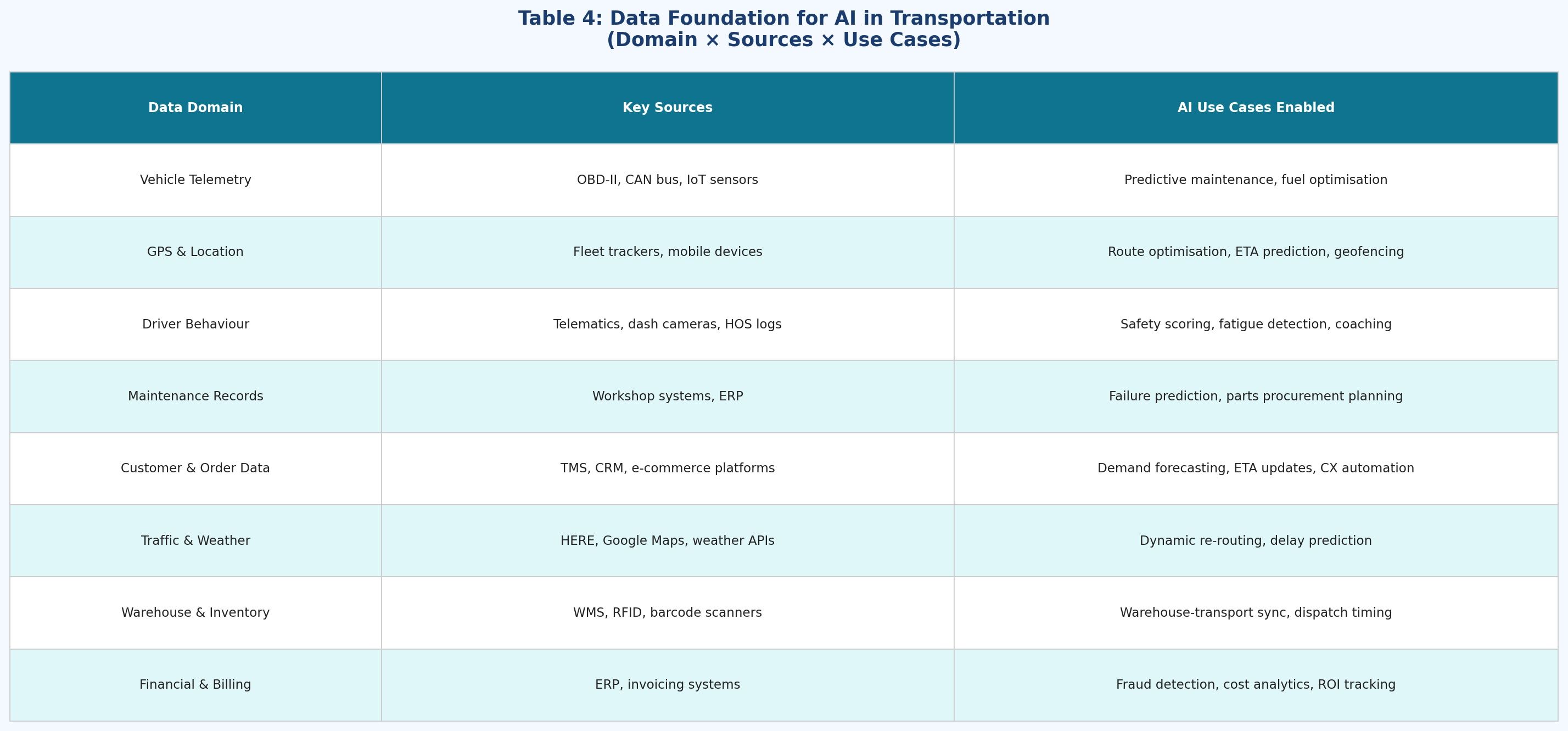
Real-time streaming pipelines — not batch-based data warehouses — are required to power most AI use cases in transportation. Data governance, quality standards, and security controls must be in place before AI models can produce decisions that operations teams are willing to trust and act on.
8. How to Build AI-Powered Transportation Software: A Practical Roadmap
Successful AI adoption in transportation follows a structured, phased approach:
Step 1.Identify high-value business problems — Start with pain points that cost the most: breakdowns, fuel waste, late deliveries, or dispatch inefficiency.
Step 2.Assess data availability and system landscape — Inventory existing data sources, integration gaps, and data quality issues.
Step 3.Prioritise AI use cases based on ROI and feasibility — Start where data is richest and impact is clearest (see quadrant diagram).
Step 4.Build an MVP or pilot — Test the AI model on a subset of your fleet, routes, or operations before full deployment.
Step 5.Integrate with existing transportation systems — Connect AI capabilities to TMS, ERP, WMS, and telematics platforms.
Step 6.Add AI models, analytics, and automation workflows — Layer intelligence on top of integrated data pipelines.
Step 7.Test for accuracy, safety, and operational reliability — Validate model outputs against real-world decisions before going live.
Step 8.Deploy with monitoring and human-in-the-loop controls — Ensure operators can review, override, and audit AI recommendations at any time.
Step 9.Train users and drive adoption — AI tools only deliver value when operations teams trust and use them consistently.
Step 10.Continuously improve models — Feed performance data back into retraining pipelines to improve accuracy over time.
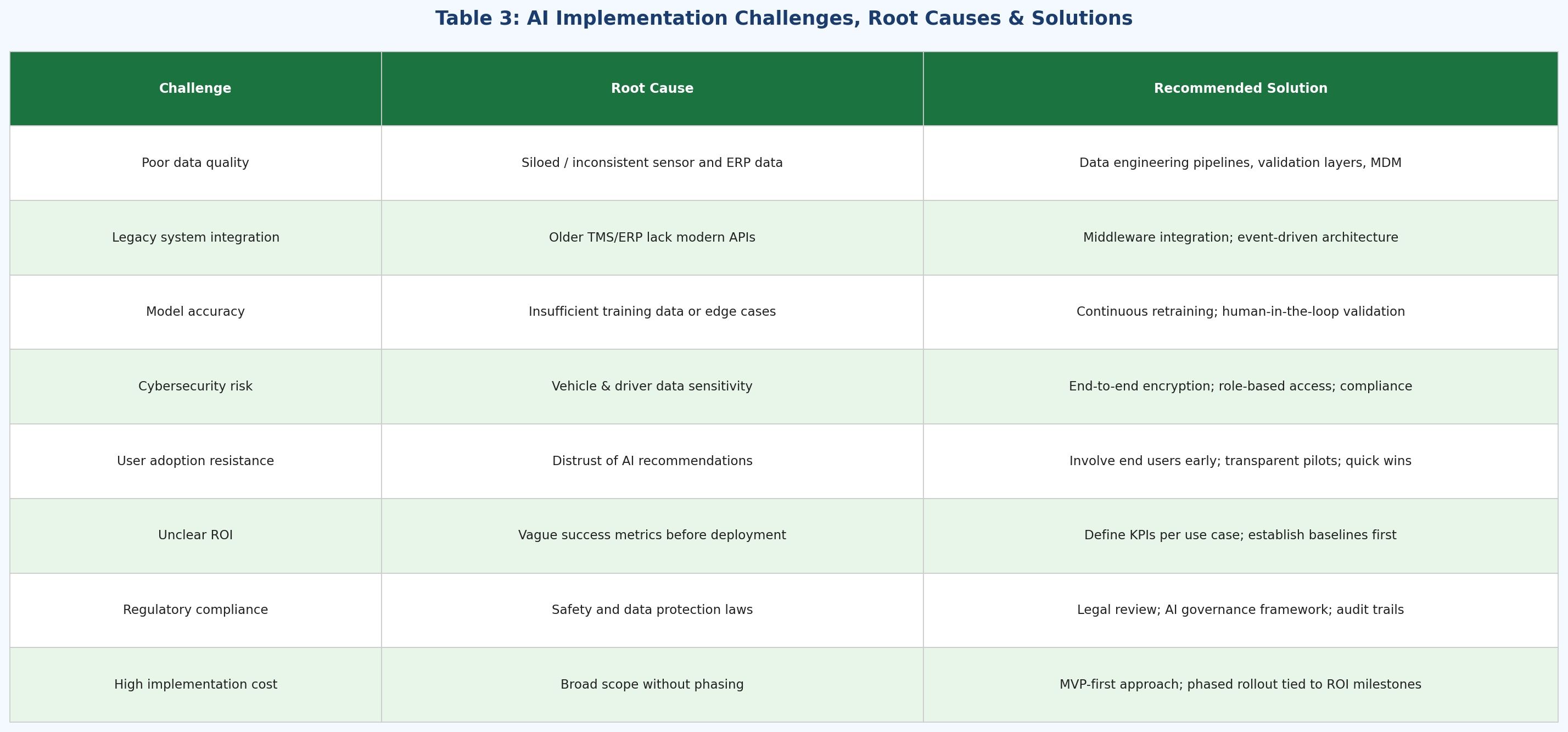
9. Common Challenges — and How to Overcome Them
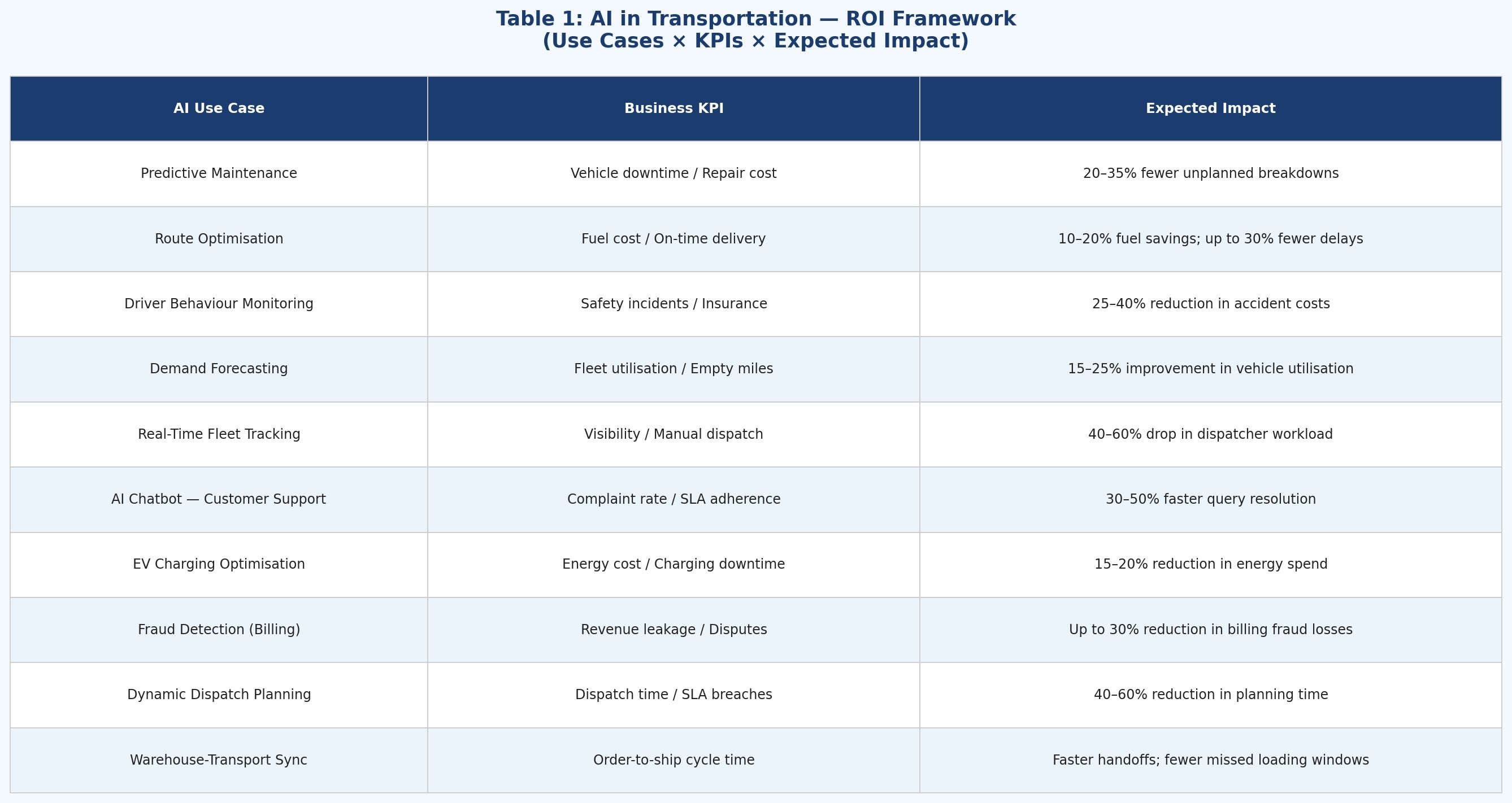
10. Measuring ROI from AI in Transportation
Quantifying the value of AI investment requires linking each use case to measurable business outcomes. Establish baseline measurements before deployment and track KPI movement at 30, 90, and 180 days post-launch to build an accurate ROI picture.
11. The Future of AI in Transportation
The current wave of AI in transportation is only the beginning. Over the next three to five years, the following capabilities will reshape how fleets, logistics networks, and mobility systems operate:
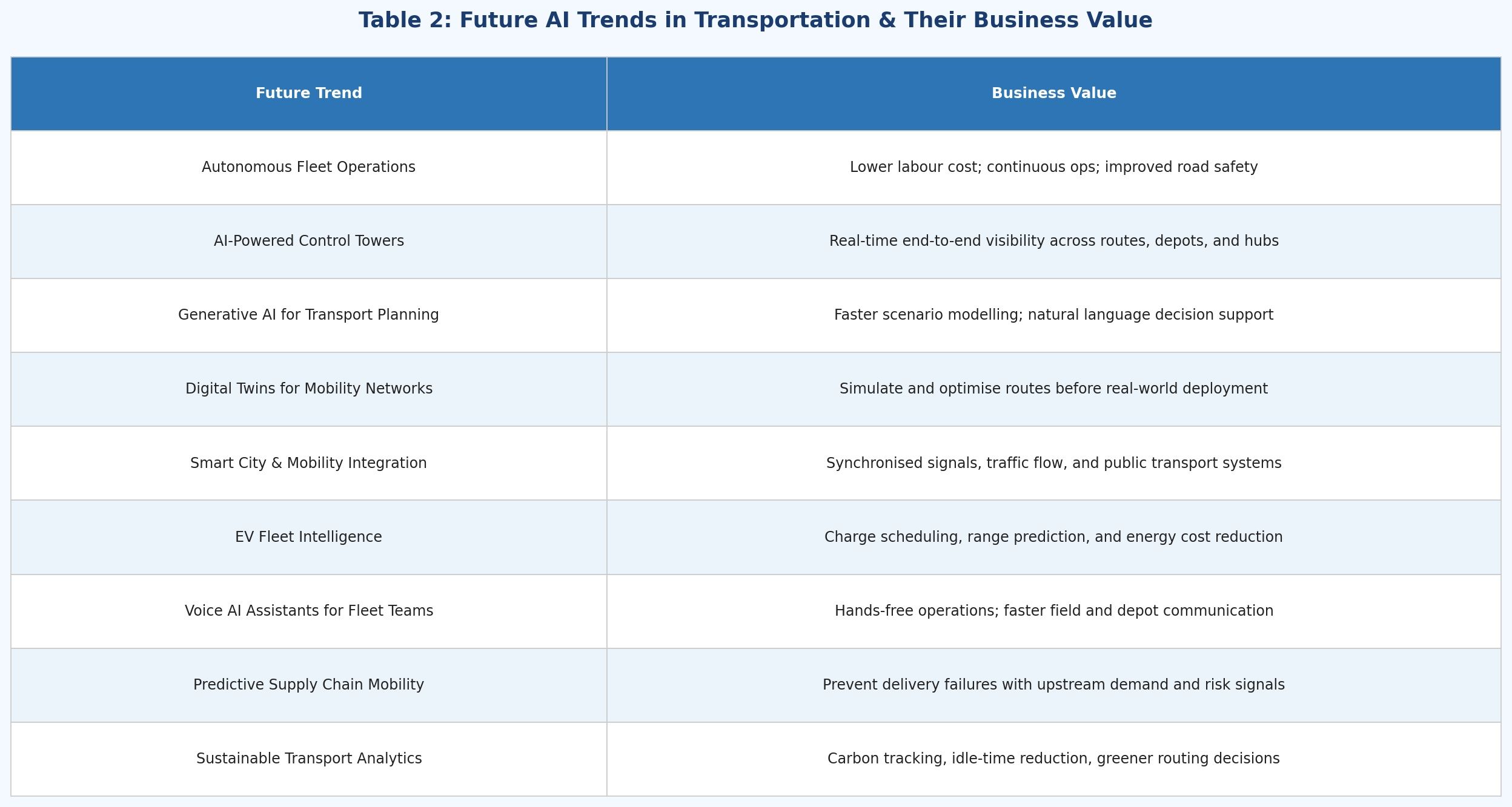
The convergence of AI, IoT, cloud infrastructure, and real-time data platforms is creating a new category of intelligent transportation operations — where entire fleets, networks, and supply chains can self-optimise around changing conditions, customer demands, and sustainability goals.
12. Conclusion: AI is Not Optional for Transportation's Future
Transportation companies that continue to rely on manual processes, static planning, and disconnected data systems will find themselves increasingly at a disadvantage — on cost, reliability, sustainability, and customer experience. The companies gaining ground are those treating AI not as a one-off project, but as a core operational capability.
AI in transportation is about more than automation. It is about building organisations that sense faster, decide better, respond smarter, and continuously improve. It requires combining AI with strong data engineering, cloud-native infrastructure, thoughtful system integration, and a culture that trusts data-driven decisions.
The businesses that get this right will not just reduce costs. They will build more resilient, more adaptive, and more competitive mobility operations — capable of meeting whatever comes next.