
Introduction
Businesses today no longer compete solely on products or pricing—they compete on how quickly they can build, scale, and adapt their teams. Whether you're launching a SaaS platform, modernizing enterprise applications, migrating infrastructure to the cloud, or implementing AI solutions, the ability to access skilled professionals quickly has become a competitive advantage.
Traditional hiring often struggles to keep pace with rapidly changing project demands. Recruiting permanent employees can take weeks or even months, while projects frequently require specialized expertise immediately. This is where contract hiring has evolved from a temporary staffing solution into a strategic workforce model.
India has emerged as one of the world's most preferred destinations for hiring contract professionals. With one of the largest technology talent pools globally, deep expertise across modern technology stacks, strong English proficiency, and significant cost advantages, India enables organizations to scale engineering and business teams without the long-term commitments associated with permanent hiring.
Whether you're a startup building your first product, a mid-sized company expanding delivery capacity, or an enterprise managing multiple digital transformation initiatives, hiring contract resources in India provides the flexibility to respond quickly to changing business priorities while maintaining operational efficiency.
In this comprehensive guide, you'll learn:
• What contract resources are and how they differ from permanent employees.
• When businesses should hire contract professionals.
• Different engagement models available in India.
• Benefits and challenges of contract hiring.
• Industries that rely on contract resources.
• The end-to-end hiring process.
• Cost considerations and timelines.
• Compliance best practices.
• How to choose the right staffing partner.
• Future trends shaping contract hiring in India.
Key Takeaways
✔ Hire specialized professionals without long-term employment commitments.
✔ Reduce recruitment time for critical business projects.
✔ Scale engineering and business teams based on project requirements.
✔ Access India's large talent ecosystem across software development, cloud, AI, DevOps, QA, cybersecurity, and business functions.
✔ Improve workforce flexibility while optimizing hiring costs.
✔ Choose the right engagement model based on project complexity, duration, and business objectives.
What Are Contract Resources?
Contract resources are professionals engaged for a defined duration, project, or business requirement rather than as permanent employees. They are typically hired to provide specialized expertise, augment existing teams, accelerate project delivery, or address temporary workforce needs.
Unlike traditional employees, contract professionals are brought in to achieve specific business outcomes. Their engagement may last from a few weeks to several months—or longer—depending on project scope, contractual terms, and organizational requirements.
Organizations commonly hire contract resources for:
• Software development projects
• Product launches
• Cloud migrations
• ERP implementations
• AI and machine learning initiatives
• Cybersecurity assessments
• Digital transformation programs
• Seasonal workload spikes
• Business expansion
Rather than replacing permanent employees, contract professionals complement existing teams by providing expertise where and when it's needed most.
Why Businesses Are Increasingly Choosing Contract Resources
The demand for contract resources is being driven by a fundamental shift in how organizations build and manage their workforce. Instead of hiring large permanent teams, businesses are prioritizing specialized skills that align with specific projects and evolving technology needs.
According to NASSCOM, India's technology hiring landscape is shifting from high-volume recruitment to targeted, skill-based hiring, with organizations increasingly investing in AI, cloud computing, cybersecurity, product engineering, and flexible contract talent models. India's technology workforce now comprises nearly 5.8–6 million professionals, making it one of the world's largest technology talent ecosystems.
NASSCOM also highlights the growing adoption of structured gig and contract workforce models, enabling organizations to improve agility, access niche expertise faster, and respond more effectively to changing business demands. Additionally, with over 80% of digital roles being augmented by AI rather than replaced, companies are increasingly building hybrid teams that combine permanent employees with specialized contract professionals.
As a result, contract hiring has evolved beyond a short-term staffing solution—it has become a strategic workforce model that helps businesses accelerate innovation, optimize costs, and scale with greater flexibility.
(NASSCOM – Decoding the Gig Workforce 2.0 and recent NASSCOM technology workforce insights.)
Contract Resources vs Permanent Employees
Choosing between contract and permanent hiring depends on your organization's goals, project timelines, and workforce strategy.
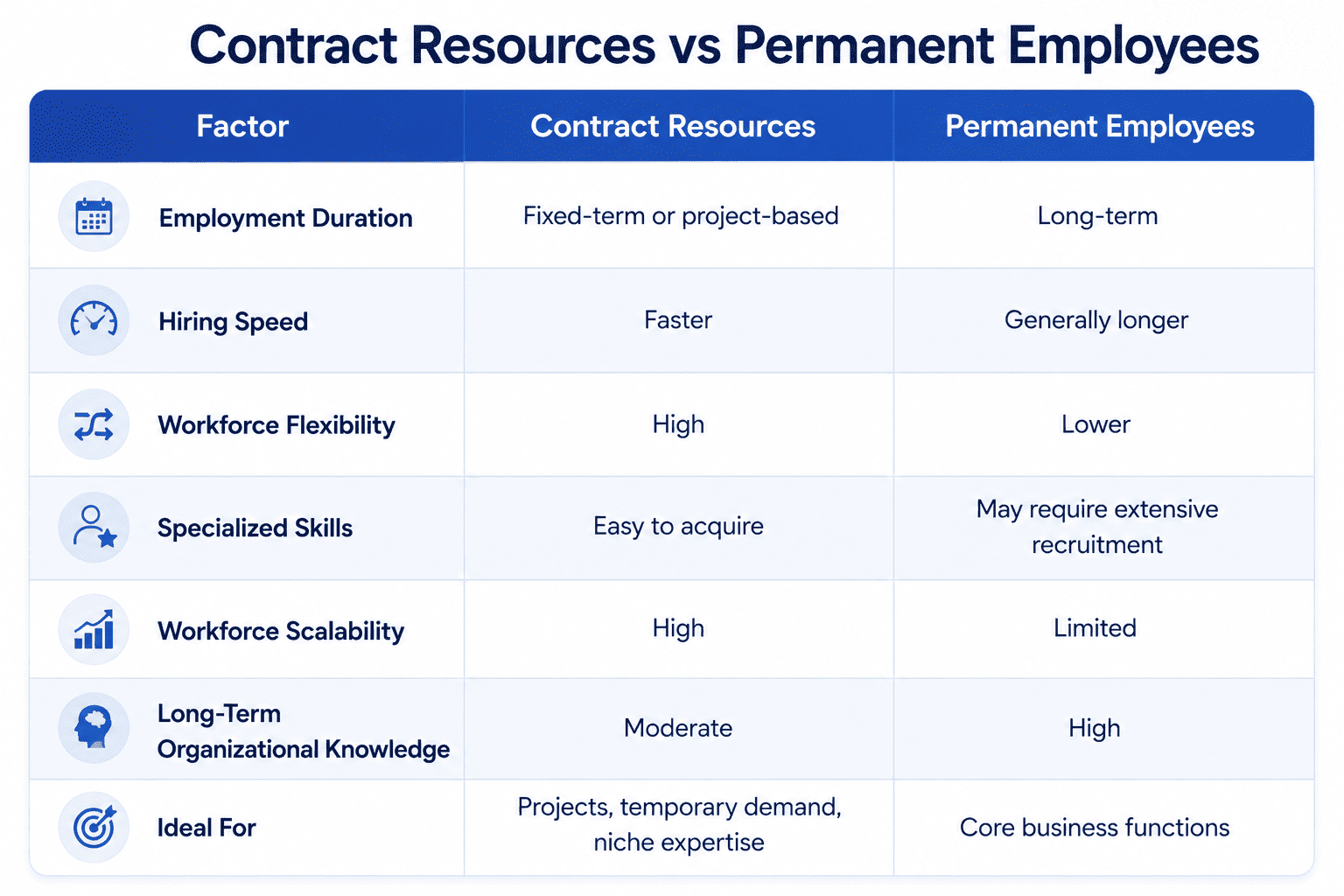
Neither approach is universally better. High-performing organizations often use a hybrid workforce model, combining permanent employees with contract professionals to balance stability and flexibility.
Contract Hiring vs Staff Augmentation vs Dedicated Teams
These terms are often used interchangeably, but they address different business needs.
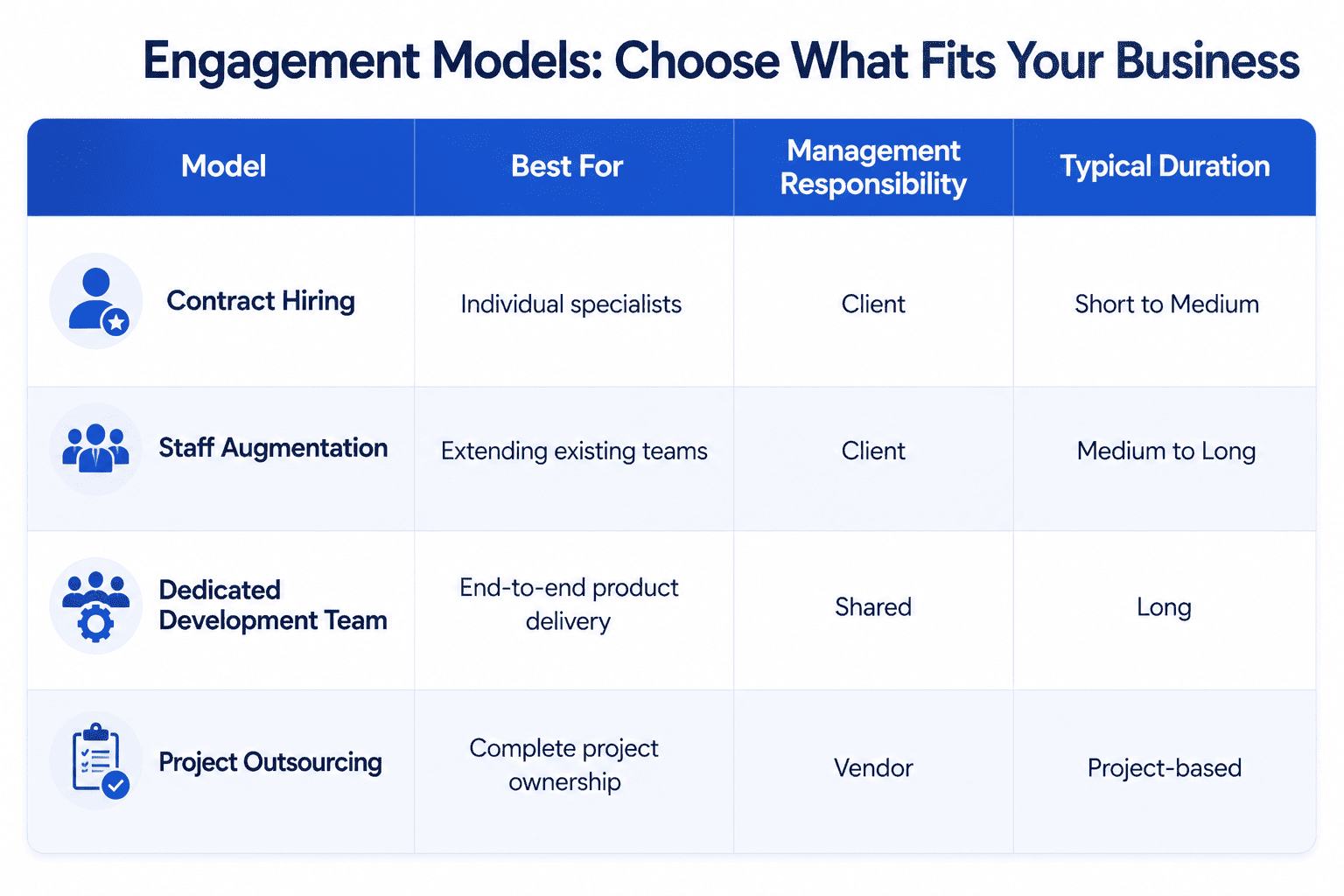
Understanding these engagement models helps organizations choose the right workforce strategy instead of relying on a one-size-fits-all hiring approach.
Related Services
• Custom Software Development Services
Types of Contract Resources Businesses Hire
Organizations across industries hire contract professionals for a wide range of technical and business functions.
Technology Roles
• Full Stack Developers
• Java Developers
• .NET Developers
• Python Developers
• React Developers
• Angular Developers
• Node.js Developers
• Mobile App Developers
• Cloud Engineers
• DevOps Engineers
• Site Reliability Engineers (SRE)
• AI & Machine Learning Engineers
• Data Engineers
• Data Scientists
• Cybersecurity Specialists
• QA Automation Engineers
• Manual Test Engineers
• Solution Architects
• UI/UX Designers
Business & Operations Roles
• Business Analysts
• Scrum Masters
• Project Managers
• Product Managers
• ERP Consultants
• Salesforce Consultants
• SAP Consultants
• Digital Marketing Specialists
• Technical Writers
• Customer Success Specialists
As technology stacks become more specialized, organizations increasingly combine multiple contract roles within the same project to accelerate delivery and reduce hiring bottlenecks.
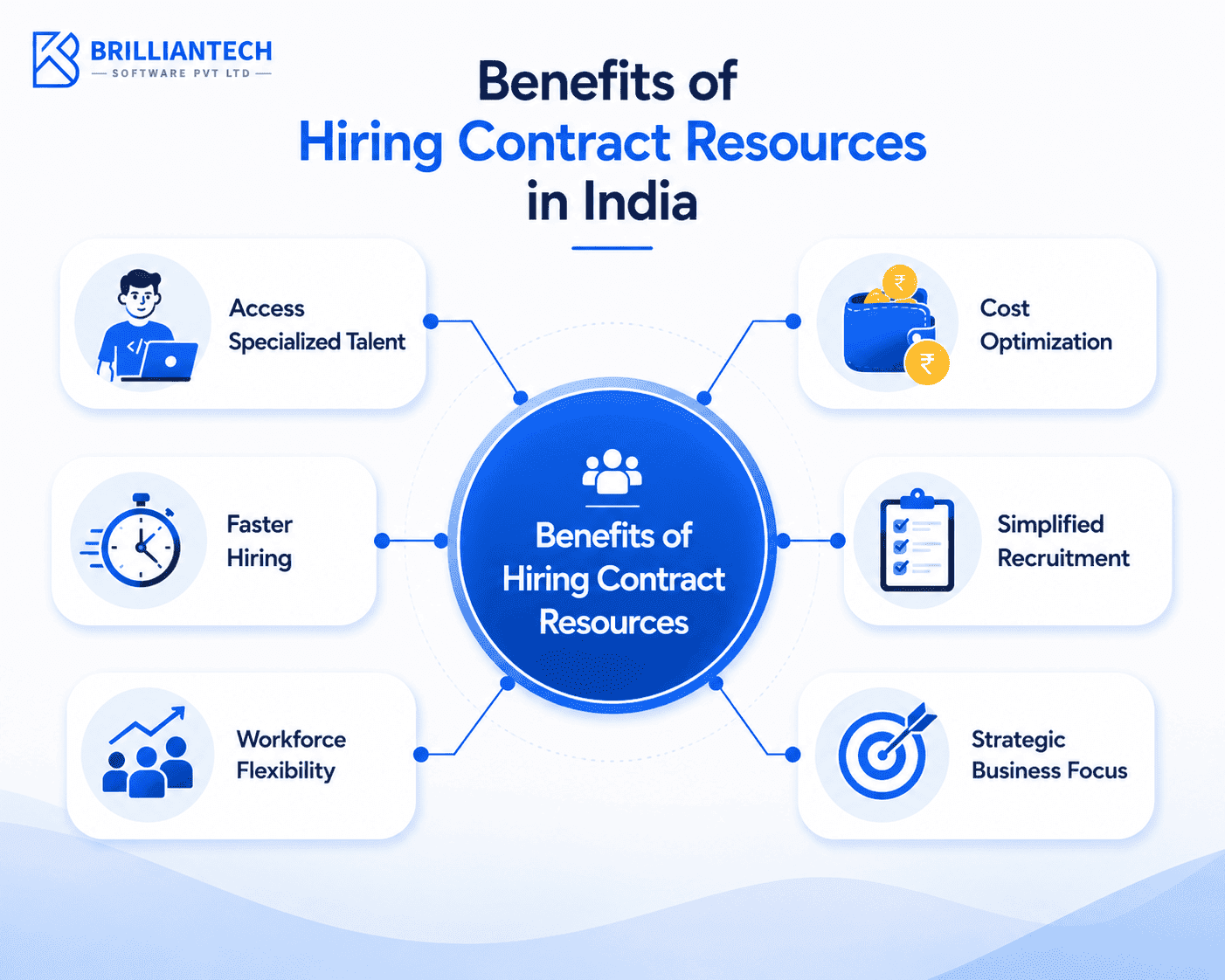
Benefits of Hiring Contract Resources in India
In today's fast-paced business environment, organizations need workforce strategies that allow them to respond quickly to changing market conditions, evolving technologies, and project-based demands. Traditional hiring models often involve lengthy recruitment cycles, long-term employment commitments, and significant onboarding costs, making them less suitable for businesses that require specialized expertise on short notice.
Hiring contract resources provides a flexible alternative. By engaging skilled professionals for a defined duration or specific project, businesses can quickly fill talent gaps, accelerate delivery timelines, optimize workforce costs, and improve operational agility. Whether you're a startup building your first product, an enterprise managing digital transformation, or a growing company expanding into new markets, contract hiring enables you to access the right talent without increasing permanent headcount.
Below are the key benefits of hiring contract resources in India.
Access Specialized Skills and Talent On Demand
One of the biggest advantages of contract hiring is immediate access to professionals with specialized skills and industry expertise. As technologies such as Artificial Intelligence (AI), cloud computing, DevOps, cybersecurity, data engineering, and enterprise software continue to evolve, businesses often struggle to find experienced professionals through traditional hiring channels.
Recruiting permanent employees for every specialized technology or short-term requirement may not always be practical. Many organizations only need niche expertise during a specific phase of a project, such as cloud migration, ERP implementation, application modernization, cybersecurity audits, or product development. Hiring contract resources allows businesses to bring in experienced professionals exactly when their expertise is needed and for as long as the project requires.
This approach also supports the growing shift toward skills-based hiring, where employers prioritize candidates' capabilities and practical expertise over traditional job titles or career history. Rather than hiring based solely on experience, organizations increasingly focus on whether professionals possess the technical and functional skills required to achieve specific business outcomes.
Deloitte's Global Human Capital Trends – From Jobs to Skills to Outcomes: Rethinking How Work Gets Done highlights the growing importance of skills-based workforce planning. According to the report, 93% of surveyed respondents believe moving away from traditional job structures is important or very important to organizational success, reflecting a broader shift toward deploying talent based on skills, capabilities, and outcomes instead of fixed job roles.
Similarly, LinkedIn's Future of Recruiting 2025 report found that over nine out of ten talent acquisition professionals believe accurately assessing candidates' skills is crucial for improving hiring quality. The report also notes that organizations using the highest level of skills-based searches are 12% more likely to make quality hires, reinforcing the value of hiring based on capabilities rather than credentials alone.
For businesses hiring contract resources in India, this means faster access to professionals who possess the precise technical expertise needed to solve business challenges, complete projects efficiently, and contribute from day one.
Why it matters: Contract hiring enables organizations to bridge critical skill gaps quickly while ensuring every project has access to professionals with the expertise required for successful delivery
Accelerate Hiring and Project Delivery
In highly competitive industries, speed often determines business success. Delays in hiring can postpone product launches, extend development cycles, increase project costs, and impact customer satisfaction. Traditional recruitment processes typically involve multiple interview rounds, lengthy notice periods, onboarding activities, and training before new employees become fully productive.
Contract hiring significantly reduces these delays by providing access to pre-qualified professionals who can join projects quickly and contribute with minimal onboarding. This enables organizations to maintain project momentum, meet critical deadlines, and respond rapidly to changing customer or market requirements.
Recruitment processes themselves are also becoming faster through Artificial Intelligence and automation. Modern recruitment technologies help streamline repetitive tasks such as resume screening, candidate sourcing, interview scheduling, and initial assessments, allowing recruiters to spend more time evaluating talent and improving candidate quality.
LinkedIn's Future of Recruiting 2025 report states that 73% of talent acquisition professionals believe AI will transform the way organizations hire. The report further reveals that organizations already integrating or experimenting with generative AI in recruitment save approximately 20% of recruiters' workweek by automating repetitive hiring activities. This additional time allows recruiters to focus on strategic initiatives such as candidate engagement, skills assessment, and improving hiring quality.
When combined with contract hiring, these improvements enable businesses to fill critical positions faster, reduce time-to-productivity, and accelerate project execution without compromising hiring quality.
For organizations managing digital transformation initiatives, software development projects, cloud migrations, or seasonal business demands, faster hiring directly contributes to improved delivery timelines and stronger business outcomes.
Why it matters: Faster access to experienced contract professionals helps organizations reduce hiring delays, improve project delivery, and respond more effectively to changing business priorities.
Scale Teams with Greater Workforce Flexibility
Business needs are constantly evolving. A company may require additional developers during a product launch, cybersecurity specialists during a compliance project, data engineers for a migration initiative, or customer support professionals during seasonal demand. Hiring permanent employees for every temporary requirement can increase fixed costs and reduce workforce efficiency once those projects are completed.
Contract hiring provides the flexibility to scale teams up or down based on actual business requirements. Organizations can quickly expand their workforce during periods of high demand and reduce team size once projects conclude, ensuring resources remain aligned with operational priorities.
This flexible workforce model has become increasingly important as organizations move away from rigid organizational structures toward more agile operating models that combine permanent employees, contract professionals, automation, and AI.
Deloitte's Global Human Capital Trends – From Jobs to Skills to Outcomes: Rethinking How Work Gets Done explains that organizations are redesigning work around skills, tasks, and business outcomes rather than traditional job structures. This approach enables businesses to create more agile workforce models capable of adapting quickly to changing priorities and evolving market conditions.
Supporting this perspective, McKinsey & Company's article, The Critical Role of Strategic Workforce Planning in the Age of AI (2025), notes that strategic workforce planning helps organizations anticipate future capability requirements, redeploy talent more effectively, and improve agility by aligning workforce decisions with long-term business strategy.
For businesses managing multiple projects, expanding into new markets, or responding to fluctuating customer demand, contract hiring offers the flexibility to build high-performing teams without committing to long-term increases in permanent headcount.
Why it matters: A flexible workforce allows organizations to respond quickly to changing business needs, improve resource utilization, and maintain operational agility without increasing long-term employment costs
Optimize Costs Without Sacrificing Quality
For many businesses, hiring decisions are influenced not only by talent availability but also by budget constraints. While full-time employees bring long-term value, they also involve ongoing expenses such as salaries, employee benefits, recruitment costs, onboarding, training, infrastructure, insurance, paid leave, and other operational overheads.
Contract hiring offers a more flexible and cost-efficient workforce model by allowing organizations to engage professionals only for the duration of a project or business requirement. Instead of committing to permanent payroll costs, companies can allocate resources where they generate the highest business value while maintaining greater financial flexibility.
This approach is especially valuable for startups, growing businesses, and organizations managing project-based workloads. Whether launching a new product, expanding development capacity, or implementing a digital transformation initiative, businesses can access experienced professionals without increasing long-term fixed employment costs.
It's important to note that cost optimization should not be viewed as simply reducing expenses. Rather, it involves making smarter workforce decisions that balance quality, speed, and budget. Contract professionals often bring years of specialized experience, enabling them to contribute immediately with minimal training and onboarding.
McKinsey & Company's article, The Critical Role of Strategic Workforce Planning in the Age of AI (2025), emphasizes that organizations should evaluate multiple approaches—including external hiring, internal redeployment, reskilling, outsourcing, and upskilling—when addressing workforce capability gaps. The article highlights that effective workforce planning helps businesses balance talent availability, hiring speed, and overall workforce costs instead of relying solely on permanent recruitment.
Organizations that align hiring decisions with business priorities are better positioned to control costs while maintaining productivity and service quality.
Why it matters: Contract hiring helps organizations optimize workforce spending by aligning talent investments with actual business needs rather than maintaining excess permanent capacity.
Reduce Recruitment Complexity and Administrative Burden
Finding the right talent requires considerably more than reviewing resumes. Modern recruitment involves sourcing qualified candidates, conducting technical assessments, scheduling interviews, verifying credentials, negotiating offers, completing compliance checks, managing onboarding documentation, and coordinating payroll and administrative processes.
For organizations hiring multiple professionals or searching for niche technical expertise, these activities can consume significant time and resources.
Partnering with a contract staffing provider simplifies this process by handling much of the recruitment lifecycle. Staffing partners maintain networks of pre-screened professionals and often manage candidate sourcing, initial screening, background verification, onboarding formalities, payroll administration, and employment compliance.
This allows internal HR and talent acquisition teams to shift their focus from repetitive administrative work toward strategic priorities such as employer branding, employee engagement, leadership development, workforce planning, and retention initiatives.
Contract staffing also reduces hiring risks by giving organizations access to professionals who have already been evaluated for technical skills, project experience, and role suitability.
For businesses operating in fast-moving industries such as technology, healthcare, manufacturing, financial services, and consulting, reducing recruitment complexity can significantly improve hiring efficiency and accelerate project execution.
Why it matters: Working with an experienced contract staffing partner streamlines recruitment, reduces administrative workload, and enables HR teams to focus on long-term talent strategy rather than day-to-day hiring operations.
Enable Internal Teams to Focus on Strategic Business Goals
Successful organizations recognize that not every business function requires permanent hiring. Instead, they build balanced workforce models where permanent employees focus on core business initiatives while contract professionals provide specialized expertise for project-based or short-term requirements.
This approach enables internal teams to dedicate more time to innovation, customer experience, product development, strategic planning, and business growth rather than becoming overloaded with temporary operational demands.
For example, during a cloud migration or enterprise software implementation, contract specialists can manage technical execution while internal teams continue focusing on customer relationships, product roadmaps, and organizational priorities. Similarly, during seasonal demand or business expansion, contract resources can provide additional capacity without disrupting long-term workforce planning.
This combination of permanent and contract talent creates a more resilient workforce capable of responding quickly to changing market conditions while maintaining operational continuity.
McKinsey & Company's article, The Critical Role of Strategic Workforce Planning in the Age of AI (2025), explains that organizations treating workforce planning as a strategic business capability—not simply an HR function—are better equipped to anticipate future talent needs, allocate resources effectively, and improve organizational agility. Aligning workforce decisions with long-term business objectives enables companies to respond more effectively to changing market demands while strengthening overall business resilience.
By integrating contract professionals into broader workforce planning strategies, organizations can maintain operational efficiency while allowing permanent teams to concentrate on activities that drive innovation and sustainable competitive advantage.
Why it matters: A balanced workforce strategy enables businesses to leverage contract professionals for specialized project execution while empowering internal teams to focus on innovation, customer value, and long-term growth.
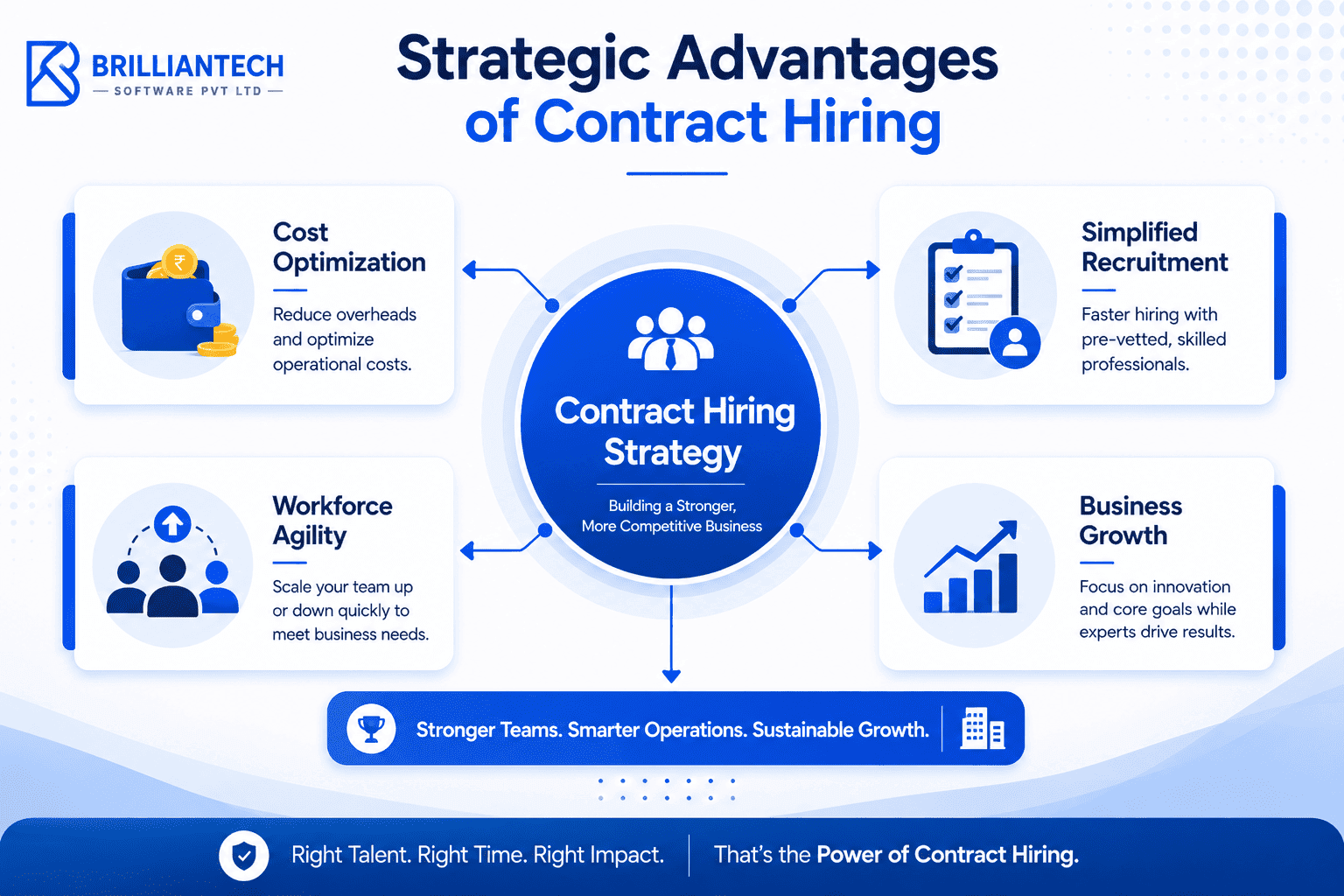
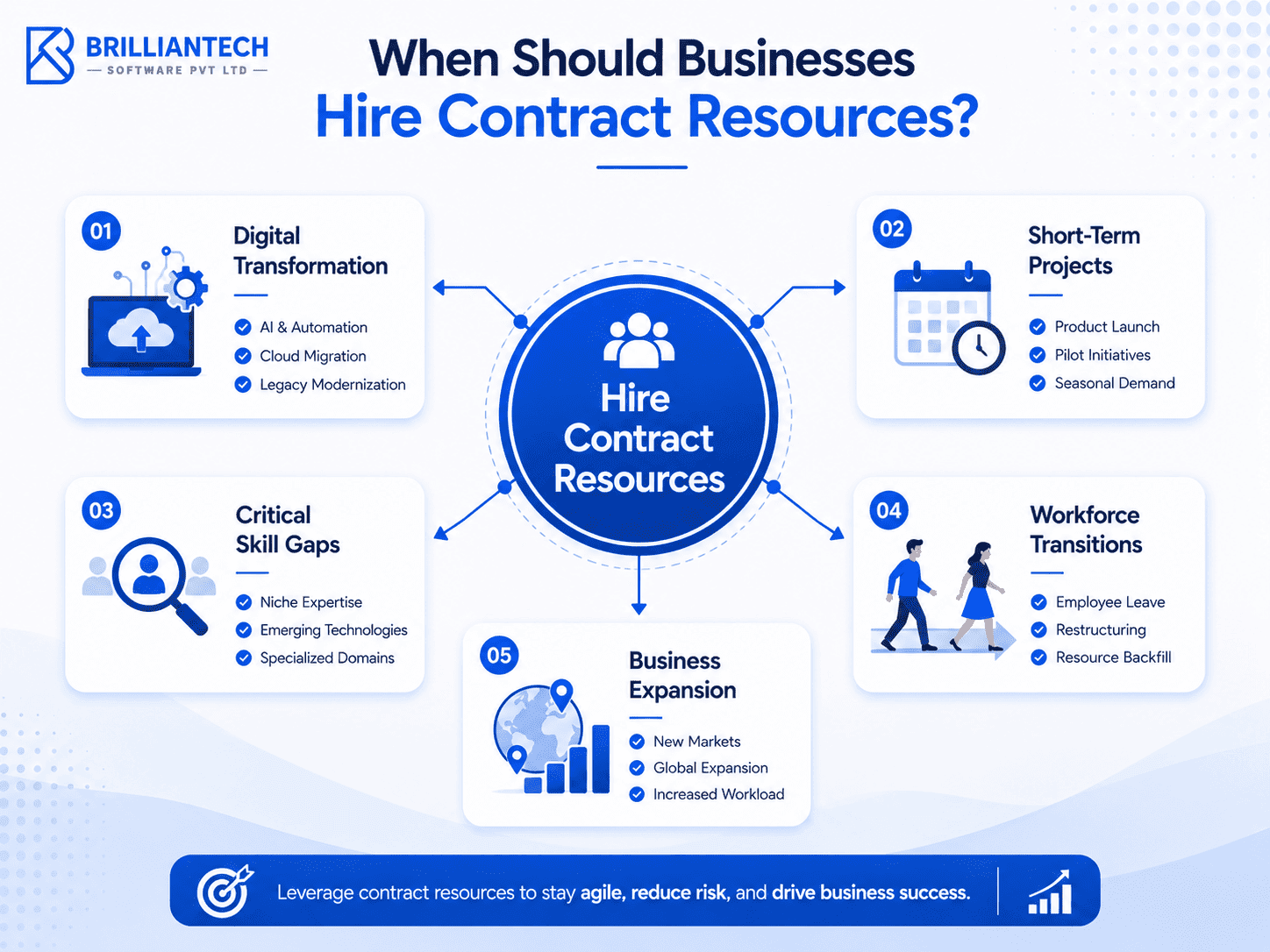
When Should Businesses Hire Contract Resources?
Hiring contract resources is not just about filling vacant positions—it's about responding strategically to changing business needs. Organizations often require additional expertise for limited periods, specialized technologies, or rapidly evolving projects where permanent hiring may not be the most efficient solution.
Whether you're scaling a development team, launching a new digital product, or replacing a critical employee, contract professionals provide the flexibility to access skilled talent without the long-term commitments associated with traditional hiring.
Below are some of the most common situations where hiring contract resources can help businesses achieve better operational and project outcomes.
During Digital Transformation Initiatives
Digital transformation projects often require expertise that many organizations do not possess internally. Cloud migration, AI implementation, cybersecurity modernization, ERP deployment, automation, and application modernization frequently demand specialists with hands-on experience in emerging technologies.
Hiring permanent employees for every transformation initiative may increase costs and extend hiring timelines. Contract professionals enable organizations to access experienced specialists for the duration of the project, ensuring faster implementation while allowing internal teams to continue managing day-to-day operations.
Organizations can also scale technical teams as project requirements evolve, reducing the risk of resource shortages during critical implementation phases.
Why it matters: Contract specialists help organizations accelerate digital transformation while minimizing disruption to existing business operations.
When Scaling Teams for Short-Term Projects
Business workloads often fluctuate based on client requirements, seasonal demand, product launches, or large implementation projects. Expanding permanent teams for temporary increases in workload can create unnecessary long-term employment costs once the project concludes.
Contract hiring provides the flexibility to quickly expand teams when demand increases and reduce workforce size after project completion. This approach allows organizations to maintain productivity without permanently increasing payroll expenses.
Industries such as software development, IT services, consulting, engineering, manufacturing, and healthcare frequently use contract professionals to support project-based work.
Why it matters: Project-based hiring allows businesses to respond quickly to changing workloads while maintaining workforce efficiency.
To Fill Critical Skill Gaps Quickly
Technology evolves faster than traditional hiring cycles. Businesses may suddenly require expertise in cloud platforms, AI, cybersecurity, DevOps, Salesforce, SAP, data analytics, or other specialized domains that are not available within their existing workforce.
Instead of delaying projects while searching for permanent employees, organizations can hire contract professionals with proven experience in these technologies.
This approach reduces project delays while ensuring critical business initiatives continue moving forward.
Why it matters: Contract hiring helps businesses address urgent skill shortages without slowing business growth.
During Employee Absences or Workforce Transitions
Unexpected resignations, parental leave, medical leave, internal promotions, or organizational restructuring can create temporary resource gaps that affect business continuity.
Contract professionals provide immediate support during these transition periods, allowing projects and daily operations to continue without interruption.
Rather than rushing permanent hiring decisions, organizations can maintain productivity while taking the time to recruit the right long-term employees.
Why it matters: Temporary staffing ensures business continuity while reducing operational disruptions caused by workforce changes.
When Expanding into New Markets or Business Functions
Business expansion often requires specialized expertise before permanent teams are fully established. Whether entering a new geographic market, launching a new product line, or opening a delivery center, organizations frequently need additional technical, operational, or managerial resources during the expansion phase.
Hiring contract professionals allows businesses to test new initiatives, build initial capabilities, and support growth without immediately committing to long-term hiring.
Once operations stabilize, companies can determine which positions should transition into permanent roles.
Why it matters: Contract hiring reduces expansion risks by providing flexible access to experienced professionals during periods of business growth.
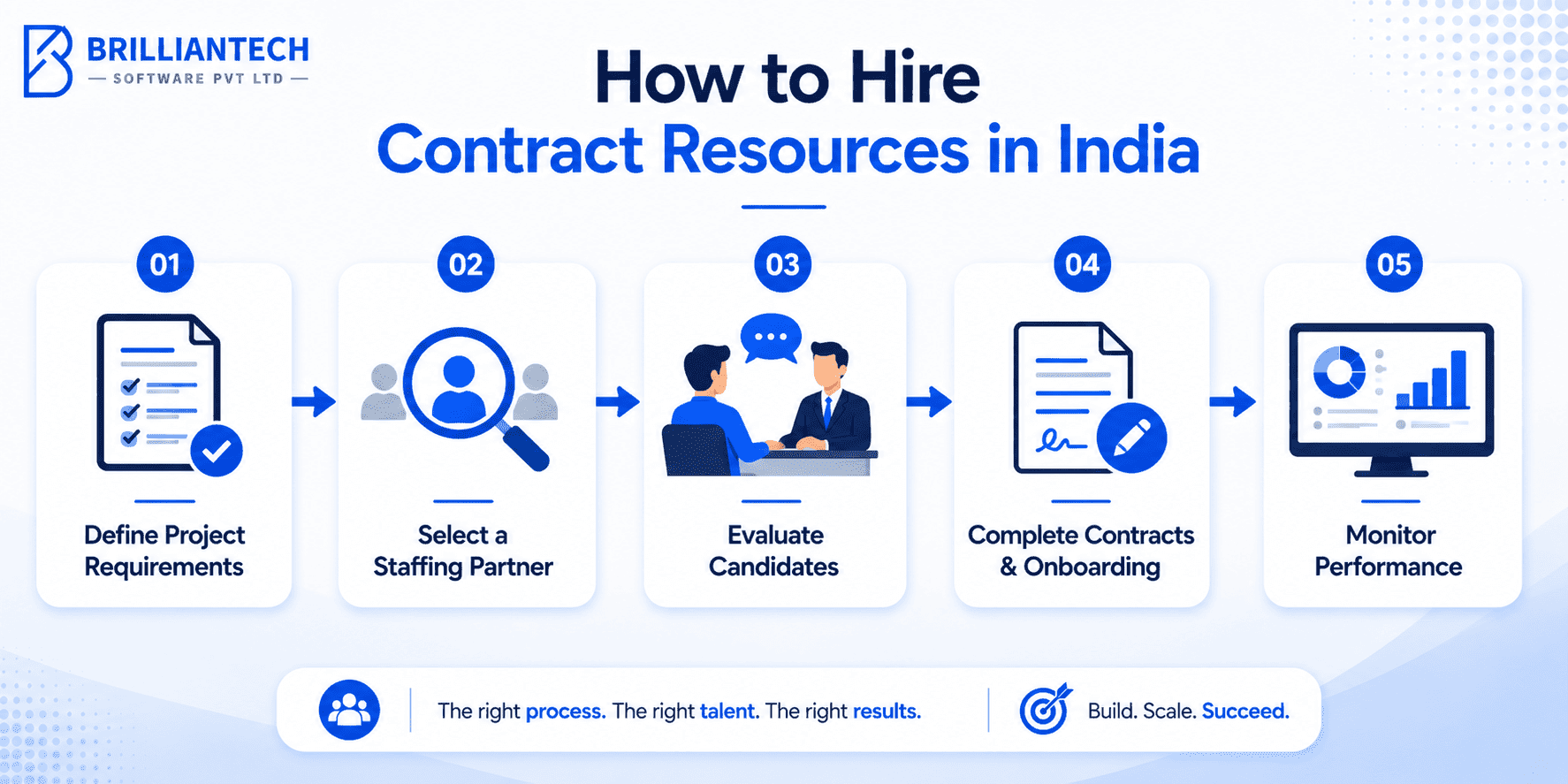
How to Hire Contract Resources in India: A Step-by-Step Process
Hiring contract resources involves more than simply identifying available professionals. Businesses need to define project requirements, evaluate technical expertise, ensure legal and compliance requirements are met, and onboard talent efficiently. Following a structured hiring process helps organizations reduce hiring risks, improve project outcomes, and ensure they engage professionals with the right skills and experience.
Whether you're hiring a single software developer or building an entire project team, the following steps can help you streamline the contract hiring process.
Step 1: Define Your Project Requirements
Before beginning the hiring process, clearly identify why you need contract resources and what business objectives they will support.
Start by answering questions such as:
• What problem are you trying to solve?
• Which technical or business skills are required?
• Is the requirement short-term or long-term?
• How many professionals are needed?
• What are the expected project timelines?
• Will the professionals work remotely, onsite, or in a hybrid model?
Clearly defined project requirements reduce hiring delays and help staffing partners recommend candidates who closely match your business needs.
Best Practice: Create a detailed project brief that includes technical skills, responsibilities, project duration, preferred experience level, and expected deliverables before starting the hiring process.
Step 2: Choose the Right Contract Staffing Partner
The success of contract hiring depends heavily on selecting the right staffing partner. An experienced staffing provider does more than share resumes—they understand your business objectives, assess technical requirements, source qualified professionals, and support the entire hiring lifecycle.
When evaluating staffing partners, consider factors such as:
• Industry experience
• Technical recruitment expertise
• Access to pre-screened talent
• Speed of hiring
• Compliance and payroll support
• Client references
• Ability to scale teams quickly
Working with an established staffing partner also reduces recruitment complexity by managing candidate sourcing, screening, documentation, and onboarding.
Best Practice: Choose a staffing partner with experience in your industry and access to professionals across multiple technologies and business domains.
Step 3: Evaluate Technical and Cultural Fit
Technical expertise alone is not enough. Contract professionals should also align with your team's communication style, work processes, and organizational culture.
A comprehensive evaluation typically includes:
• Technical interviews
• Skills assessments
• Portfolio or project reviews
• Communication evaluation
• Problem-solving ability
• Industry experience
• Availability and project readiness
This balanced assessment helps ensure professionals can contribute effectively from the first day of the engagement.
Best Practice: Evaluate candidates based on both technical capabilities and their ability to collaborate within existing teams.
Step 4: Finalize Contracts, Compliance, and Onboarding
After selecting suitable candidates, businesses should complete all contractual and compliance formalities before project onboarding.
Key considerations include:
• Scope of work
• Project duration
• Payment terms
• Confidentiality agreements (NDAs)
• Intellectual Property (IP) ownership
• Data security requirements
• Compliance documentation
• Payroll responsibilities
• Exit clauses
A well-defined contract protects both the business and the contract professional while minimizing legal and operational risks.
Once documentation is complete, structured onboarding ensures contract professionals understand project objectives, communication channels, reporting structures, and organizational expectations.
Best Practice: Standardize onboarding checklists so contract professionals become productive as quickly as possible.
Step 5: Monitor Performance Throughout the Engagement
Hiring is only the beginning. Organizations should continuously monitor project progress, communication, productivity, and deliverables throughout the engagement.
Regular performance reviews help identify challenges early, improve collaboration, and ensure project objectives remain on track.
Performance metrics may include:
• Delivery timelines
• Quality of work
• Communication effectiveness
• Team collaboration
• Issue resolution
• Client satisfaction
• Achievement of project milestones
Providing regular feedback also strengthens the relationship between the organization and contract professionals, increasing the likelihood of successful future engagements.
Best Practice: Schedule periodic performance reviews and maintain clear communication throughout the project lifecycle.
Common Challenges in Contract Hiring and How to Overcome Them
While contract hiring offers flexibility, faster access to specialized talent, and cost advantages, it also comes with challenges that businesses need to manage effectively. Poor planning, unclear expectations, or inadequate screening can impact project timelines, team collaboration, and overall business outcomes.
The good news is that most of these challenges can be minimized by following structured hiring practices and working with experienced contract staffing partners. Understanding these potential obstacles before hiring allows organizations to build stronger teams, improve workforce efficiency, and maximize the value of contract engagements.
Below are some of the most common contract hiring challenges and practical ways to overcome them.
Finding Candidates with the Right Technical Skills
One of the biggest challenges in contract hiring is identifying professionals who possess the required technical expertise and practical project experience. While resumes may list relevant technologies, they don't always reflect a candidate's ability to solve real-world business problems or adapt to complex project environments.
This challenge becomes even greater when hiring for specialized roles involving cloud computing, Artificial Intelligence (AI), cybersecurity, enterprise platforms, or emerging technologies where experienced professionals are in high demand.
Businesses can address this challenge by conducting structured technical assessments, reviewing previous project experience, and partnering with staffing providers that maintain networks of pre-screened professionals.
Best Practice: Evaluate candidates using technical interviews, practical assessments, portfolio reviews, and role-specific problem-solving exercises rather than relying solely on resumes.
Ensuring Cultural and Team Fit
Technical expertise alone does not guarantee project success. Contract professionals often work alongside permanent employees, making communication, collaboration, and adaptability equally important.
Professionals who struggle to align with team workflows or organizational culture may slow decision-making, create communication gaps, and reduce overall productivity.
During the hiring process, organizations should assess interpersonal skills, communication style, adaptability, and experience working in collaborative project environments.
Providing structured onboarding, assigning clear reporting relationships, and defining project expectations from the beginning can also improve integration with existing teams.
Best Practice: Assess both technical capabilities and interpersonal skills to ensure contract professionals can collaborate effectively within your organization.
Managing Knowledge Transfer and Business Continuity
Since contract engagements are temporary, organizations must ensure that valuable project knowledge does not leave when a contract ends.
Without proper documentation and knowledge-sharing processes, businesses may face delays during future maintenance, upgrades, or employee transitions.
To reduce this risk, organizations should encourage contract professionals to maintain detailed documentation, record technical decisions, and participate in regular knowledge-transfer sessions with internal teams throughout the engagement rather than waiting until the project concludes.
This approach improves long-term operational continuity while reducing dependence on individual contributors.
Best Practice: Incorporate documentation requirements and knowledge-transfer milestones into every contract engagement.
Maintaining Compliance and Data Security
Many contract professionals work with confidential business information, customer data, intellectual property, or proprietary software systems. Without appropriate contractual safeguards, organizations may expose themselves to legal, financial, and operational risks.
Businesses should establish clear contractual agreements covering:
• Confidentiality (NDA)
• Intellectual Property (IP) ownership
• Data protection obligations
• Access permissions
• Compliance with industry regulations
• Exit procedures
Regular security reviews and role-based system access also help protect sensitive business information throughout the engagement.
Best Practice: Standardize legal agreements and security protocols before granting contract professionals access to business systems or customer data.
Retaining High-Performing Contract Professionals
Organizations often invest significant time in onboarding contract professionals and integrating them into ongoing projects. Losing experienced contractors before project completion can disrupt timelines and increase recruitment costs.
Maintaining strong communication, providing timely feedback, recognizing contributions, and offering opportunities for future engagements can improve retention throughout the contract period.
Businesses that build long-term relationships with reliable contract professionals also create a trusted talent network that can be leveraged for future projects, reducing hiring time for subsequent engagements.
Best Practice: Treat contract professionals as valuable members of the project team by maintaining regular communication and creating a positive working experience.
How to Choose the Right Contract Staffing Partner in India
Hiring contract resources is only one part of building a successful workforce strategy. Equally important is choosing the right contract staffing partner who can consistently deliver qualified professionals, simplify hiring processes, and support your business throughout the engagement.
An experienced staffing partner goes beyond candidate sourcing. They understand your technical requirements, evaluate talent, ensure compliance, manage onboarding, and help organizations scale teams efficiently. Selecting the wrong partner, however, can lead to delayed hiring, poor candidate quality, compliance issues, and increased project risks.
Below are the key factors businesses should evaluate before choosing a contract staffing partner in India.
Evaluate Industry Experience and Domain Expertise
Every industry has unique workforce requirements. A staffing partner that understands your sector is better equipped to identify professionals with the right technical knowledge, industry certifications, and project experience.
For example, hiring software developers requires a different recruitment approach than hiring healthcare professionals, manufacturing engineers, or financial consultants. Industry expertise enables staffing partners to better assess candidate capabilities and recommend professionals who can contribute effectively from day one.
Review the provider's experience across industries, client portfolio, and successfully completed staffing engagements before making a decision.
What to evaluate:
• Years of staffing experience
• Industries served
• Technical recruitment expertise
• Client success stories
• Understanding of business-specific hiring challenges
Why it matters: Industry expertise improves candidate quality and reduces the learning curve for both employers and contract professionals.
Assess the Quality of the Talent Network
The strength of a staffing partner lies in the quality of its talent pool. Providers with extensive networks of pre-screened professionals can fill positions faster and offer candidates with verified technical skills and relevant industry experience.
A robust talent network is particularly valuable when hiring for high-demand roles such as software developers, cloud architects, AI engineers, cybersecurity specialists, DevOps engineers, business analysts, and project managers.
Ask potential staffing partners how they source candidates, maintain their talent database, and verify technical competencies before recommending professionals.
What to evaluate:
• Size of the candidate network
• Access to niche technical talent
• Candidate screening methodology
• Technical assessment process
• Availability of project-ready professionals
Why it matters: A strong talent pipeline reduces hiring time and improves the likelihood of finding professionals who match your business requirements.
Review Recruitment, Compliance, and Support Services
An effective staffing partner should provide end-to-end workforce support rather than simply forwarding resumes.
In addition to sourcing candidates, evaluate whether the provider assists with:
• Technical screening
• Background verification
• Employment documentation
• Payroll management
• Statutory compliance
• NDA and contract administration
• Employee onboarding
• Ongoing workforce support
Managing these responsibilities through a single staffing partner simplifies administration while reducing legal and operational risks.
What to evaluate:
• Compliance management
• Payroll administration
• Documentation support
• Employee onboarding process
• Dedicated account management
Why it matters: Comprehensive staffing services reduce administrative overhead and allow internal HR teams to focus on strategic workforce initiatives.
Consider Scalability and Hiring Speed
Business requirements can change rapidly. A staffing partner should be capable of supporting both immediate hiring needs and long-term workforce expansion.
Whether you need one contract developer or an entire cross-functional project team, your staffing partner should have the recruitment capacity and operational processes to scale efficiently without compromising candidate quality.
Discuss average hiring timelines, resource availability, and experience managing high-volume hiring projects before finalizing your decision.
What to evaluate:
• Average time-to-hire
• Ability to scale teams quickly
• Recruitment capacity
• Geographic coverage
• Experience handling large staffing engagements
Why it matters: Scalable staffing support enables organizations to respond quickly to changing business priorities without delaying critical projects.
Evaluate Communication, Transparency, and Long-Term Partnership
The most successful staffing relationships are built on transparency and collaboration. A reliable staffing partner should maintain regular communication, provide clear hiring updates, respond quickly to changing requirements, and proactively resolve workforce challenges.
Transparency in pricing, hiring timelines, candidate evaluation, and service-level expectations helps establish trust and reduces misunderstandings throughout the engagement.
Rather than viewing staffing providers as transactional vendors, businesses should seek long-term workforce partners who understand their organizational goals and can support future hiring needs.
What to evaluate:
• Communication process
• Reporting frequency
• Pricing transparency
• Client support responsiveness
• Long-term partnership approach
Why it matters: Strong communication and transparency create more effective staffing partnerships and contribute to better long-term hiring outcomes.
Why Choose BrillianTech to Hire Contract Resources in India?
Finding skilled contract professionals is only part of the hiring journey. Businesses also need a staffing partner that understands their industry, responds quickly to changing workforce needs, and simplifies the entire recruitment process—from sourcing talent to onboarding and ongoing support.
At BrillianTech, we help organizations build flexible, high-performing teams by connecting them with qualified contract professionals across a wide range of technologies and business functions. Whether you need a single specialist or an entire project team, our contract staffing services are designed to help you hire faster, scale efficiently, and maintain business continuity.
Our recruitment process focuses on understanding your business requirements first, allowing us to recommend professionals who not only meet technical expectations but also align with your project goals and organizational culture.
Why Businesses Partner with BrillianTech
• Access to pre-screened contract professionals
• Faster hiring for project-based and urgent requirements
• Flexible staffing models tailored to your business needs
• Support for remote, onsite, and hybrid engagements
• End-to-end recruitment, onboarding, and workforce support
• Transparent communication throughout the hiring process
• Scalable staffing solutions for startups, SMEs, and enterprises
Whether you're expanding your engineering team, accelerating a digital transformation initiative, or filling specialized skill gaps, BrillianTech provides the flexibility and expertise to help you build the right workforce at the right time.
Conclusion
Contract hiring has become an essential workforce strategy for organizations seeking agility, specialized expertise, and greater operational efficiency. Instead of relying solely on permanent recruitment, businesses are increasingly combining full-time employees with contract professionals to respond quickly to changing market demands, project requirements, and evolving technologies.
Throughout this guide, we've explored what contract resources are, their key benefits, when businesses should hire them, how to build an effective hiring process, common challenges to anticipate, and the factors to consider when selecting a contract staffing partner.
The success of contract hiring depends on more than simply filling open positions. It requires careful workforce planning, clear project requirements, effective candidate evaluation, and a trusted staffing partner capable of delivering qualified professionals efficiently.
As workforce needs continue to evolve, organizations that adopt flexible staffing strategies will be better positioned to innovate, scale operations, and remain competitive in an increasingly dynamic business environment.
If your organization is looking to hire contract resources in India, partnering with an experienced staffing provider can help you reduce hiring complexity, access specialized talent faster, and build teams that drive long-term business success.