
Introduction
If you're searching for the top mobile app developers in India, you've probably realized that almost every company claims to be the best. With thousands of software development firms offering Android, iOS, Flutter, and React Native development, comparing providers based on marketing promises alone can quickly become overwhelming.
In reality, choosing the right development partner goes far beyond comparing hourly rates or portfolios. Technical expertise, communication, scalability, security practices, and long-term product support all play a critical role in the success of your application. In this guide, you'll learn how to evaluate mobile app development companies, understand why India has become one of the world's leading software development destinations, and discover the qualities that businesses should prioritize before starting a mobile app project.
Key Takeaways
• Mobile app development companies design, develop, test, deploy, and maintain custom Android, iOS, and cross-platform applications.
• India has become one of the world's leading destinations for mobile app development because of its skilled engineering talent, competitive pricing, and global delivery capabilities.
• Selecting the right development partner improves software quality, accelerates product launches, and reduces long-term development risks.
• Modern frameworks like Flutter and React Native enable businesses to launch applications across multiple platforms using a shared codebase.
• Brilliantech delivers end-to-end mobile application development using agile methodologies, modern technologies, and scalable cloud architectures.
• Evaluating technical expertise, industry experience, communication, and post-launch support is essential before choosing a mobile app development company.
• Successful mobile applications require continuous maintenance, performance optimization, and feature enhancements after launch.
What Is a Mobile App Development Company?
A mobile app development company specializes in designing, developing, testing, deploying, and maintaining applications for Android, iOS, and cross-platform platforms. These companies combine business strategy, UI/UX design, software engineering, cloud infrastructure, and quality assurance to transform ideas into secure and scalable digital products.
Unlike agencies that only build interfaces or freelancers who focus on coding, a professional mobile app development company manages the complete software development lifecycle. This includes product discovery, technical planning, application architecture, interface design, backend development, testing, deployment, maintenance, and future product enhancements.
As mobile usage continues to grow worldwide, businesses increasingly invest in custom mobile applications to improve customer engagement, streamline operations, and create new revenue opportunities. According to Sensor Tower's State of Mobile Report, consumers continue to spend more time using mobile applications each year, making mobile experiences a primary channel for digital interaction and commerce. — Sensor Tower, State of Mobile
What Services Does a Mobile App Development Company Offer?
A professional mobile app development company provides end-to-end services that support every phase of an application's lifecycle. Instead of focusing solely on software development, experienced teams help businesses validate ideas, design intuitive user experiences, build scalable architectures, integrate third-party services, and maintain applications after launch.
Core services typically include:
• Android app development
• iOS app development
• Flutter app development
• React Native development
• Enterprise mobile application development
• MVP development
• UI/UX design
• API integration
• Cloud integration
• Quality assurance testing
• App deployment
• Application maintenance and support
For example, Spotify continuously evolves its mobile application by combining backend engineering, user experience design, recommendation algorithms, cloud infrastructure, and performance optimization. This demonstrates how successful mobile products depend on multiple disciplines working together rather than development alone. — Spotify Engineering
To understand the complete development process and available solutions, explore our Mobile App Development Services and discover how we help businesses build scalable, high-performance mobile applications.
Custom Mobile Apps vs Off-the-Shelf Applications
Custom mobile applications are built around an organization's unique business goals, while off-the-shelf applications provide standardized features designed for a broad audience. Businesses that require competitive differentiation, scalability, or specialized workflows often choose custom development because it provides greater flexibility and long-term value.
A practical example is Starbucks, whose mobile application combines mobile ordering, digital payments, loyalty rewards, and personalized recommendations into a single experience. These features are closely aligned with Starbucks' business strategy and customer expectations, making a generic off-the-shelf solution insufficient. — Starbucks Investor Relations
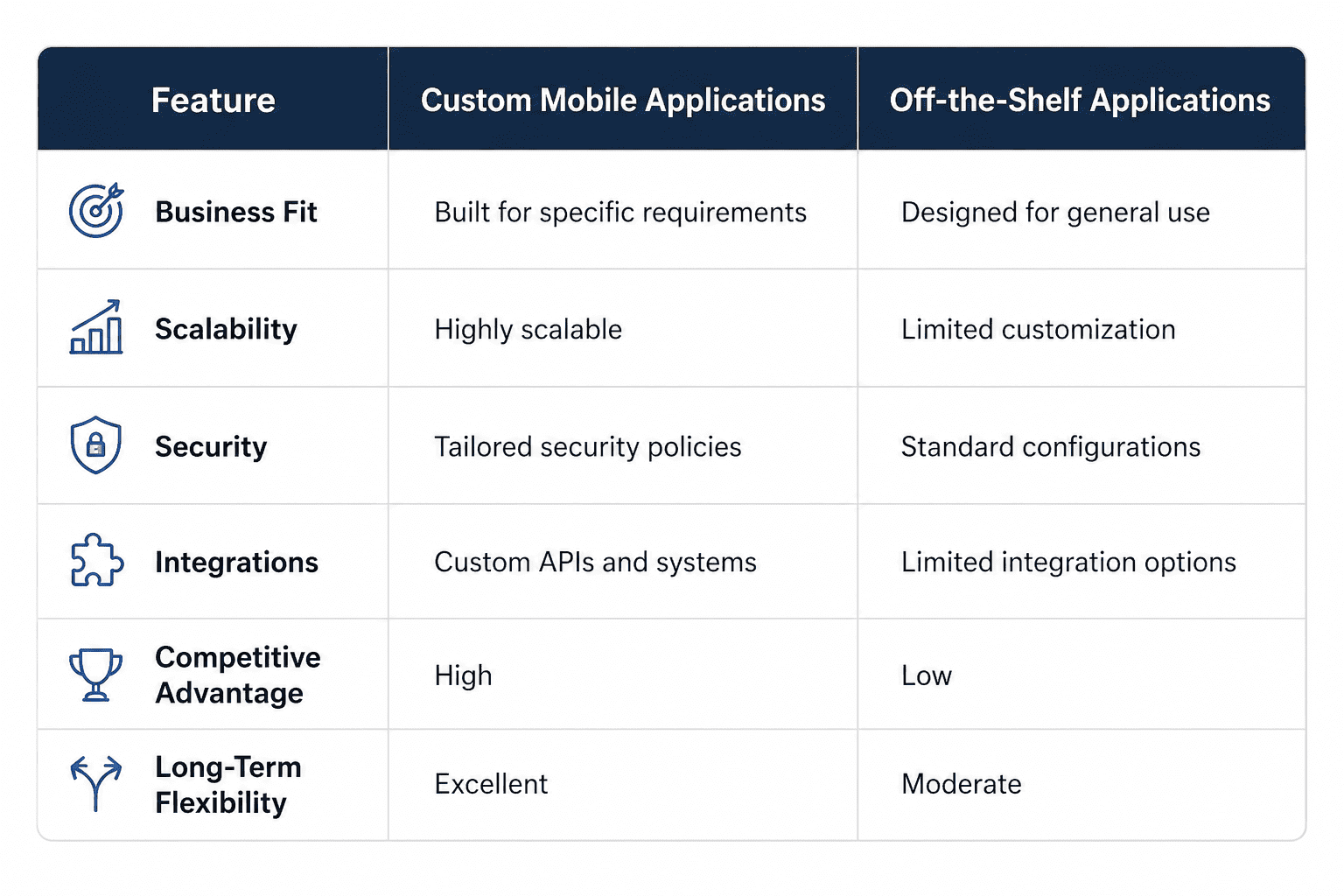
Businesses planning digital transformation initiatives generally achieve greater long-term value through custom mobile applications because they can evolve alongside changing customer expectations and business requirements.
Why Does Choosing the Right Mobile App Development Partner Matter?
Choosing the right mobile app development partner directly influences product quality, customer experience, scalability, and long-term return on investment. While technology frameworks and programming languages are important, the expertise and processes behind development often determine whether a mobile application succeeds after launch.
An experienced development partner helps organizations validate product ideas, reduce technical debt, establish scalable architectures, and deliver software using structured development methodologies. In contrast, selecting an inexperienced provider may result in delayed releases, inconsistent code quality, increased maintenance costs, and security vulnerabilities.
According to the Cloud Native Computing Foundation (CNCF) and SlashData, India is home to approximately 2.25 million cloud-native developers, making it one of the largest engineering communities specializing in Kubernetes, containers, cloud infrastructure, and modern software architectures. This growing expertise enables Indian development companies to build mobile applications capable of supporting long-term business growth. — CNCF & SlashData, 2026
Faster Time-to-Market
Launching a mobile application quickly enables businesses to validate ideas, gather customer feedback, and respond to market opportunities before competitors.
Experienced development teams accelerate delivery by using Agile methodologies, reusable components, automated testing, and continuous integration pipelines.
For example, Shopify Engineering has invested heavily in modular development practices and automated deployment systems to help engineering teams release features more efficiently while maintaining platform reliability. — Shopify Engineering
Better User Experience
A successful mobile application solves user problems through intuitive navigation, responsive interfaces, and consistent performance rather than simply offering numerous features.
Development teams improve user experience by investing in user research, information architecture, accessibility, interface design, and usability testing throughout the development lifecycle.
For example, Duolingo Engineering continuously conducts experimentation and A/B testing to improve onboarding experiences, lesson completion rates, and long-term learner engagement across its mobile applications. — Duolingo Engineering Blog
Scalability From Day One
Scalable mobile applications are designed to support future business growth without requiring significant architectural redesigns.
Building scalability into the initial development process reduces maintenance costs while allowing businesses to introduce new features, support additional users, and integrate emerging technologies more efficiently.
For example, Canva Engineering expanded from a simple online design platform into a global collaboration ecosystem by investing early in scalable cloud infrastructure, modular services, and engineering practices capable of supporting millions of users worldwide. — Canva Engineering
Why Is India a Global Hub for Mobile App Development?
India has become one of the world's leading destinations for mobile app development because of its experienced engineering workforce, mature technology ecosystem, competitive pricing, and ability to deliver software for global businesses. Today, organizations ranging from startups to Fortune 500 enterprises collaborate with Indian software companies to build secure, scalable, and high-performing mobile applications.
Unlike many outsourcing destinations that compete primarily on cost, India's software industry has evolved into a technology ecosystem recognized for cloud-native development, AI integration, DevOps practices, cybersecurity expertise, and cross-platform engineering capabilities.
Access to a Large and Skilled Engineering Workforce
India's technology ecosystem benefits from one of the world's largest communities of software professionals working across mobile development, cloud computing, artificial intelligence, and enterprise software engineering.
According to the Cloud Native Computing Foundation (CNCF) and SlashData, India has approximately 2.25 million cloud-native developers, making it one of the largest global communities building applications using Kubernetes, containers, and modern cloud technologies. — CNCF & SlashData, 2026
This technical diversity enables businesses to find experienced teams specializing in Flutter, Kotlin, Swift, React Native, Node.js, Firebase, AWS, Azure, and Google Cloud Platform.
Cost Efficiency Without Compromising Quality
Competitive pricing remains one of India's strengths, but businesses increasingly choose Indian development partners because of engineering quality, mature delivery processes, and long-term collaboration.
Organizations benefit from:
• Experienced multidisciplinary teams
• Agile development methodologies
• Structured quality assurance processes
• Strong English communication
• Flexible engagement models
• Long-term product support
As a result, businesses can accelerate digital transformation while maintaining high engineering standards and optimizing development budgets.
What Makes a Mobile App Development Company One of the Best in India?
A top mobile app development company combines technical expertise, industry experience, transparent communication, and long-term product support to deliver applications that solve real business problems. While many companies offer similar services, the best development partners distinguish themselves through consistent delivery, engineering excellence, and a structured development process.
Businesses should look beyond attractive portfolios or low pricing when comparing providers. Instead, evaluate whether the company has experience building applications similar to your project, follows proven development methodologies, prioritizes security, and provides post-launch support. These factors have a greater impact on project success than hourly rates alone.
According to the Google Developer Experts (GDE) Program, successful software projects are built by teams that continuously adopt modern engineering practices, optimize performance, and invest in developer expertise rather than relying solely on technology choices. — Google Developer Experts
Strong Technical Expertise
Technical expertise enables development teams to choose the right architecture, programming languages, and frameworks for each project instead of applying the same technology stack to every application.
A capable development company should demonstrate expertise across multiple technologies, including:
• Flutter
• Kotlin
• Swift
• React Native
• Java
• Node.js
• Firebase
• AWS
• Azure
• Google Cloud
For example, Google's Android Developers recommend selecting technologies based on business requirements, performance expectations, maintainability, and long-term scalability rather than following technology trends. A startup building an MVP may benefit from Flutter, while an enterprise banking application may require native Android and iOS development for maximum performance and security. — Android Developers
Industry Experience
Industry expertise helps development teams understand compliance requirements, customer expectations, and operational challenges before writing a single line of code.
For example:
• Healthcare applications require secure handling of patient information and regulatory compliance.
• FinTech platforms prioritize authentication, encryption, and secure payment processing.
• Retail applications focus on seamless shopping experiences, personalization, and digital payments.
• Logistics applications depend on GPS tracking, route optimization, and real-time notifications.
For example, Mayo Clinic's mobile health initiatives demonstrate how healthcare applications must balance intuitive user experiences with strong privacy and security controls. This illustrates why industry knowledge is just as important as technical capability. — Mayo Clinic Platform
Transparent Communication and Agile Delivery
Successful mobile app projects depend on continuous collaboration between stakeholders, designers, developers, and quality assurance teams.
Professional development companies typically adopt Agile methodologies that divide projects into short development cycles, allowing businesses to review progress, prioritize features, and respond to changing requirements throughout the project lifecycle.
According to the Agile Alliance, iterative development improves transparency, reduces project risks, and enables teams to deliver customer value more frequently than traditional development approaches. —Agile Alliance
Businesses should look for development partners that provide:
• Dedicated project managers
• Sprint planning sessions
• Weekly progress reports
• Regular product demonstrations
• Transparent communication channels
These practices improve visibility while reducing misunderstandings during development.
Quality Assurance and Security
Quality assurance ensures a mobile application performs reliably across different devices, operating systems, and network conditions before it reaches users.
Testing should include:
• Functional testing
• Performance testing
• Security testing
• Usability testing
• Compatibility testing
• Regression testing
For example, the OWASP Mobile Application Security Project (MASVS) provides widely recognized best practices for securing mobile applications against common vulnerabilities such as insecure authentication, data leakage, and improper cryptography. Development companies that follow these standards help businesses reduce security risks before deployment. — OWASP MASVS
How Do You Choose the Right Mobile App Development Partner?
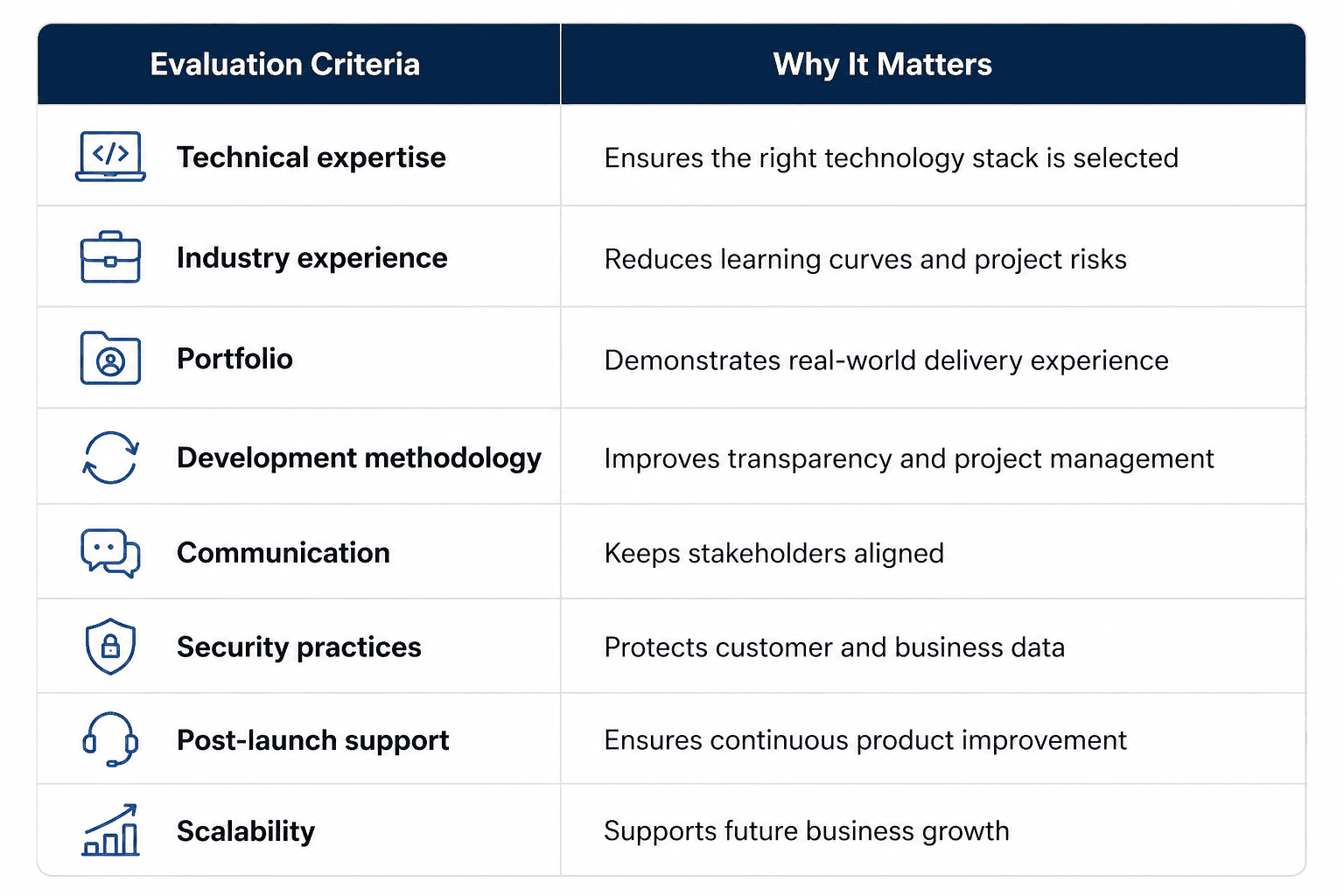
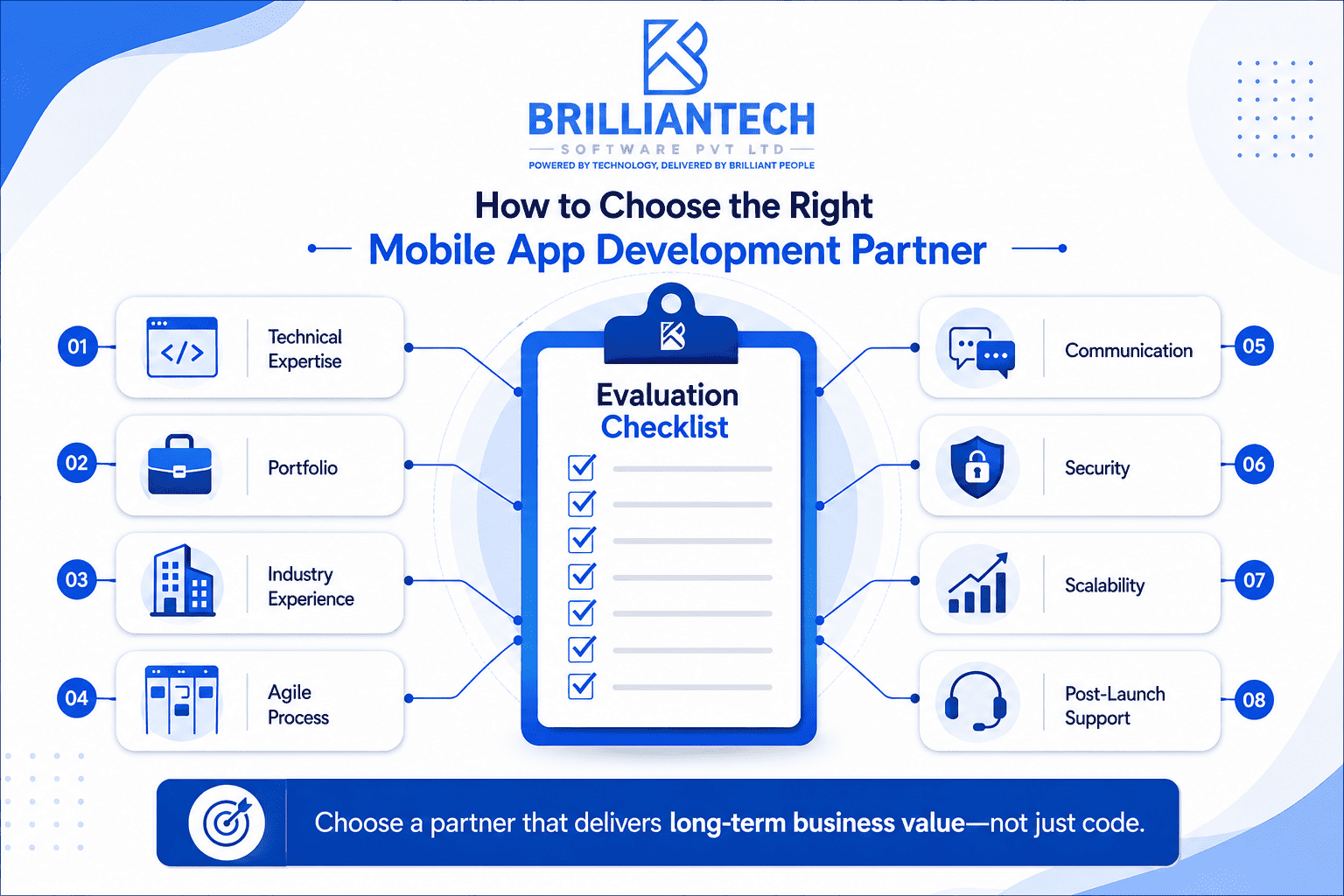
Choosing the right mobile app development partner requires evaluating technical capabilities, business understanding, communication processes, and long-term support rather than comparing pricing alone. The ideal partner should understand your business objectives as well as the technologies required to achieve them.
Instead of asking only "How much will my app cost?", businesses should ask "Can this team successfully deliver and maintain my product over the next several years?"
The following checklist can help simplify the evaluation process.
What Mobile App Development Services Does BrillianTech Offer?
BrillianTech provides end-to-end mobile app development services that help startups, SMBs, and enterprises transform ideas into scalable digital products. Rather than offering isolated development services, BrillianTech supports businesses throughout the complete product lifecycle—from product discovery and UI/UX design to development, deployment, and ongoing maintenance.
Every project follows an agile development methodology that emphasizes collaboration, transparency, and continuous delivery. This approach enables businesses to validate ideas early, prioritize features based on user feedback, and launch products more efficiently.
Core services include:
• Android App Development
• iOS App Development
• Flutter App Development
• React Native Development
• Enterprise Mobile Applications
• MVP Development
• UI/UX Design
• API Integration
• Cloud Integration
• Application Maintenance & Support
Need more than just a mobile app? Explore our Custom Software Development Services to build secure, scalable, and high-performance digital solutions tailored to your business goals.
Android App Development
BrillianTech develops native Android applications using Kotlin and Java, following Google's recommended architecture and development practices.
Native Android applications are ideal for businesses requiring maximum performance, deeper device integration, and long-term platform support.
iOS App Development
BrillianTech builds secure, high-performance iOS applications using Swift while following Apple's Human Interface Guidelines and modern iOS development standards.
Native iOS development is particularly suitable for premium consumer applications, enterprise mobility solutions, and industries with strict performance or security requirements.
Cross-Platform App Development
BrillianTech also develops cross-platform applications using Flutter and React Native, enabling businesses to deploy Android and iOS applications from a shared codebase.
Cross-platform development helps reduce development time, optimize budgets, and maintain a consistent user experience across multiple operating systems without sacrificing scalability.
Which Technologies Does BrillianTech Use to Build Mobile Applications?
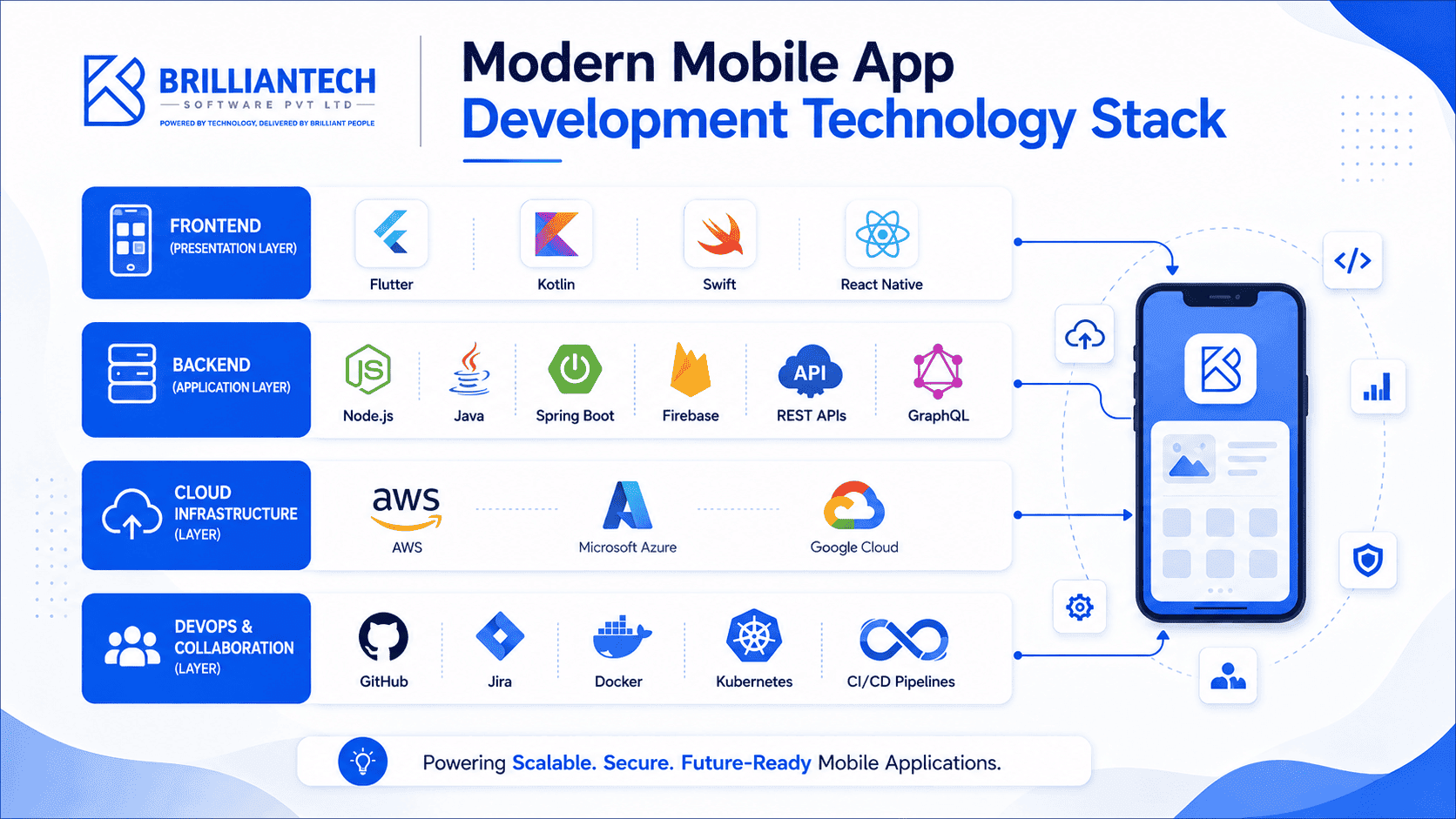
Choosing the right technology stack is one of the most important decisions in mobile app development because it directly affects performance, scalability, security, and long-term maintenance. Instead of relying on a single framework, BrillianTech selects technologies based on business requirements, target users, project complexity, and future growth plans.
A well-planned technology stack enables businesses to launch reliable applications faster while reducing technical debt and simplifying future enhancements.
Frontend Mobile Technologies
Frontend technologies determine how users interact with a mobile application. The right framework influences application performance, responsiveness, maintainability, and development speed.
BrillianTech develops mobile applications using:
• Flutter
• React Native
• Kotlin
• Swift
For example, Google's Flutter team highlights that Flutter enables developers to build high-performance applications for multiple platforms from a single codebase while maintaining a consistent user experience. Businesses launching MVPs or cross-platform products often choose Flutter to reduce development time without compromising quality. — Flutter Documentation & Flutter Blog
Backend and Cloud Technologies
A powerful backend enables mobile applications to process data, authenticate users, integrate third-party services, and support thousands—or even millions—of concurrent users.
BrillianTech uses modern backend technologies such as:
• Node.js
• Java
• Spring Boot
• Firebase
• REST APIs
• GraphQL
For cloud infrastructure and scalability, development teams work with:
• Amazon Web Services (AWS)
• Microsoft Azure
• Google Cloud Platform
For example, Firebase provides real-time databases, authentication, cloud messaging, analytics, and crash reporting that help businesses launch mobile applications more efficiently while simplifying backend management. — Firebase Documentation
Development and Collaboration Tools
Modern application development relies on collaboration and automation as much as programming languages.
BrillianTech uses tools such as:
• Android Studio
• Xcode
• GitHub
• Jira
• Docker
• Kubernetes
These tools improve version control, sprint planning, continuous integration, testing, deployment, and infrastructure management.
According to GitHub's State of Developer Productivity, collaborative development workflows, version control, and automated CI/CD pipelines significantly improve engineering efficiency and software quality. — GitHub Engineering
What Industries Benefit Most from Custom Mobile Apps?
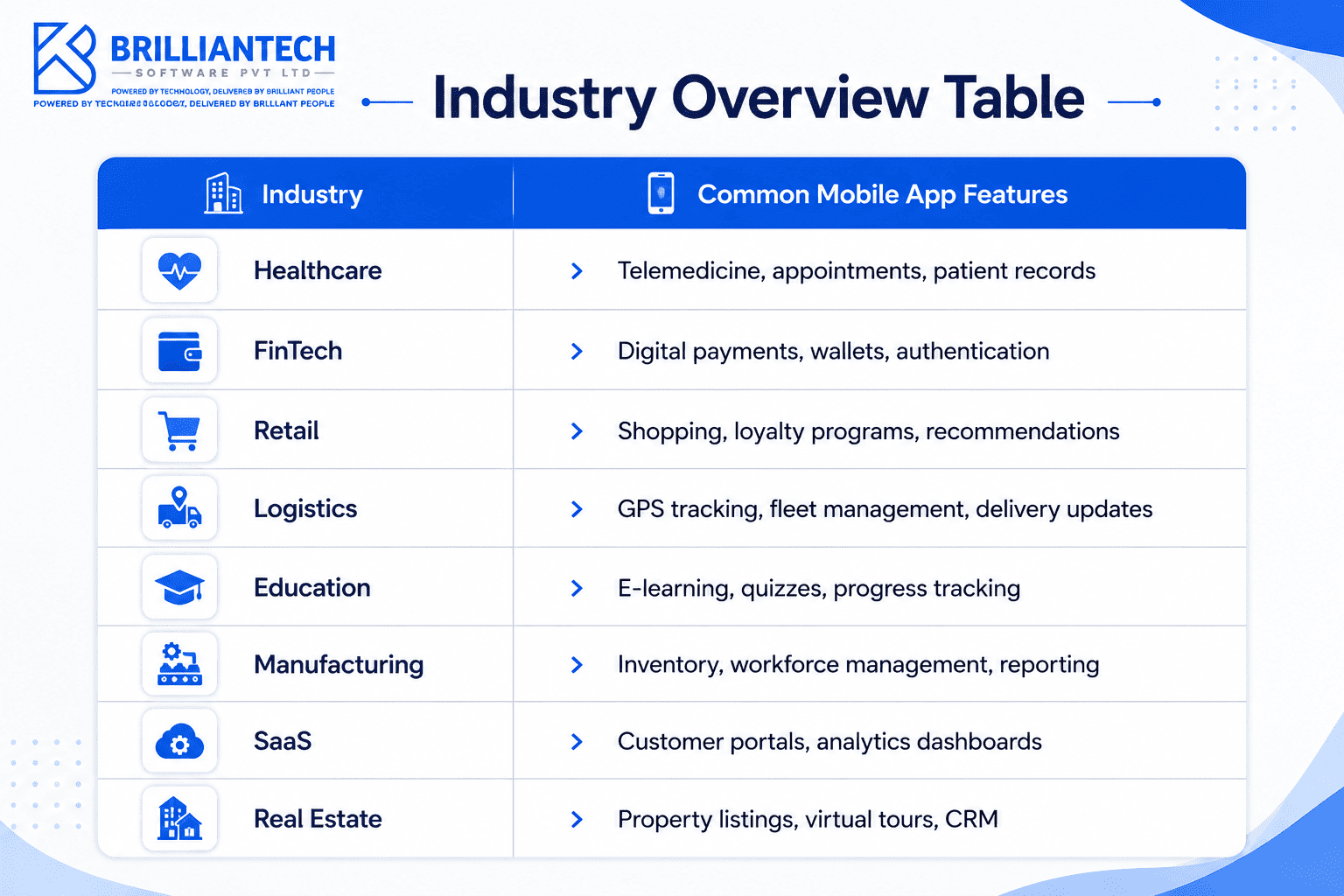
Custom mobile applications help organizations improve customer engagement, automate workflows, and create new digital experiences across nearly every industry. While the core development process remains similar, each industry requires different features, integrations, and compliance considerations.
Healthcare
Healthcare applications enable hospitals, clinics, and healthcare providers to deliver better patient experiences through appointment scheduling, telemedicine, remote monitoring, digital prescriptions, and secure medical records.
For example, Cleveland Clinic's mobile application allows patients to manage appointments, access medical information, and communicate with healthcare professionals through a secure digital platform. — Source: Cleveland Clinic
FinTech
Financial technology applications prioritize security, authentication, digital payments, fraud detection, and real-time financial transactions.
Typical features include:
• Digital wallets
• UPI integration
• Investment platforms
• Expense tracking
• Multi-factor authentication
For example, Wise (formerly TransferWise) focuses on secure international payments supported by intuitive mobile experiences and scalable infrastructure. — Wise Engineering
Retail & E-commerce
Retail businesses use mobile applications to improve shopping experiences, increase customer retention, and personalize marketing campaigns.
Popular features include:
• Product search
• Personalized recommendations
• Digital payments
• Loyalty programs
• Order tracking
• Push notifications
For example, Nike's mobile ecosystem combines personalized shopping, membership rewards, exclusive product launches, and digital experiences that strengthen customer engagement beyond traditional e-commerce. — Nike News
Logistics & Transportation
Mobile applications simplify fleet management, route optimization, shipment tracking, warehouse operations, and proof-of-delivery processes.
Real-time GPS tracking and automated notifications improve operational efficiency while enhancing customer satisfaction.
Education
Educational applications support online learning, assessments, live classes, progress tracking, and collaboration between students and instructors.
Platforms like Khan Academy demonstrate how mobile learning applications increase accessibility and encourage continuous learning through intuitive interfaces and personalized experiences. — Khan Academy
How Much Does Mobile App Development Cost in India?
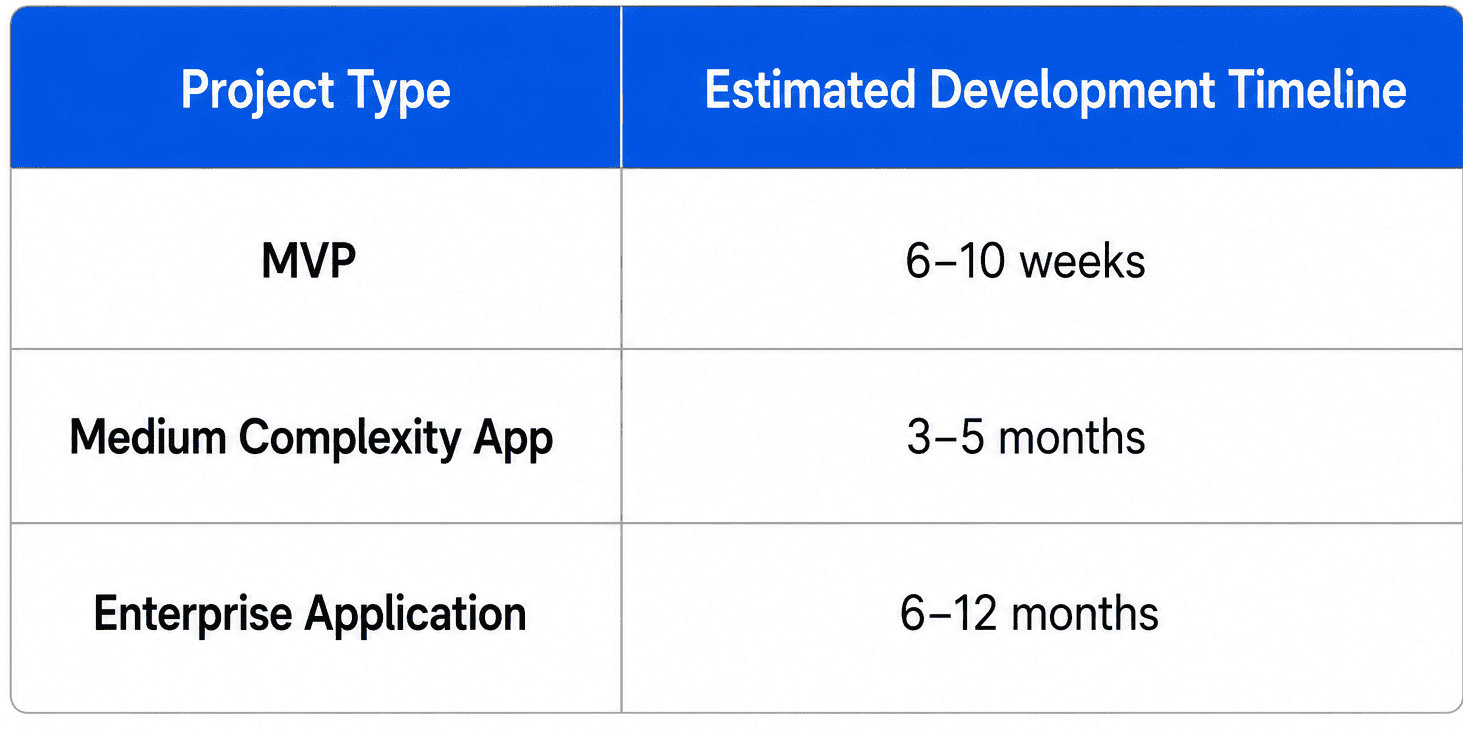
The cost of mobile app development in India depends on application complexity, platform selection, feature requirements, integrations, and development timelines. There is no fixed price because every project has different business objectives and technical requirements.
A simple MVP typically requires fewer development hours than an enterprise application with advanced integrations, analytics, payment gateways, and cloud infrastructure.
Instead of focusing only on development costs, businesses should evaluate the total cost of ownership, including maintenance, infrastructure, future feature development, security updates, and long-term scalability.
Factors That Influence Development Cost
Development costs are primarily influenced by:
• Number of application features
• Android, iOS, or cross-platform development
• UI/UX complexity
• Backend infrastructure
• Third-party integrations
• Security requirements
• Cloud architecture
• Testing and quality assurance
• Post-launch maintenance
Choosing an experienced development partner often reduces long-term costs by minimizing technical debt and future redevelopment efforts.
How Long Does It Take to Develop a Mobile Application?
Most custom mobile applications require between two and twelve months to develop, depending on project complexity, feature scope, and development methodology. Agile development allows businesses to release products incrementally rather than waiting for every feature to be completed.
A typical development process includes:
1. Discovery & Planning
2. Wireframing & UI/UX Design
3. Application Development
4. Testing & Quality Assurance
5. Deployment
6. Continuous Improvement
For startups, launching a Minimum Viable Product (MVP) first enables faster market validation while reducing initial investment.
Should You Choose Native or Cross-Platform App Development?
The choice between native and cross-platform development depends on your business goals, budget, performance requirements, and long-term product strategy. Neither approach is universally better; the right option depends on the specific needs of your application.
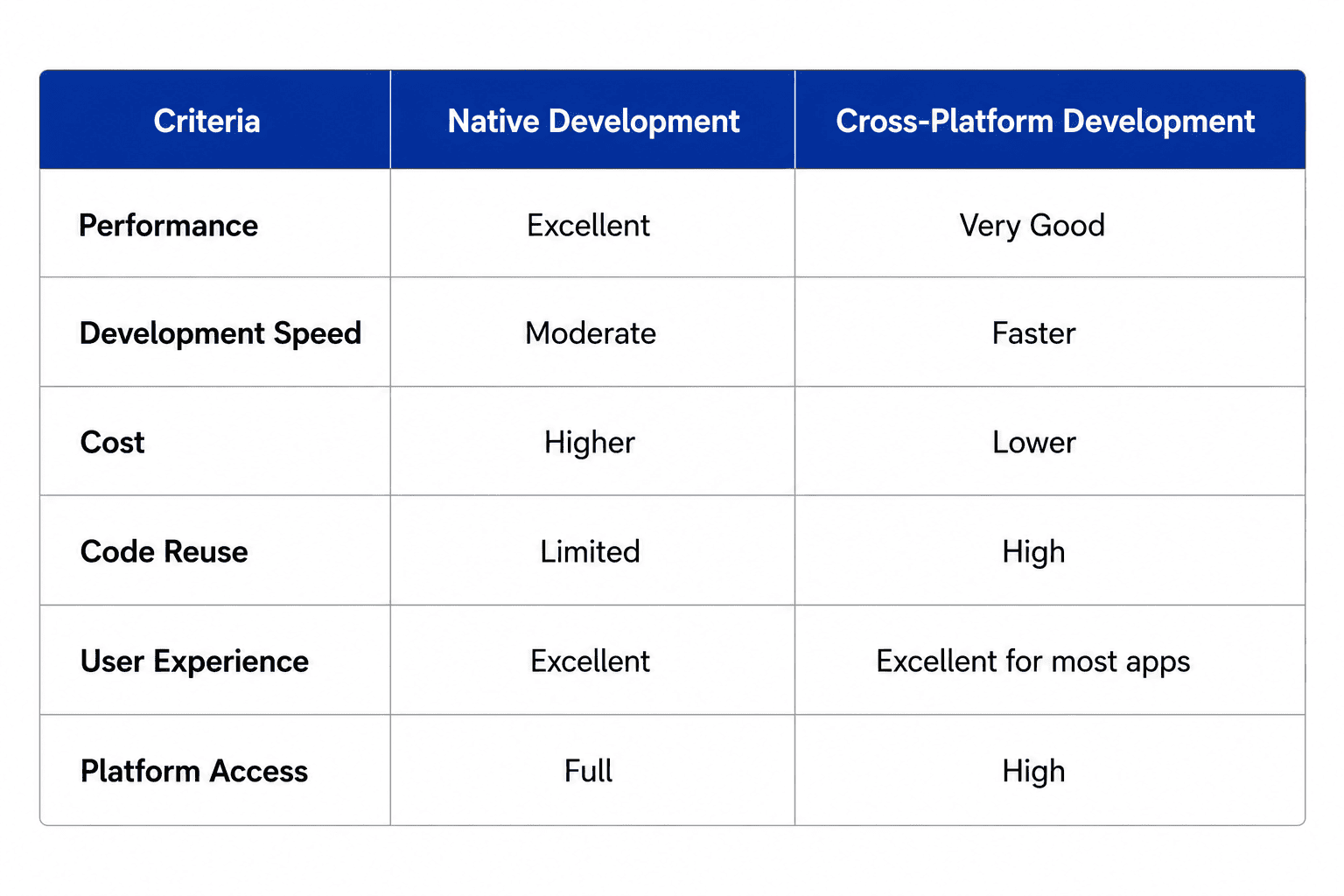
Native development using Swift and Kotlin is ideal for applications requiring maximum performance and deep hardware integration. Cross-platform development with Flutter or React Native is often the preferred choice for startups and businesses looking to accelerate time-to-market while managing development costs.
What Happens After Your Mobile App Is Launched?
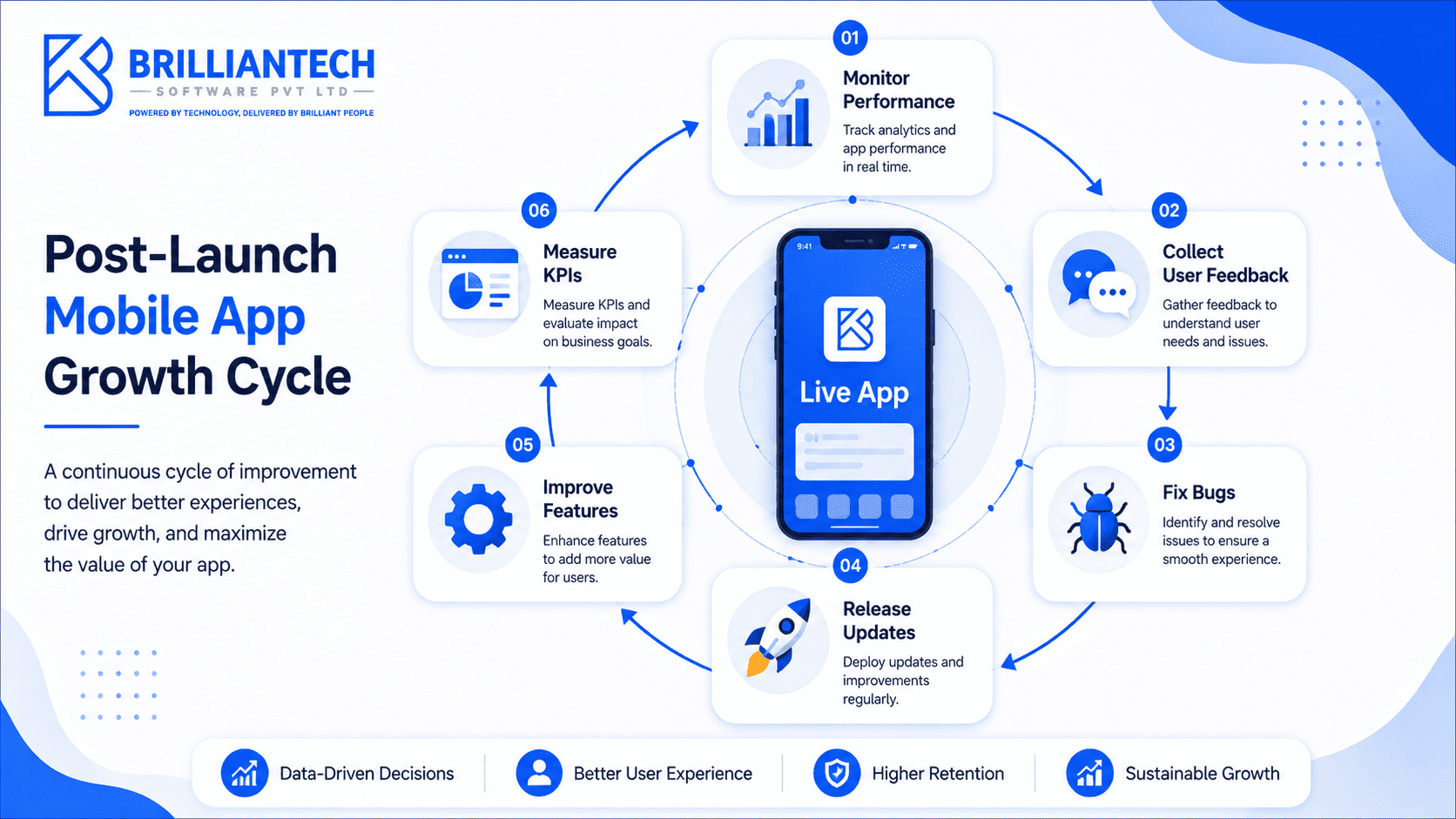
Launching a mobile application is not the end of the development journey—it's the beginning of continuous improvement. The most successful apps evolve based on user feedback, performance analytics, security updates, and changing business requirements.
After launch, businesses should focus on monitoring performance, improving user engagement, and regularly introducing new features to remain competitive.
Key post-launch activities include:
• Performance monitoring
• Crash reporting and bug fixes
• Security updates
• OS compatibility updates
• Feature enhancements
• User feedback analysis
• Analytics and KPI tracking
• App Store Optimization (ASO)
For example, Duolingo releases frequent updates based on user behavior, A/B testing, and learning analytics. Continuous iteration has played a major role in improving user retention and engagement over time. — Duolingo Engineering
Mobile App Maintenance
Regular maintenance ensures applications remain secure, reliable, and compatible with evolving Android and iOS operating systems.
Maintenance services typically include:
• Bug fixing
• Performance optimization
• Security patching
• Cloud infrastructure monitoring
• API updates
• Database optimization
• Third-party SDK updates
Ignoring maintenance can lead to reduced performance, security vulnerabilities, and poor user experiences.
Measuring Application Success
Businesses should monitor key performance indicators (KPIs) after launch to evaluate whether the application is achieving its objectives.
Common mobile app KPIs include:
• Downloads
• Monthly Active Users (MAU)
• Daily Active Users (DAU)
• User Retention Rate
• Session Duration
• Customer Lifetime Value (CLV)
• Crash Rate
• App Store Ratings
• Conversion Rate
Using analytics platforms such as Firebase Analytics or Google Analytics 4 helps teams identify user behavior patterns and prioritize future improvements.
Why Choose BrillianTech for Mobile App Development?
Selecting a development partner is about more than technical expertise—it's about choosing a team that understands your business goals and can deliver scalable, future-ready solutions.
At BrillianTech, we combine strategic consulting, UI/UX design, software engineering, quality assurance, and post-launch support to help businesses build mobile applications that deliver measurable business value.
Why businesses partner with BrillianTech:
• Experienced Android, iOS, Flutter, and React Native developers
• Agile development methodology with transparent communication
• Scalable cloud-native architecture
• Security-first development approach
• End-to-end development from discovery to maintenance
• Flexible engagement models for startups, SMBs, and enterprises
• Dedicated post-launch support and continuous improvements
Whether you're building an MVP, modernizing an existing application, or developing an enterprise-grade solution, our team focuses on creating mobile experiences that are reliable, scalable, and aligned with your long-term business objectives.
Looking for more than just mobile app development? Explore our Mobile App Development Services, Custom Software Development, AI Development Services, and Staff Augmentation Services to discover how BrillianTech helps businesses build scalable, intelligent, and future-ready digital solutions. If you're ready to discuss your project, Contact Us for a free consultation.
Conclusion
Choosing the top mobile app developers in India is about more than comparing portfolios, hourly rates, or technology stacks. The right development partner should understand your business objectives, recommend the most suitable technologies, and deliver secure, scalable, and user-centric mobile applications that support long-term growth.
Throughout this guide, we've explored what mobile app development companies do, why India has become a global technology hub, the qualities that define an exceptional development partner, and the factors that influence project success—from selecting the right technology stack to estimating development costs and timelines. These insights can help businesses make informed decisions and minimize the risks associated with mobile app development.
Whether you're building a startup MVP, modernizing an enterprise application, or launching a customer-facing mobile platform, investing in the right development partner can significantly improve your project's success. A collaborative team, a well-defined development process, and ongoing post-launch support are just as important as the technology itself.
At BrillianTech, we combine technical expertise, agile development methodologies, and a business-first approach to build mobile applications that are secure, scalable, and designed for long-term success. From strategy and UI/UX design to development, deployment, and continuous maintenance, our team works closely with clients to transform innovative ideas into high-performing digital products.
If you're ready to build your next mobile application, contact BrillianTech today to discuss your requirements and discover how our experienced developers can help bring your vision to life.