
Introduction
Launching a new application quickly has become a competitive necessity rather than just a business goal. However, rushing development without the right process often leads to missed deadlines, quality issues, budget overruns, and products that fail to meet customer expectations. In this guide, you'll learn how Agile app development enables faster software delivery, why it has become the preferred development methodology for modern businesses, and the best practices that help organizations launch high-quality applications faster.
Whether you're a startup building your first MVP, an enterprise modernizing legacy systems, or a product manager looking to accelerate release cycles, understanding Agile can help you reduce development risks while delivering greater value to users.
Key Takeaways
• Agile app development delivers software through short, iterative development cycles, enabling faster releases and continuous improvement.
• Sprint planning, continuous integration, and automated testing help development teams reduce delivery time while maintaining software quality.
• Customer feedback throughout development ensures applications remain aligned with business goals and evolving user expectations.
• Cross-functional collaboration improves communication, reduces bottlenecks, and accelerates software delivery.
• DevOps practices and CI/CD pipelines automate testing and deployment, making software releases faster, safer, and more reliable.
• Choosing an experienced Agile development partner helps businesses improve transparency, scalability, and long-term project success.
What Is Faster App Delivery with Agile?
Faster app delivery with Agile is an iterative software development approach that enables teams to build, test, and release applications through short development cycles, continuous feedback, and incremental improvements. Instead of waiting months to launch a fully completed application, Agile focuses on delivering working software in small, manageable releases that can be improved continuously based on real user feedback.
Traditional software development often follows a linear process where planning, design, development, testing, and deployment happen sequentially. While this approach can work for stable projects with fixed requirements, it struggles to adapt when business priorities or customer expectations change during development.
Agile takes a fundamentally different approach.
Instead of treating software development as one large project, Agile divides work into smaller iterations called sprints, typically lasting one to four weeks. Each sprint produces a working version of the application that stakeholders can review, test, and improve before the next iteration begins.
This iterative model helps businesses reduce development risks, shorten release cycles, and respond quickly to changing market demands.
According to the 17th State of Agile Report, organizations continue to adopt Agile because it improves collaboration, accelerates delivery, and enables faster responses to changing business priorities.
What Does "Faster Delivery" Actually Mean?
Many organizations assume faster delivery simply means writing code more quickly. In reality, faster delivery means delivering business value sooner—not rushing development.
Agile achieves this by prioritizing high-impact features, removing unnecessary delays, automating repetitive tasks, and encouraging continuous collaboration between developers, testers, designers, and stakeholders.
For example, imagine a fintech startup developing a digital payment application. Rather than spending eight months building every planned feature, the team first launches a secure MVP with user registration, wallet functionality, and payment processing. After collecting customer feedback, they gradually introduce additional features such as budgeting tools, rewards, and investment options.
By releasing a usable product earlier, the company begins acquiring customers, generating revenue, and validating product ideas months ahead of a traditional development schedule.
Faster app delivery with Agile involves prioritizing high-value features, planning short sprints, automating testing, and continuously deploying working software to users.
Agile vs Traditional Software Development
One of the easiest ways to understand Agile is by comparing it with traditional software development methodologies.
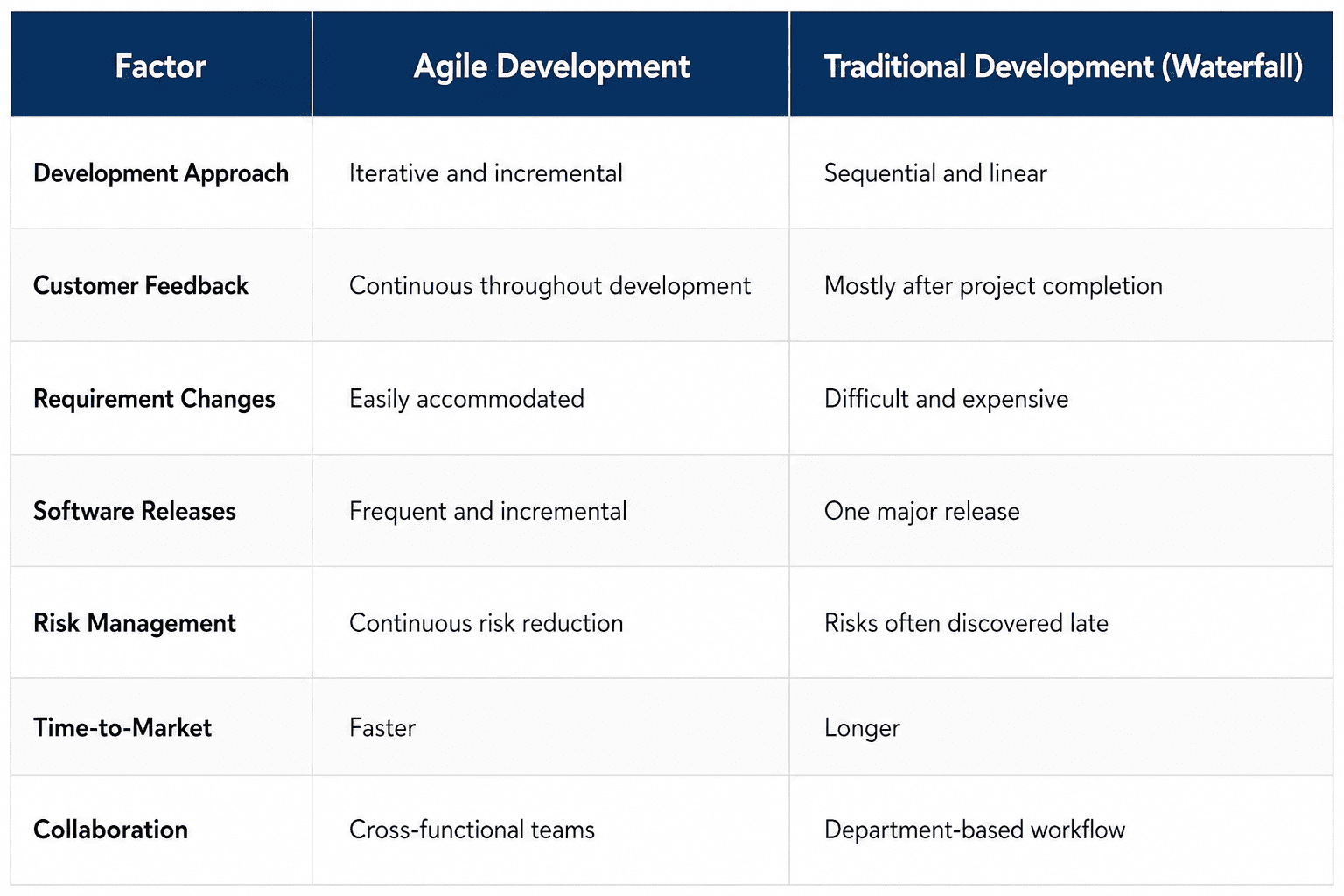
Unlike Waterfall development, Agile allows businesses to respond to customer feedback without restarting entire projects.
This flexibility is particularly valuable for startups, SaaS companies, healthcare providers, fintech organizations, and enterprises operating in rapidly changing markets.
Why Businesses Are Moving Toward Agile Development
Software has become one of the biggest drivers of competitive advantage.
Customers expect frequent updates, seamless digital experiences, and rapid feature improvements. Businesses that cannot deliver software quickly often lose opportunities to faster-moving competitors.
Agile helps organizations overcome this challenge by enabling:
• Faster product launches
• Continuous feature releases
• Better collaboration
• Reduced project risks
• Improved customer satisfaction
• Greater adaptability
• Faster return on investment
According to the Project Management Institute (PMI), organizations using Agile practices report higher project success rates because Agile improves stakeholder engagement, team collaboration, and responsiveness to changing business needs.
For example, leading technology companies such as Spotify, Amazon, and Netflix rely heavily on Agile principles to deliver continuous updates, experiment with new features, and improve customer experiences without disrupting existing services.
If you're planning to build a scalable digital product, explore our Web Application Development Services to learn how we design and develop secure, high-performance web applications tailored to your business needs.
Why Does Agile Matter for Modern App Development?
Agile matters because it enables businesses to deliver software faster while maintaining quality, reducing development risks, and continuously adapting to customer needs. In today's digital economy, where user expectations and market conditions evolve rapidly, organizations can no longer afford development cycles that take a year or more before delivering value.
Whether you're launching a mobile application, SaaS platform, enterprise solution, or AI-powered product, speed alone is not enough. Businesses also need flexibility, collaboration, and continuous improvement—all of which are built into Agile methodologies.
Reduced Time-to-Market
One of the biggest advantages of Agile is its ability to shorten development cycles.
Rather than waiting until every feature is completed, Agile teams release working software incrementally. This allows businesses to launch an MVP, gather customer feedback, and begin generating revenue much sooner.
For example, an eCommerce startup can launch a basic shopping application with product listings, checkout, and payment functionality before adding advanced features such as AI recommendations, loyalty programs, and personalized marketing.
This phased approach reduces delays while allowing development priorities to evolve based on actual customer behavior.
Better Product Quality
Contrary to popular belief, faster delivery does not mean compromising quality.
Agile integrates testing throughout the development lifecycle rather than leaving quality assurance until the end of the project. Developers, testers, and product owners collaborate continuously to identify issues early, reducing costly rework later.
Modern Agile teams also combine:
• Automated testing
• Continuous Integration (CI)
• Continuous Delivery (CD)
• Code reviews
• Sprint demonstrations
• User acceptance testing
These practices significantly improve software reliability while maintaining rapid release cycles
Delivering software faster doesn't mean sacrificing quality. Explore our Quality Assurance Testing Services to see how comprehensive testing helps ensure every release is secure, reliable, and bug-free.
Greater Business Agility
Markets change faster than ever before. Customer expectations evolve, competitors release new products, and technologies continue to advance.
Agile enables businesses to respond to these changes without disrupting ongoing development.
Instead of treating change as a project risk, Agile embraces it as an opportunity to improve products continuously.
For example, if customer feedback reveals demand for a new payment option or AI-powered feature, Agile teams can prioritize that functionality in the next sprint rather than waiting for the next major software release.
This adaptability is one of the primary reasons Agile has become the preferred software development methodology for startups, scale-ups, and global enterprises alike.
Improved Collaboration and Transparency
Successful software development requires close collaboration between business stakeholders, developers, designers, testers, and product owners.
Agile promotes transparent communication through daily stand-ups, sprint planning sessions, backlog refinement, sprint reviews, and retrospectives. These practices ensure that everyone remains aligned on project goals, priorities, and progress.
Rather than discovering problems months later, teams identify and resolve challenges early, reducing delays and improving project outcomes.
What Are the Core Principles of Agile Software Development?
Agile software development is built on a set of principles that prioritize collaboration, adaptability, continuous improvement, and delivering working software in short, iterative cycles. Instead of following rigid project plans, Agile enables teams to respond quickly to changing business needs while maintaining high product quality and customer satisfaction. These principles form the foundation of faster app delivery and help organizations reduce development risks without compromising innovation.
According to the 17th State of Agile Report, improving collaboration, accelerating software delivery, and responding to changing priorities remain among the primary reasons organizations adopt Agile methodologies. — Digital.ai State of Agile Report, 2024
Customer Collaboration Over Contract Negotiation
Customer collaboration is a core Agile principle that keeps stakeholders involved throughout the development lifecycle. Instead of collecting requirements once and building in isolation, Agile teams continuously gather feedback to ensure the application evolves according to real business and user needs.
For example, a healthcare startup developing a telemedicine platform may initially prioritize appointment scheduling and video consultations. After the first sprint, user feedback might reveal that prescription management is a higher priority than originally planned. Agile allows the team to adjust the product backlog and deliver the most valuable features first.
This collaborative approach minimizes costly rework and increases the likelihood of building a product that users actually want.
Iterative Development and Incremental Releases
Iterative development enables teams to deliver software in small, manageable increments rather than waiting for a single large release. Each sprint produces a functional version of the application, allowing stakeholders to review progress, validate assumptions, and recommend improvements.
For example, instead of waiting six months to launch a food delivery application, an Agile team might first release user registration, restaurant listings, and online ordering. Additional capabilities such as live order tracking, loyalty rewards, and AI-powered recommendations can then be introduced in future sprints.
This incremental delivery model reduces project risk while helping businesses reach the market much faster.
Cross-Functional Teams Improve Delivery Speed
Cross-functional teams bring together developers, designers, testers, DevOps engineers, and product owners to work collaboratively toward a shared objective. Eliminating departmental silos improves communication, reduces bottlenecks, and accelerates decision-making.
Rather than waiting for work to move sequentially between departments, Agile teams solve problems together throughout each sprint. This collaborative structure shortens development cycles while improving software quality and accountability.
Looking to build a dedicated Agile team? Explore our Dedicated Development Team Services to learn how cross-functional experts can accelerate software delivery while maintaining quality.
Continuous Improvement Through Retrospectives
Continuous improvement ensures Agile teams become more efficient after every sprint. At the end of each iteration, the team reviews what worked well, identifies challenges, and defines actions for future improvement.
Retrospectives encourage learning, strengthen collaboration, and eliminate recurring bottlenecks. Over time, these incremental improvements lead to higher productivity, faster delivery, and better customer outcomes.
Successful Agile application development relies on cross-functional collaboration, transparent communication, customer feedback, and continuous improvement throughout the software lifecycle.
How Does the Agile App Development Process Work?
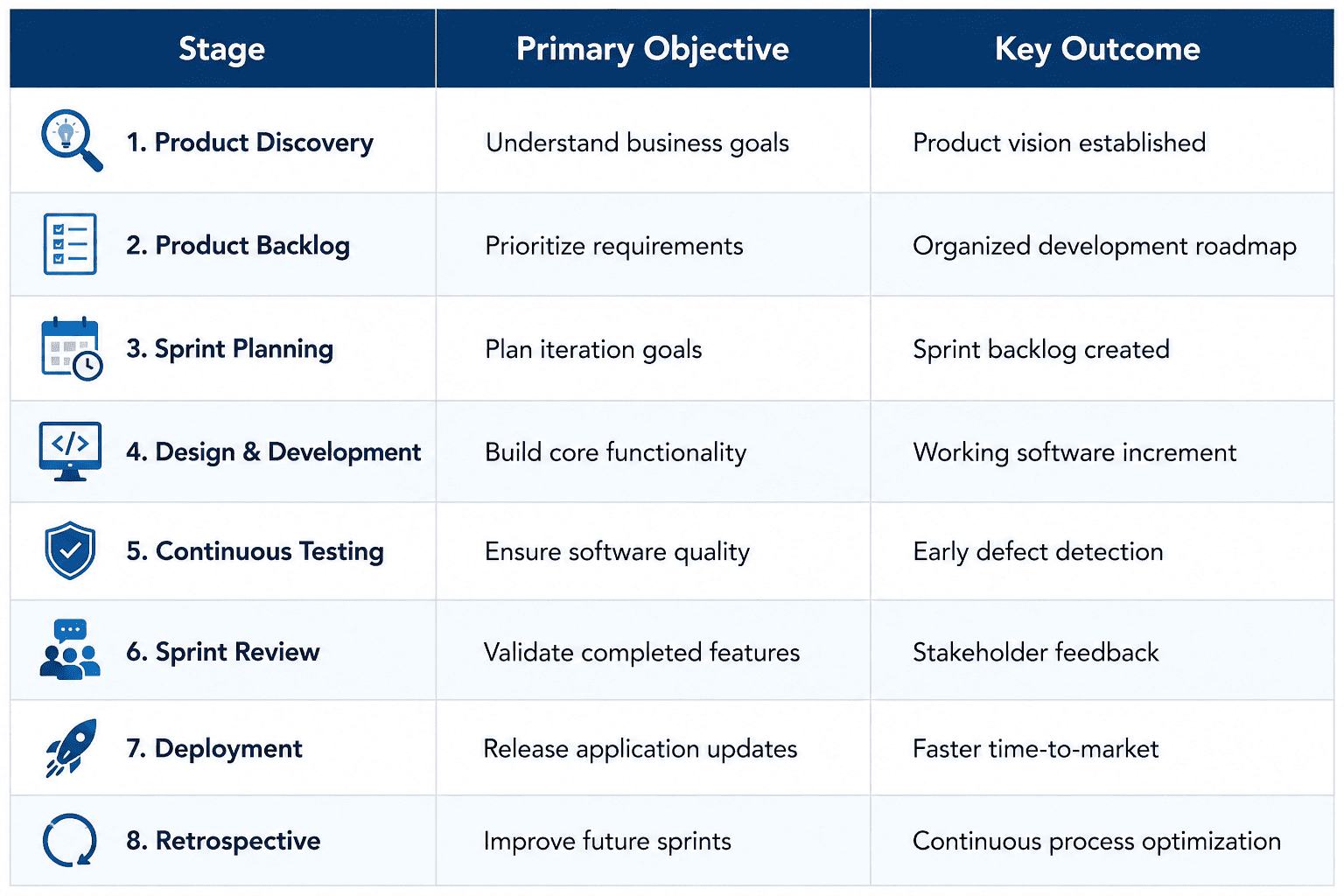
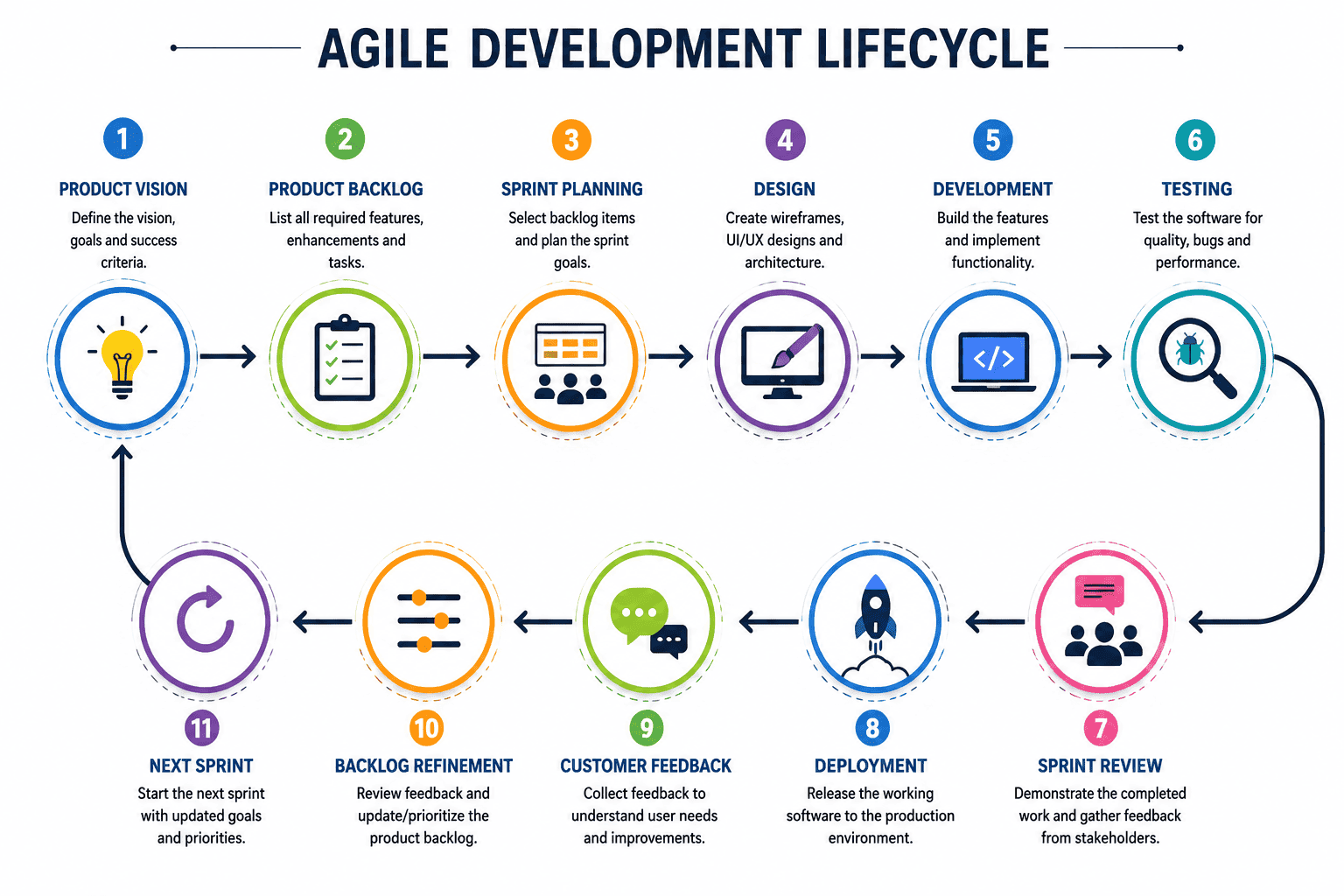
The Agile app development process follows an iterative lifecycle where planning, development, testing, deployment, and customer feedback occur continuously rather than sequentially. This structured workflow enables businesses to release software faster while adapting to changing requirements throughout the project.
Unlike traditional development models, Agile treats software as an evolving product rather than a one-time project. Every sprint delivers working functionality that brings measurable business value.
Step 1: Requirement Discovery and Product Vision
Every successful Agile project begins with understanding the business problem.
During discovery sessions, stakeholders, product owners, and development teams define:
• Business objectives
• Target users
• Core challenges
• Success metrics
• Technical requirements
Rather than documenting every future feature, Agile focuses on defining a clear product vision that can evolve over time.
Step 2: Create and Prioritize the Product Backlog
A product backlog is a prioritized list of features, enhancements, bug fixes, and technical tasks that guide Agile development. Product owners continuously refine this backlog based on business priorities, customer feedback, and technical dependencies.
Common prioritization techniques include:
• MoSCoW Method
• Value vs. Effort Matrix
• Weighted Shortest Job First (WSJF)
• Customer Impact Scoring
Maintaining a well-organized backlog ensures teams always work on the features that deliver the greatest business value.
Step 3: Sprint Planning
Sprint planning determines what the team will deliver during the upcoming iteration, typically lasting one to four weeks.
During this meeting, teams:
• Select backlog items
• Estimate development effort
• Define sprint goals
• Allocate responsibilities
• Identify potential risks
Clear sprint planning reduces uncertainty and keeps everyone aligned throughout development.
Step 4: Design, Development, and Continuous Testing
Once sprint planning is complete, development begins.
Unlike traditional projects where testing occurs only after coding is finished, Agile integrates quality assurance into every sprint.
Development activities typically include:
• UI/UX design
• Front-end development
• Back-end development
• API integration
• Automated testing
• Code reviews
• Performance testing
Testing throughout development reduces defects, improves software stability, and prevents expensive late-stage fixes.
Delivering software faster doesn't mean sacrificing quality. Explore our Quality Assurance Testing Services to see how comprehensive testing helps ensure every release is secure, reliable, and bug-free.
Step 5: Sprint Review and Customer Feedback
At the end of each sprint, the team demonstrates completed functionality to stakeholders.
This review enables businesses to:
• Validate new features
• Collect customer feedback
• Identify improvement opportunities
• Adjust priorities before the next sprint
Continuous stakeholder involvement ensures the final product remains aligned with business objectives instead of outdated assumptions.
Step 6: Deployment and Continuous Improvement
After successful testing and approval, new functionality is deployed to production or a staging environment.
Modern Agile teams typically combine deployment with:
• Continuous Integration (CI)
• Continuous Delivery (CD)
• Automated monitoring
• Performance analytics
• Customer feedback collection
This continuous release cycle allows organizations to introduce improvements regularly rather than waiting months for major software updates.
Agile App Development Lifecycle
Which Agile Practices Help Teams Deliver Apps Faster?
Agile practices help teams deliver applications faster by improving collaboration, prioritizing high-value work, automating repetitive processes, and continuously delivering working software. Rather than focusing solely on speed, Agile emphasizes delivering the right features at the right time while maintaining quality and reducing development risks.
Organizations that consistently release successful software don't rely on a single Agile practice. Instead, they combine multiple frameworks, engineering practices, and collaboration techniques to create an efficient and predictable development workflow.
Prioritize Minimum Viable Product (MVP) Development
An MVP (Minimum Viable Product) is the simplest version of an application that delivers core functionality to early users. Building an MVP first allows businesses to validate ideas quickly, collect real-world feedback, and reduce unnecessary development costs.
For example, a startup launching a fitness application might initially release workout tracking, user registration, and progress analytics. Advanced features like AI coaching, wearable integrations, and nutrition planning can be introduced after validating market demand.
Benefits of MVP development include:
• Faster product launches
• Lower development costs
• Early customer validation
• Reduced business risk
• Continuous product improvement
Maintain a Well-Refined Product Backlog
A refined product backlog ensures development teams always work on the highest-value features first. Regular backlog grooming prevents outdated requirements from slowing progress and helps product owners adapt priorities based on business goals and customer feedback.
Effective backlog management includes:
• Removing obsolete tasks
• Breaking large features into smaller user stories
• Reprioritizing based on business value
• Clarifying acceptance criteria
• Estimating development effort
A healthy backlog enables smoother sprint planning and minimizes development delays.
Conduct Daily Stand-Up Meetings
Daily stand-ups are short team meetings that improve communication, identify blockers, and keep everyone aligned on sprint goals. Typically lasting no more than 15 minutes, these meetings help Agile teams maintain momentum without disrupting productivity.
Each team member answers three questions:
1. What did I complete yesterday?
2. What am I working on today?
3. Are there any blockers?
This simple practice improves transparency, accountability, and collaboration across cross-functional teams.
Monitor Sprint Velocity
Sprint velocity measures how much work a team completes during each sprint. Tracking velocity helps organizations estimate future delivery timelines, improve planning accuracy, and identify opportunities for process optimization.
Rather than encouraging teams to work faster, sprint velocity provides valuable insights into team capacity and sustainable delivery pace.
Businesses should use velocity trends to:
• Improve sprint forecasting
• Balance workloads
• Identify recurring bottlenecks
• Optimize resource allocation
Encourage Continuous Stakeholder Feedback
Continuous feedback ensures software evolves according to business and customer expectations rather than assumptions. Agile teams regularly demonstrate completed functionality during sprint reviews, enabling stakeholders to validate progress before the next iteration begins.
Early feedback reduces expensive rework while increasing customer satisfaction and product-market fit.
Discover how our Custom Software Development Services help businesses build scalable applications using Agile methodologies and continuous customer collaboration.
How Do DevOps and CI/CD Support Agile App Delivery?
DevOps and CI/CD extend Agile by automating software integration, testing, deployment, and monitoring, enabling teams to release applications faster with greater reliability. While Agile improves collaboration and planning, DevOps accelerates the technical delivery process through automation and continuous improvement.
Continuous Integration and Continuous Delivery (CI/CD) complement Agile by automating code integration, testing, and deployment, enabling faster and more reliable software releases.
Continuous Integration (CI)
Continuous Integration is the practice of automatically integrating new code into a shared repository several times a day. Automated builds and testing quickly identify issues before they impact the application.
Key benefits include:
• Faster bug detection
• Improved code quality
• Reduced merge conflicts
• Higher developer productivity
Continuous Delivery (CD)
Continuous Delivery automates the release process, ensuring software is always ready for deployment. Every successful build passes through automated testing, making deployments faster and more predictable.
Organizations adopting Continuous Delivery experience:
• Shorter release cycles
• Lower deployment risks
• Improved release consistency
• Faster customer feedback
Why DevOps Complements Agile
Agile defines how teams build software, while DevOps defines how software reaches users efficiently.
Together they enable:
• Automated deployments
• Infrastructure as Code (IaC)
• Cloud scalability
• Continuous monitoring
• Rapid incident recovery
• Frequent software releases
Learn how our DevOps Consulting Services help businesses automate software delivery, improve deployment reliability, and accelerate digital transformation.
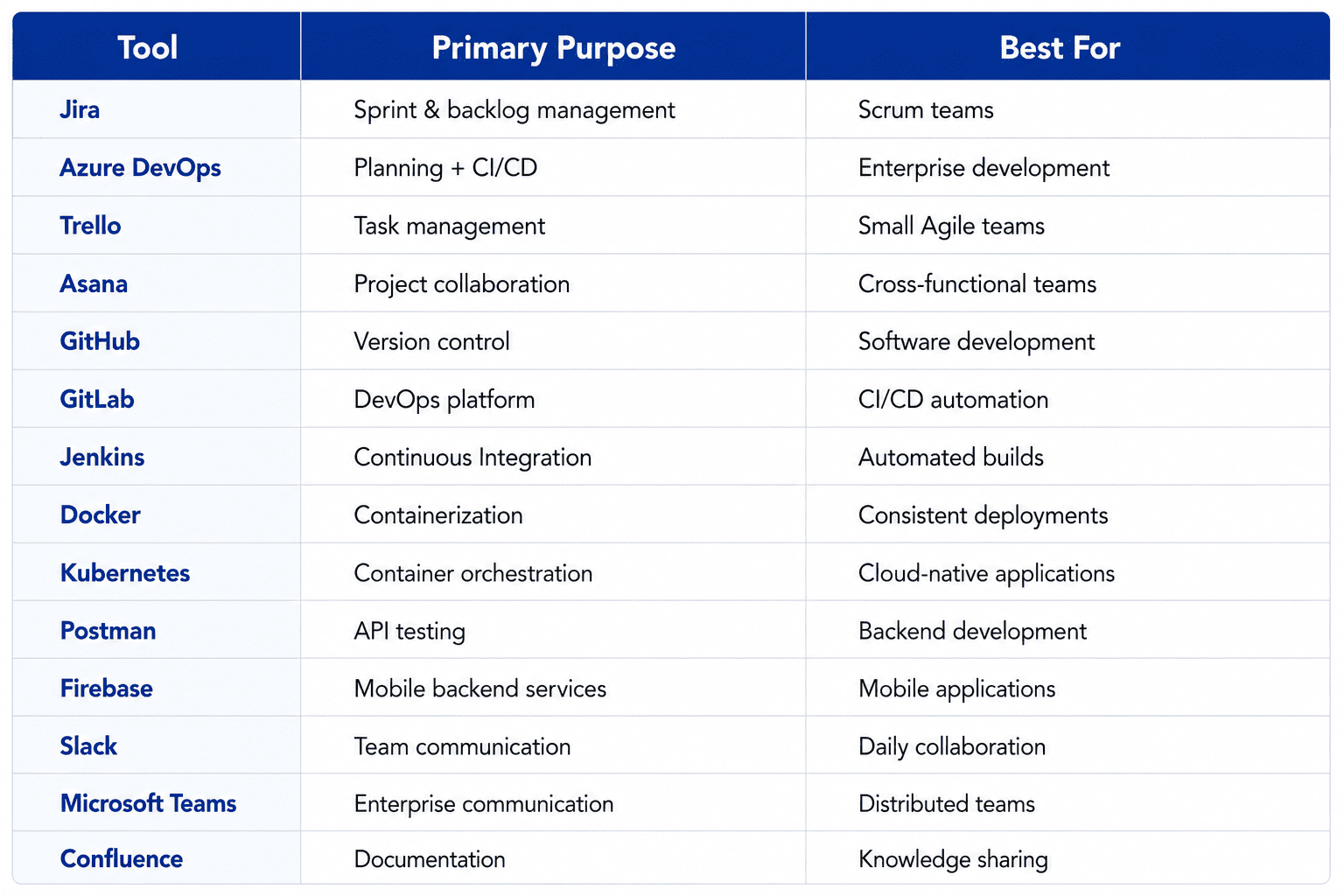
Which Tools Are Best for Agile Application Development?
Agile development tools improve collaboration, project visibility, automation, and release management throughout the software lifecycle. Selecting the right tools enables teams to manage sprints effectively, automate workflows, and deliver applications faster.
What Common Challenges Slow Down Agile Development Projects?
Agile projects can still experience delays when teams face communication issues, poor planning, technical debt, or inconsistent delivery practices. Recognizing these challenges early helps organizations improve sprint performance and maintain predictable release cycles.
Scope Creep
Frequent requirement changes without proper prioritization can overload development teams and delay releases.
Solution: Maintain a clearly prioritized product backlog and evaluate every new request against business value.
Poor Backlog Management
An outdated or poorly organized backlog creates confusion during sprint planning.
Solution: Schedule regular backlog refinement sessions with stakeholders and product owners.
Communication Gaps
Lack of communication between developers, QA engineers, designers, and business stakeholders often results in misunderstandings and unnecessary rework.
Solution: Encourage daily stand-ups, sprint reviews, and collaborative planning sessions.
Technical Debt
Choosing shortcuts to accelerate development may create long-term maintenance challenges.
Solution: Allocate dedicated sprint capacity for code refactoring, documentation, and architecture improvements.
Resource Constraints
Limited engineering capacity can reduce sprint velocity and delay releases.
Solution: Scale development teams using experienced specialists whenever project requirements increase.
Scale your engineering capacity with our Staff Augmentation Services to accelerate Agile software delivery.
How Can Businesses Measure Agile Delivery Success?
Agile delivery success should be measured using performance metrics that evaluate speed, quality, predictability, and customer satisfaction rather than development activity alone. Tracking the right KPIs enables continuous improvement and supports data-driven decision-making.
Essential Agile KPIs
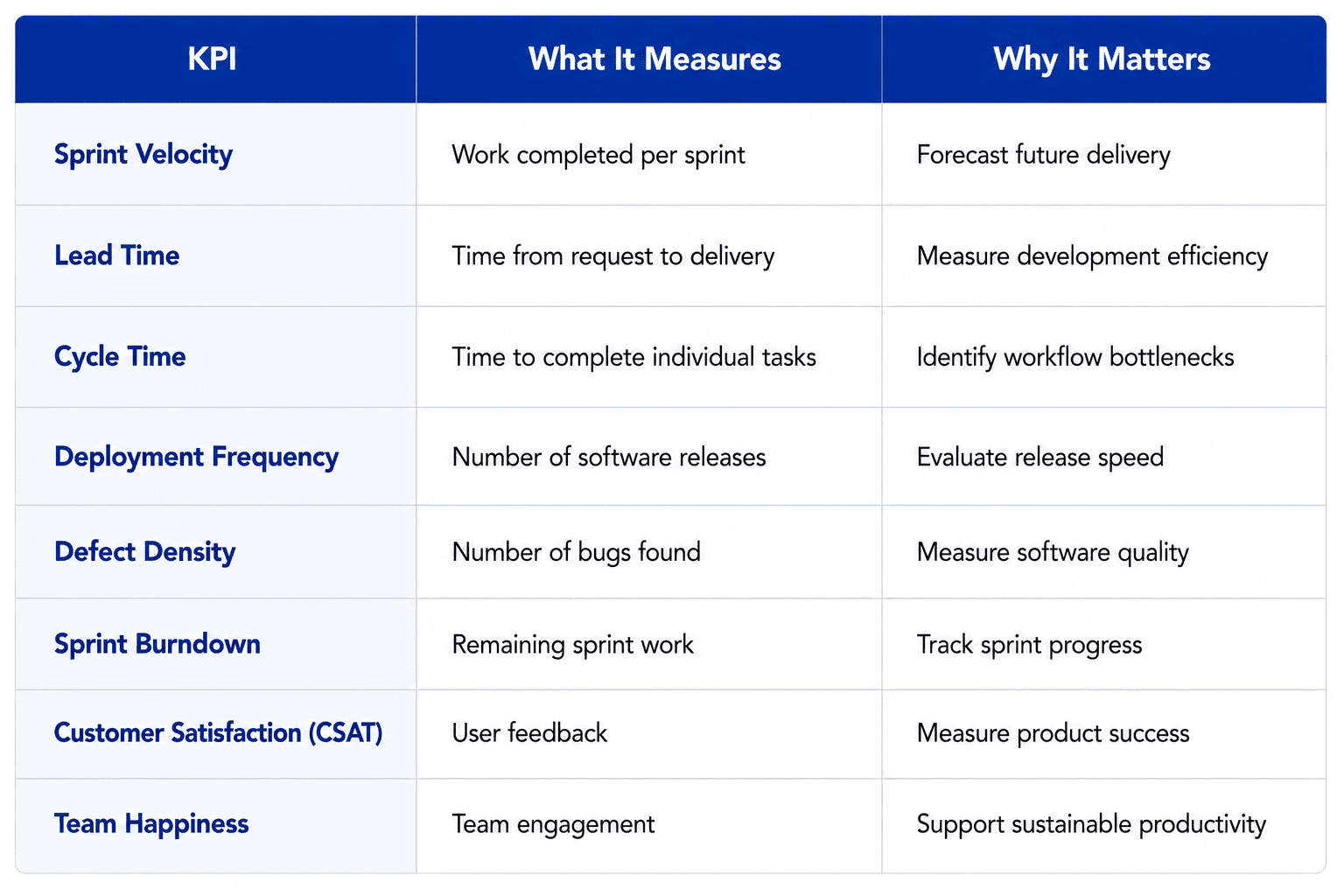
Organizations that regularly monitor these KPIs can identify bottlenecks, improve sprint planning, and continuously optimize software delivery performance.
Agile Delivery Checklist
Before starting your next Agile project, ensure your team can answer "Yes" to these questions:
• ✔ Have business goals been clearly defined?
• ✔ Is the product backlog prioritized?
• ✔ Are sprint objectives measurable?
• ✔ Is automated testing implemented?
• ✔ Does the project use CI/CD pipelines?
• ✔ Are stakeholders involved in sprint reviews?
• ✔ Are Agile KPIs tracked consistently?
• ✔ Is there a plan for continuous improvement?
Teams that consistently follow this checklist are more likely to deliver high-quality software on time and adapt successfully to changing business requirements.
Why Choose Brilliantech for Agile App Development?
Choosing the right Agile development partner is essential for delivering high-quality software on time, within budget, and aligned with your business objectives. While Agile methodologies provide the framework for rapid application development, experienced teams, modern engineering practices, and transparent collaboration determine whether a project succeeds.
At Brilliantech, we combine Agile development, DevOps automation, and business-focused consulting to help startups, SMEs, and enterprises accelerate digital product delivery. Our cross-functional teams work closely with clients throughout the development lifecycle—from product discovery and MVP development to deployment, scaling, and continuous support.
Businesses partner with Brilliantech because we offer:
• Agile-certified development teams experienced in Scrum and Kanban
• Rapid MVP development to validate ideas and reduce time-to-market
• Dedicated Scrum teams for transparent and predictable project execution
• DevOps expertise with CI/CD automation for faster, reliable deployments
• Cross-functional collaboration between developers, designers, QA engineers, and product owners
• Transparent sprint reporting with regular reviews and stakeholder feedback
• Scalable engagement models, including dedicated teams and staff augmentation
• End-to-end application development for web, mobile, cloud, AI, and enterprise solutions
Whether you're building a customer-facing mobile application, a SaaS platform, or an enterprise system, our Agile-first approach helps transform ideas into scalable, secure, and high-performing digital products.
Accelerate your digital transformation with our Agile Software Development Services, designed to deliver high-quality applications through iterative development and continuous delivery.
How Should Businesses Get Started with Agile App Development?
Getting started with Agile app development requires a structured roadmap that aligns business goals, technical execution, and continuous customer feedback. Organizations that invest time in planning and prioritization are better positioned to deliver successful applications faster while minimizing project risks.
Step 1: Define Business Goals
Clearly identify the problem your application will solve, your target audience, and the outcomes you want to achieve.
Step 2: Prioritize High-Value Features
Focus on the features that provide the greatest value to users and support your business objectives. These should form the foundation of your Minimum Viable Product (MVP).
Step 3: Build a Product Backlog
Organize features into a prioritized backlog that can evolve as customer needs and market conditions change.
Step 4: Choose the Right Agile Development Partner
Evaluate potential development partners based on:
• Agile maturity
• Technical expertise
• DevOps capabilities
• Communication practices
• Industry experience
• Portfolio of successful Agile projects
Step 5: Form a Cross-Functional Team
Bring together product owners, developers, designers, QA engineers, and DevOps specialists to ensure seamless collaboration throughout the project.
Step 6: Launch, Learn, and Improve
Release an MVP, collect customer feedback, monitor Agile KPIs, and continuously improve your application through future sprints.
Ready to build your next digital product? Contact Brilliantech Agile Experts to discuss your project and receive a customized Agile development roadmap.
Conclusion
Faster app delivery with Agile is more than a software development methodology—it is a business strategy that helps organizations innovate, adapt, and compete in today's fast-moving digital landscape. By embracing iterative development, continuous feedback, cross-functional collaboration, and DevOps automation, businesses can reduce time-to-market without compromising software quality.
Whether you're building a mobile app, web application, SaaS platform, or enterprise solution, Agile empowers your team to deliver value early, respond quickly to customer feedback, and continuously improve your product with every release.
Success with Agile depends not only on adopting the right framework but also on partnering with a development team that understands your business goals and has the technical expertise to turn ideas into scalable digital products.
At Brilliantech, we help organizations accelerate software delivery through Agile methodologies, modern engineering practices, and customer-centric collaboration. From product discovery to deployment and continuous optimization, our experts are committed to helping you build software that delivers measurable business value.
Brilliantech accelerates application delivery through Agile methodologies, dedicated development teams, DevOps automation, and scalable engineering practices that help businesses bring products to market faster.