
Introduction
Choosing business software is no longer just an IT decision—it's a strategic business decision that affects productivity, customer experience, operational efficiency, and long-term growth. While ready-made software allows businesses to get started quickly, it may not always keep pace with evolving operational needs. On the other hand, custom software requires a larger initial investment but provides greater flexibility, scalability, and competitive advantage over time.
If you're evaluating custom software vs ready-made software, you're likely asking questions such as: Which option offers better value? Which solution will support future growth? Is building custom software worth the investment?
In this comprehensive guide, you'll learn the differences between both approaches, compare them across critical business factors, explore real-world examples, and understand how to choose the right software strategy for your organization.
Key Takeaways
• Custom software is built specifically for an organization's unique workflows, processes, and long-term business objectives.
• Ready-made software provides standardized functionality, faster deployment, and lower upfront costs for common business requirements.
• Choosing the right software depends on your budget, scalability needs, implementation timeline, integration requirements, and long-term ROI.
• Custom software offers complete ownership, greater flexibility, and seamless integration, while ready-made software excels in affordability and speed.
• Many organizations adopt a hybrid software strategy, combining ready-made platforms with custom development to maximize efficiency and innovation.
• Evaluating the total cost of ownership (TCO) is more important than comparing only the initial purchase price.
What Is the Difference Between Custom Software and Ready-Made Software?
Custom software is built exclusively for a specific business, whereas ready-made software is designed for a broad audience with standardized features. Although both help organizations digitize operations, they differ significantly in terms of customization, ownership, scalability, implementation time, and long-term business value.
Think of it like purchasing a suit. A ready-made suit is available immediately and works well for most people. A custom-tailored suit, however, is designed around your exact measurements, preferences, and style. Both serve the same purpose, but one provides a far better fit.
The same principle applies to business software.
Ready-made software helps companies adopt industry-standard processes quickly. Custom software, on the other hand, adapts to your existing business processes and evolves as your organization grows.
According to Gartner, global enterprise software spending continues to increase as organizations prioritize digital transformation, automation, cloud computing, and AI-powered business operations. This shift reflects the growing recognition that software is no longer just a support function—it's a strategic investment that drives competitive advantage. - Gartner Forecast Analysis, 2025
Custom Software at a Glance
Custom software is designed and developed specifically to solve the unique challenges of a single organization. Every feature, workflow, dashboard, and integration is created around business objectives rather than generic industry standards.
Instead of asking employees to change the way they work, custom software is built to support existing processes while eliminating inefficiencies and manual tasks.
Businesses typically invest in custom software when they need:
• Unique business workflows
• Advanced automation
• Industry-specific compliance
• Integration with existing systems
• Long-term scalability
• Better data security
• Competitive differentiation
For example, an enterprise logistics company may require a transportation management platform that integrates GPS tracking, warehouse management, route optimization, GST compliance, and customer notifications. While individual SaaS products may provide some of these capabilities, building a unified custom platform creates a more efficient and scalable solution.
Custom software is a solution designed specifically to meet an organization's unique business requirements, workflows, and long-term objectives.
What Is Custom Software?
Custom software is a tailor-made application developed exclusively for one organization to address its specific operational needs and business goals. Unlike commercial software products, custom applications are designed with a company's existing workflows, customers, and future growth plans in mind.
Because businesses own the software, they have complete control over feature development, integrations, security policies, and future enhancements. This level of ownership allows organizations to innovate without being constrained by a vendor's product roadmap.
Key Characteristics of Custom Software
Custom software stands apart because it is designed with flexibility and business alignment at its core.
Some of its defining characteristics include:
• Tailored business workflows
• Unlimited customization
• Full ownership of the source code
• Scalable architecture
• Integration with existing software
• Enhanced security controls
• Better long-term adaptability
Unlike subscription-based applications, custom software evolves alongside the business rather than forcing the business to adapt to software limitations.
Real-World Examples of Custom Software
Many of the world's most successful companies rely heavily on custom-built software to create competitive advantages.
Netflix developed its proprietary recommendation engine to personalize content suggestions based on viewing history and user preferences. This technology is one of the primary reasons users spend more time on the platform.
Amazon operates using thousands of custom software systems that manage inventory forecasting, warehouse automation, logistics, fraud detection, and personalized product recommendations.
Uber built a sophisticated dispatching platform capable of matching drivers and passengers in real time while dynamically calculating fares based on traffic conditions, demand, and driver availability.
In India, companies such as Zerodha and Razorpay have invested significantly in custom software platforms to deliver seamless financial services, improve transaction processing, and support millions of users without relying entirely on off-the-shelf solutions.
These organizations demonstrate an important principle:
Businesses rarely build custom software because existing software doesn't work—they build it because they want software that creates competitive advantage.
Common Use Cases for Custom Software
Custom software is commonly used across industries where standard applications cannot efficiently manage complex operations.
Examples include:
• Enterprise Resource Planning (ERP)
• Customer Relationship Management (CRM)
• Healthcare Management Systems
• Banking & FinTech Platforms
• Manufacturing Automation
• Supply Chain Management
• Fleet & Logistics Management
• E-learning Platforms
• SaaS Products
• AI-powered Business Applications
For instance, a healthcare provider may require software that integrates patient records, appointment scheduling, laboratory reports, insurance claims, and telemedicine into a single platform. Developing this as a custom solution improves efficiency while ensuring compliance with healthcare regulations.
What Is Ready-Made Software?
Ready-made software, also known as off-the-shelf software, is a pre-built application designed to solve common business challenges for a broad range of organizations. Rather than being developed for one company, these products are created to meet the needs of thousands—or even millions—of users with similar requirements.
Because these solutions are already built, businesses can deploy them quickly, often within hours or days. Vendors also handle software updates, security patches, and feature enhancements, reducing the need for in-house development resources.
Some of the most widely used ready-made software platforms include:
• Salesforce CRM
• Microsoft Dynamics 365
• Shopify
• HubSpot CRM
• Zoho CRM
• SAP Business One
• QuickBooks
• Jira
• Slack
These platforms have become industry leaders because they offer proven functionality, extensive documentation, and strong customer support.
According to IDC, organizations worldwide continue to increase investment in cloud-based SaaS applications as they accelerate digital transformation and modernize business operations. - IDC Worldwide Software Forecast, 2024.
Key Characteristics of Ready-Made Software
Ready-made software is designed to provide businesses with immediate functionality without the time and cost associated with custom development.
Its key characteristics include:
• Quick implementation
• Lower upfront investment
• Subscription-based pricing
• Standardized features
• Vendor-managed maintenance
• Regular security updates
• Large user communities
• Extensive third-party integrations
For many startups and small businesses, these advantages make ready-made software the most practical starting point before investing in more specialized solutions.
What Are the Advantages of Custom Software Development?
Custom software development provides businesses with tailored functionality, greater flexibility, complete ownership, and long-term scalability. Unlike off-the-shelf applications, custom software is built around your unique business processes, enabling you to improve efficiency, automate workflows, and support future growth without being constrained by vendor limitations.
According to Deloitte, organizations that align technology investments with business strategy are significantly more likely to improve operational performance and accelerate digital transformation initiatives. - Deloitte Tech Trends, 2025.)
Built Around Your Business Processes
One of the biggest advantages of custom software is that it fits your business instead of forcing your business to adapt to generic workflows.
Most organizations have unique approval processes, reporting requirements, customer journeys, or operational models that cannot be fully supported by standard software. Custom applications eliminate unnecessary features while providing exactly the functionality your teams need.
For example, a manufacturing company may require production scheduling, inventory tracking, supplier management, and quality inspections to work together within a single platform. Rather than purchasing multiple disconnected applications, a custom solution centralizes these processes, improving productivity and reducing manual work.
Learn how tailored business applications improve operational efficiency through our Enterprise Software Development solutions
Unlimited Customization and Scalability
Business requirements change over time. New departments are created, customer expectations evolve, and regulations are updated. Custom software grows alongside your business, allowing you to add new features whenever required.
Unlike ready-made software, which often limits customization based on subscription plans, custom applications give organizations complete control over future development.
For example, an eCommerce startup may initially require inventory management and order processing. As the business grows internationally, it can expand the same platform to include multilingual support, AI-powered recommendations, warehouse automation, and advanced analytics without replacing the entire system.
According to IBM, scalable software architecture helps organizations reduce technical debt while improving long-term agility and innovation. - IBM Technology Lifecycle Services, 2024
Seamless Integration with Existing Systems
Modern businesses rely on multiple applications, including CRMs, ERPs, accounting platforms, payment gateways, marketing tools, and cloud services. Custom software can integrate these systems into a unified ecosystem, reducing data duplication and eliminating manual processes.
For example, a healthcare organization may integrate electronic health records, appointment scheduling, laboratory systems, payment gateways, and insurance verification into one centralized platform. This creates a better experience for both staff and patients while reducing administrative effort.
Greater Security and Compliance
Custom software allows businesses to implement security measures based on their specific industry requirements instead of relying on default configurations.
Organizations operating in industries such as healthcare, banking, insurance, or government often require advanced authentication, encryption, audit logs, and compliance reporting.
For instance, financial institutions handling sensitive customer information must comply with regulations such as PCI DSS and local data protection laws. A custom-built application enables security policies to be designed around these compliance requirements.
According to IBM's Cost of a Data Breach Report 2024, organizations with mature security practices and automation experience significantly lower breach-related costs than those relying on reactive security measures.
Higher Long-Term Return on Investment
Although custom software generally involves higher upfront development costs, it often produces stronger long-term returns for organizations with specialized workflows.
Instead of paying recurring subscription fees for multiple software products, businesses own the application and can enhance it whenever needed.
For example, imagine a company paying $2,500 per month for several SaaS platforms. Over five years, that amounts to $150,000 in subscription costs, excluding premium features and additional user licenses. A well-designed custom platform may require a larger initial investment but can significantly reduce recurring software expenses over time while improving operational efficiency.
Custom software delivers greater long-term value because organizations own the application, control future development, and eliminate many recurring licensing costs.
What Are the Benefits of Ready-Made Software?
Ready-made software offers immediate functionality, lower upfront costs, and faster implementation for businesses with standardized operational requirements. It enables organizations to adopt proven solutions without investing in lengthy software development projects.
For startups, small businesses, and organizations with limited technical resources, ready-made software often provides the quickest path to digital transformation.
Faster Deployment
The biggest advantage of ready-made software is speed.
Most cloud-based SaaS applications can be configured and deployed within a few hours or days instead of several months.
For example, a new retail business can launch an online store using Shopify, integrate payment gateways, and begin selling products almost immediately. Building the same functionality from scratch would require considerably more time and development resources.
This rapid implementation allows businesses to begin generating value quickly while minimizing project risk.
Lower Initial Investment
Custom software development requires planning, design, development, testing, and deployment. Ready-made software eliminates these upfront development costs by offering subscription-based pricing.
This makes it particularly attractive for:
• Startups
• Small businesses
• Early-stage SaaS companies
• Nonprofits
• Businesses validating new ideas
Instead of making a significant capital investment, organizations can begin with affordable monthly subscriptions and upgrade as their needs evolve.
Continuous Updates and Vendor Support
Leading software vendors continuously improve their products by releasing security updates, bug fixes, and new features.
Platforms such as Salesforce, Microsoft Dynamics 365, HubSpot, and Zoho regularly introduce enhancements without requiring customers to manage software maintenance themselves.
This allows businesses to focus on growth rather than infrastructure management.
Large Ecosystem and Community Support
Another significant advantage is the mature ecosystem surrounding popular software platforms.
Businesses gain access to:
• Extensive documentation
• Certified implementation partners
• Third-party integrations
• Online training resources
• Large user communities
For example, Salesforce offers thousands of applications through its AppExchange marketplace, allowing businesses to extend functionality without developing everything internally.
What Are the Challenges of Custom Software?
Custom software provides exceptional flexibility, but it also requires greater planning, investment, and long-term commitment. Understanding these challenges helps businesses make realistic technology decisions.
Higher Initial Investment
Developing software from scratch requires investment in business analysis, UI/UX design, development, testing, deployment, and maintenance.
Although the long-term ROI can be substantial, organizations should ensure that custom development aligns with their growth strategy and available budget.
Longer Development Timeline
Unlike ready-made software, custom applications cannot be deployed immediately.
Depending on project complexity, development may take several weeks or even months. However, using Agile development methodologies allows businesses to release functional versions incrementally rather than waiting for the complete product.
Ongoing Maintenance
Software requires continuous updates to remain secure, compatible, and aligned with evolving business needs.
This includes:
• Performance optimization
• Security patches
• Feature enhancements
• Cloud infrastructure updates
• Third-party API maintenance
Choosing an experienced technology partner ensures these responsibilities are managed effectively throughout the software lifecycle.
What Are the Challenges of Ready-Made Software?
Ready-made software simplifies implementation but often limits flexibility, customization, and long-term scalability. These limitations become increasingly noticeable as businesses grow and processes become more specialized.
Limited Customization
Off-the-shelf applications are designed for thousands of organizations rather than one specific business.
As a result, businesses often modify their workflows to fit the software instead of optimizing software around their operations.
Recurring Licensing Costs
Subscription fees may appear affordable initially, but costs increase over time as businesses add more users, storage, integrations, and premium features.
For growing organizations, recurring licensing costs can eventually exceed the cost of developing custom software.
Vendor Lock-In
Businesses using SaaS platforms depend on vendors for pricing, feature availability, integrations, and future product direction.
If a vendor changes pricing, discontinues features, or limits API access, organizations have limited control over these decisions.
Integration Limitations
Although many SaaS applications provide APIs, integrating multiple platforms often requires additional middleware, third-party connectors, or manual processes.
As organizations expand, these integration challenges can create operational inefficiencies and increase IT complexity.
Custom Software vs Ready-Made Software: A Side-by-Side Comparison
Choosing between custom software and ready-made software isn't about determining which option is universally better—it's about identifying which solution best aligns with your business goals, operational complexity, budget, and future growth plans.
Ready-made software is ideal for organizations that need a fast, cost-effective solution for standard business processes. In contrast, custom software is built to address unique challenges, automate specialized workflows, and support long-term scalability.
The following comparison highlights the key differences that business leaders should evaluate before making a technology investment.
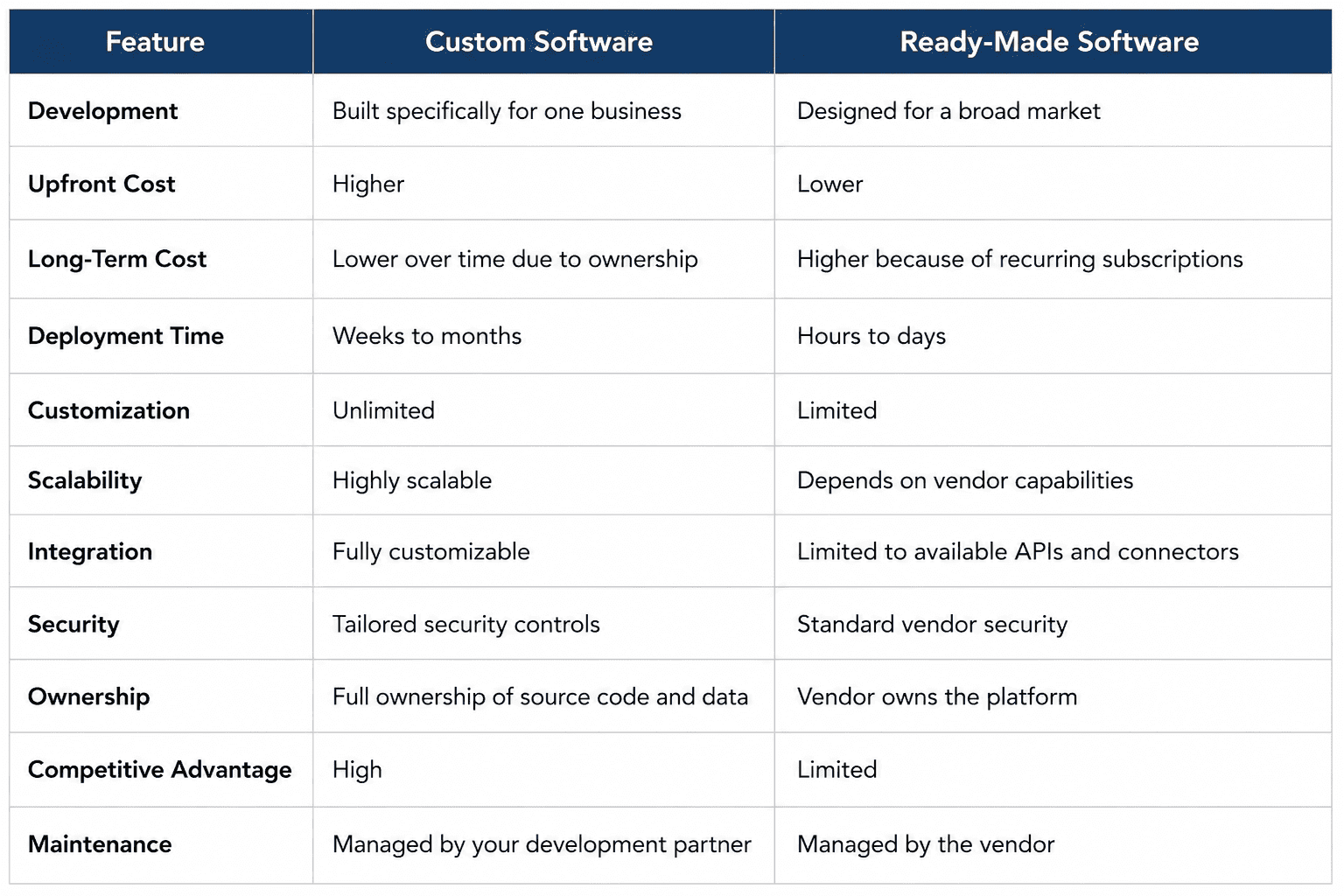
Although both options solve business problems, the right choice depends on how your organization plans to grow over the next three to five years rather than just what it needs today.
Custom Software vs Ready-Made Software: Cost Comparison
One of the most common misconceptions is that ready-made software is always less expensive. While it typically requires a lower initial investment, businesses often overlook the long-term costs associated with subscriptions, additional user licenses, premium features, third-party integrations, and migration expenses.
For example, consider a business using multiple SaaS applications:
• CRM Software
• Project Management Tool
• Accounting Software
• Inventory Management Platform
• Marketing Automation Software
Each application charges a monthly subscription fee. As the company grows and adds employees, these recurring costs increase significantly year after year.
Now compare this with a custom-built platform that combines these capabilities into one centralized system. Although development requires a larger upfront investment, businesses avoid many recurring licensing fees while benefiting from a solution tailored to their operations.
Think Beyond Initial Costs
Instead of asking:
"Which option is cheaper today?"
Ask:
"Which option creates greater value over the next five years?"
When calculating software costs, consider:
• Subscription fees
• User licensing costs
• Maintenance expenses
• Integration costs
• Employee training
• Productivity gains
• Operational efficiency
• Future expansion requirements
This approach, known as Total Cost of Ownership (TCO), provides a far more accurate picture of long-term value than comparing purchase prices alone.
Learn how our Software Consulting Services help businesses evaluate technology investments based on long-term ROI rather than short-term costs.
Which Software Offers Better ROI?
Return on Investment (ROI) isn't determined solely by how much software costs—it's determined by how much value it creates for your business.
A custom solution may improve productivity, reduce manual work, automate repetitive tasks, enhance customer experiences, and eliminate the need for multiple software subscriptions. These operational improvements often translate into measurable financial returns over time.
For example, imagine a logistics company where employees manually process shipments, inventory updates, and customer notifications using five separate applications. By implementing a custom logistics platform that automates these tasks, the company can reduce manual errors, improve delivery times, and increase employee productivity.
Similarly, a healthcare provider using a custom patient management system can reduce administrative workload, streamline appointment scheduling, and improve patient satisfaction—all of which contribute to stronger long-term returns.
According to McKinsey & Company, organizations that successfully integrate digital technologies into their business operations consistently achieve higher productivity and operational efficiency than those relying on fragmented systems.
The takeaway is simple:
Software should not be viewed as an expense—it should be viewed as an investment that supports sustainable business growth.
When Should You Choose Custom Software?
Custom software is the right choice when your business requires flexibility, automation, and long-term scalability beyond what standard applications can provide.
Your Business Has Unique Workflows
If your daily operations involve specialized approval processes, complex reporting structures, or industry-specific requirements, custom software allows you to build technology around those workflows instead of changing the way your teams work.
You Plan to Scale Rapidly
Businesses expecting significant growth should invest in software that can evolve alongside increasing customers, employees, transactions, and operational complexity.
Custom software allows new features, modules, and integrations to be added without replacing the entire system.
Security and Compliance Are Critical
Industries such as healthcare, finance, insurance, manufacturing, and government often require strict compliance with industry regulations.
Custom software enables organizations to implement security policies, user permissions, audit logs, and compliance reporting tailored to regulatory requirements.
You Need Competitive Differentiation
If technology plays a key role in delivering customer value, proprietary software can become a significant competitive advantage.
Companies like Amazon, Netflix, Uber, and Airbnb have built much of their market leadership through custom technology platforms that competitors cannot easily replicate.
Discover how our Custom Software Development Services help organizations build scalable digital solutions designed for long-term competitive advantage.
When Should You Choose Ready-Made Software?
Ready-made software remains an excellent option for businesses with straightforward operational needs and limited budgets.
You Need to Launch Quickly
If speed is your highest priority, SaaS platforms allow businesses to begin operations almost immediately.
Startups validating new business ideas often benefit from launching quickly before investing in fully customized solutions.
Your Processes Follow Industry Standards
Businesses using common workflows such as accounting, payroll, email marketing, or customer relationship management often find that ready-made software meets most of their requirements.
Budget Is Limited
For early-stage companies, subscription-based software provides predictable monthly expenses without significant capital investment.
This makes it easier to conserve resources while focusing on customer acquisition and business growth.
Your Requirements Are Unlikely to Change
If your business model is relatively stable and unlikely to require advanced customization, ready-made software can remain an effective long-term solution.
Can Businesses Combine Both Approaches?
Absolutely.
Many successful organizations adopt a hybrid software strategy, combining the reliability of ready-made software with the flexibility of custom development.
For example:
• Use Microsoft 365 for collaboration.
• Use Salesforce for CRM.
• Use QuickBooks for accounting.
• Build a custom customer portal.
• Develop a custom ERP system.
• Create proprietary dashboards and analytics.
This approach allows businesses to reduce development costs while still building software that differentiates them from competitors.
Rather than replacing every existing application, organizations invest in custom development only where it creates the greatest business value.
Decision Checklist: Which Option Is Right for You?
If you're still unsure which path to take, ask yourself the following questions:
✅ Are our business processes unique or highly standardized?
✅ Will we outgrow our current software within the next three to five years?
✅ Do we need advanced integrations with existing systems?
✅ Are recurring subscription costs becoming difficult to manage?
✅ Does software play a strategic role in delivering customer value?
✅ Do we require complete ownership of our technology and data?
If you answered "Yes" to most of these questions, custom software is likely the better investment.
If you answered "No" to most of them, ready-made software will likely meet your current needs while minimizing implementation costs and deployment time.
Why Choose Brilliantech for Custom Software Development?
Choosing the right technology partner is just as important as choosing the right software. Even the best idea can fail if it is built without proper planning, scalable architecture, or long-term support. That's why businesses should look beyond technical expertise and evaluate a development partner's industry experience, communication process, security practices, and ability to deliver solutions aligned with business objectives.
At Brilliantech, we don't just develop software—we build digital solutions that solve real business problems. Our team works closely with clients to understand their goals, challenges, and workflows before writing a single line of code. This business-first approach helps us create software that drives efficiency, improves customer experiences, and supports long-term growth.
Whether you're a startup launching your first product or an enterprise modernizing legacy systems, we develop scalable applications that evolve with your business.
Our Custom Software Development Services
We offer end-to-end software development solutions, including:
• Custom Software Development
• Enterprise Software Development
• Web Application Development
• Mobile App Development (Android, iOS & Flutter)
• SaaS Product Development
• ERP & CRM Development
• API Development & System Integration
• AI & Machine Learning Solutions
• Cloud Application Development
• Software Modernization & Migration
• UI/UX Design
• Ongoing Maintenance & Support
Every solution is designed with scalability, security, and performance in mind, ensuring your software continues to deliver value as your business grows.
Why Businesses Choose Brilliantech
Organizations partner with Brilliantech because we combine technical expertise with a deep understanding of business challenges.
Here's what sets us apart:
• Business-Centric Approach: We focus on solving business problems, not just developing software.
• Experienced Development Team: Skilled professionals with expertise across modern technologies and frameworks.
• Agile Development Methodology: Faster releases, continuous feedback, and greater project transparency.
• Scalable Architecture: Applications designed to support future growth and evolving business needs.
• Security-First Development: Industry best practices for data protection and secure software architecture.
• Transparent Communication: Regular project updates, milestone tracking, and collaborative decision-making.
• Post-Launch Support: Continuous maintenance, enhancements, and technical support after deployment.
Explore our Custom Software Development Services to build software tailored to your business.
Learn how our Mobile App Development Services help businesses create engaging digital experiences.
Discover our AI Development Services for intelligent automation and data-driven decision-making.
Conclusion
Choosing between custom software and ready-made software isn't about finding a universally better option—it's about selecting the solution that aligns with your business goals, operational requirements, and future growth plans.
Ready-made software is an excellent choice for businesses that need a fast, cost-effective solution for standard processes. It enables organizations to get up and running quickly with proven features, minimal setup, and predictable subscription costs. For startups, small businesses, and companies with straightforward requirements, it can deliver immediate value without a significant upfront investment.
However, as businesses grow, their needs often become more complex. Unique workflows, increasing customer expectations, integration challenges, and scalability requirements can expose the limitations of off-the-shelf software. This is where custom software becomes a strategic advantage. By providing complete ownership, tailored functionality, seamless integrations, and the flexibility to evolve with your business, custom software helps organizations improve efficiency, strengthen security, and gain a competitive edge.
Before making a decision, evaluate your current challenges, long-term objectives, budget, and technology roadmap. Consider not only the initial investment but also the total cost of ownership (TCO), scalability, and the value the software will deliver over the next five to ten years.
If your goal is to build a solution that supports innovation, automates critical business processes, and grows alongside your organization, partnering with an experienced software development company can make all the difference.
At Brilliantech, we specialize in developing scalable, secure, and business-focused software solutions tailored to your unique requirements. Whether you're building a new product, modernizing legacy systems, or accelerating your digital transformation journey, our team is ready to help you create software that delivers measurable business value.
Ready to build software that fits your business—not the other way around? Contact Brilliantech today to discuss your project and discover the right solution for your long-term success.