
Introduction
Building a successful startup begins with building the right development team. Whether you're creating a minimum viable product (MVP), launching a SaaS platform, or scaling after securing funding, the developers you hire will directly influence your product quality, development speed, and long-term business success. However, hiring software developers is often one of the biggest challenges for startup founders, especially when balancing limited budgets, aggressive timelines, and evolving technical requirements.
Choosing the wrong hiring model, overlooking technical evaluations, or recruiting too quickly can lead to delayed product launches, higher development costs, and unnecessary technical debt. In this step-by-step guide, you'll learn how to hire developers for your startup strategically, compare different hiring models, avoid common recruitment mistakes, and discover how BrillianTech helps startups build scalable engineering teams with confidence.
Key Takeaways
• Startup developer hiring begins with clearly defining your product vision, technical requirements, and hiring budget before searching for candidates.
• Choosing the right hiring model helps startups balance flexibility, development speed, long-term scalability, and overall costs.
• Technical assessments, portfolio reviews, and structured interviews significantly improve hiring quality while reducing recruitment risks.
• Effective onboarding and well-defined development workflows enable developers to become productive faster.
• Dedicated development teams and staff augmentation provide startups with scalable alternatives to traditional in-house hiring.
• Avoiding common hiring mistakes, such as unclear requirements and rushed recruitment, increases the likelihood of successful product delivery.
• A structured hiring strategy helps startups launch MVPs faster while supporting sustainable long-term business growth.
What Does Hiring Developers for a Startup Mean?
Startup developer hiring is the process of identifying, evaluating, recruiting, and onboarding software engineers who can build, launch, and scale a startup's technology products. Rather than simply filling technical positions, startup hiring focuses on assembling a team capable of transforming ideas into reliable, scalable, and market-ready software solutions.
Unlike established enterprises that often expand existing engineering departments, startups usually build their first technical team from scratch. Every hiring decision affects product development, customer experience, operational efficiency, and future scalability. Selecting developers with the right technical expertise, problem-solving abilities, and collaborative mindset can significantly improve a startup's chances of success.
According to the World Economic Forum's Future of Jobs Report 2025, demand for software developers, AI specialists, cloud engineers, and technology professionals continues to grow rapidly as businesses accelerate digital transformation. — World Economic Forum, 2025
If you're planning to build a custom software product, explore BrillianTech's Custom Software Development Services to transform your startup idea into a scalable digital solution
Who Should Hire Developers?
Every startup reaches a stage where technical expertise becomes essential. Whether you're a non-technical founder validating a business idea or a growing company expanding an existing product, hiring developers allows you to build, improve, and maintain software that supports business growth.
Startups commonly hire developers for:
• Building a Minimum Viable Product (MVP)
• Developing SaaS platforms
• Creating web applications
• Building Android and iOS mobile applications
• Modernizing legacy software
• Integrating APIs and third-party platforms
• Implementing AI-powered features
• Scaling cloud infrastructure
For example, Airbnb initially built a simple MVP to validate its business idea before expanding its engineering team as the platform experienced rapid user growth. This iterative approach enabled the company to refine its product based on customer feedback while scaling its technology alongside business demand .- Airbnb Engineering & Company History
Which Types of Developers Do Startups Typically Hire?
The type of developers your startup needs depends on your product roadmap, technology stack, and stage of growth. Early-stage startups often prioritize versatile engineers who can contribute across multiple areas, while scaling businesses gradually build specialized teams.
Common startup hiring roles include:
• Frontend Developers
• Backend Developers
• Full-Stack Developers
• Mobile App Developers
• UI/UX Developers
• DevOps Engineers
• Cloud Engineers
• QA Engineers
• AI & Machine Learning Engineers
• Data Engineers
Each role contributes differently throughout the product lifecycle. For instance, frontend developers create user interfaces, backend developers build server-side logic and APIs, while DevOps engineers ensure reliable deployments and infrastructure management.
How Does Hiring Change as Your Startup Grows?
Startup hiring evolves alongside business growth, funding milestones, and product complexity. The engineering team required to build an MVP differs significantly from the team needed to support thousands of active users.
A typical hiring progression looks like this:
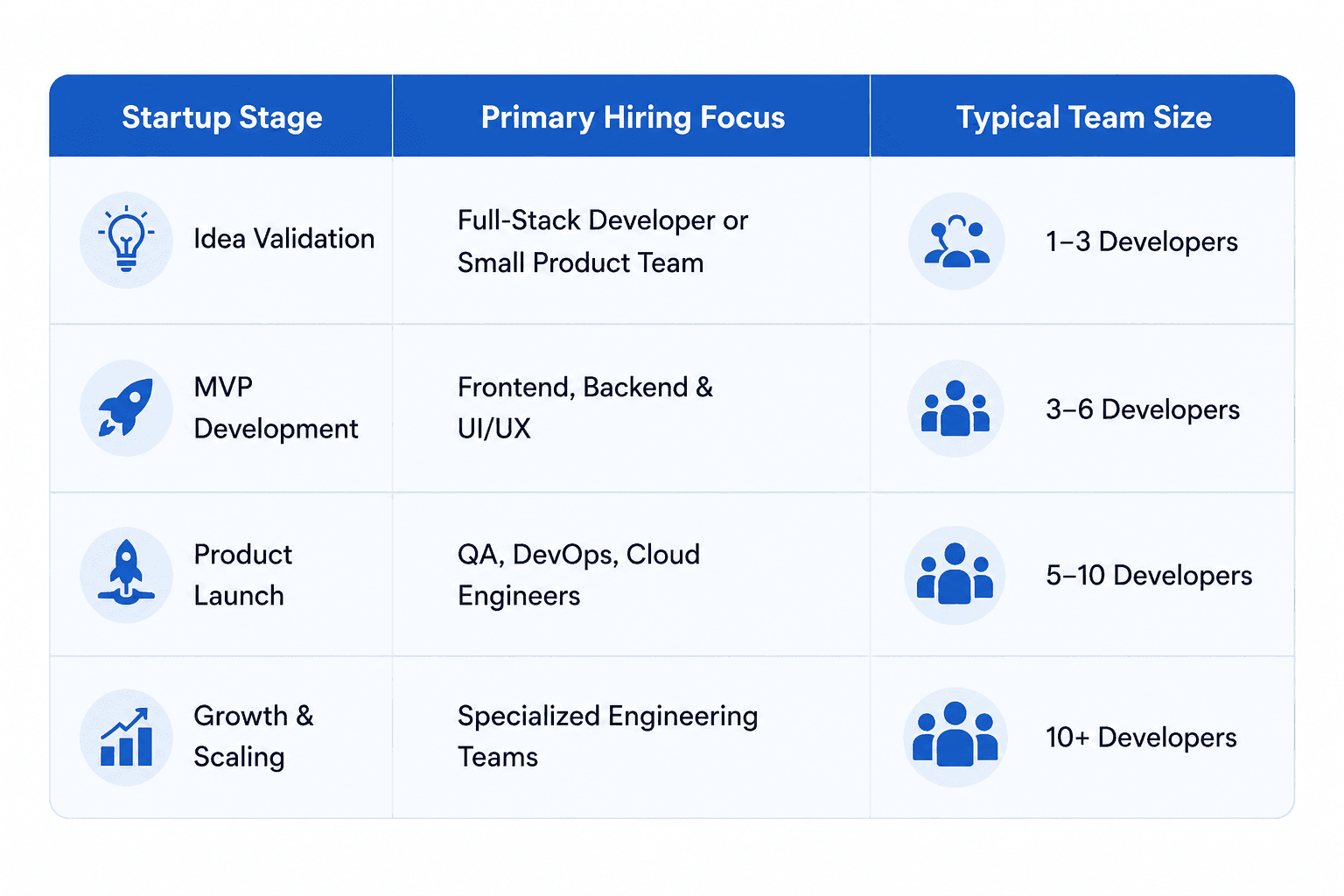
By aligning hiring decisions with business objectives, startups avoid unnecessary costs while maintaining the flexibility to expand their engineering capabilities when required.
Why Is Hiring the Right Development Team Critical for Startup Success?
Hiring the right development team directly influences product quality, speed to market, customer satisfaction, and long-term business growth. While innovative ideas are important, successful startups depend on experienced developers who can transform those ideas into reliable software products.
According to CB Insights, one of the most common reasons startups fail is building products that don't effectively meet market needs. Hiring experienced developers enables startups to validate ideas faster, iterate based on user feedback, and reduce costly development mistakes. — CB Insights Startup Failure Analysis
Faster MVP Development
A Minimum Viable Product (MVP) helps startups validate business ideas quickly by focusing development on essential features before expanding functionality. Hiring experienced developers ensures that MVPs are built efficiently without sacrificing quality or scalability.
For example, Dropbox validated demand for its product with a simple MVP before investing heavily in full-scale development, allowing the company to confirm market interest before expanding its engineering resources. - AWS Presentation Archive.
Reduced Technical Debt
Technical debt occurs when software is developed using shortcuts that create future maintenance challenges. While early-stage startups often prioritize speed, experienced developers build scalable architectures that reduce long-term costs and simplify future development.
Strong engineering practices include:
• Clean software architecture
• Well-documented code
• Automated testing
• Secure development practices
• Scalable cloud infrastructure
• Continuous integration and deployment
By investing in experienced developers early, startups reduce future rework while improving software reliability.
Better Customer Experience and Business Growth
Customers judge startups based on product quality, performance, security, and usability. Slow applications, frequent outages, and unreliable features can quickly damage customer trust and reduce retention.
Experienced development teams help startups deliver:
• Faster application performance
• Better security
• Reliable software releases
• Improved scalability
• Higher product quality
• Continuous feature improvements
As your startup grows, these advantages become increasingly important for attracting new customers, securing funding, and maintaining a competitive advantage.
How Do You Define Your Startup's Technical Requirements Before Hiring?
Defining your startup's technical requirements before hiring ensures you recruit developers with the right skills, avoid unnecessary costs, and accelerate product development. Many startups begin recruiting before clearly identifying their product scope, resulting in mismatched hires, delayed timelines, and expensive project changes.
According to the Project Management Institute (PMI), poor requirements management is one of the leading causes of project failure, often resulting in schedule delays, increased costs, and reduced software quality. — PMI Pulse of the Profession
Before publishing a job description or contacting developers, clearly document your product vision, target audience, essential features, technical expectations, timeline, and available budget.
If you're validating a new product idea, explore BrillianTech's Product Development Services to transform your concept into a market-ready MVP with expert technical guidance.
Step 1: Define Your Minimum Viable Product (MVP)
A Minimum Viable Product (MVP) helps startups validate business ideas by building only the essential features required to solve a customer's primary problem. Rather than investing months developing a feature-rich product, startups launch faster, gather real customer feedback, and improve the application through continuous iteration.
This approach reduces development costs while minimizing business risk.
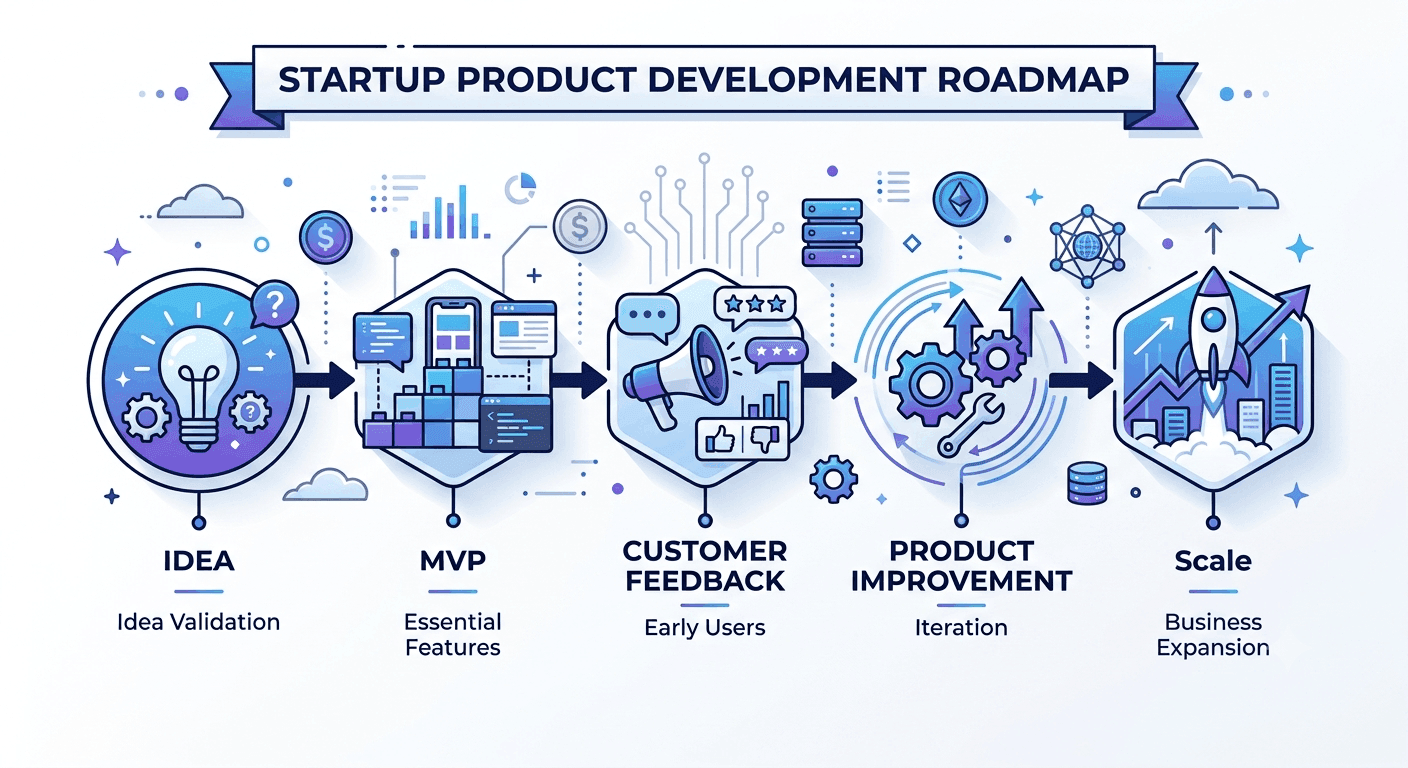
According to CB Insights, many startups fail because they build products without validating customer demand first. Launching an MVP enables founders to test assumptions before making significant technology investments. — CB Insights Startup Failure Analysis
For example, Buffer validated its business idea with a simple landing page that explained the product before building the full application. The page allowed visitors to sign up for updates and pricing information, helping the founders confirm customer demand before investing significant time and resources in product development. - Buffer Blog – "The Idea to Paying Customers in 7 Weeks"; Buffer Founder Joel Gascoigne
our MVP planning should answer questions such as:
• What problem does the product solve?
• Who is the target audience?
• Which features are absolutely essential?
• Which features can be introduced later?
• What defines a successful MVP launch?
Step 2: Identify Your Technical Requirements
Technical requirements define the technologies, expertise, infrastructure, and development capabilities needed to build your product successfully. Clear technical planning enables startups to hire developers with the appropriate skills instead of recruiting based on assumptions.
Common technical decisions include:
• Frontend framework
• Backend technology
• Mobile application requirements
• Cloud infrastructure
• Database selection
• API integrations
• Security requirements
• Third-party services
• DevOps workflow
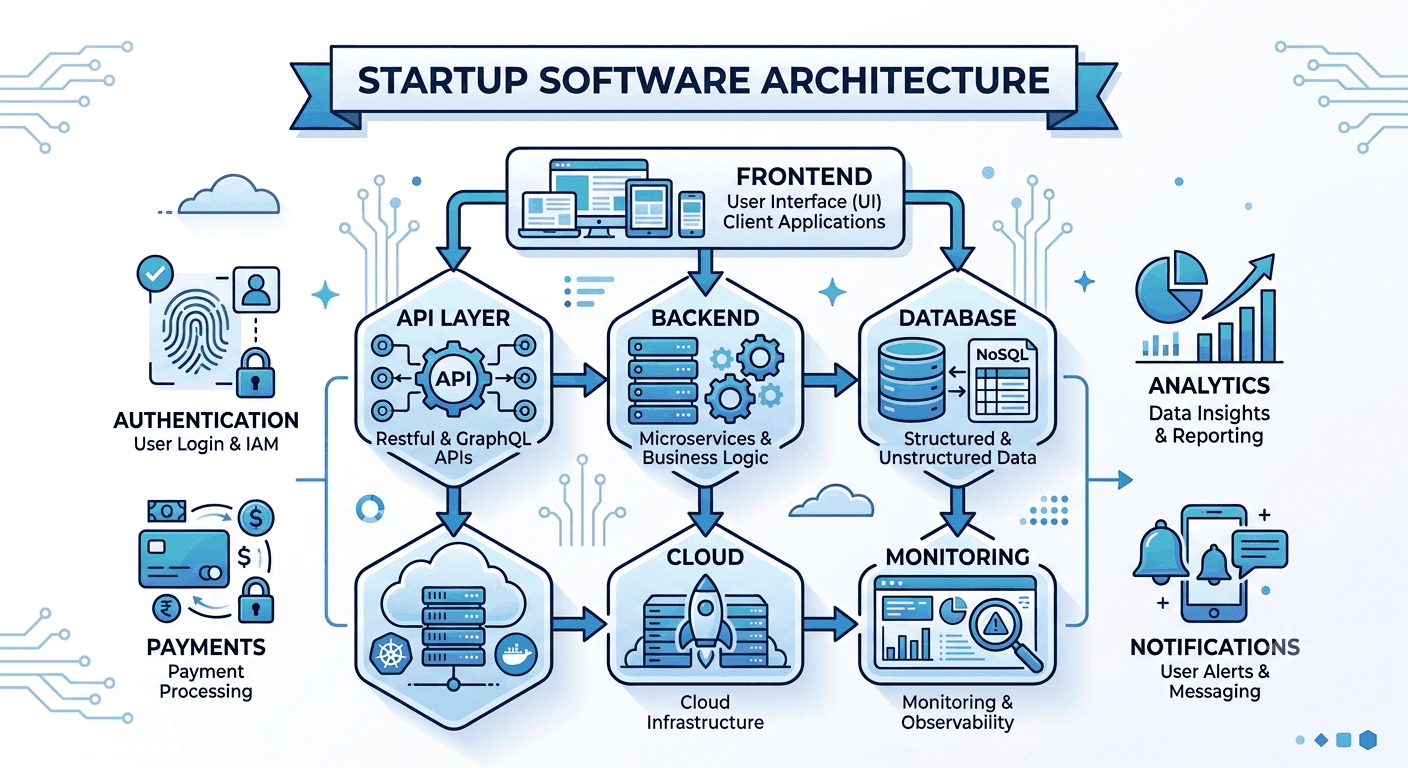
For example, a SaaS startup developing a subscription-based platform may require React for the frontend, Node.js or Java Spring Boot for backend services, PostgreSQL for data storage, and AWS for scalable cloud infrastructure.
Documenting these requirements early improves recruitment quality and shortens hiring timelines
Step 3: Establish a Realistic Hiring Budget
Hiring budgets should balance product goals, developer expertise, hiring model, and long-term business sustainability. While startups often focus on minimizing costs, selecting developers solely based on lower pricing can increase technical debt and delay product delivery.
Several factors influence development costs:
• Developer experience
• Technology stack
• Geographic location
• Hiring model
• Project complexity
• Development timeline
• Ongoing maintenance
According to Grand View Research, global software outsourcing continues to grow as startups increasingly seek cost-effective access to experienced engineering talent without compromising development quality. — Grand View Research, IT Services Market
Many startups successfully reduce hiring costs by combining experienced senior engineers with mid-level developers and scalable outsourcing models.
How Do You Choose the Right Technology Stack for Your Startup?
Choosing the right technology stack determines how quickly your startup can build, launch, maintain, and scale its software product. The technologies selected during the early stages influence development speed, future scalability, hiring availability, infrastructure costs, and long-term maintenance.
Rather than selecting technologies based on popularity alone, founders should align their technology stack with business goals, product complexity, expected user growth, and available engineering expertise.
Frontend Technologies
Frontend technologies control everything users see and interact with inside your application. Choosing an appropriate frontend framework improves performance, usability, and long-term maintainability.
Popular frontend technologies include:
• React
• Angular
• Vue.js
• Next.js
For example, Airbnb uses React extensively across its web platform to build highly interactive user interfaces while maintaining consistent performance for millions of global users. - Airbnb Engineering Blog
Backend Technologies
Backend technologies manage business logic, authentication, APIs, databases, and application security.
Popular backend technologies include:
• Java
• Spring Boot
• Node.js
• Python
• .NET
For example, Netflix uses Java and the Spring ecosystem to power thousands of backend microservices that independently handle streaming, recommendations, billing, and user management at global scale. - Netflix Technology Blog; Spring Case Study – Netflix
Mobile Development Technologies
Mobile applications enable startups to reach customers across Android and iOS devices while improving engagement and customer retention.
Popular mobile frameworks include:
• Flutter
• React Native
• Kotlin
• Swift
According to Statista, mobile applications continue to account for the majority of digital consumer engagement, making mobile-first development an important growth strategy for startups. — Statista Mobile App Market Report
If your startup plans to launch a mobile product, explore BrillianTech's Mobile App Development Services to build high-performance Android and iOS applications from a single development roadmap.
Cloud Infrastructure and DevOps
Cloud infrastructure enables startups to deploy, scale, and maintain applications without investing heavily in physical servers.
Modern startups commonly use:
• Amazon Web Services (AWS)
• Microsoft Azure
• Google Cloud Platform
• Docker
• Kubernetes
• GitHub Actions
• Jenkins
According to Flexera's State of the Cloud Report, over 89% of enterprises now adopt multi-cloud strategies to improve scalability, availability, and resilience. — Flexera State of the Cloud Report, 2025
Cloud-native infrastructure helps startups scale quickly as customer demand increases.
If you're building scalable cloud-native applications, explore BrillianTech's Cloud Development Services to design secure, reliable, and future-ready cloud architectures.
Which Hiring Model Is Best for Early-Stage Startups?
The best hiring model for a startup depends on your budget, product stage, technical requirements, and long-term growth plans. Early-stage startups often prioritize flexibility and speed, while scaling businesses require stable engineering teams capable of supporting continuous product development.
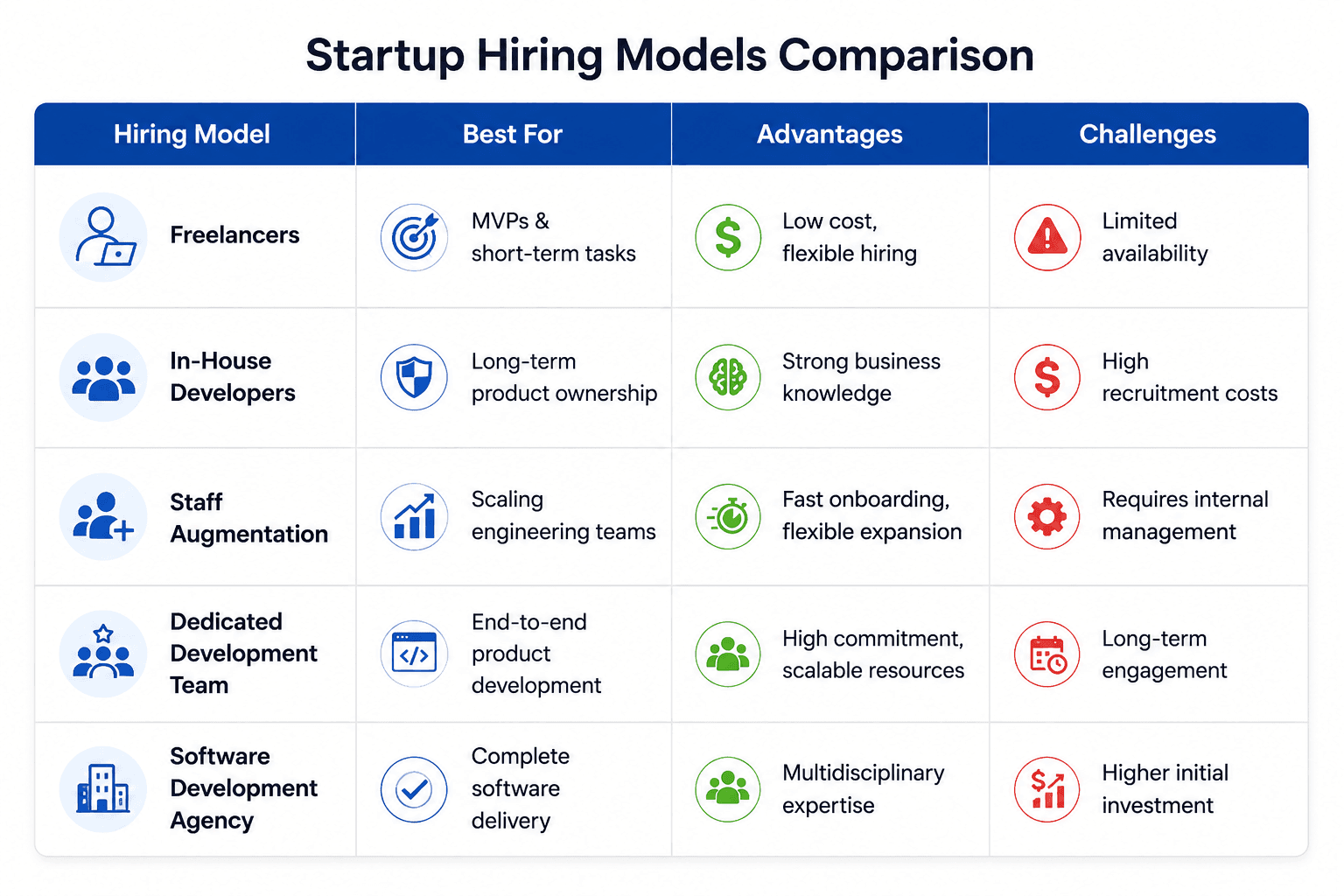
There is no one-size-fits-all approach. Some startups benefit from hiring freelancers for short-term work, while others achieve better results through dedicated development teams or staff augmentation. Understanding the advantages and limitations of each model helps founders make informed hiring decisions.
Dedicated Development Team
A dedicated development team consists of experienced software professionals who work exclusively on your project while functioning as an extension of your internal team. This model provides startups with long-term stability, consistent collaboration, and the flexibility to scale resources as business needs evolve.
Dedicated teams are ideal for:
• SaaS product development
• Long-term MVP evolution
• Enterprise software
• AI applications
• Large-scale web platforms
• Continuous product development
According to Deloitte's Global Outsourcing Survey, organizations increasingly choose dedicated outsourcing partnerships to improve access to specialized talent, accelerate delivery, and enhance operational flexibility. — Deloitte Global Outsourcing Survey
Staff Augmentation
Staff augmentation enables startups to expand existing engineering teams by adding experienced external developers without increasing permanent headcount. Instead of replacing your internal team, external engineers work alongside your existing developers to accelerate product delivery.
Staff augmentation works best for:
• Scaling after funding
• Filling skill gaps
• Short-term feature development
• Technology migrations
• Product expansion
• Meeting aggressive release schedules
For example, Shopify rapidly expanded its engineering organization by hiring globally and embracing distributed development teams, enabling the company to accelerate product innovation while supporting millions of merchants worldwide. - Shopify Engineering Blog
If you need experienced developers quickly, BrillianTech's Staff Augmentation Services provide pre-vetted engineers across multiple technologies, helping startups scale without lengthy recruitment cycles.
Freelancers vs Development Agencies
Freelancers and software development agencies serve different business needs. Freelancers are often suitable for small projects, bug fixes, or prototype development, whereas agencies provide multidisciplinary teams capable of delivering complete software products.
Freelancers generally offer:
• Lower upfront costs
• Flexible contracts
• Specialized expertise
• Quick availability
Development agencies provide:
• Project managers
• UI/UX designers
• Developers
• QA engineers
• DevOps specialists
• Long-term support
For startups building business-critical software, agencies often reduce delivery risks by providing structured project management and access to multiple technical specialists.
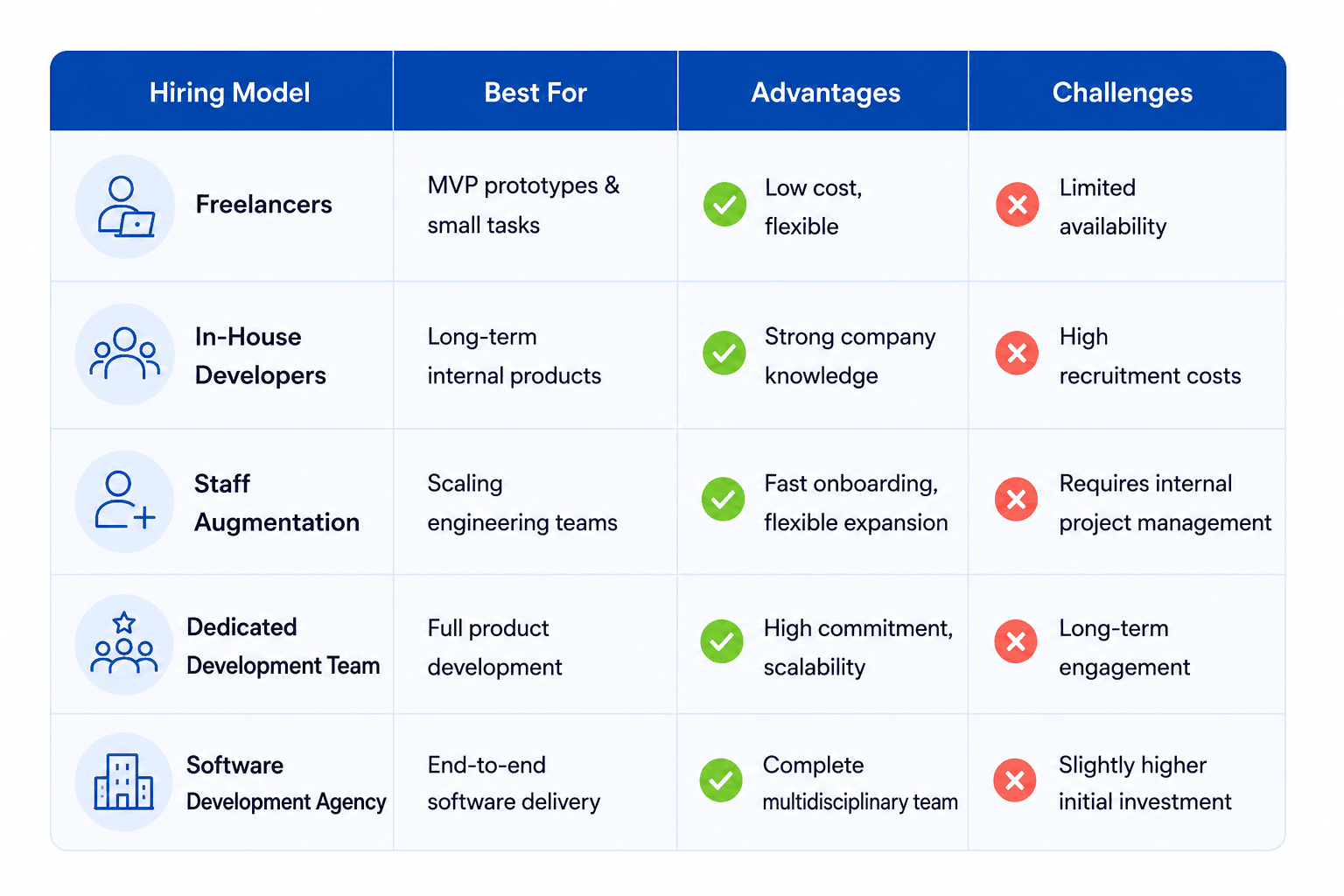
Hiring Models Comparison
Choosing the appropriate hiring model requires balancing flexibility, cost, scalability, and long-term business objectives.
How Can Startups Evaluate Developers Without a Technical Background?
Startups without technical founders can evaluate developers effectively by combining structured interviews, coding assessments, portfolio reviews, and practical problem-solving exercises. While technical expertise is important, communication skills, collaboration, and business understanding are equally valuable when building an early-stage engineering team.
Rather than relying solely on resumes or certifications, founders should assess whether candidates can solve real business problems while working effectively within startup environments.
Review Portfolios and Previous Projects
A developer's portfolio often provides more insight than a resume. Reviewing previous work helps founders understand coding quality, product complexity, industry experience, and technical capabilities.
Look for experience with:
• SaaS platforms
• Mobile applications
• Web applications
• Cloud-native software
• API development
• Enterprise systems
For example, GitHub repositories can demonstrate code quality, documentation standards, testing practices, and contribution history, providing founders with practical evidence of a developer's technical expertise beyond traditional resumes.
Conduct Practical Coding Assessments
Coding assessments evaluate how developers solve real-world programming challenges. Practical exercises reveal far more about technical ability than theoretical interview questions.
Assessments may include:
• API development
• Bug fixing
• Database optimization
• Algorithm challenges
• System design
• Frontend implementation
According to the 2024 Stack Overflow Developer Survey, practical experience remains one of the strongest indicators of software development capability, with employers increasingly emphasizing demonstrable skills over formal qualifications. — Stack Overflow Developer Survey 2024
Evaluate Communication and Problem-Solving Skills
Successful startup developers contribute beyond writing code. They communicate clearly, understand business objectives, collaborate effectively, and adapt quickly to changing priorities.
During interviews, evaluate candidates based on:
• Communication
• Team collaboration
• Product thinking
• Adaptability
• Ownership
• Critical thinking
For example, GitLab operates one of the world's largest fully remote engineering organizations and attributes much of its success to transparent communication, documentation-first collaboration, and asynchronous workflows that enable distributed teams to work effectively across time zones. - GitLab Remote Work Handbook
Use Structured Technical Interviews
Structured interviews improve hiring consistency by evaluating every candidate against the same criteria.
Interview topics should include:
• Programming fundamentals
• Software architecture
• Security best practices
• Database design
• Cloud technologies
• Testing methodologies
• Previous project experience
BrillianTech follows a structured technical evaluation process that includes live coding, architecture discussions, code reviews, and behavioral interviews to ensure developers meet both technical and business expectations.
How Can Startups Successfully Onboard New Developers?
Effective onboarding enables new developers to become productive quickly while improving collaboration, software quality, and long-term retention. Even highly experienced engineers require clear documentation, communication processes, and development standards to contribute effectively.
According to Gallup, organizations with effective onboarding programs achieve significantly higher employee engagement and retention compared to companies with inconsistent onboarding processes. — Gallup Workplace Research
Provide Complete Project Documentation
Every new developer should receive access to:
• Product documentation
• Technical architecture
• API documentation
• Coding standards
• Development roadmap
• User stories
• Sprint backlog
Well-organized documentation minimizes confusion and accelerates onboarding.
Set Up Collaboration Tools
Modern startups rely on collaborative development environments.
Common collaboration tools include:
• Slack
• Jira
• Trello
• GitHub
• GitLab
• Notion
• Confluence
• Microsoft Teams
If your development workflow includes testing before deployment, explore BrillianTech's Quality Assurance Testing Services to improve software quality through automated and manual testing.
Implement Agile Development Practices
Agile methodologies help startups deliver software continuously while adapting to customer feedback.
Typical Agile practices include:
• Sprint planning
• Daily stand-ups
• Sprint reviews
• Retrospectives
• Continuous Integration (CI)
• Continuous Deployment (CD)
By following Agile workflows, startups improve transparency, accelerate feature releases, and maintain consistent product quality.
What Are the Most Common Startup Hiring Mistakes?
Startup hiring mistakes often result in delayed product launches, higher development costs, technical debt, and poor team performance. Many founders rush the recruitment process to accelerate development, but hiring without a clear strategy frequently creates long-term challenges that are far more expensive to fix.
According to CB Insights, building products without understanding customer needs and assembling the wrong team are among the leading reasons startups fail. — CB Insights Startup Failure Analysis
Avoiding these common mistakes helps startups recruit developers who contribute to sustainable product growth rather than short-term development speed.
Hiring Too Quickly
Many startups prioritize speed over quality, believing that filling technical positions immediately will accelerate product development. In reality, hiring the wrong developer often creates delays because teams spend additional time fixing poor architecture, rewriting code, and replacing unsuitable candidates.
Before making hiring decisions:
• Clearly define technical requirements.
• Conduct structured technical interviews.
• Review portfolios and previous work.
• Verify communication skills.
• Check cultural alignment.
For example, GitLab attributes much of its successful remote hiring to structured interviews, transparent documentation, and standardized evaluation processes rather than rushed recruitment. - GitLab Remote Work Handbook
Choosing Developers Based Only on Cost
Lower development costs do not always translate into better business outcomes. Hiring inexperienced developers solely because they charge lower rates may increase technical debt, delay product releases, and require expensive redevelopment later.
Instead of comparing hourly rates alone, evaluate developers based on:
• Technical expertise
• Industry experience
• Communication
• Problem-solving ability
• Portfolio quality
• Long-term scalability
According to the 2024 Stack Overflow Developer Survey, employers increasingly prioritize practical development skills and experience over formal qualifications alone. — Stack Overflow Developer Survey 2024
Ignoring Cultural Fit
Startup teams work in fast-changing environments where collaboration, adaptability, and ownership are just as important as technical knowledge.
Developers should be able to:
• Work independently.
• Accept feedback.
• Communicate openly.
• Adapt to changing priorities.
• Collaborate across teams.
Strong cultural alignment improves productivity while reducing employee turnover.
Poor Onboarding and Documentation
Even experienced developers struggle when onboarding lacks documentation, development standards, or clear project goals.
Successful onboarding should include:
• Technical documentation
• Development roadmap
• Architecture diagrams
• Coding guidelines
• API documentation
• Team introductions
• Sprint planning
Well-documented projects reduce confusion while improving long-term development efficiency.
How Much Does It Cost to Hire Developers for a Startup?
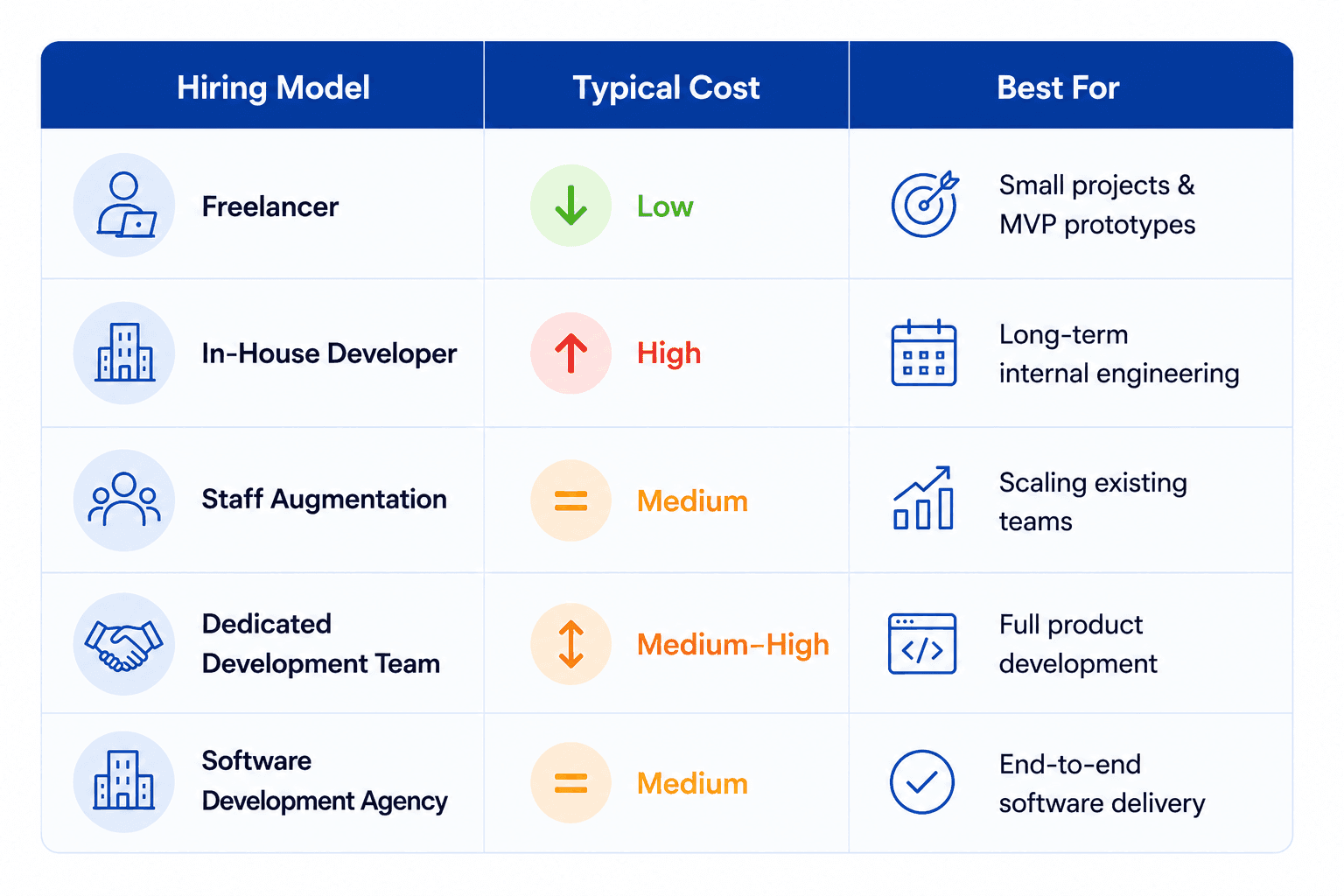
The cost of hiring developers depends on the hiring model, developer expertise, technology stack, project complexity, and geographic location. While startups naturally focus on controlling expenses, selecting the right hiring approach often provides greater long-term value than choosing the lowest-cost option.
According to Grand View Research, the global IT outsourcing market continues to expand as startups seek experienced engineering talent while reducing recruitment and operational costs. — Grand View Research
Several factors influence hiring costs:
• Technology stack
• Developer experience
• Hiring location
• Project duration
• Engagement model
• Team size
• Infrastructure requirements
Typical Startup Hiring Costs
How Can Startups Reduce Development Costs?
Reducing costs doesn't necessarily mean hiring fewer developers. Instead, startups should optimize hiring strategies to maximize productivity while maintaining software quality.
Effective cost-saving strategies include:
• Building an MVP before adding advanced features.
• Hiring dedicated developers instead of expanding permanent headcount.
• Using staff augmentation for temporary skill gaps.
• Automating testing and deployments.
• Choosing scalable cloud infrastructure.
• Reusing proven software frameworks.
These strategies allow startups to remain agile while managing limited budgets effectively.
Which Tools Help Manage Remote Development Teams?
Modern collaboration tools enable startup teams to communicate effectively, manage projects efficiently, and deliver software consistently regardless of location. Selecting the right tools improves transparency, collaboration, and development productivity.
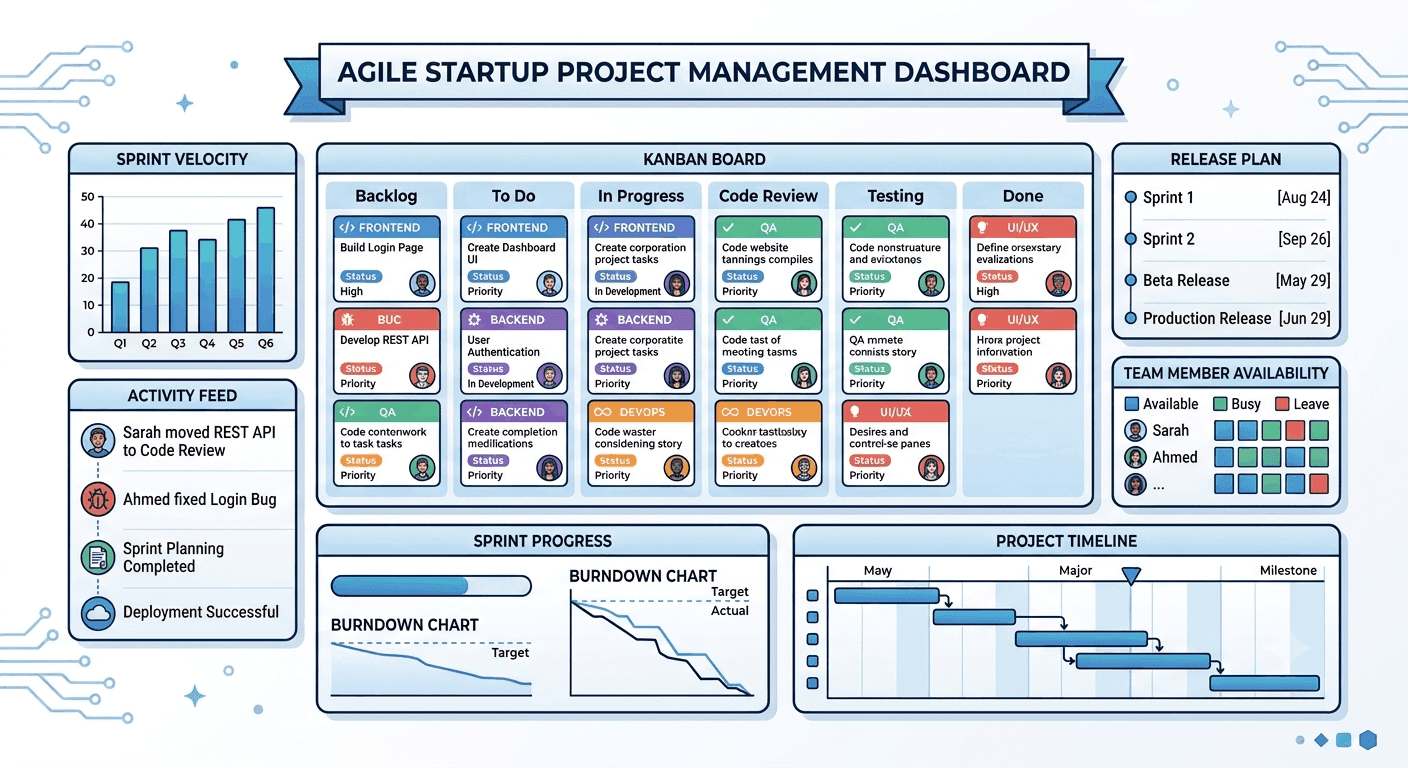
According to Atlassian, high-performing software teams rely on centralized collaboration platforms, Agile project management, and continuous communication to improve delivery performance. — Atlassian Agile Report,
Project Management
Popular project management platforms include:
• Jira
• Trello
• ClickUp
• Asana
• Monday.com
These platforms help teams organize backlogs, assign work, monitor sprint progress, and manage product roadmaps.
Communication Platforms
Remote startups commonly use:
• Slack
• Microsoft Teams
• Google Meet
• Zoom
Effective communication reduces misunderstandings while improving collaboration across distributed engineering teams.
Code Collaboration
Development teams typically collaborate using:
• GitHub
• GitLab
• Bitbucket
These platforms support:
• Version control
• Pull requests
• Code reviews
• Continuous Integration
• Deployment pipelines
Documentation and Knowledge Management
Keeping documentation organized helps developers become productive faster.
Popular documentation tools include:
• Notion
• Confluence
• Google Workspace
• Microsoft SharePoint
Centralized documentation supports better onboarding while reducing project risks.
Development Infrastructure
Modern startup engineering teams frequently rely on:
• Docker
• Kubernetes
• Jenkins
• GitHub Actions
• AWS
• Microsoft Azure
• Google Cloud Platform
Cloud-native infrastructure enables startups to scale applications without major infrastructure investments.
How Can BrillianTech Help Startups Build Scalable Development Teams?
BrillianTech helps startups build scalable development teams by providing experienced software engineers, flexible engagement models, and end-to-end product development services. Whether you're building your first MVP, expanding an existing engineering team, or accelerating product delivery after funding, BrillianTech provides the technical expertise needed to move your startup forward.
Unlike traditional recruitment, BrillianTech enables startups to access pre-vetted developers across multiple technologies without lengthy hiring cycles.
Our expertise includes:
• Custom Software Development
• Web Application Development
• Mobile App Development
• AI Solutions
• Cloud Application Development
• Dedicated Development Teams
• Staff Augmentation
• Quality Assurance Testing
• UI/UX Design
• Software Maintenance & Support
Whether you need one developer or an entire cross-functional engineering team, BrillianTech provides flexible hiring models that grow alongside your business.
Why Startups Choose BrillianTech
Startups partner with BrillianTech because we combine technical expertise with flexible delivery models designed for growing businesses.
Benefits include:
• Pre-vetted software developers
• Fast onboarding
• Agile development methodology
• Transparent pricing
• Flexible engagement models
• Daily and weekly progress reporting
• Scalable engineering teams
• Dedicated project managers
• Long-term technical support
From MVP development to enterprise-scale applications, our teams focus on building software that supports sustainable business growth.
Startup Hiring Checklist
A structured hiring checklist helps startups recruit developers more efficiently while reducing hiring risks and improving long-term project success.
Before hiring your first developer, confirm that you've completed each of the following steps:
✅ Clearly define your business goals.
✅ Finalize your MVP feature list.
✅ Select your preferred technology stack.
✅ Estimate your hiring budget.
✅ Choose the right hiring model.
✅ Prepare a detailed job description.
✅ Review developer portfolios.
✅ Conduct structured technical interviews.
✅ Verify communication and collaboration skills.
✅ Establish onboarding documentation.
✅ Set up Agile development workflows.
✅ Plan for future team scalability.
Following this checklist significantly improves recruitment quality while helping startups avoid costly hiring mistakes.
What's Next After Hiring Developers for Your Startup?
Hiring developers is only the first step toward building a successful startup. Long-term success depends on maintaining efficient development processes, continuously improving your product, and scaling your engineering team as customer demand increases.
After hiring your developers, your next priorities should include:
1. Launch your Minimum Viable Product (MVP).
2. Collect customer feedback.
3. Prioritize feature improvements.
4. Monitor product performance.
5. Strengthen security and quality assurance.
6. Expand your engineering team strategically.
7. Invest in cloud infrastructure and automation.
8. Continue optimizing your product based on user behavior.
If you're ready to move from hiring to product development, partnering with an experienced software development company can help you build faster, improve product quality, and scale efficiently. BrillianTech's software development team supports startups with custom software development, mobile app development, cloud solutions, quality assurance, and scalable engineering services to bring products from idea to growth.
Conclusion
Hiring developers for your startup is a strategic business decision that influences product quality, development speed, customer satisfaction, and long-term growth. By defining your product requirements, selecting the right technology stack, choosing an appropriate hiring model, and following a structured recruitment process, you can build a development team capable of turning innovative ideas into successful digital products.
Rather than hiring as quickly as possible, successful startups hire intentionally. Experienced developers, effective onboarding, and scalable engineering practices help reduce technical debt while supporting continuous product innovation.
Whether you're building your first MVP or scaling after investment, BrillianTech provides experienced developers, dedicated development teams, and staff augmentation services that help startups accelerate software delivery with confidence.
If you're ready to build a high-performing engineering team, contact BrillianTech's Startup Experts to discuss your project and discover the right hiring strategy for your business.