
01. Why Smart Businesses Are Building AI Apps Right Now
For years, software simply followed instructions. You clicked a button, and the app did exactly what it was told. That era is ending. Companies are now building intelligent applications that can predict outcomes, recommend next steps, automate decisions, personalize experiences, and help people make better choices. This shift is the heart of modern AI app development.
You can already see AI-powered apps at work everywhere: answering customer questions, scoring sales leads, spotting fraud, supporting doctors, optimizing delivery routes, reading documents, and predicting machine failures before they happen. A growing number of these are AI agent apps that can carry out multi-step tasks with very little human input.
Here is the part many teams underestimate. The hard work is not "adding AI" to a screen. The real challenge of AI application development is connecting seven things at once: a clear business goal, trusted data, the right model, real workflows, strong security, a usable experience, and a way to keep improving. Get those right, and you have a durable advantage. Miss them, and you have an expensive demo. This guide walks through how to build an AI app the right way.
02. What Exactly Is an AI App? (And How It Differs From Regular Software)
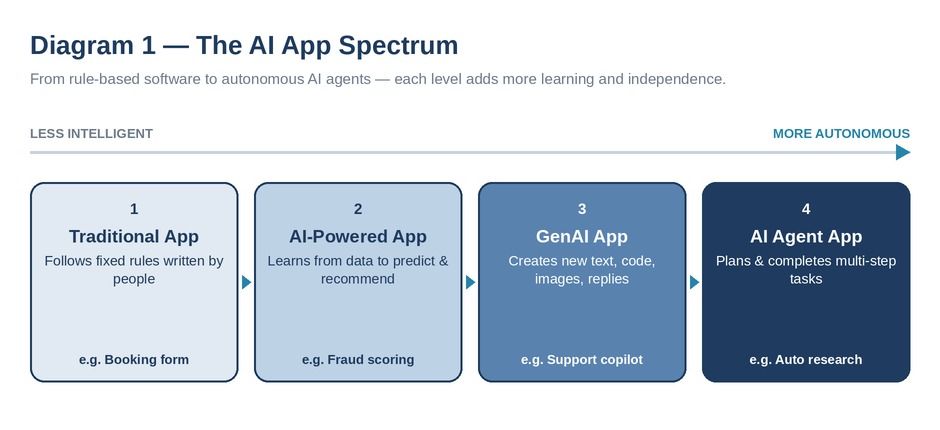
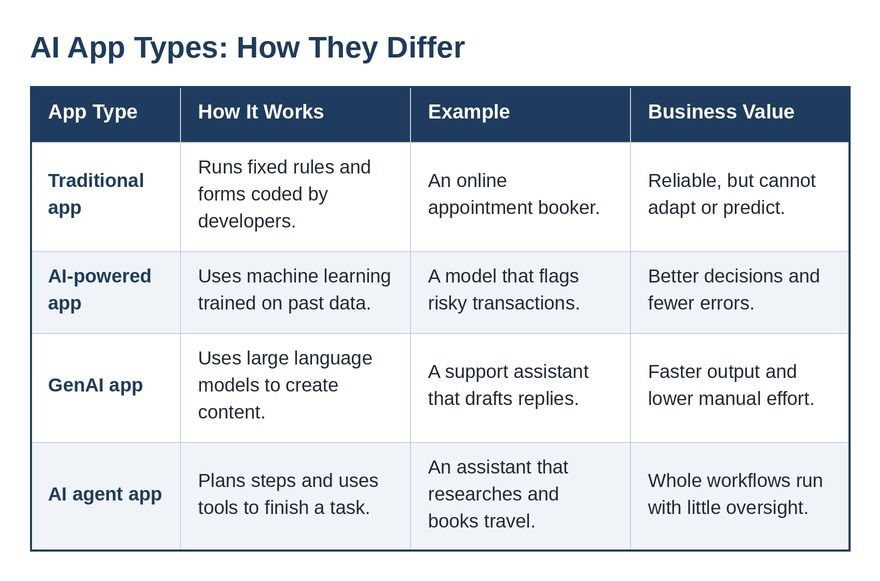
An AI app is software that uses artificial intelligence to do things ordinary code cannot do well: understand language, read images, predict what happens next, automate decisions, personalize content, or guide a user through a smart workflow. A traditional app follows fixed rules someone wrote in advance. An AI-powered app learns from data, adapts to behavior, and supports smarter decisions over time.
It helps to see AI apps as a spectrum. Each step adds more intelligence and more independence.
03. Should You Build an AI App? A Simple Way to Decide
Not every problem needs AI. The best custom AI application projects begin with a clear, repeated decision worth improving. Use this simple test before you commit budget.
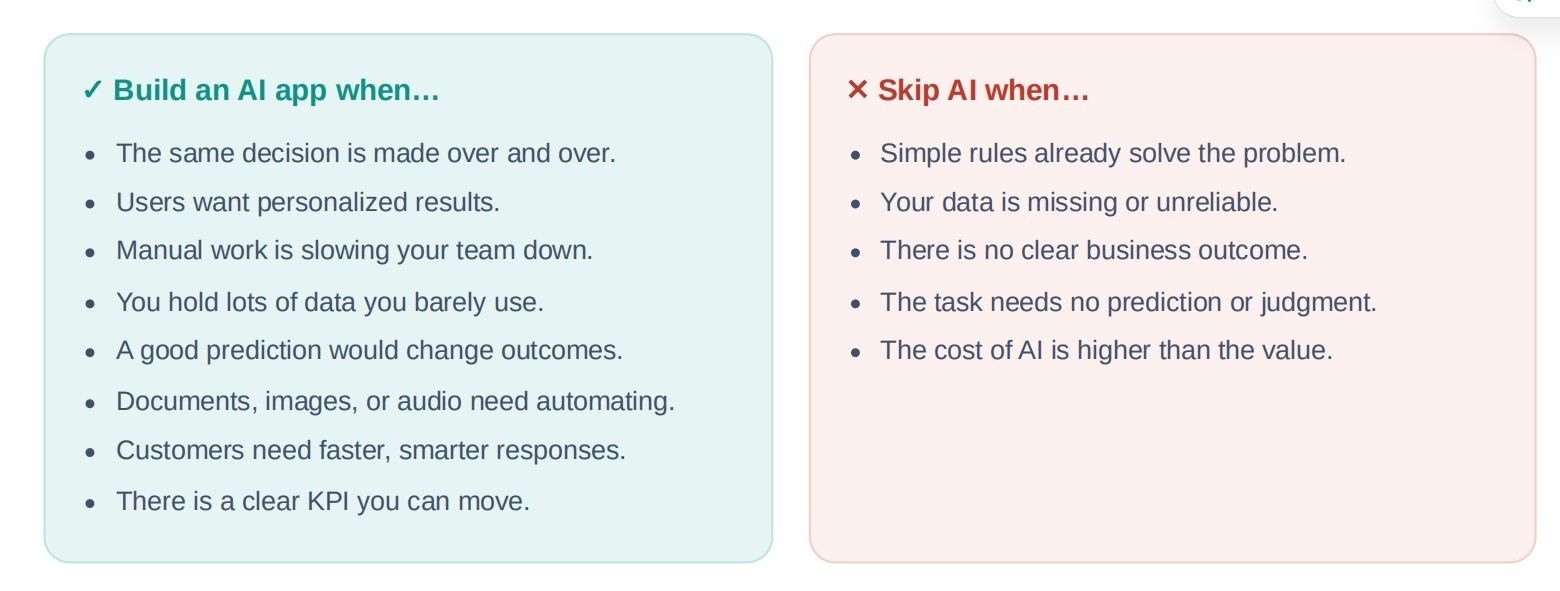
Rule of thumb: If a short checklist of rules can do the job, use rules. Save AI for problems where learning from data clearly beats fixed logic.
04. 15 AI Apps Businesses Are Building Today
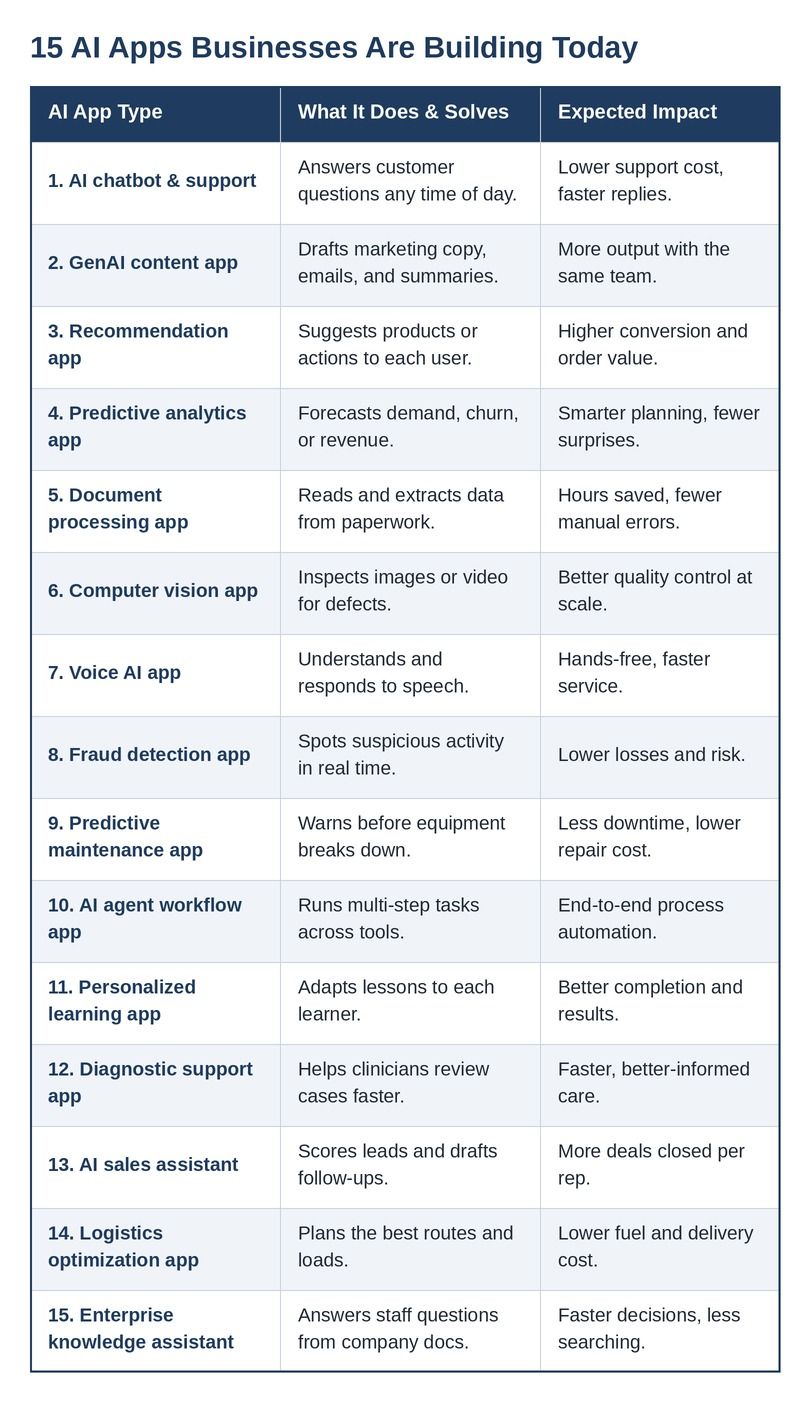
Here are practical categories of AI apps, the problem each one solves, and the impact you can expect. Most real projects combine two or three of these.
05. How to Build an AI App: A 12-Step Roadmap From Idea to Production
This is the core AI app development process. Notice that it starts with a business problem, not a model. The biggest mistakes happen when teams pick the technology first and look for a problem later.
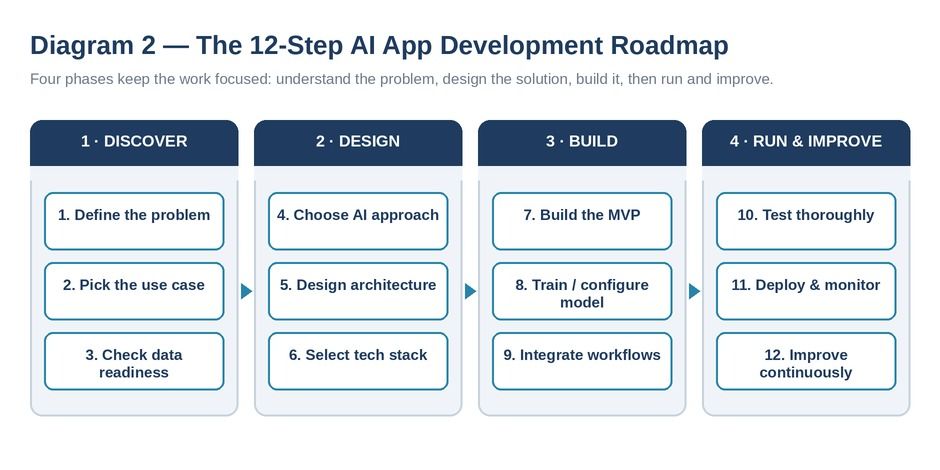
Step 1 — Define the business problem
Start with the problem, not the technology. Answer four questions clearly: What are we solving? Who are the users? Which decision or workflow gets better? Which KPI proves success? If you cannot name the KPI, you are not ready to build.
Step 2 — Pick the right use case
Choose a use case where the pain is real, the data exists, users will adopt it, and the payback is clear. Good first targets include cutting support response time, lifting sales conversion, predicting equipment failure, automating document review, or detecting fraud.
Step 3 — Check your data readiness
Data is the foundation of every AI app. Before writing code, review what data you have, how clean it is, who owns it, how private it is, its formats, how much history exists, and whether you need real-time feeds. Also check for bias and gaps. Weak data leads to weak AI — no model can fix bad inputs.
Step 4 — Choose the right AI approach
Match the method to the problem: simple rule-based automation, classic machine learning, deep learning, natural language processing, computer vision, generative AI, a RAG application that grounds answers in your documents, or full AI agents. Often a hybrid works best. The smartest AI software development teams pick the simplest approach that meets the goal — not the flashiest model.
Step 5 — Design the AI app architecture
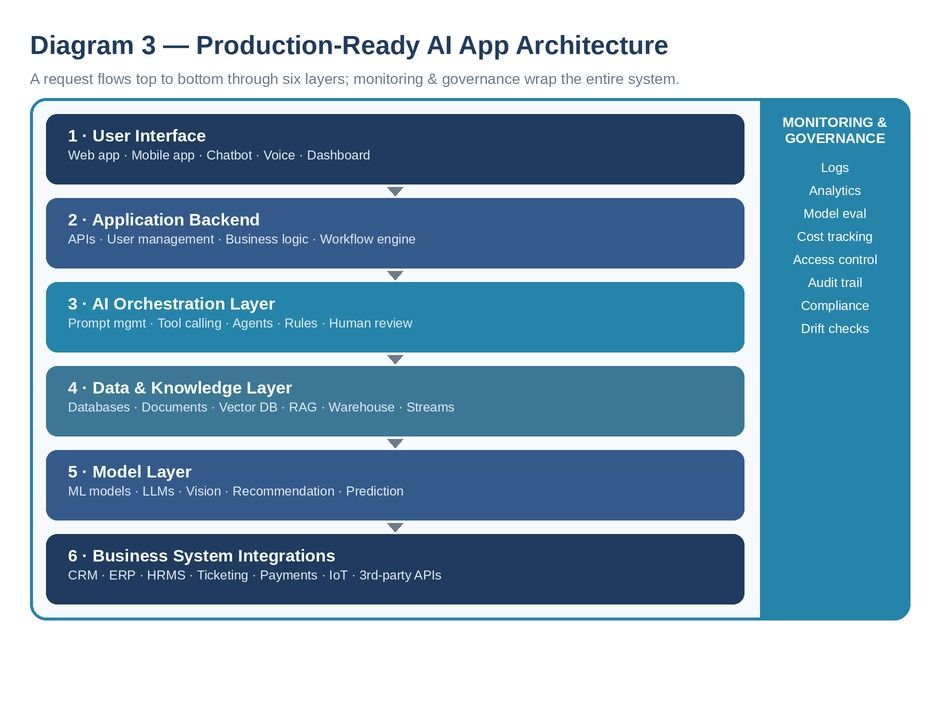
Map the layers before building: the user experience, the application backend, data ingestion, the model layer, a knowledge or RAG layer, workflow orchestration, API integrations, security and access control, monitoring, and a feedback loop for retraining. A clear AI app architecture prevents painful rework later.
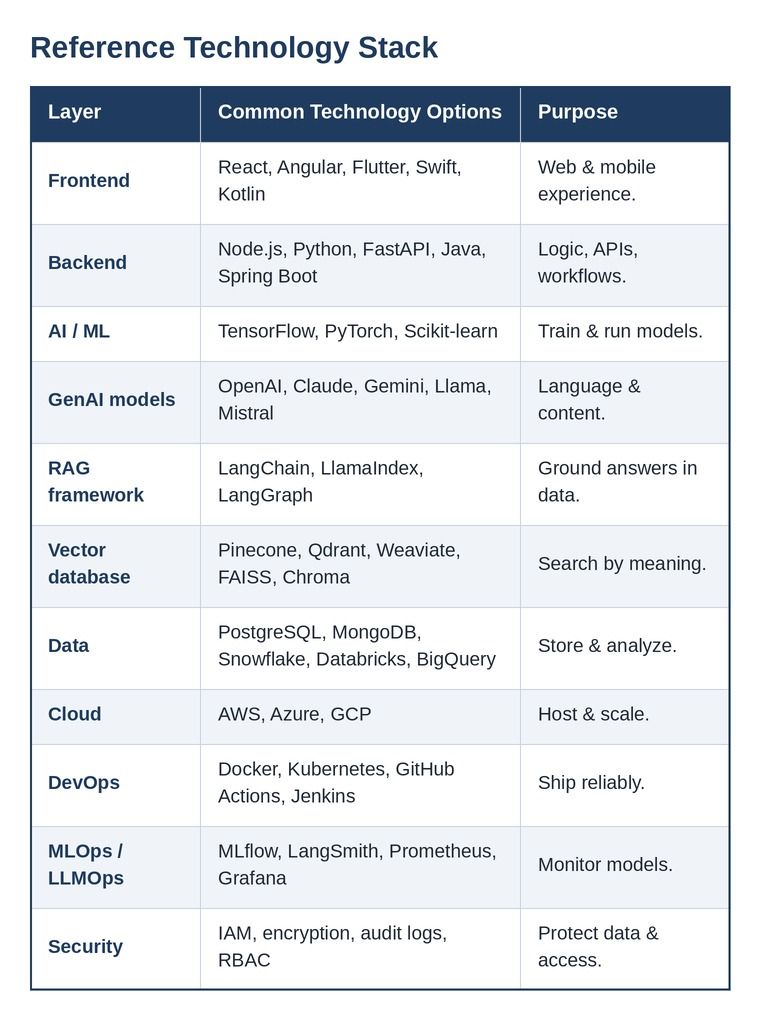
Step 6 — Select the technology stack
Pick tools that fit your team and scale. Below is a practical reference stack used across many enterprise AI app projects.
Step 7 — Build the MVP
Start small and prove value fast. A focused MVP should cover one high-value journey, the minimum AI capability needed, basic integration, a way to collect feedback, a success metric, and human review where mistakes are costly.
Step 8 — Train, fine-tune, or configure the model
Depending on the use case, you might use a pre-trained model as-is, fine-tune one on your data, train a custom ML model, build a RAG pipeline, rely on careful prompt engineering, add human-in-the-loop checks, or combine several methods. Start simple and add complexity only when results demand it.
Step 9 — Integrate AI into real workflows
AI creates value only when it lives inside the tools people already use. Connect the app to your CRM, ERP, HRMS, data platforms, ticketing tools, document stores, chat tools, and payment systems. An isolated model is a science project; an integrated one is a business asset.
Step 10 — Test for accuracy, security, and usability
Test more than functionality. Check model accuracy, control hallucinations in GenAI app development, test for bias, protect privacy, confirm API reliability, run load tests, gather user acceptance feedback, cover edge cases, and make outputs explainable.
Step 11 — Deploy and monitor
Launch is the start, not the finish. Watch accuracy, latency, cost per request, user feedback, failure rate, model drift, security events, usage patterns, and the business KPI you set in Step 1. This is where MLOps and LLMOps earn their keep.
Step 12 — Improve continuously
A production-ready AI app gets better with use. Improve it through new data, retraining, prompt updates, feedback, behavior analysis, and process refinement. Treat the app as a living product, not a one-time delivery.
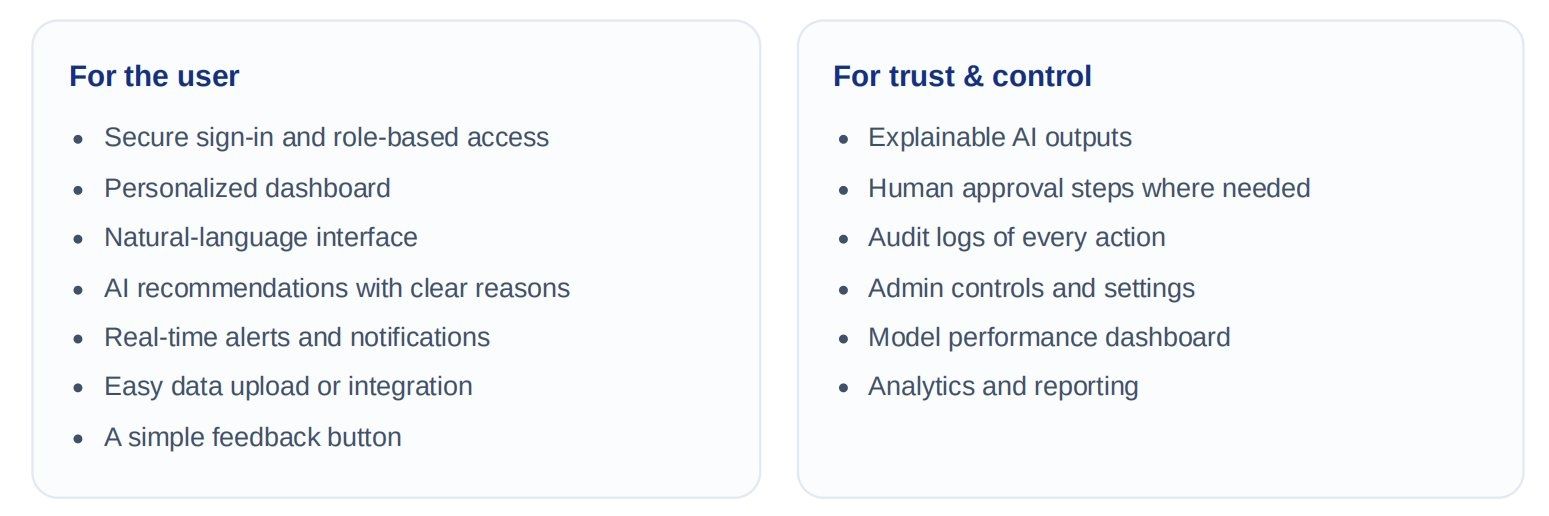
06. Features That Make an AI App Trustworthy and Useful
Choose features by business impact, not by what is trending. These are the building blocks most successful AI apps share:
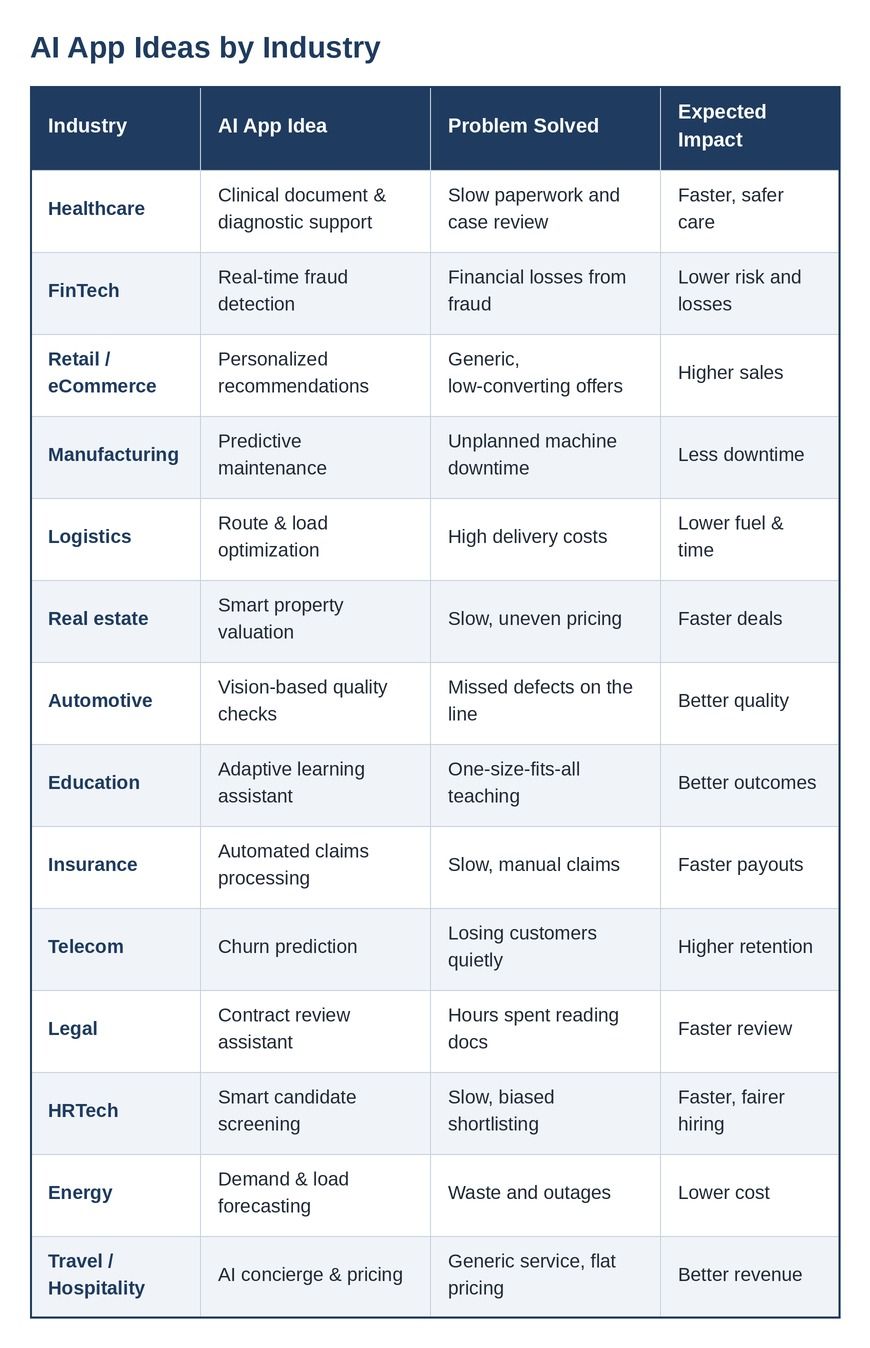
07. AI App Ideas by Industry
The same technology solves very different problems depending on the sector. Here are grounded ideas across major industries.
08. What Does It Cost to Build an AI App?
There is no single price tag, and anyone who quotes one before understanding your problem is guessing. The AI app development cost depends on use-case complexity, data readiness, the type of model, the number of integrations, UX needs, cloud infrastructure, security and compliance, model training, MLOps/LLMOps work, team size, and ongoing support. Instead of a fixed number, think in tiers.
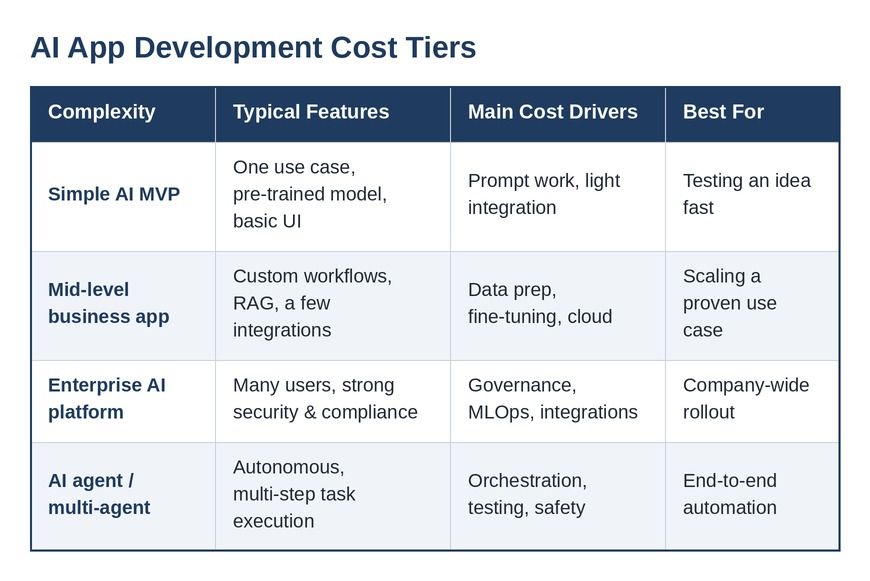
Smart budgeting: Start with a Simple AI MVP to prove value, then invest in the next tier only after the KPI moves. This protects your budget and builds internal trust.
09. Turning Your AI App Into Revenue
If you plan to sell your AI app, the pricing model should match the value it creates. Charging a flat fee for something that saves thousands of hours leaves money on the table; charging per use for a low-frequency tool scares users away. Common AI app monetization models include:
- SaaS subscription — a predictable monthly or yearly fee.
- Usage-based pricing — pay for what you actually use.
- Per-seat pricing — a price for each active user.
- Freemium — a free tier that upgrades to paid features.
- Enterprise licensing — a custom contract for large organizations.
- API-based pricing — charge other apps that call your AI.
- Outcome-based pricing — tie price to results, like deals closed.
- White-label — let partners rebrand and resell your app.
- Marketplace model — earn a share of transactions.
- Managed AI service — sell setup, hosting, and support.
10. Proving the Value: How to Measure AI App ROI
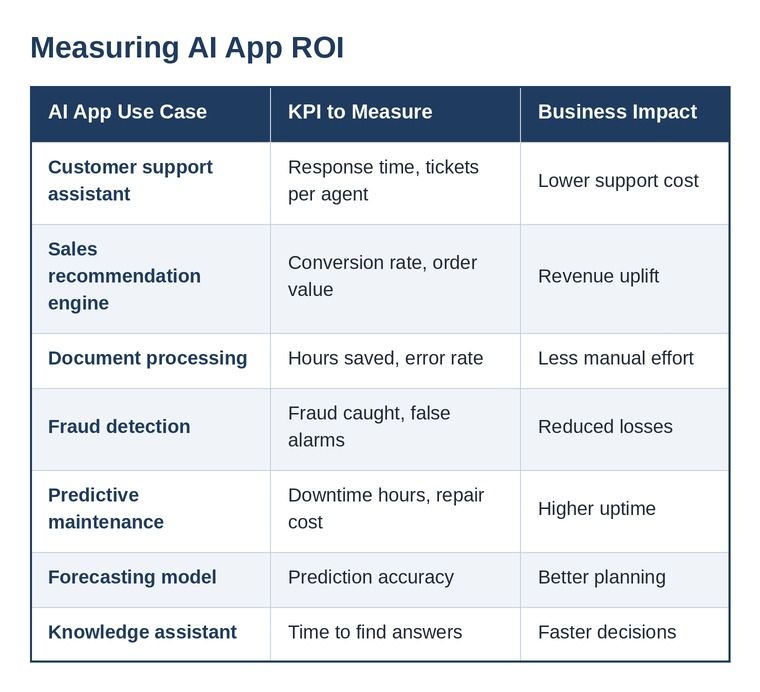
An AI app earns its budget only when you can show what changed. Pick one or two clear KPIs at the start, measure them before launch, and track them after. Below are common use cases and the metrics that prove value.
11. Building AI Apps People Can Trust: Security & Governance
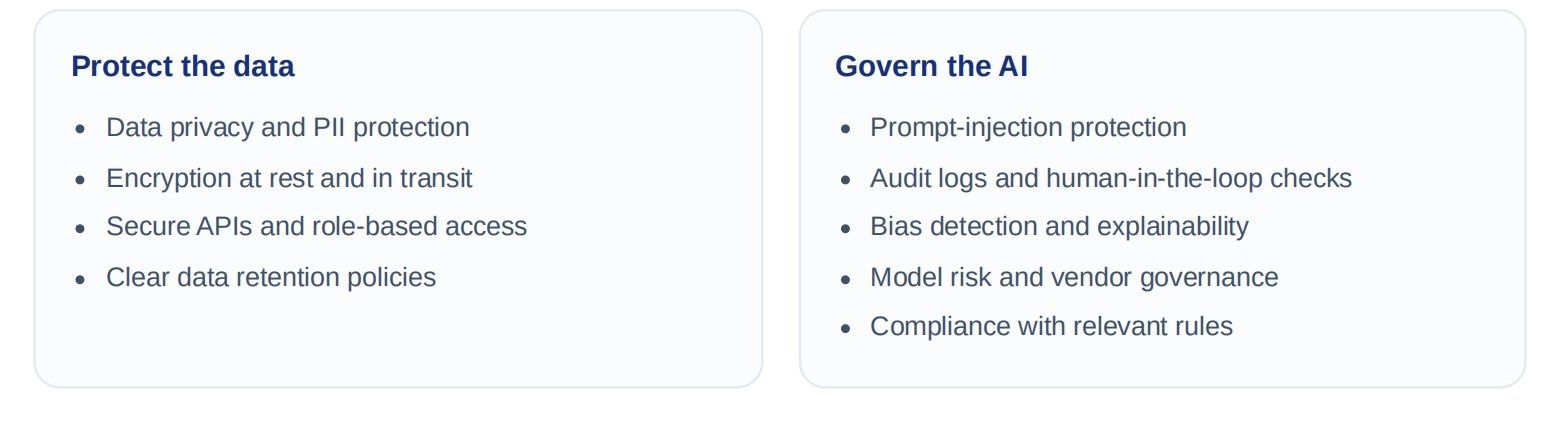
For enterprises, trust is not optional. AI governance is what turns a promising prototype into something a regulated business can actually deploy. Build these controls in from day one, not after launch:
12. The Real Reasons AI Projects Fail (And How to Avoid Them)
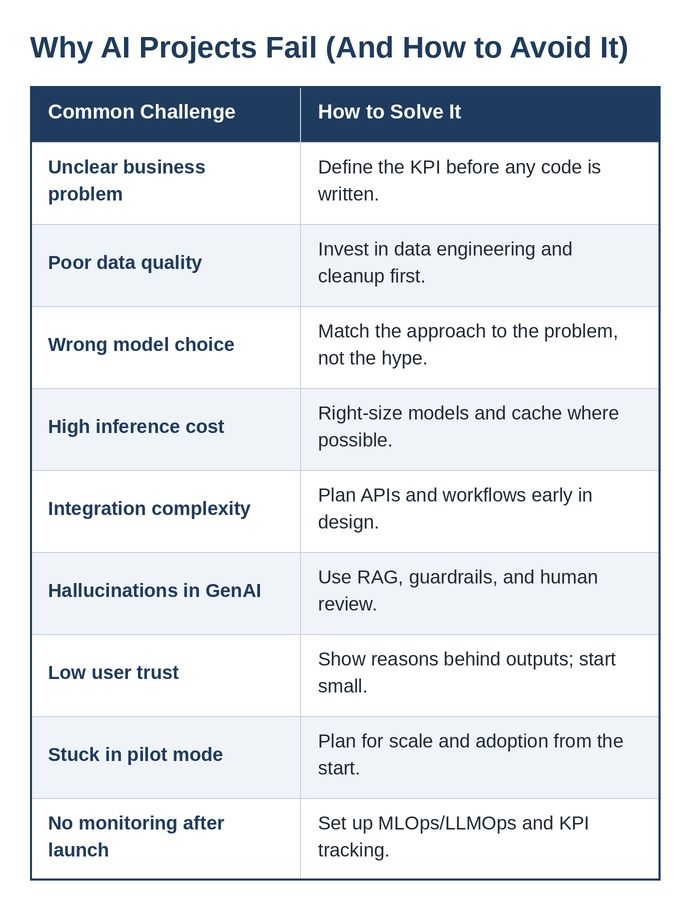
Most failed AI projects do not fail because of the model. They fail for predictable, avoidable reasons. Here are the common traps and the fix for each.
13. What a Production-Ready AI App Looks Like Under the Hood
A real AI app is more than a model behind a screen. It is a set of layers that work together, wrapped in monitoring and governance. The diagram below shows how a request flows from the user, through the AI, into your data and business systems, and back — with oversight at every step.
14. Where AI App Development Is Heading Next
The space is moving fast, but a few clear directions are worth planning for now:
- AI agents inside business apps that handle whole tasks, not just answers.
- Multimodal apps that work with text, images, voice, and video together.
- Voice-first interfaces and personalized AI copilots for every role.
- Edge AI and private or on-prem LLMs for speed and data control.
- RAG-based knowledge apps that answer from a company's own content.
- AI observability and governance platforms becoming standard, not optional.
- Low-code AI development and stronger human–AI collaboration.
- Domain-specific apps tuned deeply for one industry.
15. From Idea to Impact: Your Next Step
Building an AI app is not about bolting a model onto software. It is a business transformation journey that brings together a clear problem, trusted data, the right AI approach, solid product engineering, secure architecture, real workflow integration, and a habit of continuous improvement. Do those well, and you get an application that earns its place in the business — and keeps getting better.