
Key Takeaways
• Microservices architecture divides an application into independently deployable services organized around specific business capabilities.
• Spring Boot simplifies production-ready Java services, but scalability depends on architecture, infrastructure, communication, and operations.
• Independent data ownership, asynchronous communication, caching, load balancing, and horizontal scaling can help services handle increasing workloads.
• Timeouts, retries, circuit breakers, and bulkheads help prevent failures in one microservice from cascading through the application.
• Docker, Kubernetes, CI/CD, and cloud infrastructure help teams package, deploy, monitor, and scale services independently.
• Observability combines metrics, logs, and distributed tracing to diagnose problems across distributed services.
• Microservices are not automatically more scalable than monoliths; architecture and operational discipline determine scalability.
What Are Scalable Microservices with Spring Boot?
Scalable microservices are independently deployable application services designed around specific business capabilities and built to handle changing workloads. Spring Boot provides the Java development foundation, while the surrounding architecture determines how effectively those services communicate, scale, recover from failures, and operate in production.
For example, an e-commerce platform could separate its functionality into User, Product, Order, Payment, Inventory, and Notification services. If product traffic suddenly increases during a sale, the Product Service can be scaled independently instead of adding resources to the entire application.
Microservices architecture is a software architecture approach in which an application is divided into independently deployable services organized around specific business capabilities. Each service should have a clear responsibility and ownership boundary rather than becoming another tightly coupled component.
Microservices vs Monolithic Architecture
A monolithic application packages multiple business capabilities into one deployable unit, while microservices separate those capabilities into independently deployable services. The difference matters most when teams need independent scaling, faster releases, or isolation between application components.
For example, a banking application built as a monolith may require the entire application to be redeployed when one feature changes. A microservices architecture can allow a team to update the Payment Service independently, provided its contracts and dependencies remain compatible.
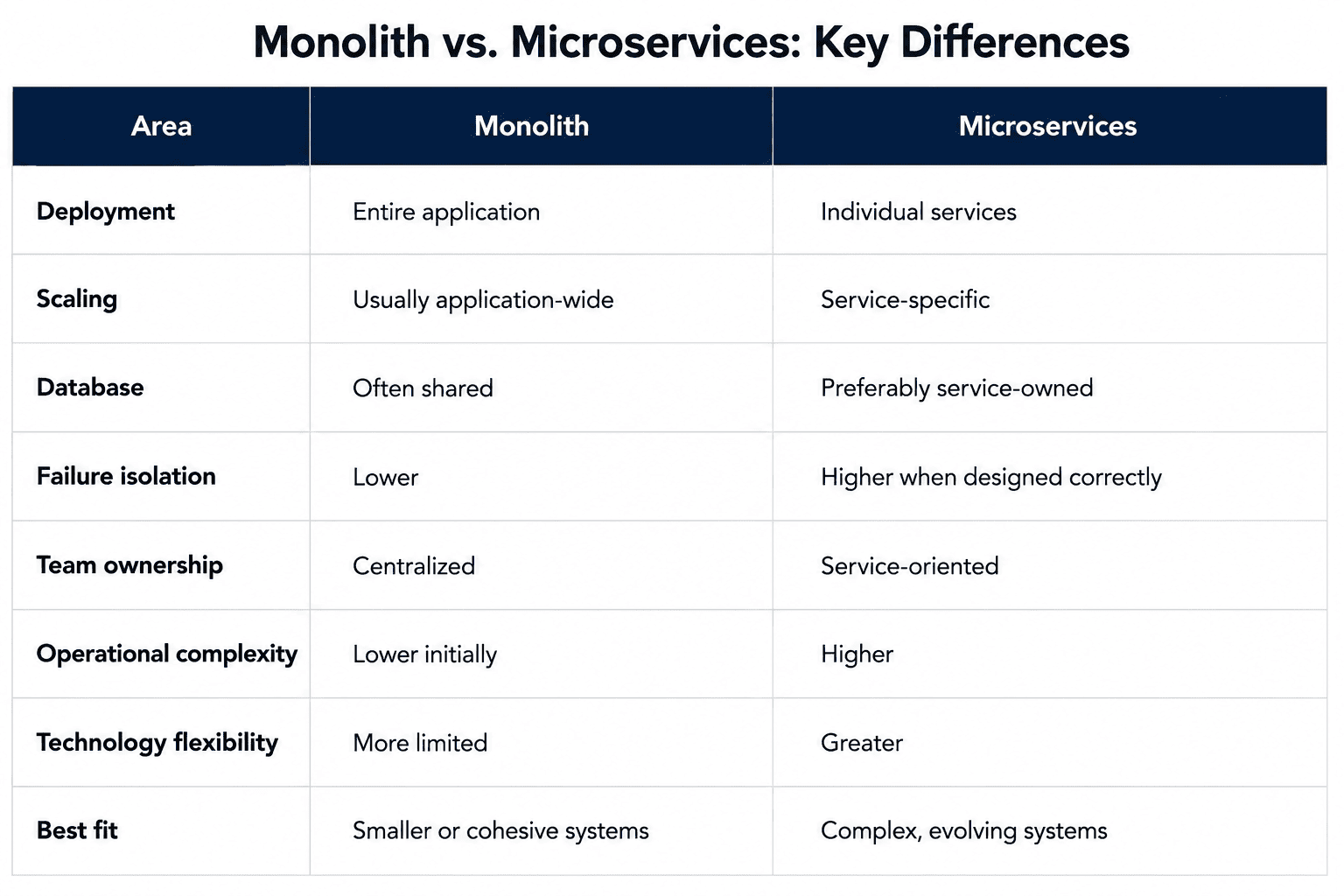
Microservices do not automatically make an application more scalable. A poorly designed microservices system can introduce network latency, distributed transactions, operational overhead, and difficult debugging.
That trade-off is important. A well-structured modular monolith can be a better starting point when the application does not yet justify distributed-system complexity.
Why Is Spring Boot Suitable for Microservices Development?
Spring Boot is a Java framework that simplifies the development of independently deployable, production-ready services and provides an extensive ecosystem for building backend applications. Its conventions, auto-configuration, embedded server support, and integration with the wider Spring ecosystem reduce infrastructure work so developers can focus more heavily on business logic.
For example, a team can create a Spring Boot REST service with Spring Web, connect it to PostgreSQL using Spring Data, secure endpoints with Spring Security, and expose operational information through Spring Boot Actuator.
Spring Cloud extends this ecosystem for distributed-system patterns including configuration management, service discovery, routing, service-to-service calls, and load balancing.
What Role Does Spring Cloud Play in Microservices?
Spring Cloud provides tools for implementing common distributed-system patterns around Spring-based applications. It can help teams address configuration, service registration and discovery, routing, service-to-service communication, and load balancing without building every supporting mechanism from scratch.
For example, when services run dynamically across multiple instances, hard-coding the location of every service becomes fragile. Service discovery allows applications to locate available service instances dynamically.
However, the exact architecture depends on the deployment environment. Kubernetes, for example, already provides service discovery mechanisms, so introducing additional infrastructure should be based on an actual requirement rather than following a checklist blindly.
Spring Boot provides the application foundation; Spring Cloud and cloud infrastructure provide supporting distributed-system capabilities.
For businesses looking to build robust Java-based applications, Java Development Services can provide the expertise needed to develop and scale Spring Boot solutions effectively.
How Do You Design a Scalable Microservices Architecture with Spring Boot?
A scalable Spring Boot microservices architecture starts with clear business boundaries and then adds reliable communication, independent data ownership, resilience, security, observability, and automated deployment. The architecture should evolve from business capabilities rather than from an arbitrary decision to create many small services.
A practical architecture can look like this:
Customer → API Gateway → Order Service → Payment Service
** ↘ Inventory Service**
** ↘ Notification Service**
Each service can own its code, deployment lifecycle, and data while communicating through well-defined APIs or events.
How Should You Define Service Boundaries?
Service boundaries should generally follow business capabilities, ownership boundaries, and domain responsibilities rather than simply splitting classes or database tables. Domain-driven design can help teams identify meaningful boundaries while avoiding services that are too large or unnecessarily small.
For example, an e-commerce application may have an Order Service responsible for order creation and status, while the Payment Service handles payment authorization and transaction state.
A useful service boundary should answer three questions:
1. What business capability does this service own?
2. Which data does it control?
3. Which team is responsible for operating and changing it?
A microservice should have a clear reason to exist. Creating dozens of tiny services without clear ownership can produce excessive network communication and operational overhead.
For businesses that need software tailored to their workflows and growth goals, Custom Software Development Services can help turn complex requirements into scalable digital solutions.
How Do You Create Individual Spring Boot Services?
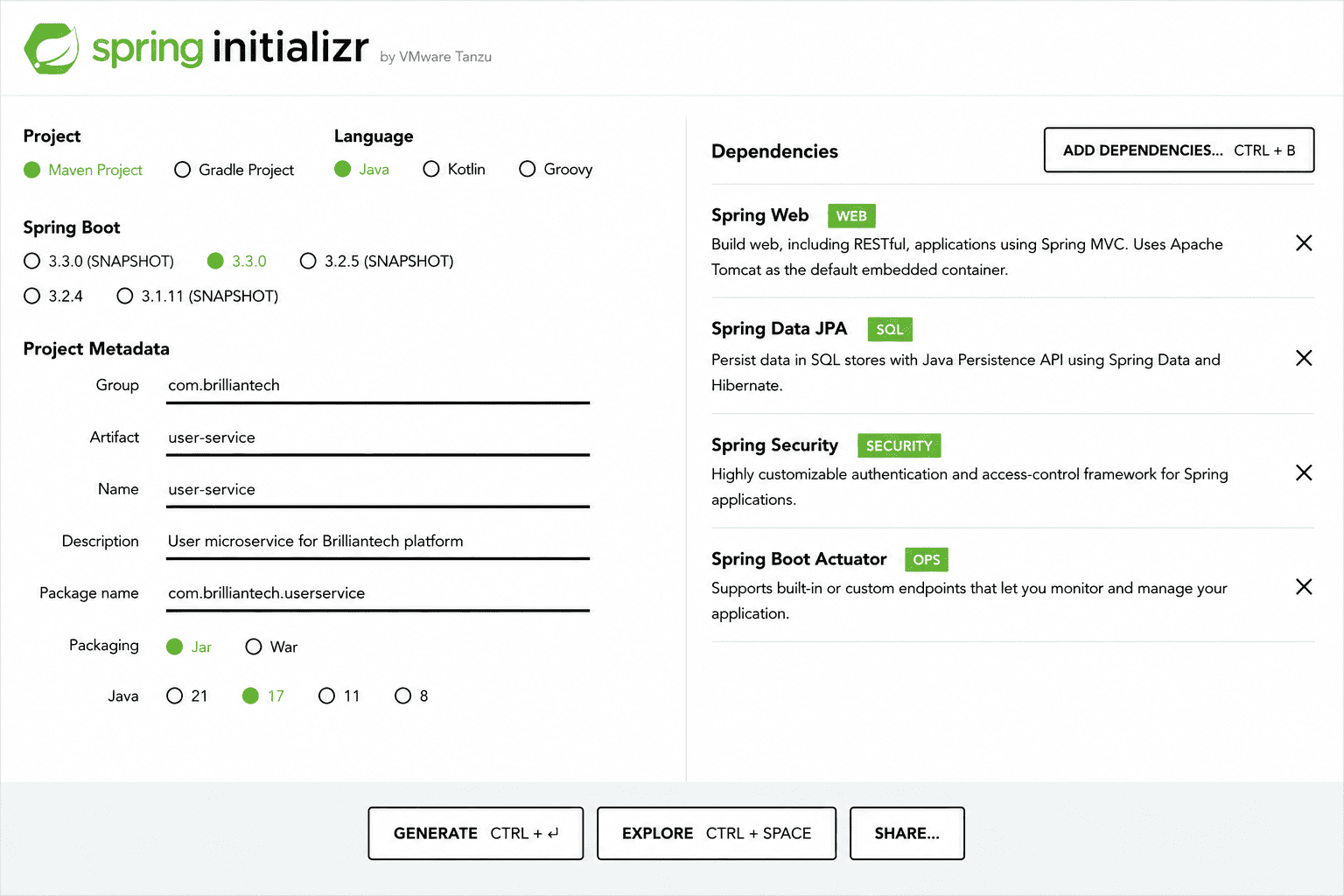
Each microservice should be developed as an independently buildable and deployable Spring Boot application. Spring Initializr can generate the project structure and dependencies needed to begin development.
A typical service can include:
• Spring Web for REST APIs
• Spring Data for persistence
• Spring Security for authentication and authorization
• Spring Boot Actuator for health and metrics
• Validation libraries for request validation
• A messaging client when event-driven communication is required
For example, an Order Service might expose POST /orders and GET /orders/{id} while keeping its internal domain model separate from the external API contract.
Spring's official service-discovery guide demonstrates how Spring applications can register with and discover other services using a service registry.
How Do Spring Boot Microservices Communicate With Each Other?
Spring Boot microservices typically communicate through synchronous APIs, asynchronous messaging, or a combination of both. The correct choice depends on latency requirements, consistency needs, failure tolerance, and the degree of coupling acceptable between services.
For example, an Order Service may synchronously call an Inventory Service when it needs an immediate stock response. After the order is confirmed, it could publish an event that the Notification Service consumes asynchronously.
When Should You Use REST APIs?
REST is appropriate when a service needs an immediate response from another service. REST APIs are easy to understand, widely supported, and suitable for many request-response workflows.
For example, GET /products/123 can retrieve product information from a Product Service while an API Gateway routes the client request to the correct service.
However, excessive synchronous calls can create a dependency chain.
Consider:
Order → Payment → Inventory → Shipping → Notification
If every call must complete before the Order Service responds, one slow dependency can slow the entire transaction.
Synchronous communication is useful for immediate decisions, but excessive synchronous dependencies can reduce resilience.
When Should You Use Kafka or RabbitMQ?
Asynchronous messaging is useful when services can process events independently rather than requiring an immediate response. Kafka and RabbitMQ are common technologies for implementing event-driven communication, although their architecture and operating models differ.
For example, after an order is placed, the Order Service can publish an OrderCreated event. Payment, analytics, inventory, and notification components can consume that event according to their responsibilities.
This approach reduces direct coupling between producers and consumers. It can also help absorb traffic spikes because consumers can process queued events at their own rate.
Event-driven architecture can improve decoupling, but it introduces additional concerns such as event ordering, duplication, retries, idempotency, and eventual consistency.
How Should Databases Be Designed for Spring Boot Microservices?
A scalable microservices architecture generally gives each service ownership of its own data rather than allowing every service to directly modify a shared database. Independent data ownership reduces coupling and allows services to evolve their persistence strategies separately.
For example, the Order Service may own order data while the Payment Service owns payment transactions. The two services communicate through APIs or events instead of directly updating each other's database tables.
Why Is Database-per-Service Important?
Database-per-service means each microservice controls the data required for its business capability. The underlying database technology does not necessarily have to be different for every service; ownership and access boundaries are the important principles
For example:
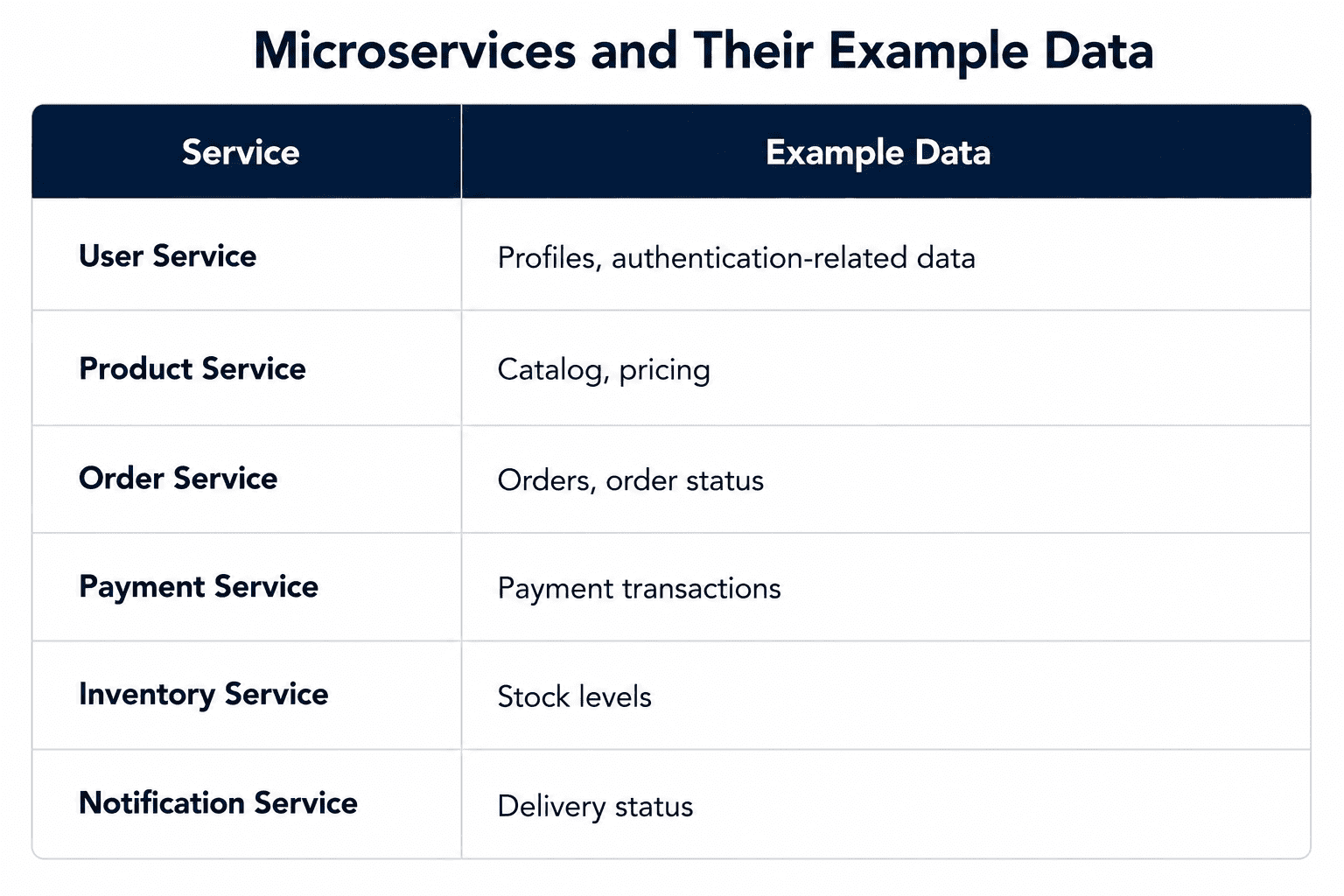
The major challenge is distributed consistency. A single ACID transaction cannot always span multiple independent databases in the same way as a traditional monolith.
For workflows requiring multiple services, teams can consider patterns such as event-driven workflows, sagas, CQRS, or carefully designed compensating actions.
How Can You Handle Failures in a Spring Boot Microservices Architecture?
Resilience in microservices means designing services to continue operating acceptably when dependencies become slow, unavailable, or unreliable. Timeouts, retries, circuit breakers, bulkheads, fallback strategies, and idempotency are core techniques for limiting failure propagation.
For example, if a Payment Service becomes unavailable, the Order Service should not wait indefinitely for a response or repeatedly create payment requests.
How Do Timeouts, Retries, and Circuit Breakers Work?
Timeouts limit how long a service waits, retries handle selected transient failures, and circuit breakers temporarily stop calls to an unhealthy dependency. These mechanisms work together to prevent one failing component from consuming resources throughout the system.
For example:
1. Order Service calls Payment Service.
2. Payment Service does not respond within the configured timeout.
3. A limited retry may occur if the failure is considered transient.
4. Repeated failures open the circuit.
5. The Order Service uses an appropriate fallback or returns a controlled response.
Retries must be designed carefully. Retrying a non-idempotent payment operation can accidentally create duplicate transactions if the system does not use idempotency controls.
Resilience patterns protect a distributed system by controlling how failures propagate between services.
How Do You Secure Spring Boot Microservices?
Spring Boot microservices should use layered security that protects external APIs, service-to-service communication, identities, secrets, and data in transit. Spring Security supports common enterprise authentication and authorization requirements, while OAuth 2.0, OpenID Connect, JWTs, TLS, and role-based access control can form part of a broader security architecture.
For example, an API Gateway can validate an access token before forwarding an authenticated request to an internal service, while services still enforce authorization for sensitive operations.
A production security strategy should consider:
• OAuth 2.0/OIDC
• JWT validation
• Role-based access control
• TLS/HTTPS
• Secret management
• Input validation
• Dependency vulnerability scanning
• Service-to-service authentication
• Least-privilege access
Security should not be added immediately before production. It should be part of the architecture from the beginning.
How Do Docker and Kubernetes Help Scale Spring Boot Microservices?
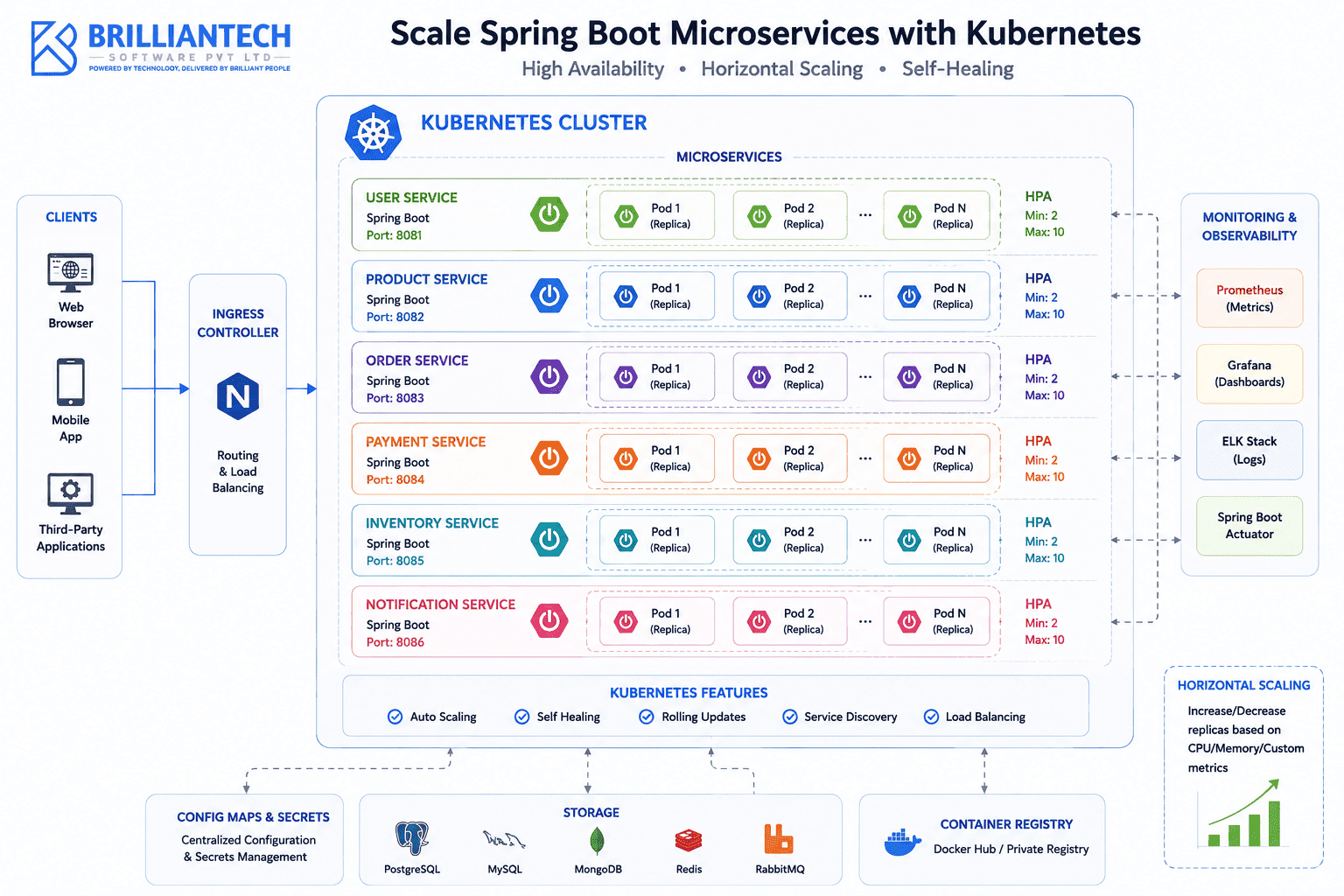
Docker packages Spring Boot services into portable containers, while Kubernetes provides orchestration capabilities for deploying, scaling, and managing containerized workloads. This combination is useful when an organization needs repeatable deployments and service-level scaling across cloud infrastructure.
Docker's official Java documentation specifically demonstrates how to containerize and run Spring Boot applications with Maven and use Docker-based development workflows.
How Does Kubernetes Enable Horizontal Scaling?
Kubernetes can run multiple instances of a microservice and automatically adjust capacity according to configured policies and workload conditions. Horizontal scaling allows a heavily used service to receive additional instances without necessarily scaling every other service.
For example, during a large e-commerce sale, the Product Service may require 10 replicas while the internal Administration Service continues running with two.
Kubernetes also supports rolling deployments, health checks, resource requests and limits, and load distribution between available instances.
The technology has become widely established in cloud-native environments. 82% of container users reported running Kubernetes in production in the CNCF's 2025 Annual Cloud Native Survey, up from 66% in 2023. — CNCF Annual Cloud Native Survey, 2026
For businesses looking to build, deploy, and scale cloud-native applications, Cloud Application Development Services can provide the expertise needed to create secure, scalable, and high-performance solutions.
What Should You Configure Before Scaling?
Horizontal scaling works effectively only when the application and infrastructure are designed for multiple instances. Services should generally avoid local session state, externalize configuration, expose health information, and manage shared resources carefully.
For example, storing user sessions only in one container can create problems when a load balancer sends the next request to another instance.
Before increasing replicas, review:
• Stateless application behavior
• Database connection limits
• CPU and memory requests
• Health probes
• Load-balancing configuration
• Cache strategy
• Message-processing concurrency
• Autoscaling thresholds
• Cloud infrastructure costs
Adding more replicas does not fix an architectural bottleneck inside the database or a slow downstream dependency.
How Do You Monitor and Observe Spring Boot Microservices?
Microservices observability combines metrics, centralized logs, and distributed traces to explain what is happening across multiple services. Without observability, diagnosing a production problem can require manually reconstructing a request path from disconnected systems.
Spring Boot Actuator provides production-oriented features for monitoring and managing applications, including health and metrics capabilities.
For example, if an Order request takes three seconds, distributed tracing can help determine whether the delay originated in the Order Service, Payment Service, database, or another dependency.
Which Observability Tools Should You Use?
A practical observability stack can combine Spring Boot Actuator, Prometheus, Grafana, centralized logging, and OpenTelemetry. Each tool addresses a different part of the operational picture.
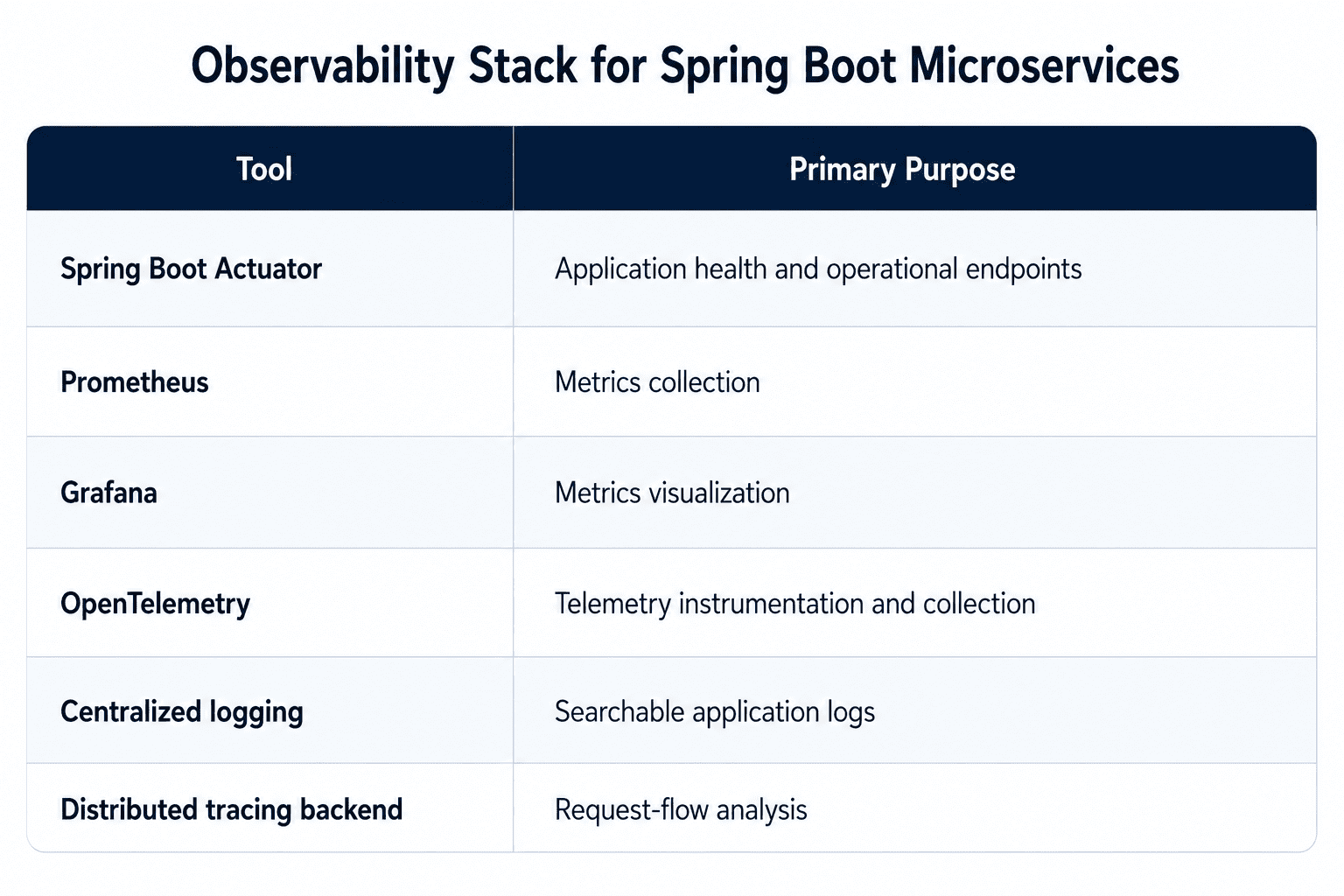
OpenTelemetry is a vendor-neutral framework for generating, collecting, and exporting telemetry such as traces, metrics, and logs.
In 2025, more than 24,000 contributors were associated with OpenTelemetry according to CNCF's annual survey reporting, and nearly 20% of respondents reported using profiling in their observability stack. — CNCF Annual Cloud Native Survey, 2026
Observability turns distributed-system behavior into measurable evidence that engineering teams can investigate.
How Can You Automate CI/CD for Spring Boot Microservices?
CI/CD automation allows each microservice to be built, tested, scanned, packaged, and deployed through a repeatable software delivery pipeline. This is essential when multiple services have independent release cycles.
For example, a code change to the Inventory Service can trigger automated unit tests, integration tests, security checks, container image creation, and deployment without rebuilding unrelated services.
A typical pipeline contains:
1. Developer commits code.
2. Automated unit tests run.
3. Integration tests validate dependencies.
4. Security and quality checks run.
5. Container image is created.
6. Image is stored in a registry.
7. Deployment is triggered.
8. Health checks validate the release.
9. Rollback occurs if required.
GitHub Actions, GitLab CI/CD, and Jenkins can all support these workflows.
CNCF's 2024 cloud-native survey reported that 60% of organizations were leveraging CI/CD for most or all applications. — CNCF Annual Cloud Native Survey, 2025
DORA's current framework measures software delivery using five metrics covering throughput and instability, including change lead time, deployment frequency, failed deployment recovery time, change fail rate, and deployment rework rate.
What Are the Best Tools for Building Spring Boot Microservices?
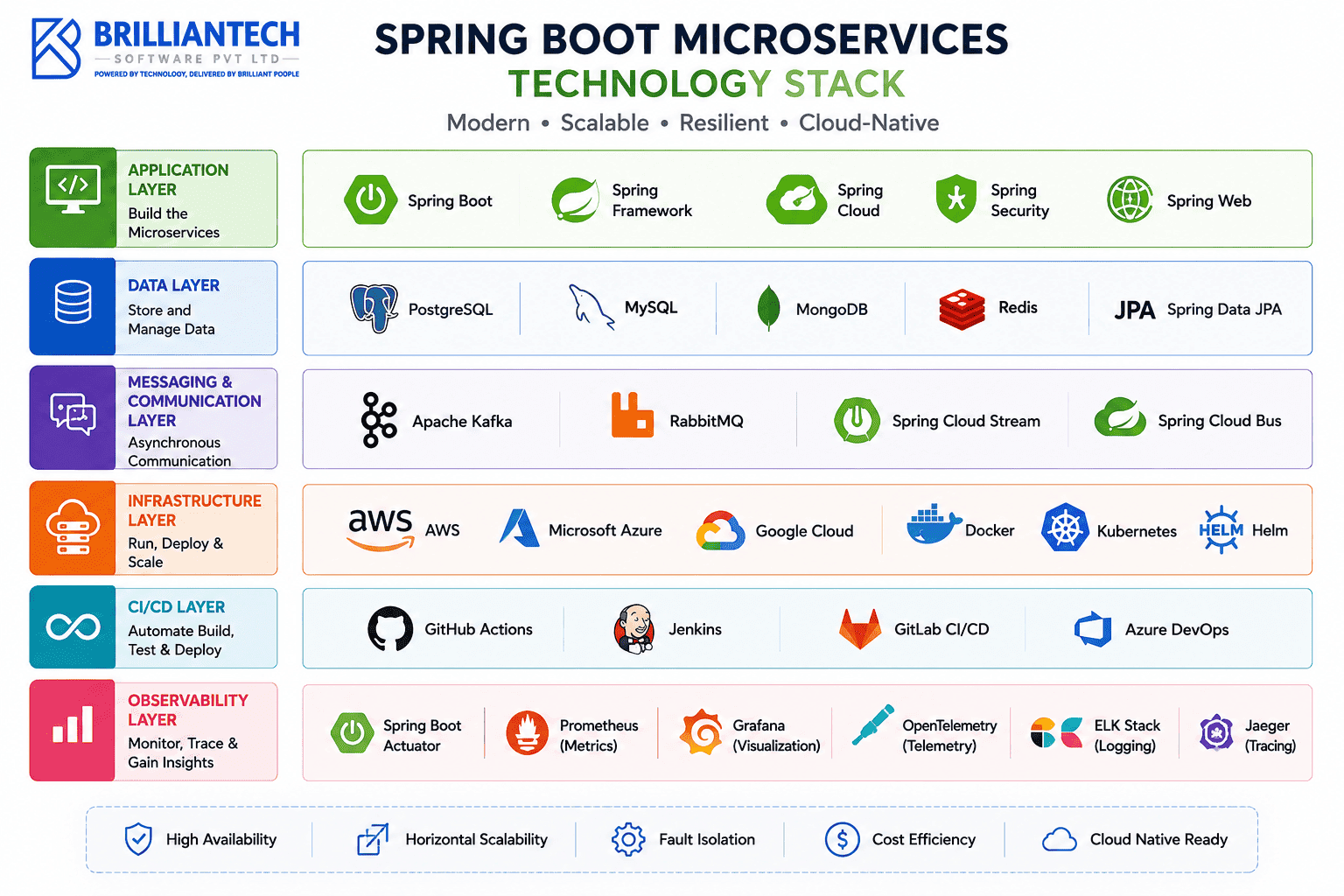
The best Spring Boot microservices stack combines application development, communication, data, infrastructure, cloud, DevOps, and observability tools according to actual system requirements. No single technology is automatically the best choice for every application.
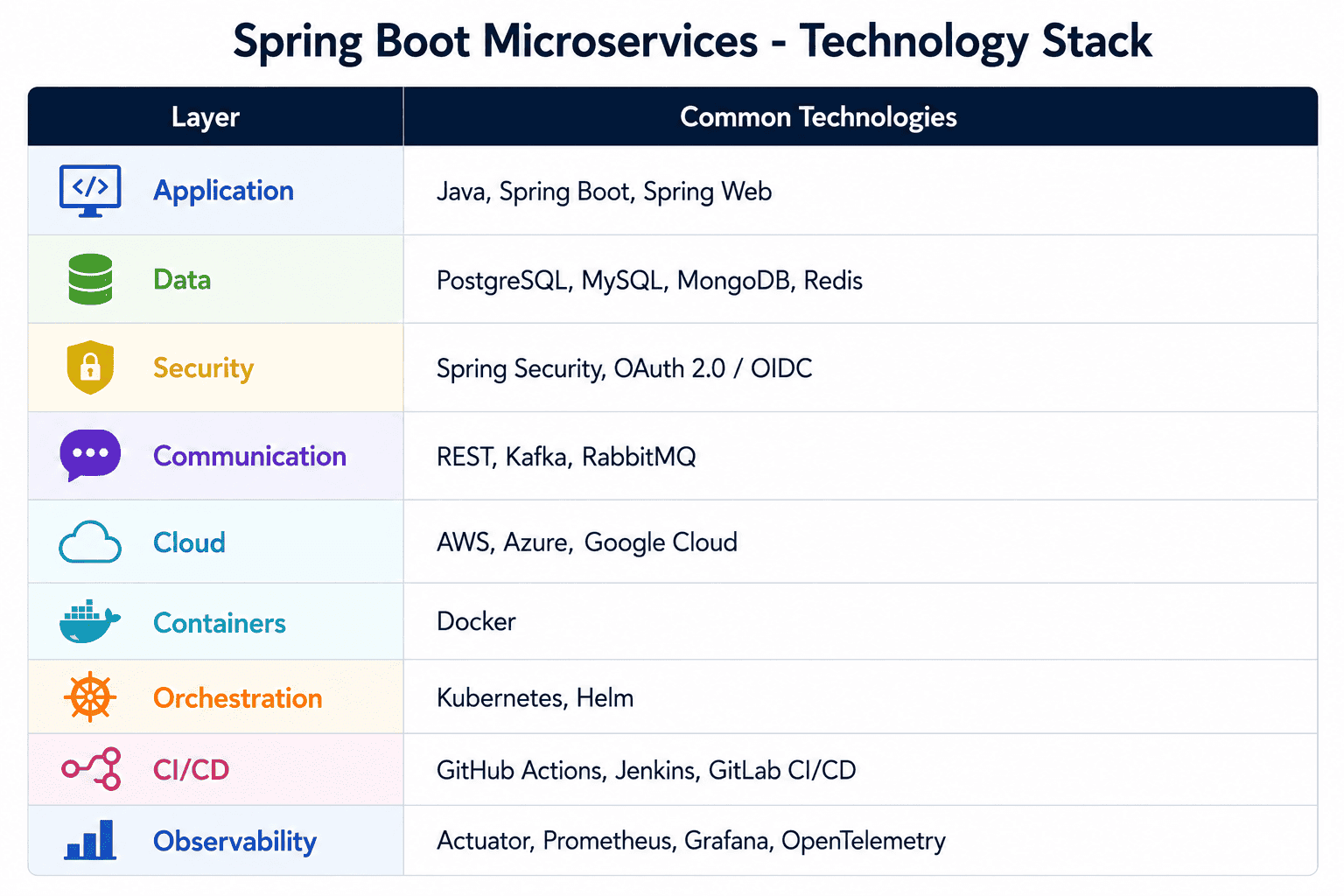
For example, a commerce platform may use PostgreSQL for transactional data, Redis for carefully selected caching use cases, Kafka for domain events, Docker for packaging, and Kubernetes for orchestration.
What Are the Most Common Spring Boot Microservices Mistakes to Avoid?
The most common microservices mistakes involve poor service boundaries, excessive synchronous communication, shared databases, weak observability, and premature complexity. These problems can make a distributed architecture harder to operate than the monolith it replaced.
Avoid these common failures:
• Creating services that are too small.
• Sharing database tables between services.
• Making every service call synchronous.
• Retrying requests without idempotency.
• Deploying without health checks.
• Scaling application instances without examining database capacity.
• Exposing internal services unnecessarily.
• Treating monitoring as an afterthought.
• Introducing Kubernetes before the team understands the operational requirements.
• Measuring only deployment speed and ignoring reliability.
Microservices should reduce business and technical bottlenecks, not simply increase the number of deployable applications.
When Should a Business Choose Microservices Instead of a Monolith?
A business should choose microservices when independent scaling, deployment, team ownership, fault isolation, or domain complexity justify the additional operational complexity. Microservices are not a mandatory evolution for every application.
A microservices architecture may make sense when:
• Different business capabilities scale at different rates.
• Multiple teams need independent ownership.
• Release frequency is constrained by a large monolith.
• Failure isolation is strategically important.
• The organization already has strong DevOps and observability capabilities.
• The application has clearly defined business domains.
A modular monolith may be preferable when the team is small, the domain is still changing rapidly, or the application has modest scale.
The right architecture is the simplest architecture that can reliably meet current and foreseeable requirements.
What Is a Practical Architecture for Spring Boot Microservices?
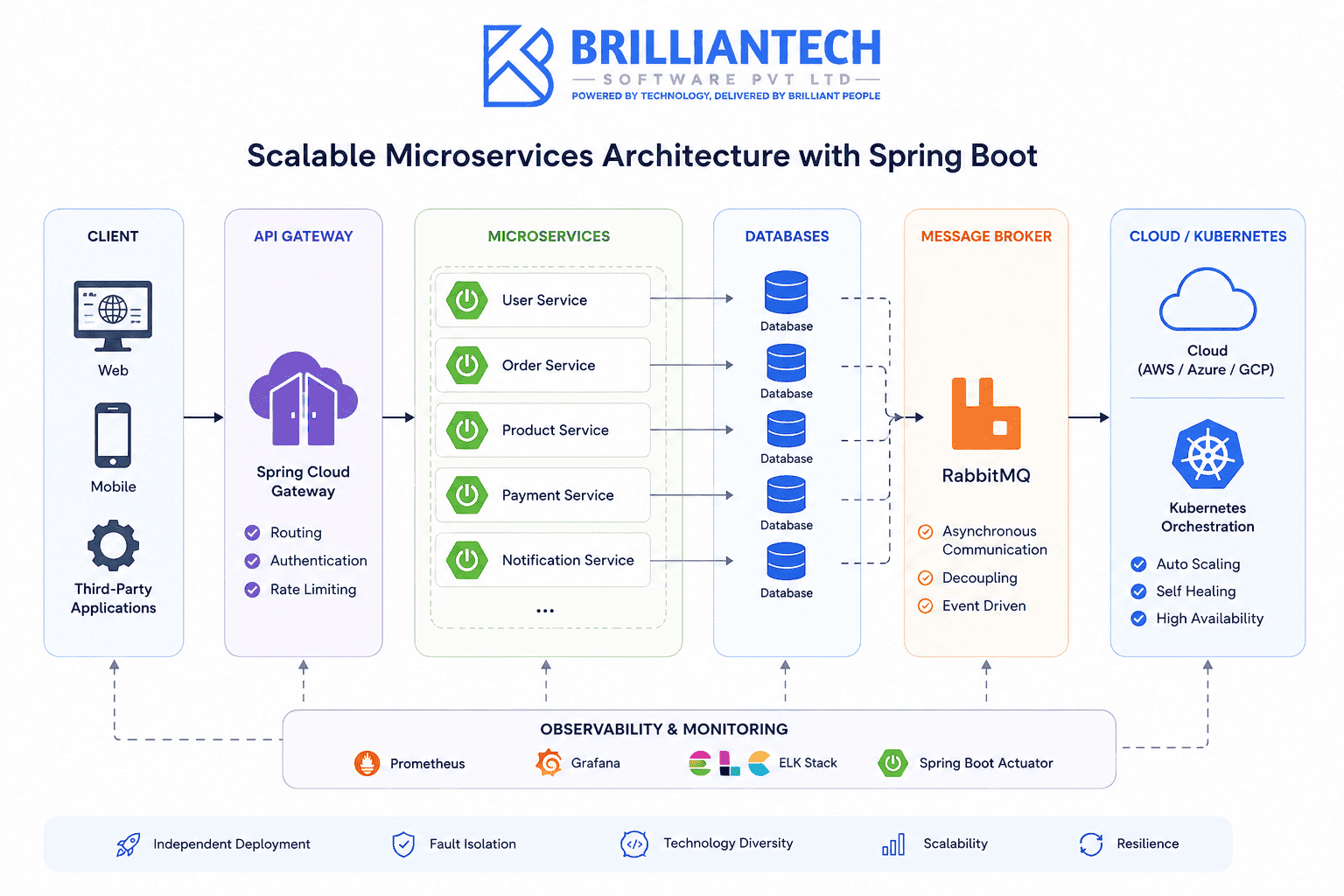
A practical Spring Boot microservices architecture separates client access, routing, business services, data ownership, asynchronous communication, and infrastructure responsibilities. A representative e-commerce system could look like this:
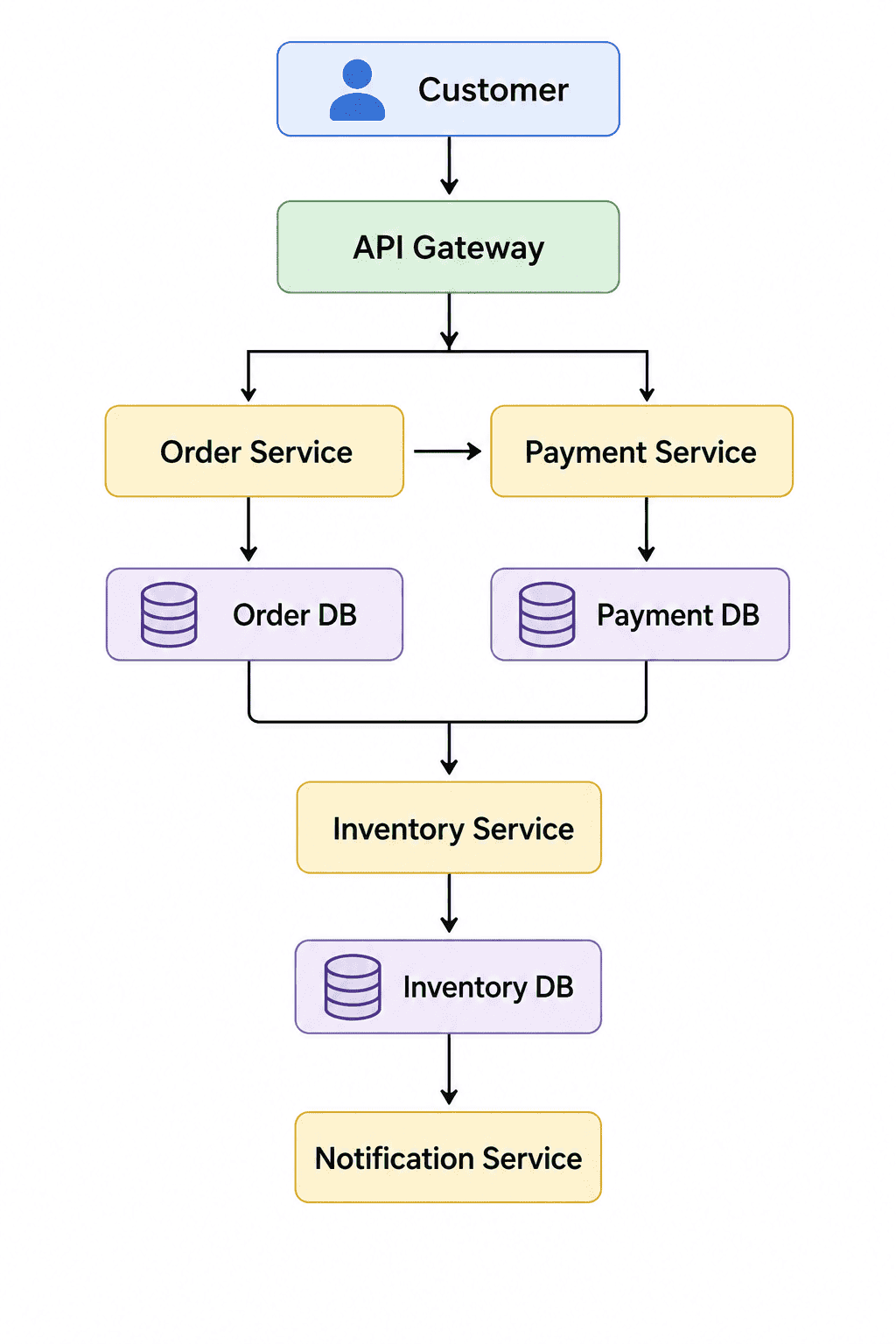
Alongside these services, a message broker can distribute events while Kubernetes manages containerized workloads.
For example, an OrderCreated event can trigger inventory reservation and customer notification without forcing the Order Service to synchronously manage every downstream operation.
This design supports independent scaling while preserving clear ownership boundaries. The exact implementation should depend on business requirements, traffic patterns, consistency requirements, and operational maturity.
How Can Brilliantech Help Build Spring Boot Microservices?
Brilliantech can support organizations that need professional Java, Spring Boot, cloud, and microservices development across architecture, implementation, deployment, and ongoing engineering needs. The company can be positioned as a development partner when an internal team needs additional technical expertise or wants to modernize a complex application.
A professional implementation can include:
• Architecture assessment
• Service-boundary design
• Spring Boot development
• REST and event-driven APIs
• Database architecture
• Security implementation
• Docker and Kubernetes deployment
• CI/CD automation
• Observability
• Application modernization
• Ongoing maintenance
For larger engineering initiatives, organizations can combine their internal teams with specialized resources through [Staff Augmentation Services] and strengthen software reliability with [Quality Assurance Services] throughout the development lifecycle.
What Should You Do Next When Building Spring Boot Microservices?
The best way to start a scalable Spring Boot microservices project is to validate the architecture first, then introduce services incrementally instead of decomposing the entire application at once. A staged approach reduces architectural risk and allows teams to learn from production behavior.
Use this implementation roadmap:
1. Assess the current application and identify genuine scaling or ownership problems.
2. Map business domains and define candidate service boundaries.
3. Start with a limited number of services rather than creating dozens immediately.
4. Define API and data ownership before implementation.
5. Establish security and observability early.
6. Containerize the services with Docker.
7. Automate testing and CI/CD.
8. Deploy to an appropriate cloud environment.
9. Introduce Kubernetes or another orchestrator when operational requirements justify it.
10. Measure production performance and reliability.
11. Scale individual services according to actual demand.
12. Continuously review architecture as business requirements change.
Spring Boot Microservices Production-Readiness Checklist
A production-ready microservices system needs operational controls in addition to working application code. Before releasing your architecture, verify the following:
• API authentication and authorization
• Service routing and discovery
• Request timeouts
• Controlled retries
• Circuit breakers
• Idempotency
• Database ownership
• Backup and recovery
• Centralized logging
• Application metrics
• Distributed tracing
• Automated testing
• CI/CD
• Containerization
• Health checks
• Resource limits
• Monitoring and alerting
• Cost controls
• Rollback procedures
• Security scanning
DORA recommends measuring delivery performance through multiple indicators rather than optimizing a single metric. Its current framework distinguishes throughput from instability, helping teams understand whether they are becoming faster and safer.
Conclusion: How Do You Build Scalable Microservices with Spring Boot?
Building scalable microservices with Spring Boot requires more than splitting a monolithic application into smaller services. Scalability depends on well-defined service boundaries, independent data ownership, resilient communication, secure APIs, automated deployment, observability, and infrastructure capable of adapting to demand.
Spring Boot provides a strong foundation for Java microservices, while Spring Cloud can address common distributed-system patterns. Docker and Kubernetes support portable deployment and orchestration, while CI/CD and observability help teams release and operate services reliably.
Most importantly, microservices scalability is an architectural property, not simply a framework feature. A carefully designed modular monolith may be the right starting point for one business, while a large enterprise platform may benefit significantly from independently deployable services.
If your organization is planning a Spring Boot modernization project, cloud-native platform, or enterprise microservices architecture, [Contact Brilliantech Software Experts] to discuss your requirements and explore the right development approach.