
How to Choose the Right AI Development Partner
Across boardrooms today, the conversation has shifted from should we invest in AI? to why is our AI investment not yet translating into measurable business outcomes? Enterprises have funded copilots, chatbots, RAG prototypes, and AI agent experiments at impressive speed. Yet industry surveys consistently show that only a small percentage of these initiatives make it into reliable, scaled production. The gap between an AI demo that excites a steering committee and an AI capability that moves a P&L line is wider than most leaders anticipate.
That gap is rarely a model problem. It is a business design, data, integration, and governance problem. Pilots are forgiving environments — small datasets, controlled users, manual fallbacks, and no SLA pressure. Production is the opposite. The same solution that worked in a sandbox now has to handle messy real-world inputs, enterprise identity and access rules, regulatory scrutiny, and dozens of edge cases that never surfaced in the demo. This is the reason why choosing the right AI development partner has become one of the most consequential technology decisions a CIO, CTO, or digital transformation leader will make in the next two years.
This guide is written for enterprise decision-makers who are evaluating an AI consulting partner or AI implementation partner to take them beyond pilots toward production-grade AI. It outlines how to separate AI vendors from true partners, what evaluation criteria actually matter, what red flags to watch for, and the practical questions you should be asking before signing a statement of work.
Why Choosing the Right AI Partner Matters
AI success is not determined at the model layer alone. It is determined by how well a partner can orchestrate the surrounding ecosystem — business problem framing, data readiness, workflow integration, governance, user adoption, production architecture, and continuous improvement.
A capable partner brings clarity across all of these dimensions:
• Business problem clarity — translating ambition into KPIs and measurable outcomes
• Data readiness — assessing the foundation before recommending models
• Workflow integration — embedding AI into how work actually happens
• Governance and security — designing controls from day one
• User adoption — making AI usable by the people whose work it changes
• Production architecture — engineering systems that scale, observe, and recover
• Continuous improvement — measuring, learning, and iterating after go-live
Selecting an AI development company is therefore not a vendor exercise. It is a strategic decision about whether AI in your organization becomes a permanent capability or stays trapped in the pilot phase.
Why AI Projects Fail
When AI initiatives stall, leadership teams often look first at the model. In our experience, that is rarely where the failure originates. The more common patterns:
• Business outcomes were never sharply defined
• Use cases were selected without ROI clarity or executive sponsorship
• Data was fragmented, low quality, or governed by siloed owners
• AI was bolted on top of workflows instead of integrated into them
• Privacy, security, and compliance were treated as afterthoughts
• There was no evaluation framework to measure AI output quality
• No observability or monitoring existed once the system went live
• Human-in-the-loop checkpoints were missing
• Adoption was assumed instead of designed
• The team built for the pilot, not for production

Most AI failures are not model failures. They are business design, data foundation, integration, and governance failures.
A mature AI consulting partner understands this and structures the engagement accordingly — starting with problem framing, not with a model selection slide.
Build vs Buy vs Partner: Choosing the Right Path
Before evaluating any AI development partner, leadership teams need to answer a more fundamental question: should we build the capability internally, buy a productized solution off the shelf, or engage an external partner?
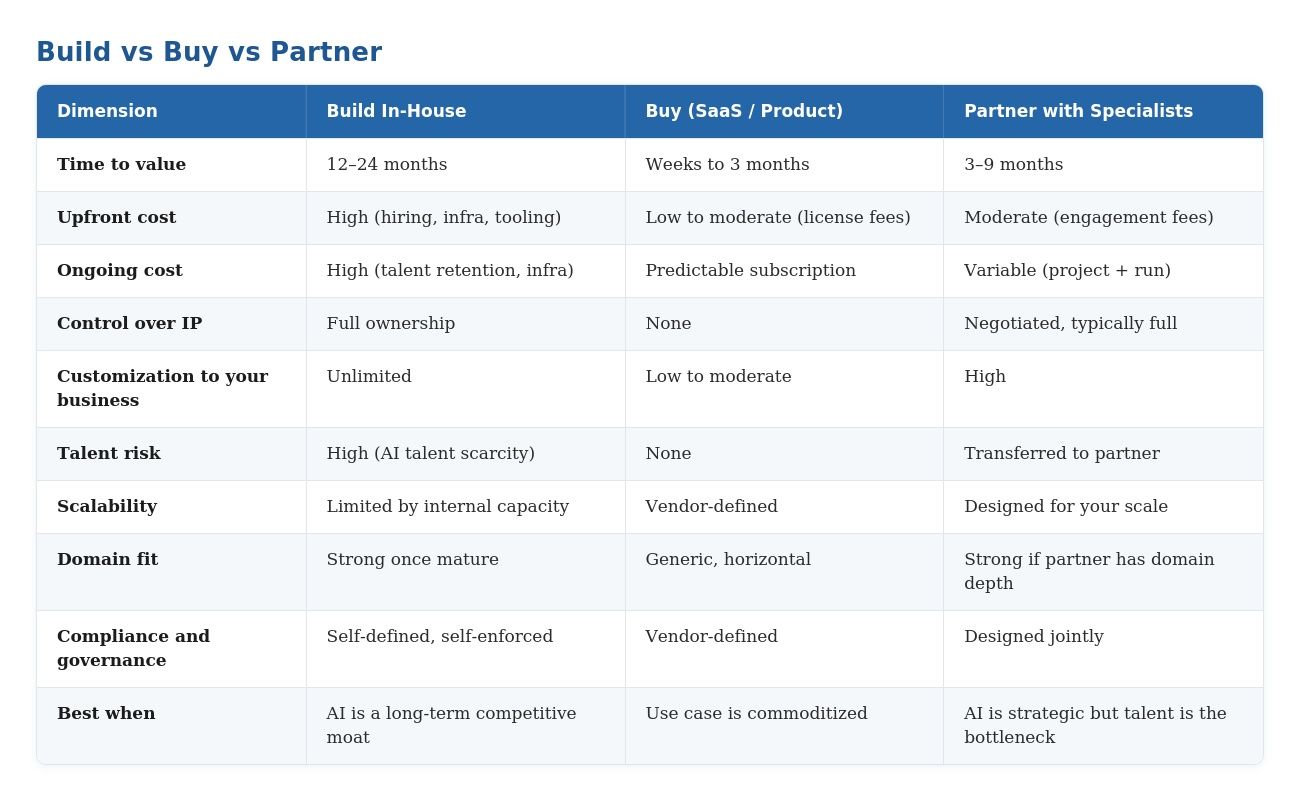
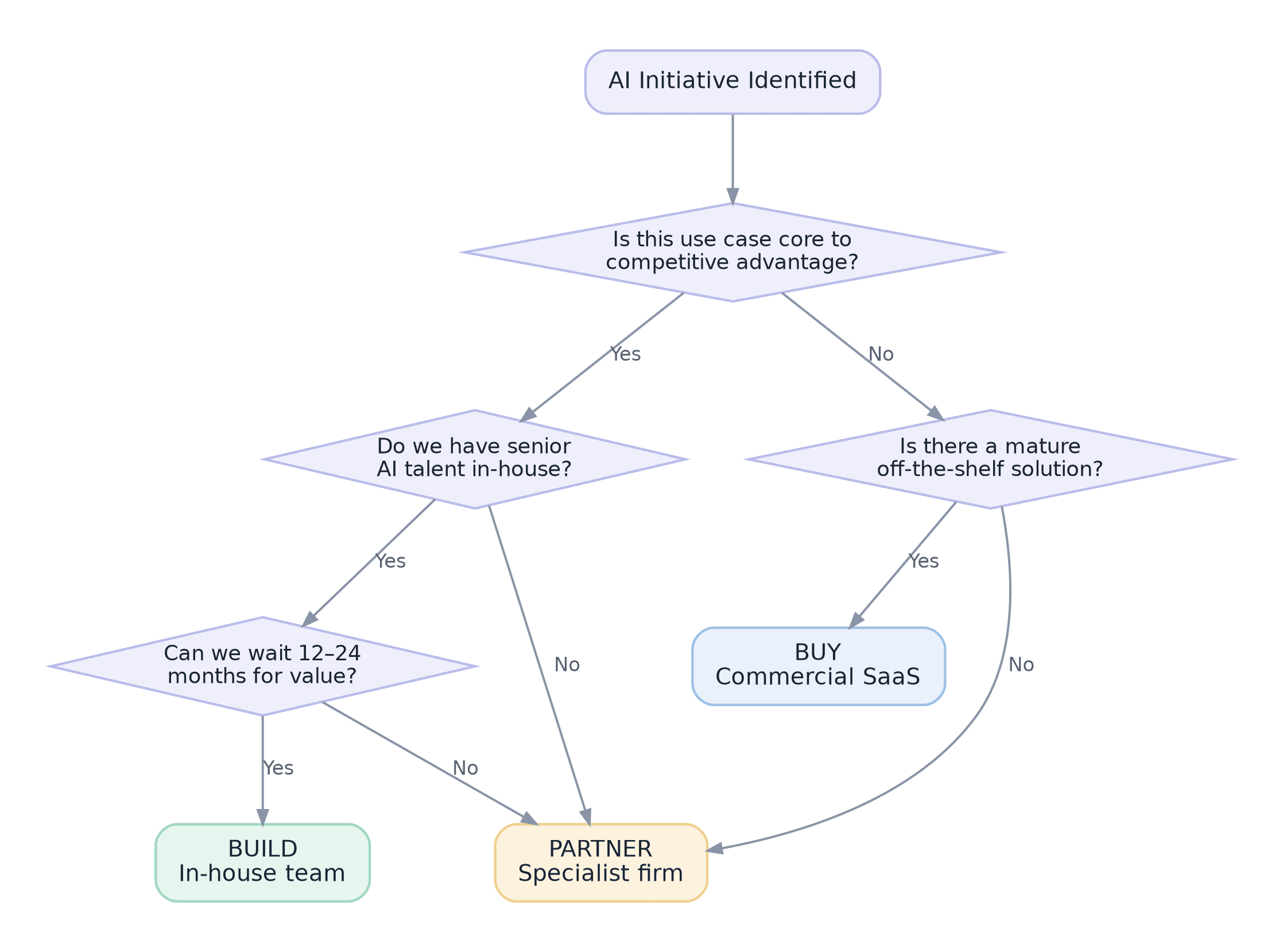
When BUILD makes sense: the use case is core to your competitive advantage, you have or can attract senior AI talent, and you are willing to absorb 12–24 months of investment before seeing returns.
When BUY makes sense: the problem is well-understood, commoditized, and not differentiating — off-the-shelf transcription, generic chatbots, standard document summarization. Buying lets you skip the engineering altogether.
When PARTNER makes sense: the use case is strategically important, requires custom integration with your enterprise systems, and the cost or risk of building from scratch outweighs the speed gain of a partner who has already solved similar problems. Most enterprise AI initiatives that move beyond pilots fall into this category.
In practice, mature enterprises do all three — buying commodity AI, partnering for strategic platforms, and building the proprietary layer that compounds competitive advantage. The mistake is treating these as one decision instead of three.
AI Vendor vs AI Development Partner
The market is crowded with firms that call themselves AI companies. A useful first filter is to understand the difference between a vendor who builds what you specify and a partner who shapes what you should build.
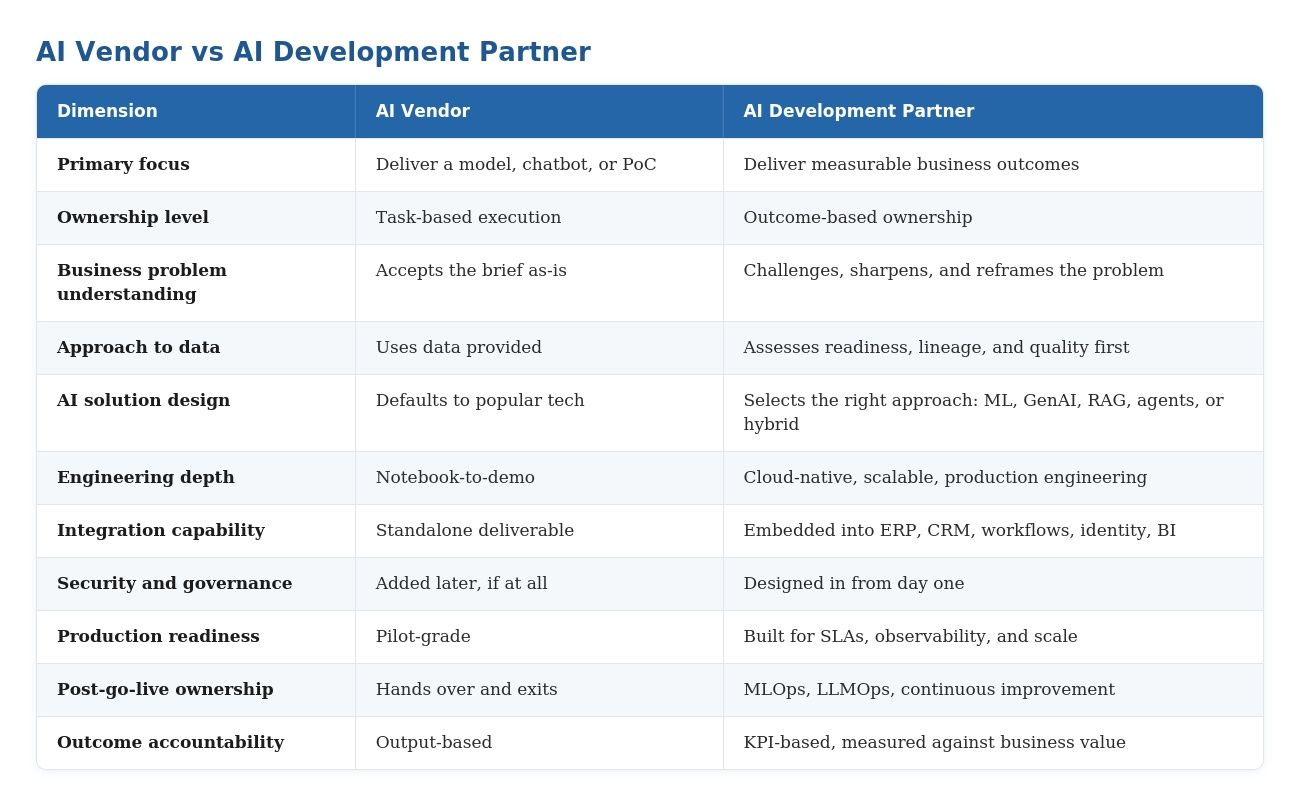
This distinction matters because the cost of choosing wrong is rarely visible upfront. It surfaces 9 to 18 months later, when the pilot will not scale, the model is drifting, adoption has stalled, and no one owns the gap.
What a Real Enterprise AI Journey Looks Like
Most enterprise AI engagements that succeed follow a recognizable arc. Understanding this arc helps you map where your partner will be involved, what each stage actually delivers, and where the common derailments occur.

1. AI Readiness Assessment. The partner audits data maturity, infrastructure, governance, and organizational readiness before committing to any solution. This avoids building on a shaky foundation.
2. Use Case Prioritization. Multiple candidate use cases are scored on business impact, feasibility, data availability, and risk. The output is a prioritized roadmap, not a single bet.
3. Data Preparation. Data is cleaned, labeled, structured, and made AI-ready. Lineage, access controls, and quality benchmarks are established. This is usually the longest stage and the one most underestimated.
4. PoC Development. A focused proof of concept validates whether AI can move the targeted KPI. Success criteria are defined before any code is written.
5. RAG / Agent Setup. The AI architecture is built — retrieval pipelines, embeddings, orchestration logic, guardrails, and evaluation frameworks. This is where many pilots quietly fail because evaluation is skipped.
6. Pilot Rollout. A controlled release to a small user group. Feedback, telemetry, and accuracy metrics are captured. Decisions to scale, refine, or retire the use case are made here — not later.
7. Security & Governance Review. Before production, the solution is audited against PII handling, access control, prompt injection resilience, audit logging, and applicable regulations (HIPAA, SOC 2, GDPR, DPDP).
8. Production Deployment. The system is hardened — scaled infrastructure, redundancy, observability, CI/CD, rollback plans. The handoff is engineered, not improvised.
9. Monitoring & LLMOps. Drift, hallucination rates, latency, cost-per-call, and business KPIs are continuously tracked. Alerts and feedback loops are operational from day one.
10. Continuous Optimization. Prompts are refined, models are upgraded, new use cases are introduced, and ROI is measured against the original hypothesis. AI becomes a permanent capability, not a project.
The strongest partners are present across all ten stages. Weaker firms tend to show up only between stages 4 and 6 — the visible, demo-able middle — and disappear before the real work of production hardening, observability, and adoption begins.
Is Your Organization Ready for AI?
Before a partner can deliver, your organization needs to be in a position to receive. A capable partner will assess you against these dimensions in the first two weeks of engagement. Doing this audit yourself first saves time, cost, and uncomfortable surprises later.
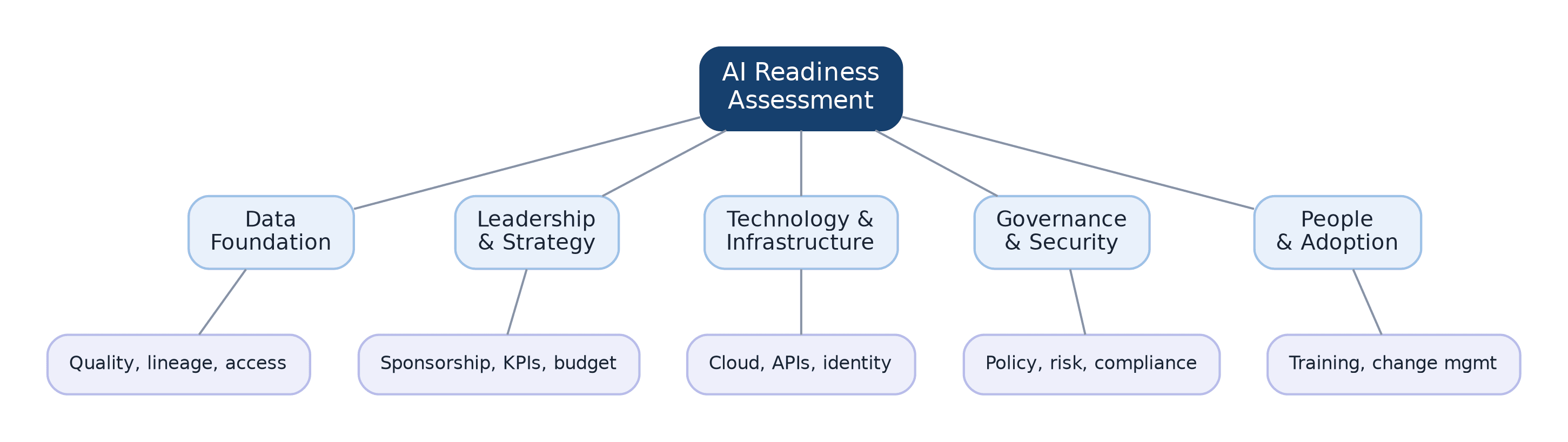
Data Foundation
✓ Critical data is accessible, not locked in silos
✓ Data quality, lineage, and ownership are documented
✓ Sensitive data (PII, PHI, financial) is classified and protected
✓ Master data and metadata standards exist
Leadership and Strategy
✓ Executive sponsorship is named, not assumed
✓ AI use cases are tied to defined business KPIs
✓ Budget and timeline expectations are realistic
✓ There is a clear escalation path for blockers
Technology and Infrastructure
✓ Cloud infrastructure is in place (AWS, Azure, GCP)
✓ APIs exist for the systems AI must integrate with
✓ Identity, SSO, and RBAC are mature
✓ Observability tooling is operational
Governance and Security
✓ AI governance framework or policy exists, even if early-stage
✓ Compliance requirements (HIPAA, SOC 2, GDPR, DPDP) are documented
✓ Risk and audit teams are engaged early
✓ Responsible AI principles are agreed at the leadership level
People and Adoption
✓ End users have been consulted, not just informed
✓ Change management capacity exists
✓ Training and adoption plans are budgeted
✓ Resistance points have been identified honestly
If you score below 60% on this list, your first engagement with a partner should be an assessment phase, not a build phase. Trying to skip readiness is the single most common reason enterprise AI initiatives stall at the pilot stage.
Evaluation Checklist: How to Choose the Right AI Development Partner
The following criteria form a practical evaluation framework for enterprise AI development engagements.
A. Business Outcome Orientation
A serious partner opens the conversation with business KPIs, not technology. They will ask:
- What business problem are we actually solving?
- Which process or decision will improve?
- What KPI will move, and by how much?
- What is the expected ROI, and how will we attribute it?
- What does success look like at 90, 180, and 365 days?
The outcomes that matter to the business are typically cost reduction, revenue growth, faster decision-making, productivity gain, customer experience improvement, risk reduction, faster turnaround time, and improved compliance. Every AI initiative should map back to at least one of these.
B. Domain Understanding
AI without domain context produces confident but irrelevant answers. The right partner brings working knowledge of industry workflows, regulatory constraints, user personas, and operational realities.
- In healthcare, accuracy, explainability, and compliance dominate.
- In financial services, risk, auditability, and data governance are non-negotiable.
- In manufacturing, shopfloor integration, quality, and downtime reduction define value.
- In telecom, network operations, service assurance, and incident response are the use cases that scale.
- In retail and CPG, demand signals, personalization, and supply chain visibility are where AI compounds.
Generic AI expertise without domain depth tends to produce generic outcomes.
C. Data Readiness and Data Engineering Capability
AI is only as strong as the data foundation beneath it. Before recommending models, a mature partner assesses:
- Data availability and accessibility
- Data quality and completeness
- Data ownership and stewardship
- Data lineage and traceability
- Data governance and policy maturity
- Real-time versus batch processing needs
- Structured, semi-structured, and unstructured sources
- Integration with enterprise systems of record
- Master data and metadata maturity
A partner who jumps straight to models without a data conversation is signalling how the project will end.
D. GenAI and Traditional AI Capability
Not every problem needs a large language model. A capable GenAI development partner knows when to apply:
- Large language models and RAG solutions
- AI agents and multi-step workflows
- Traditional machine learning and predictive analytics
- Optimization models
- Computer vision and NLP
- Rules engines
- Human-in-the-loop pipelines
- Hybrid architectures that combine these
The right partner recommends the right approach for the business problem — not the trendiest technology on the cover of last month's analyst report.
E. RAG and Knowledge Architecture Capability
Many enterprise AI use cases are fundamentally about retrieving and reasoning over organizational knowledge. A partner working on RAG solutions should be fluent in:
- Document ingestion pipelines
- Chunking strategy and embedding selection
- Vector database design and tuning
- Retrieval quality and reranking
- Access controls and tenant isolation
- Source citation and provenance
- Hallucination reduction techniques
- Evaluation of retrieved answers
- Knowledge refresh and reindexing cycles
Bad RAG looks fine in a demo and fails the moment a real user asks a real question.
F. Agentic AI and Workflow Orchestration Capability
AI agents are moving from research to enterprise production, but they require disciplined design. A capable partner should know:
- When agents are the right pattern versus when they are overkill
- How to define agent roles, scopes, and boundaries
- How to orchestrate multi-agent workflows
- How to integrate tools, APIs, and enterprise systems
- How to apply guardrails and policy enforcement
- How to prevent uncontrolled autonomy
- How to monitor agent actions and decisions
- How to keep humans in the loop where it matters
G. Cloud, Platform, and Product Engineering Strength
Production AI is 20% model and 80% engineering. The partner should bring depth in:
- Backend and API engineering
- Frontend and product experience design
- Cloud-native architecture (AWS, Azure, GCP)
- DevOps, CI/CD, containerization
- Observability and SRE practices
- Scalable, resilient infrastructure
- Enterprise integration patterns
- UX designed for AI adoption — not just AI access
A team that cannot ship a reliable application generally cannot ship a reliable AI application.
H. Security, Governance, and Compliance
AI governance must be designed from day one, not retrofitted at the end. Areas to validate:
- Data privacy and PII handling
- Role-based access control
- Prompt and output security
- Model risk management
- Audit logs and traceability
- Human approval workflows for high-impact actions
- Hallucination and toxicity controls
- Bias detection and fairness testing
- Responsible AI principles in practice
- Industry-specific compliance (HIPAA, SOC 2, GDPR, DPDP, etc.)
I. Evaluation, Observability, and Monitoring
What is not measured cannot be improved. A production-grade partner brings MLOps and LLMOps discipline that covers:
- LLM and ML evaluation frameworks
- Accuracy and quality tracking
- Hallucination monitoring
- Prompt performance and regression testing
- Model and data drift detection
- Latency and reliability SLAs
- Cost and token usage monitoring
- Feedback loops and user satisfaction signals
- Business KPI tracking tied back to AI outputs
AI observability is the difference between a system you operate and a system you hope.
J. Enterprise Integration Experience
AI must live inside your existing ecosystem. The partner should have demonstrated experience integrating with:
- ERP and CRM platforms
- Data lakes and warehouses
- Document and content management systems
- Workflow and BPM engines
- Identity providers (SSO, RBAC)
- Communication platforms (email, chat, voice)
- Legacy applications and mainframes
- Cloud platforms and BI tools
- APIs and microservices
Enterprise AI integration is where most pilots quietly die.
K. Post-Go-Live Support and Continuous Improvement
AI is not an implementation; it is a lifecycle. A real partner stays engaged through:
- User training and adoption programs
- Prompt and model refinement
- Ongoing monitoring and governance updates
- New use case roadmaps
- Cost and performance optimization
- Feedback-led improvements
- Business value measurement and reporting
How Enterprises Measure AI ROI
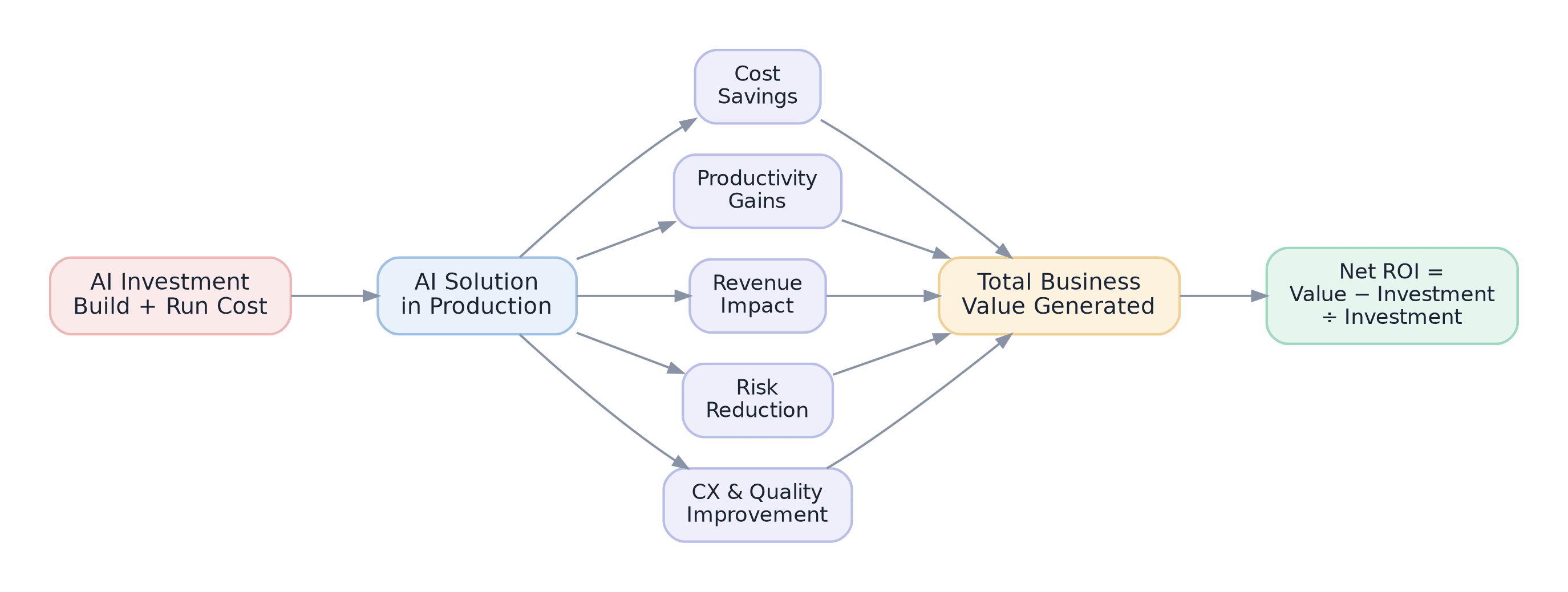
ROI is the single most-discussed and least-measured aspect of enterprise AI. The reason is rarely a lack of impact — it is a lack of an attribution model. A mature partner will help you define how value will be measured *before* any code is written.
The basic formula
ROI = (Business Value Generated − AI Investment Cost) ÷ AI Investment Cost
The formula is the easy part. The honest part is quantifying “business value generated” without inflating it.
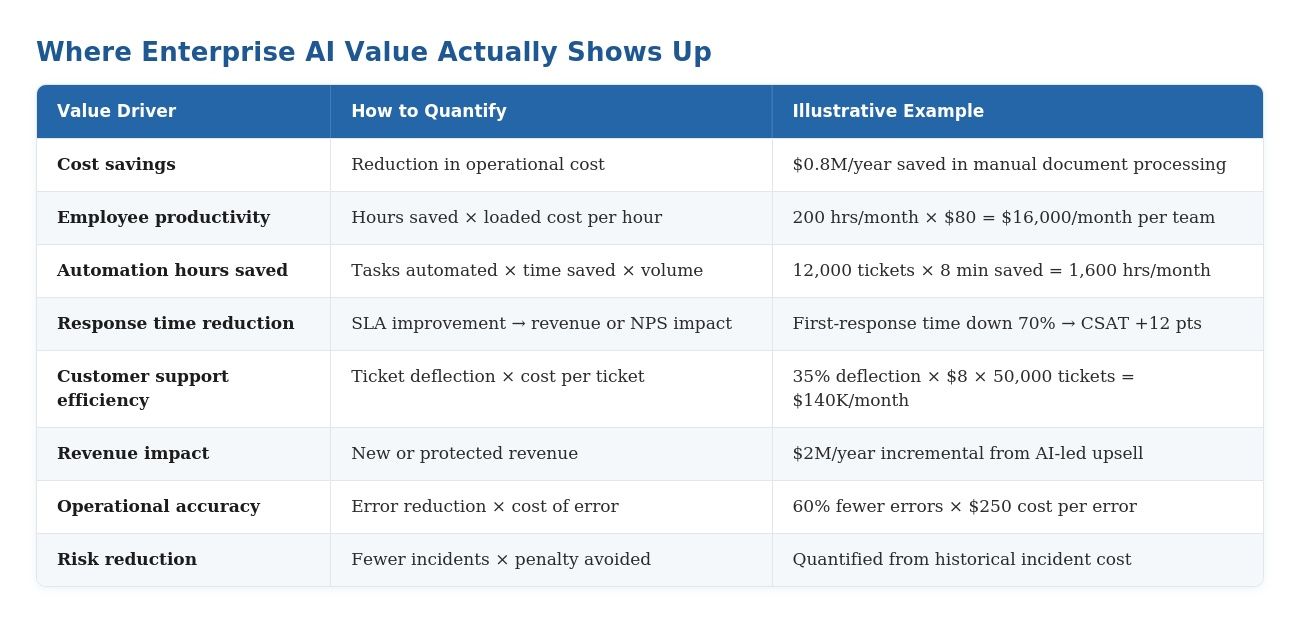
A mid-sized financial services firm deploys an AI assistant for its operations team:
- Investment: $450,000 (build + 12 months of run cost)
- Productivity gain: 18 analysts × 6 hours/week × $90/hour × 50 weeks = $486,000
- Error reduction: 40% fewer reconciliation errors × $1,200 per error × 300 errors/year = $144,000
- Total annual value: $630,000
- ROI = ($630,000 − $450,000) ÷ $450,000 = 40% in year one
Year two ROI is typically 2–3× year one, because the platform cost is amortized and additional use cases ride on the same foundation.
The discipline that separates real ROI from theatre
- Baseline metrics are captured before the AI is deployed
- Attribution is agreed upfront — what counts, what doesn't, and how it's measured
- Soft benefits are quantified conservatively, not optimistically
- Run cost (model usage, infra, observability, support) is included, not just build cost
- ROI is reported on a defined cadence — quarterly is typical — and revisited annually
A partner unwilling to commit to a measurable ROI model is a partner who does not expect to be measured.
Red Flags While Choosing an AI Development Partner
Some signals consistently predict trouble. Be cautious if a prospective partner:
- Talks only about chatbots and copilots
- Leads with technology before understanding your business problem
- Cannot articulate how AI will move a specific KPI
- Does not ask about data quality or readiness
- Treats security and governance as optional
- Has no AI evaluation or testing framework
- Cannot describe production monitoring in concrete terms
- Lacks cloud and platform engineering depth
- Cannot clearly explain RAG, LLMOps, or evaluation pipelines
- Has no enterprise integration experience to point to
- Overpromises full automation without human oversight
- Refuses to define ownership and SLAs after go-live
- Cannot present relevant case studies or reference implementations
What a Strong AI Development Partner Should Bring
The right partner is not a single specialty. They combine strategy, engineering, data, AI, governance, and adoption capability under one accountable team. At minimum, expect:
- AI strategy and roadmap definition
- AI readiness assessment and use case prioritization
- Data foundation and data engineering
- GenAI, ML, and traditional AI expertise
- RAG solution design and evaluation
- AI agent and workflow orchestration
- Product engineering and UX design
- Cloud-native development and DevOps
- MLOps and LLMOps operating models
- Security, governance, and responsible AI practices
- Observability and continuous evaluation
- Enterprise integration depth
- Change management and adoption design
- Measurable business outcomes, owned jointly
This combination is what allows organizations to move from AI transformation as a slogan to AI as a working capability.
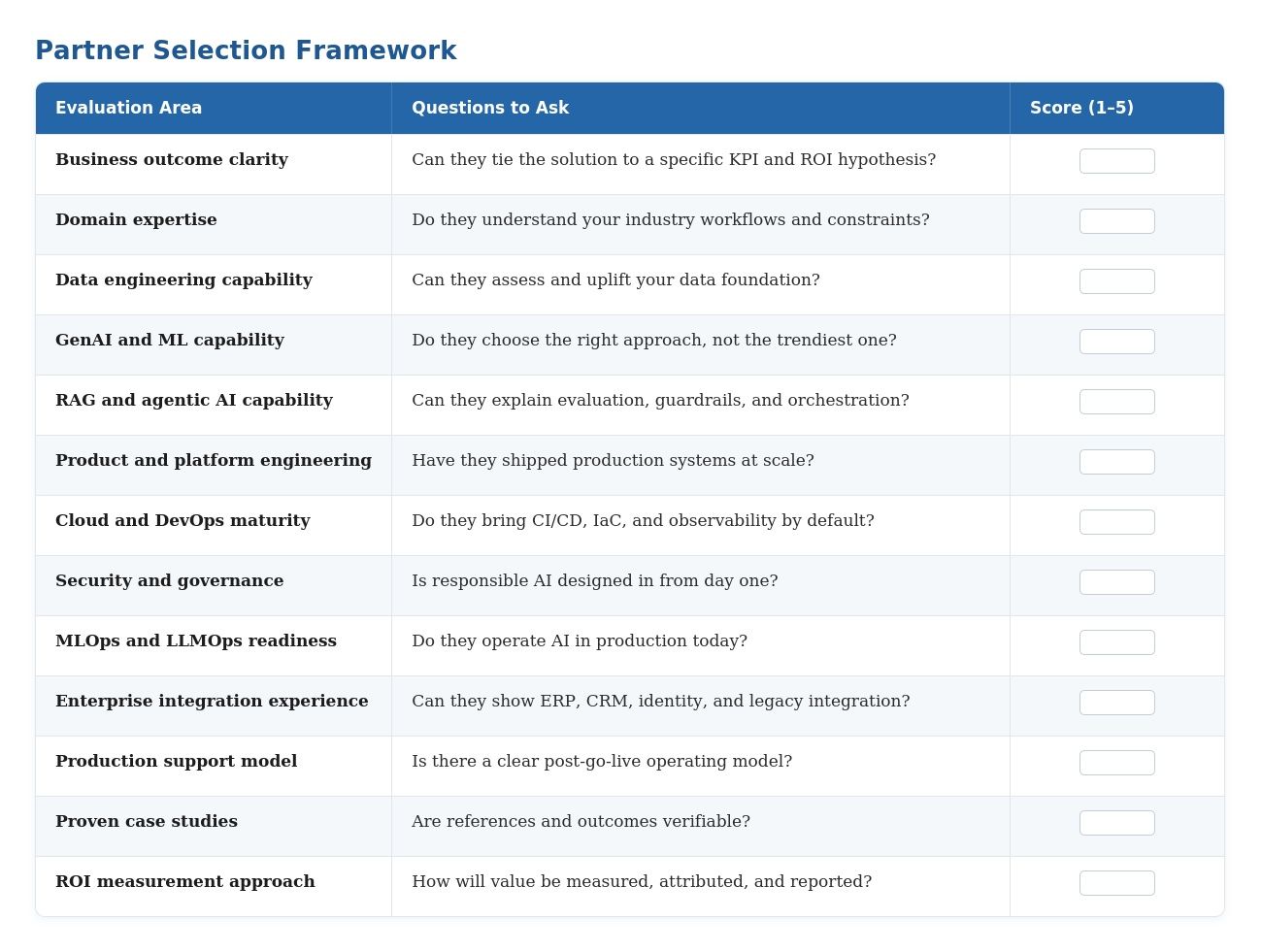
Partner Selection Framework
The following scoring framework can be applied across shortlisted firms. Score each area 1 (weak) to 5 (strong), then weight by what matters most to your context.
Questions to Ask Before Hiring an AI Development Partner
Bring these to the evaluation conversation. The quality of the answers matters more than the polish of the deck.
1. What business KPI will this AI solution improve, and how will we attribute the impact?
2. How will you validate whether AI is even the right approach for this problem?
3. How will you assess our data readiness before any model work begins?
4. What is your approach to RAG evaluation and retrieval quality?
5. How do you detect and reduce hallucinations in production?
6. How do you design human-in-the-loop workflows for high-impact decisions?
7. How do you handle security, access control, and PII across the AI stack?
8. How do you monitor AI performance, drift, and cost after deployment?
9. What does your LLMOps or MLOps operating model look like in practice?
10. How do you integrate AI with our existing ERP, CRM, and workflow systems?
11. How do you measure ROI after go-live, and over what time horizon?
12. What happens in the first 90 days after the production release?
13. Who owns the system if outcomes degrade six months in?
14. Can you walk us through a comparable production deployment, end to end?
15. What would make you advise us not to proceed with this use case?
The last question is often the most revealing. A partner willing to talk you out of a bad use case is usually the one worth signing.
Conclusion
Choosing the right AI development partner is not about finding someone who can build a quick demo or stand up a chatbot before the next board meeting. It is about finding a partner who can understand the business problem, engineer the data and platform foundation, apply the right AI approach, integrate AI into the workflows where decisions actually happen, govern risk responsibly, and deliver outcomes the business can measure.
The organizations that will lead in the next phase of AI are not the ones running the most pilots. They are the ones with a partner disciplined enough to convert ambition into a production capability — secure, scalable, governed, and accountable to KPIs. The decision you are really making is not which firm to hire. It is what kind of AI capability your organization will own three years from now.
The right AI development partner does not just build AI solutions. They help businesses turn AI ambition into production-grade, scalable, and measurable outcomes.