
01. AI Is Easy to Start. Shipping It Is the Hard Part.
Almost every business today is testing an AI idea. Some want an AI copilot for their teams. Others are building GenAI applications, predictive analytics, smart automation, or AI agents that handle real work. The tools are everywhere, and a demo can be built in a weekend.
But here is the truth most leaders learn the hard way: a clever demo is not a working product. Turning an idea into a system that is reliable, secure, and ready for daily business use is where most projects struggle. And that gap is rarely about the model. It is about people.
The success of any AI project depends on the person or team who can take a messy business problem and turn it into a stable, scalable solution. That is why the decision to hire an AI developer is not a simple recruitment task. It is a strategic business decision that shapes cost, speed, risk, and long-term value. This guide will help you make that decision with confidence — whether you need one developer, a full AI development team, or an end-to-end AI development partner.
02. First Question: Do You Actually Need an AI Developer Yet?
Hiring too early is a common and expensive mistake. Not every problem needs a dedicated AI developer on day one. Sometimes a simple report, a rule-based automation, or an off-the-shelf tool solves the need faster and cheaper. The smart move is to know which situation you are in before you spend a single rupee or dollar on hiring.
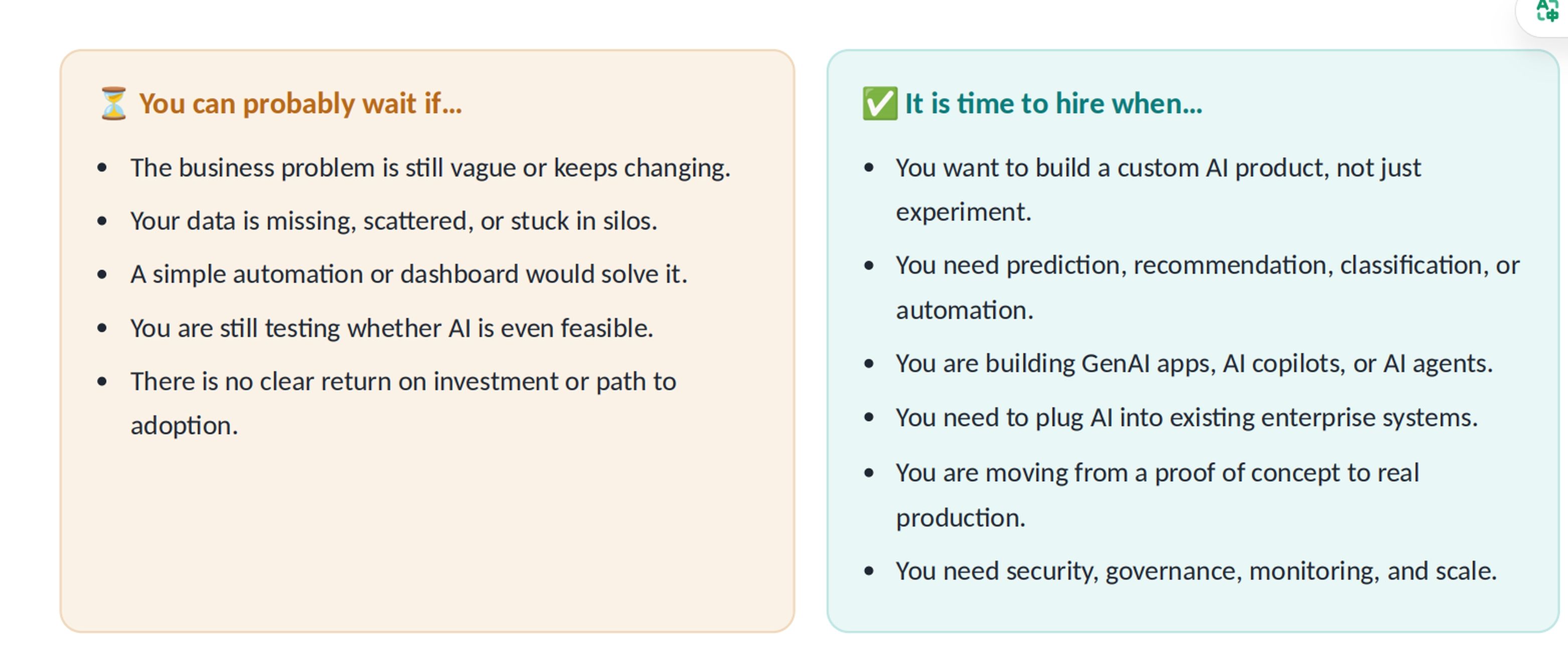
If most of your needs sit on the right side, you are ready. An AI developer for business earns their value precisely when an idea has to survive real users, real data, and real-world risk.
03. Who Does What: The Roles Behind Every Successful AI Project
"AI developer" is often used as a catch-all term, but real projects involve several distinct skills. Hiring the wrong role for the job is one of the quietest reasons projects stall. Use the table below to match the role to the outcome you actually want.
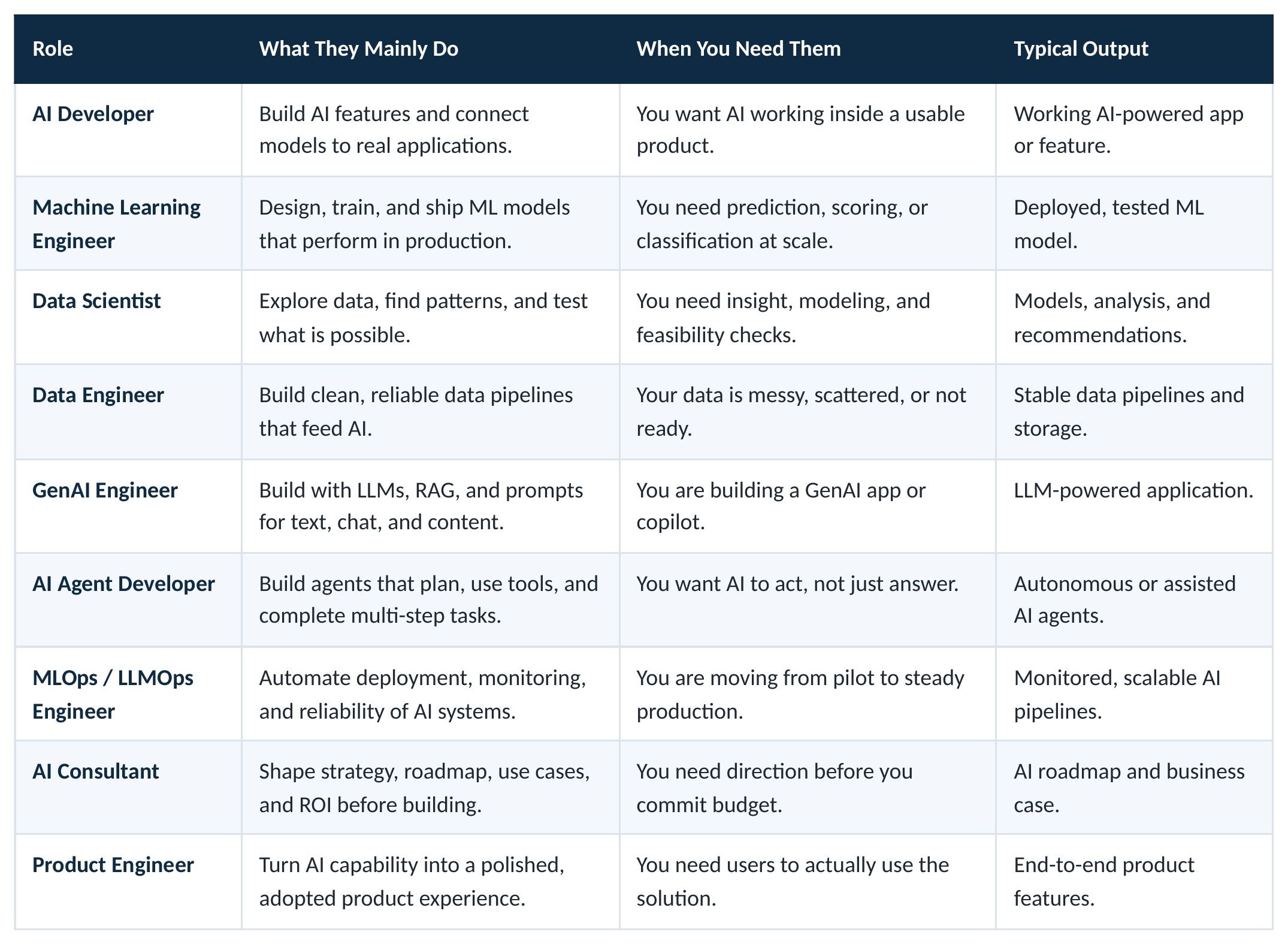
The key takeaway: most production AI projects need a combination of roles, not one heroic developer. A single GenAI developer or ML engineer can build a great prototype, but data engineering, MLOps, and product work are what carry it to launch.
04. What "Good" Looks Like: Skills That Separate Builders From Buzzwords
A strong AI hire is more than a list of frameworks. The best people pair solid engineering with business sense and a respect for safety. Use this matrix as a checklist when you review candidates or partners.
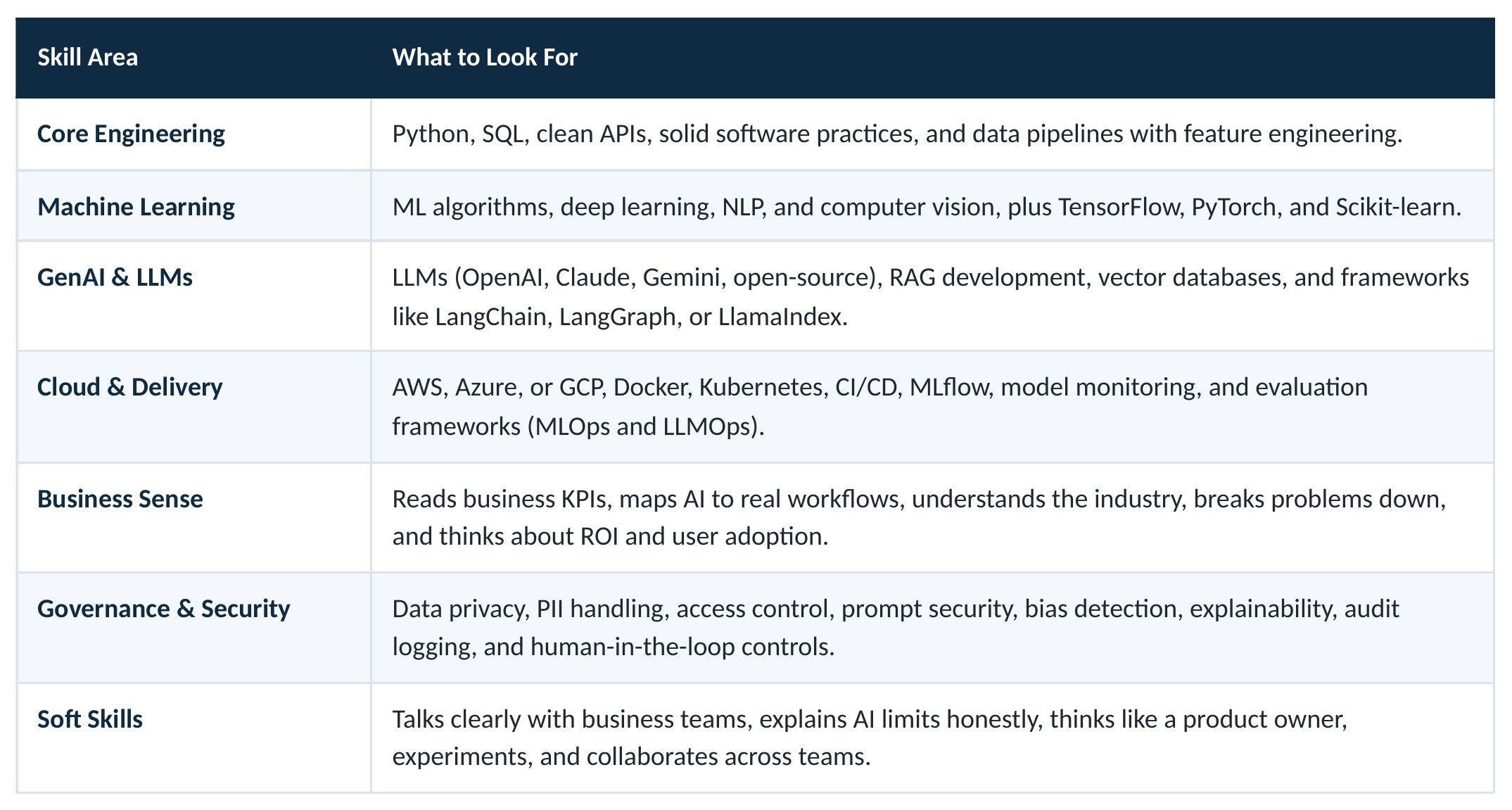
Watch for this: a candidate who only talks about models, but never asks about your users, your data quality, or how success will be measured, is a red flag — no matter how impressive the tech sounds.
05. Your 10-Step Playbook for Hiring the Right AI Developer
Good hiring follows a clear path. Start with the business outcome, not the technology, and let each step narrow your decision. Here is the roadmap, followed by what each step means in practice.
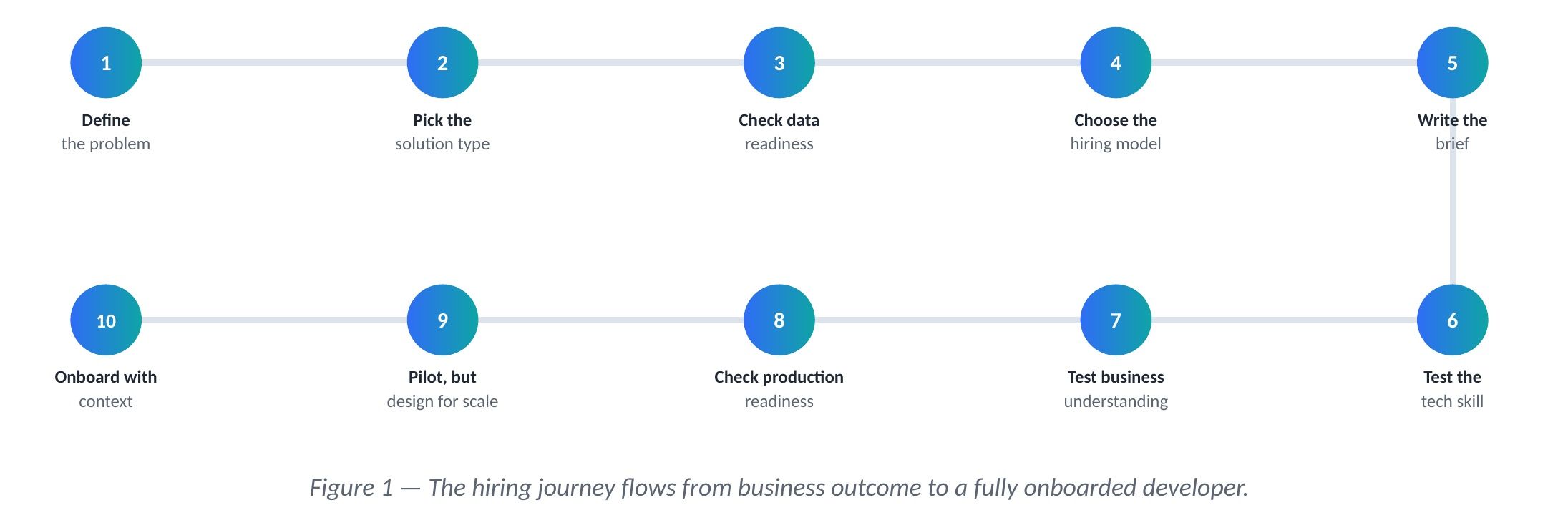
1.Define the business problem. Start with the outcome you want, in plain business terms. "Cut invoice processing time by half" beats "use an LLM."
2.Identify the type of AI solution. Is it predictive analytics, a recommendation engine, an AI chatbot, a GenAI copilot, an AI agent, computer vision, intelligent automation, or a RAG system? The answer points to the skills you need.
3. Assess data readiness. Check that your data is available, clean, accessible, secure, and relevant. Weak data sinks strong models.
4.Decide the hiring model. Choose between a freelancer, an in-house developer, a dedicated team, an AI consulting partner, or an end-to-end partner (more on this in Section 8).
5. Write a clear brief. Spell out the business goal, deliverables, data sources, tech stack, integration needs, security expectations, and how you will measure success.
6. Evaluate technical capability. Review past AI projects, ask candidates to explain an architecture, give a real problem to solve, review code quality, and dig into how they evaluate, deploy, and monitor models.
7. Evaluate business understanding. A strong hire asks about users, workflows, KPIs, data quality, adoption, and ROI — not just about models.
8. Check production readiness. Confirm they can handle deployment, scaling, monitoring, observability, governance, and support after launch.
9. Start with a pilot, but design for scale. A proof of concept is useful only if it is built with a clear road to production.
10. Onboard with context. Share business processes, data access, architecture docs, compliance rules, user personas, and expected outcomes so the work starts on the right foot.
06. The Questions That Reveal a Great Hire (and Expose a Weak One)
The right questions tell you more than any resume. Keep this checklist handy for interviews or partner discussions.
Business questions
- What business outcome will this AI solution improve, and how will we measure success?
- Which users will rely on it, and what workflow does it support?
Technical questions
What AI approach would you use, and why that one?
How will you handle messy or incomplete data?
How will the model be evaluated, integrated, deployed, and monitored?
Security & governance questions
- How will sensitive data and access be protected?
- How will you handle hallucinations, bias, or wrong outputs?
- How will audit logs and human-in-the-loop checks work?
Delivery questions
- What will the first version (MVP) include, and on what timeline?
- What skills does the team need, and what support is needed after go-live?
07. Ten Hiring Mistakes That Quietly Sink AI Projects
Most failed AI initiatives do not fail at the model. They fail at the hiring decision. Avoid these traps:
- Hiring on buzzwords instead of proven, relevant work.
- Choosing technology before defining the business problem.
- Ignoring whether your data is actually ready.
- Assuming one person can own the entire AI lifecycle.
- Skipping any check of real production deployment experience.
- Overlooking AI governance, security, and privacy.
- Never asking how models will be evaluated.
- Treating AI as a one-time project instead of an ongoing system.
- Optimizing for the lowest cost instead of the best outcome.
- Hiring a chatbot developer when you really need a full AI workflow — and forgetting to involve business users while building.
08. Freelancer, In-House Team, or AI Development Partner?
There is no single best hiring model — only the one that fits your stage, budget, and ambition. Here is a clear comparison.
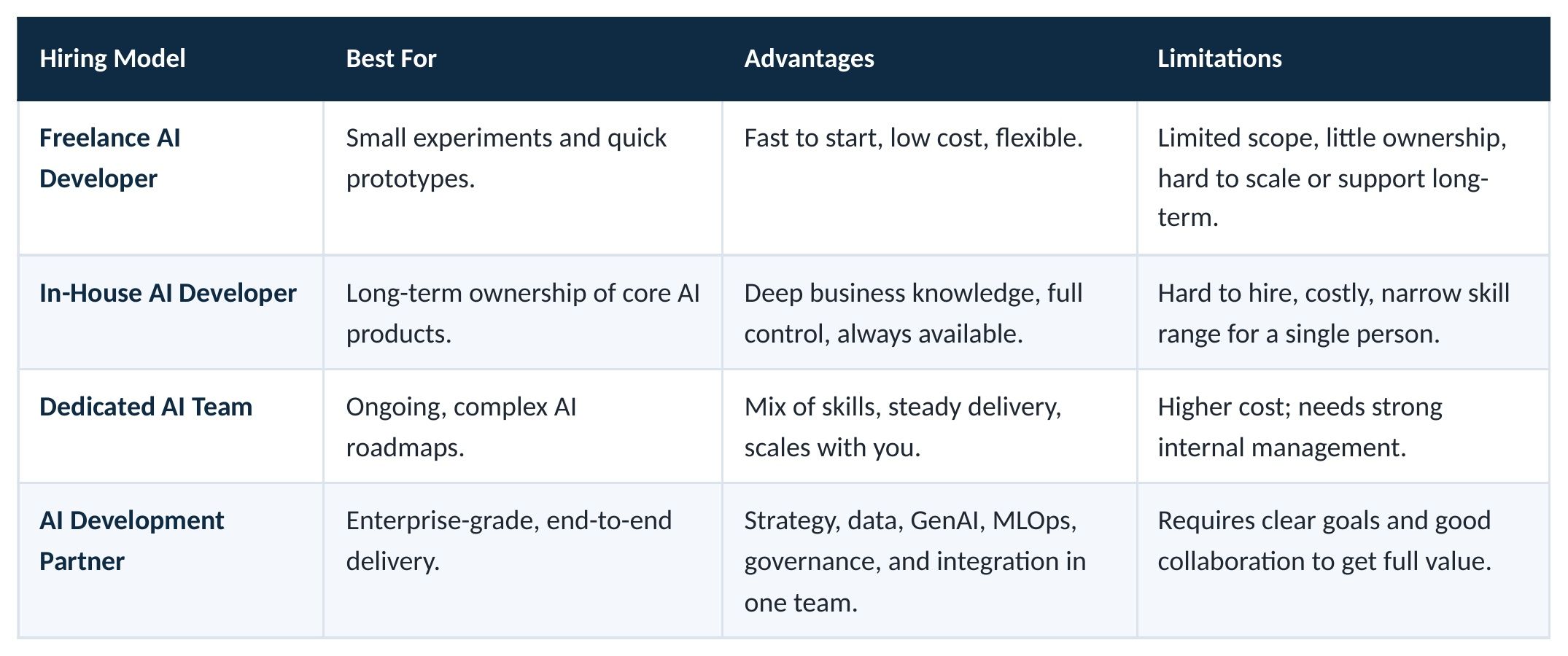
In short: freelancers suit small tests, in-house teams suit long-term ownership, and an AI development partner fits when you need strategy, data engineering, product engineering, cloud, GenAI, MLOps, LLMOps, governance, and enterprise integration working together. For serious enterprise AI development, that combined capability is often the difference between a pilot and a product.
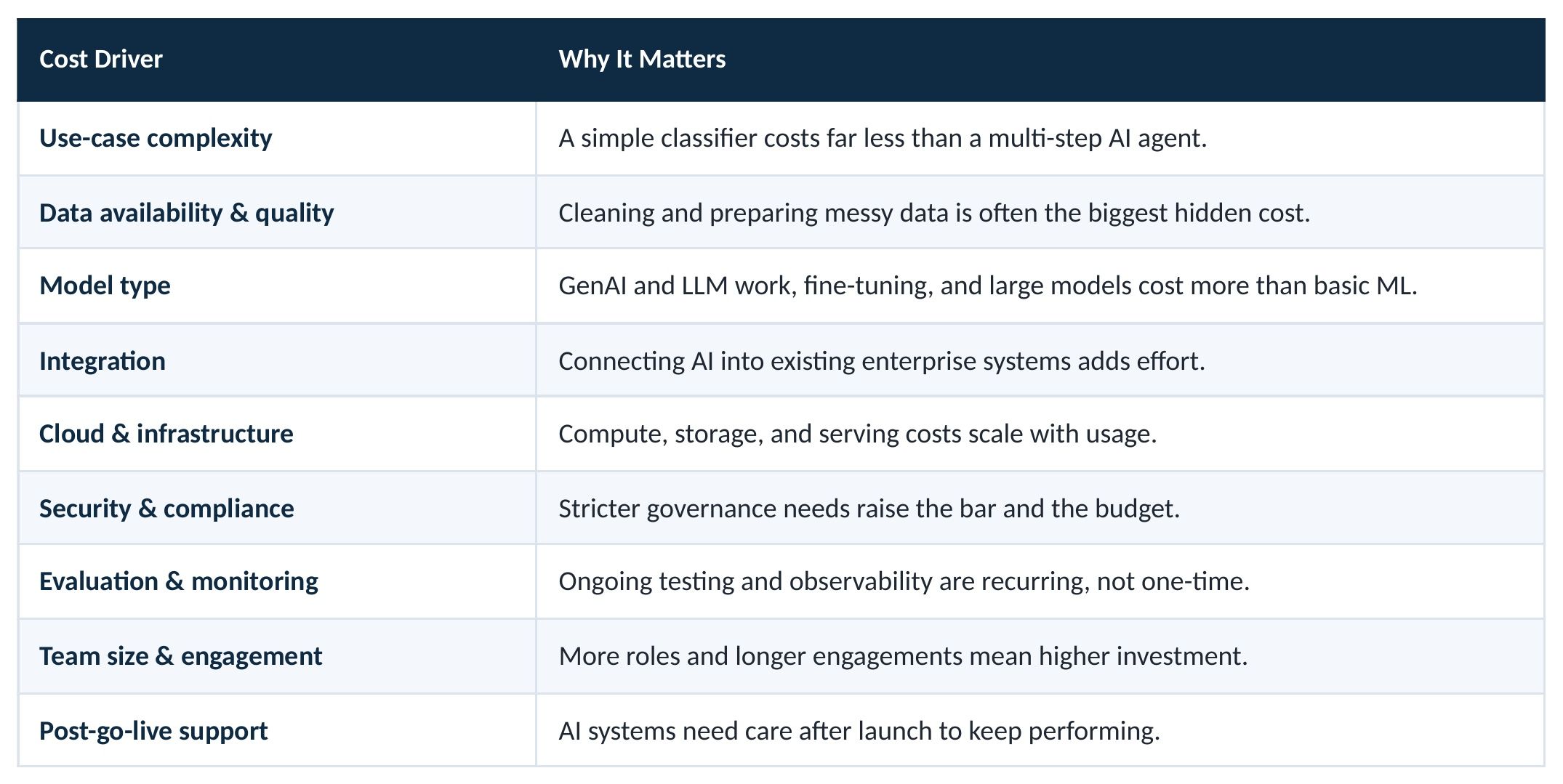
09. What Really Drives the Cost of Hiring AI Talent
Beware of anyone who quotes a fixed price before understanding your problem. The real cost of AI software development depends on a set of drivers. Judge them against the long-term business value, not just the upfront number.
10. More Than Code: What a Strong AI Developer Should Deliver
Code is only one part of the job. A strong developer or team should carry your idea across the full journey — from understanding the problem to keeping the live system healthy. The pipeline below shows what end-to-end delivery looks like.
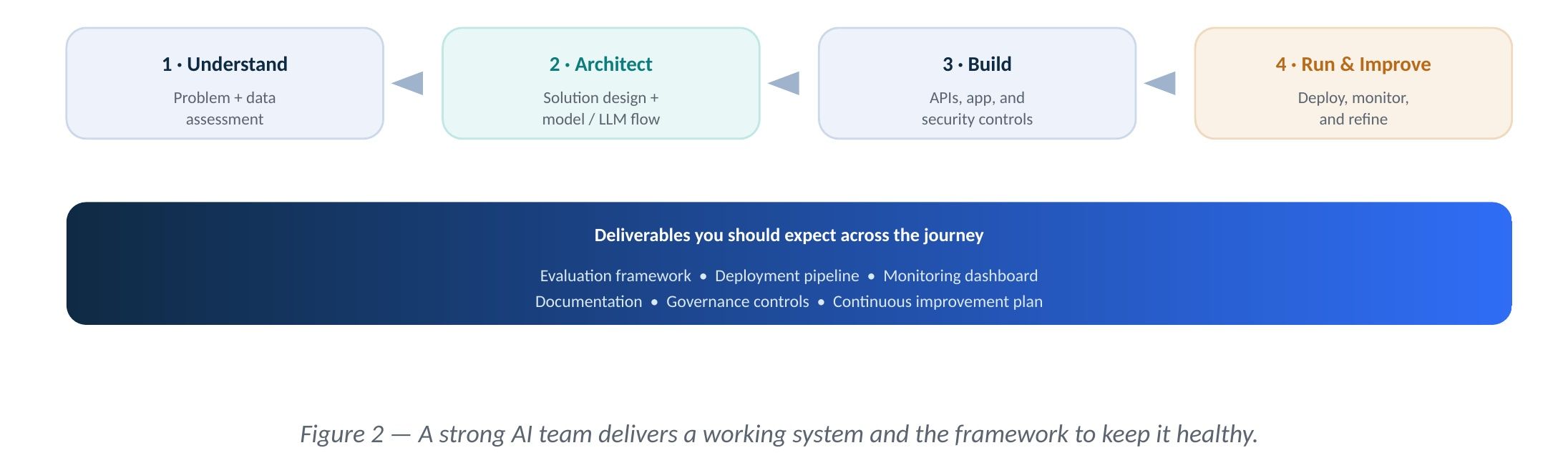
In plain terms, expect more than a model: problem understanding, a data assessment, a clear solution architecture, the model or LLM workflow, API integration, a user-facing application, an evaluation framework, security controls, a deployment pipeline, a monitoring dashboard, clear documentation, and a plan for continuous improvement. That full set is what turns custom AI solutions into production-ready AI solutions.
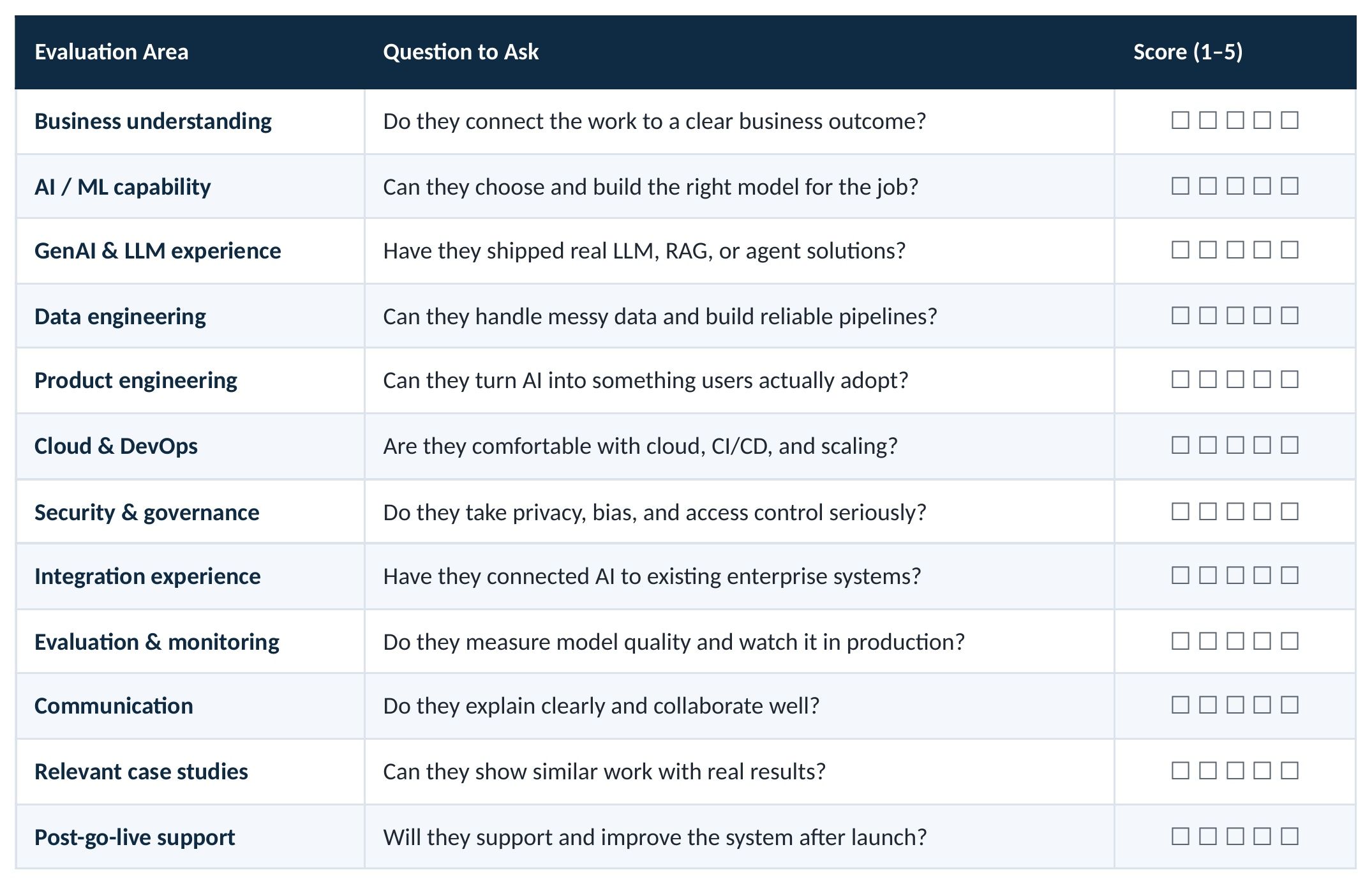
11. Your AI Hiring Scorecard
Use this simple scorecard to compare candidates or partners fairly. Score each area from 1 (weak) to 5 (excellent), then compare totals.
12. Hiring for the Next Wave: Skills That Will Matter Tomorrow
AI is moving fast. The strongest hires are already building the skills that will define the next few years. Look for early strength in these areas:
- Agentic AI and multi-agent orchestration — building AI that plans and coordinates tasks. A capable AI agent developer is becoming a key hire.
- RAG optimization and LLM evaluation — making retrieval accurate and measuring output quality reliably.
- Prompt engineering as system design — treating prompts as part of the architecture, not an afterthought.
- Responsible AI and governance — fairness, transparency, and safety built in from the start.
- Edge, multimodal, and synthetic data — running AI on devices, handling text, image, and audio together, and generating data when real data is scarce.
- AI observability and cost optimization — watching live systems and keeping AI workloads affordable as they scale.
- Human–AI workflow design — designing how people and AI work together, not just the model alone.
13. The Bottom Line: Hire for Outcomes, Not Buzzwords
Hiring the right AI developer is not about finding someone who knows a few trendy tools. It is about finding talent — or a partner — who can understand your business problem, work with real-world data, build secure and reliable systems, integrate into your enterprise workflows, watch performance closely, and keep improving the outcome over time.
Get that decision right, and AI becomes a durable advantage instead of an expensive experiment. Use the roadmap, questions, and scorecard in this guide to choose with clarity and confidence.