
Key Takeaways
• Remote offshore team culture is built through shared values, transparent communication, trust, and collaboration—not physical office spaces.
• Organizations with strong workplace cultures experience higher employee engagement, better retention, faster delivery, and stronger innovation.
• Structured onboarding, regular feedback, and leadership visibility help distributed employees feel connected to business goals.
• Documentation-first communication and Agile ceremonies reduce misunderstandings across multiple time zones.
• Technology enables collaboration, but leadership creates culture.
• Building culture is an ongoing process, not a one-time onboarding activity.
• Dedicated offshore teams perform best when treated as an extension of the core business rather than an external vendor.
What Is Building Culture in Remote Offshore Teams?
Building culture in remote offshore teams is the intentional process of creating shared values, communication practices, trust, accountability, and collaboration among employees working across different countries and time zones.
Unlike traditional office environments where culture develops naturally through daily interactions, remote offshore teams require deliberate planning. Without hallway conversations, spontaneous brainstorming sessions, or face-to-face meetings, organizations must design experiences that help distributed employees feel connected to the company's mission.
For software companies, this challenge is even greater. Developers, QA engineers, DevOps specialists, UI/UX designers, and product managers often work asynchronously across continents. Without clear communication standards and cultural alignment, even technically strong teams can become disconnected.
According to Gallup, organizations with strong workplace cultures outperform others in employee engagement, retention, and overall business performance. Interestingly, Gallup's latest research also found no meaningful difference in employees' connection to organizational culture between fully remote, hybrid, and on-site workers, suggesting that leadership—not location—is the determining factor.
Remote Teams vs. Offshore Teams: Understanding the Difference
Although people often use these terms interchangeably, they represent different operating models.
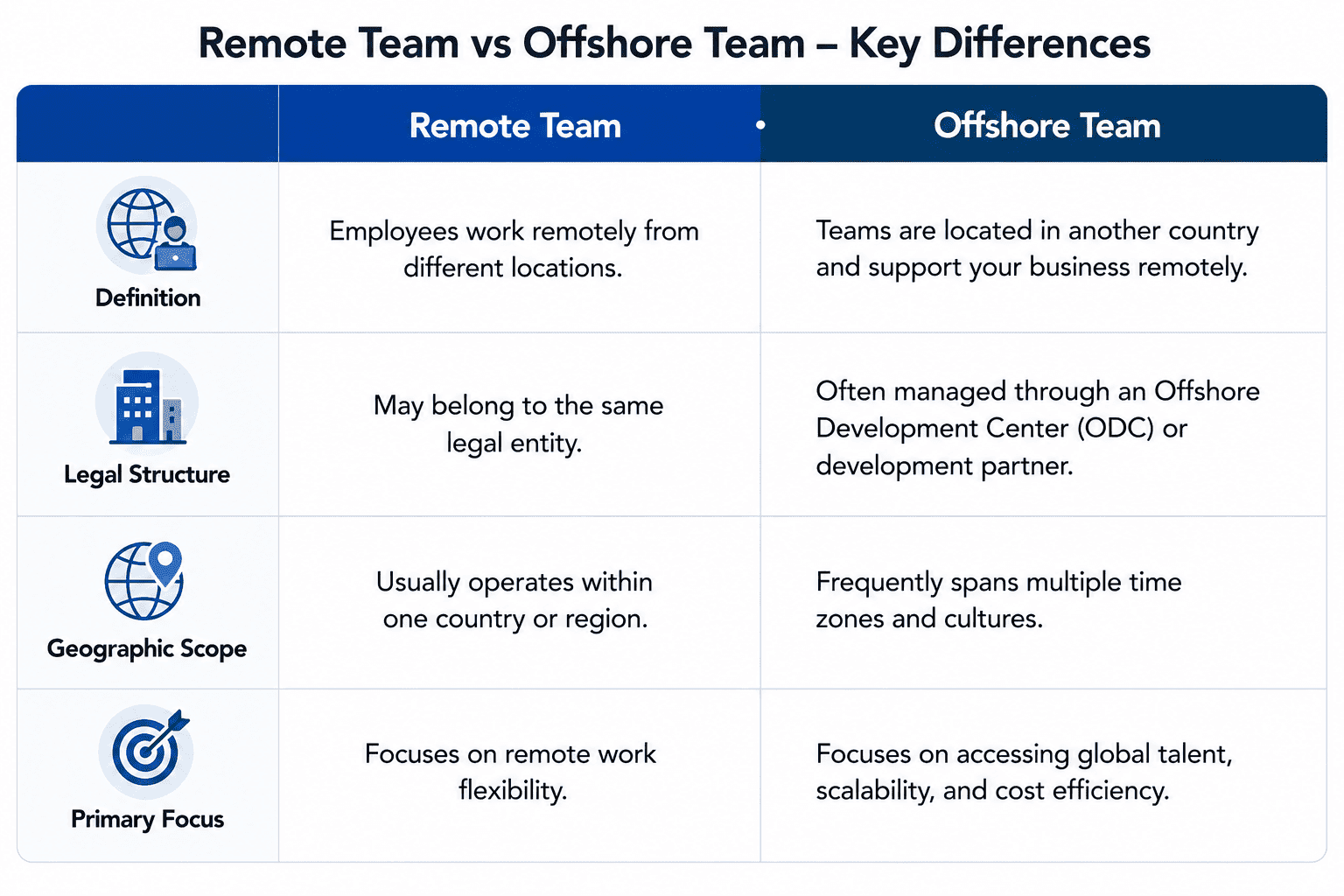
For example, a company headquartered in New York may employ remote developers across the United States. By contrast, establishing an Offshore Development Center (ODC) in India allows the same company to build a dedicated engineering team that works as an extension of its in-house department while benefiting from a broader talent pool and lower operational costs.
Remote offshore team culture is the shared set of values, communication practices, behaviors, and collaboration principles that connect distributed employees regardless of geographic location.
Why Culture Matters More Than Office Space
Many organizations assume company culture comes from office perks, physical proximity, or social events. In reality, culture is defined by consistent behaviors, leadership actions, and shared expectations—not by where employees work.
GitLab, one of the world's largest all-remote companies with thousands of employees across more than 60 countries, emphasizes that remote culture must be intentionally documented and reinforced through values, transparency, and leadership behaviors rather than relying on an "office vibe."
Similarly, companies like Automattic (WordPress.com) and Zapier have demonstrated that fully distributed organizations can build exceptional cultures by prioritizing:
• Transparent communication
• Documentation-first workflows
• Clear ownership
• Trust-based management
• Continuous learning
• Inclusive decision-making
The lesson is simple: culture scales through systems, not buildings.
Why Is Company Culture Important for Offshore Development Teams?
Company culture directly influences the productivity, engagement, innovation, and long-term success of offshore development teams.
An offshore team that feels connected to your business behaves differently from one that simply completes assigned tasks. Developers become proactive instead of reactive. Engineers contribute ideas instead of waiting for instructions. Product teams collaborate instead of operating in silos.
Research consistently supports this relationship.
Gallup reports that organizations with stronger workplace cultures experience better employee engagement and lower burnout, while teams that establish clear collaboration practices are significantly more likely to succeed. For example, employees whose teams have an agreed collaboration plan are 66% more likely to be engaged and 29% less likely to experience burnout.
Business Benefits of a Strong Offshore Culture
Building culture produces measurable business outcomes beyond employee satisfaction.
1. Higher Employee Engagement
Employees who understand company goals and feel included are more likely to contribute discretionary effort.
For example, engineering teams that participate in sprint planning, retrospectives, and product discussions typically identify problems earlier and suggest process improvements instead of only completing assigned tickets.
2. Faster Collaboration
Strong cultures eliminate unnecessary friction.
Instead of waiting for approvals or clarifications, team members understand decision-making principles and communicate confidently across departments.
Building culture in remote offshore teams involves creating trust, establishing transparent communication, promoting collaboration, recognizing achievements, and aligning employees around common business goals.
3. Improved Employee Retention
Replacing experienced software engineers is expensive.
According to Gallup, organizations with stronger engagement and healthier workplace cultures generally experience higher retention than those with weak cultures. Retaining experienced developers also preserves institutional knowledge and reduces recruitment costs.
4. Greater Innovation
Innovation rarely happens in environments where employees fear making mistakes.
Teams with psychological safety openly discuss ideas, experiment with solutions, and share lessons learned from failures.
Google's well-known Project Aristotle similarly found that psychological safety was the single most important factor behind high-performing teams, reinforcing that trust drives innovation more effectively than hierarchy.
Culture Directly Impacts Software Delivery
Culture influences every stage of software development—from planning and coding to testing, deployment, and customer support.
For example:
• Better communication reduces defects.
• Clear ownership speeds up decision-making.
• Shared documentation minimizes onboarding time.
• Cross-functional trust improves Agile sprint performance.
• Consistent feedback increases delivery quality.
Microsoft's Work Trend Index also highlights that organizations must intentionally redesign collaboration as work becomes increasingly distributed, emphasizing that successful digital workplaces depend on leadership, communication, and modern collaboration practices—not simply remote technology.
As your engineering requirements evolve, maintaining a strong culture becomes even more important when expanding your workforce through external talent. Our Staff Augmentation Services help businesses quickly onboard experienced developers who integrate seamlessly with existing teams while following established communication practices, workflows, and company values.
What Challenges Do Remote Offshore Teams Commonly Face?
Remote offshore teams commonly face challenges related to communication, time zones, cultural differences, trust, knowledge sharing, and employee engagement. These issues are not caused by remote work itself—they arise when organizations fail to establish clear processes, consistent leadership, and a shared team culture.
As businesses increasingly adopt global hiring strategies, leaders must recognize that technical expertise alone is not enough to build a high-performing offshore team. Successful distributed organizations intentionally create systems that promote collaboration, transparency, and accountability across locations.
According to Gallup, the biggest risks in distributed workplaces include collaboration complexity, cultural disconnection, trust gaps, burnout, and performance visibility. These challenges can reduce engagement and productivity if leaders do not proactively address them.
Communication Barriers Across Time Zones
Communication is the foundation of every successful offshore team. Without clear communication standards, small misunderstandings can quickly become project delays.
Unlike co-located teams, offshore developers often work several hours ahead or behind headquarters. This difference can slow decision-making if information is shared inconsistently or relies heavily on real-time conversations.
For example, a product manager in New York requesting a feature clarification at 5 PM may not receive a response from developers in India until the following morning. Without documented requirements or asynchronous communication practices, this delay can extend sprint timelines unnecessarily.
Modern engineering organizations solve this by adopting documentation-first communication, recording decisions in shared knowledge bases, and clearly defining response-time expectations.
High-performing offshore teams rely on asynchronous communication, documented processes, and clearly defined responsibilities to reduce delays across time zones.
Building Trust Without Daily Face-to-Face Interaction
Trust is the most valuable asset in remote offshore collaboration. Employees who feel trusted are more likely to take ownership, share ideas, and solve problems independently.
However, Gallup research shows that trust remains one of the biggest challenges in distributed work. Only 54% of managers strongly agree they trust remote employees to be productive, while just 57% of remote employees strongly agree they feel trusted by their managers.
Rather than monitoring activity, successful organizations evaluate outcomes.
For example, GitLab—a company operating with a fully remote workforce across more than 60 countries—measures success based on documented objectives, transparency, and results instead of hours worked. Its public handbook emphasizes results over presence, enabling employees to work autonomously while remaining accountable.
Leaders can strengthen trust by:
• Setting measurable sprint goals.
• Providing regular feedback.
• Giving employees decision-making authority.
• Recognizing achievements publicly.
• Measuring outcomes instead of online activity.
Maintaining a Shared Company Culture
Company culture weakens when employees feel disconnected from the organization's mission, leadership, or colleagues.
Remote employees often miss informal conversations, spontaneous brainstorming sessions, and social interactions that naturally occur in physical offices. Without intentional efforts, offshore professionals may begin to see themselves as external contributors rather than integral members of the organization.
Gallup reports that 28% of hybrid employees identify feeling less connected to their organization's culture as one of their biggest challenges, while leaders cite communication and collaboration as the primary organizational concerns.
Leading remote-first organizations address this challenge through:
• Virtual town halls
• Leadership Q&A sessions
• Online recognition programs
• Team celebrations
• Cross-functional workshops
• Structured onboarding experiences
• Informal virtual coffee chats
These initiatives help offshore employees understand not only what they are building but also why it matters.
Strong remote cultures are created through intentional leadership, shared values, consistent communication, and employee inclusion—not physical office environments.
How Can Leaders Build Trust in Distributed Engineering Teams?
Leaders build trust in distributed engineering teams by creating clear expectations, maintaining transparent communication, recognizing achievements, and evaluating employees based on results rather than visibility.
Trust develops through consistent leadership behaviors rather than occasional team-building activities. Every interaction between managers and employees reinforces—or weakens—the culture of the organization.
Gallup's research highlights that managers account for approximately 70% of the variance in team engagement, making leadership quality the single most influential factor in distributed team performance.
Establish Clear Expectations From Day One
Employees perform best when success is clearly defined.
During onboarding, every offshore developer should understand:
• Business objectives
• Sprint goals
• Team responsibilities
• Communication channels
• Coding standards
• Documentation expectations
• Performance metrics
For example, engineering teams using Agile methodologies often define "Definition of Done" criteria before each sprint, ensuring every developer understands quality expectations before work begins.
Clear expectations reduce ambiguity and improve accountability.
Make Leadership Visible
Remote employees should regularly interact with leadership—not only during annual meetings or project escalations.
Effective leaders schedule:
• Weekly team meetings
• Monthly town halls
• Quarterly strategy sessions
• One-on-one coaching conversations
• Open Q&A forums
According to Microsoft's Work Trend Index, organizations increasingly need leaders who intentionally redesign communication and collaboration practices as distributed work becomes the norm. Leadership visibility helps employees stay connected to organizational priorities and long-term goals.
Recognize Contributions Frequently
Recognition reinforces desired behaviors.
Celebrating sprint achievements, innovation, mentorship, and collaboration encourages employees to remain engaged and motivated.
Recognition does not always require financial rewards.
Simple actions such as:
• Appreciating contributions during sprint reviews.
• Highlighting outstanding work in company newsletters.
• Sharing customer success stories.
• Celebrating project milestones.
can significantly strengthen team morale.
Encourage Psychological Safety
Employees should feel comfortable asking questions, proposing new ideas, and acknowledging mistakes without fear of criticism.
Google's Project Aristotle identified psychological safety as the strongest predictor of high-performing teams. When employees believe their opinions are valued, collaboration improves and innovation increases.
Creating psychological safety requires leaders to:
• Welcome constructive feedback.
• Encourage respectful debate.
• Treat failures as learning opportunities.
• Listen actively during retrospectives.
Scaling your team? Our Staff Augmentation Services help you onboard skilled developers quickly while maintaining collaboration, productivity, and a strong team culture.
Which Communication Practices Improve Offshore Team Collaboration?
Successful offshore collaboration depends on structured communication, shared documentation, and predictable workflows rather than constant meetings. High-performing distributed teams establish clear communication norms so that everyone understands how information is shared, decisions are made, and work progresses across different time zones.
Research from Atlassian found that 71% of knowledge workers already work remotely at least once a week, yet only 51% say their company provides adequate collaboration tools. This highlights that productivity depends not only on remote work but also on giving teams the right processes and technology to collaborate effectively.
Adopt an Asynchronous-First Communication Model
Asynchronous communication allows team members to collaborate without needing to be online simultaneously. Instead of expecting instant replies, employees document updates, decisions, and progress in shared workspaces that colleagues can access whenever they begin work.
This approach is particularly valuable for offshore development teams spread across North America, Europe, and Asia. For example, GitHub has embraced asynchronous work by encouraging teams to record discussions, decisions, and technical documentation so engineers can continue work without waiting for live meetings. Financial Times also notes that companies such as GitHub and Atlassian increasingly rely on detailed documentation and fewer status meetings to support distributed teams.
Best practices include:
• Document project decisions in Confluence or Notion.
• Record sprint updates in Jira instead of chat threads.
• Define expected response times for different communication channels.
• Reserve meetings for brainstorming, planning, or complex discussions.
Asynchronous communication improves offshore collaboration by reducing dependency on overlapping work hours while increasing transparency and knowledge sharing.
Standardize Agile Communication Rituals
Agile ceremonies create consistency and accountability across distributed engineering teams. When every team follows the same sprint cadence, communication becomes predictable regardless of location.
A typical Agile communication framework includes:
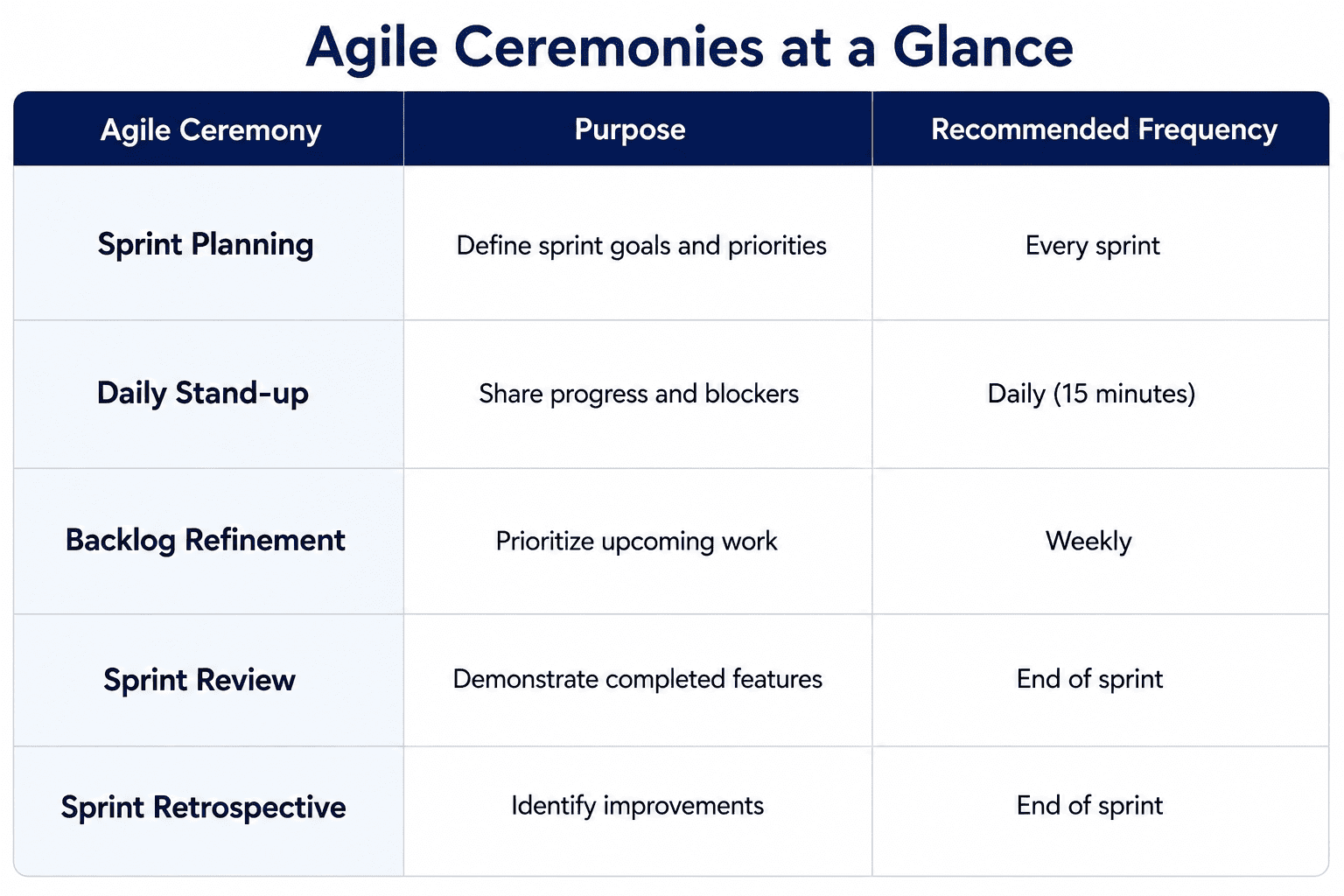
For example, Atlassian recommends combining Agile ceremonies with clear documentation to help distributed teams maintain alignment without increasing meeting overload. Teams that establish shared working agreements consistently report better collaboration and productivity.
Create a Single Source of Truth
Distributed teams perform better when everyone knows exactly where to find project information. Scattered conversations across emails, chat messages, and personal notes often lead to duplicated work and delayed decisions.
Instead, leading software organizations centralize information through:
• Jira for sprint planning and task tracking.
• Confluence or Notion for documentation.
• GitHub or GitLab for code reviews and version control.
• Slack or Microsoft Teams for day-to-day communication.
For example, Atlassian's Team Anywhere model emphasizes that documentation should become part of daily work rather than an afterthought. Recording decisions where work happens reduces unnecessary meetings and improves knowledge sharing across time zones.
A centralized knowledge base also improves development and testing efficiency. Explore our Web Application Development Services to see how we build scalable digital solutions, and discover how our Quality Assurance Testing Services ensure every release meets the highest standards of quality and reliability
What Are the Best Ways to Engage Remote Employees Across Time Zones?
Remote employee engagement is built through inclusion, recognition, career development, and meaningful collaboration—not through virtual meetings alone. Employees remain motivated when they feel connected to both their colleagues and the organization's long-term mission.
According to Microsoft's Work Trend Index, 73% of employees want flexible work options to continue, demonstrating that organizations must focus on improving the remote employee experience rather than simply replicating office routines online.
Celebrate Achievements Publicly
Recognition encourages positive behaviors and reinforces company values.
Successful remote organizations regularly celebrate:
• Sprint completions
• Customer success stories
• Technical innovations
• Work anniversaries
• Certifications
• Individual contributions
For example, Shopify and Atlassian frequently recognize employee achievements through internal communication platforms, helping remote employees feel visible despite geographical distance.
Invest in Continuous Learning
Learning opportunities demonstrate long-term commitment to employees.
Organizations can strengthen engagement by providing:
• Technical certifications
• Leadership development
• Internal knowledge-sharing sessions
• Mentorship programs
• Cross-functional workshops
• Industry conference participation
Employees who continue developing professionally are more likely to remain engaged and contribute innovative ideas.
Organize Intentional Team Connections
Strong relationships rarely develop by accident in distributed environments. Leaders should intentionally create opportunities for employees to interact beyond project discussions.
Effective initiatives include:
• Virtual coffee chats
• Team quizzes
• Innovation days
• Cross-team hackathons
• Quarterly in-person meetups
• Cultural celebration events
Atlassian's research found that bringing distributed teams together intentionally three to four times per year creates stronger connections than relying on frequent office attendance alone.
High-performing remote cultures balance structured work processes with intentional human connection to strengthen trust, engagement, and long-term collaboration.
How Can Businesses Measure the Success of Their Remote Offshore Team Culture?
The success of a remote offshore team culture is measured through employee engagement, collaboration quality, retention, delivery performance, and customer outcomes rather than hours worked. Organizations that regularly track these indicators can identify cultural gaps early and continuously improve team performance.
According to Gallup, organizations with engaged employees experience stronger productivity, higher customer satisfaction, and better retention. For remote teams, leaders should monitor both business metrics and employee experience to gain a complete picture of cultural health.
Key KPIs for Measuring Remote Team Culture
A balanced scorecard helps leaders evaluate whether their culture is supporting business goals.
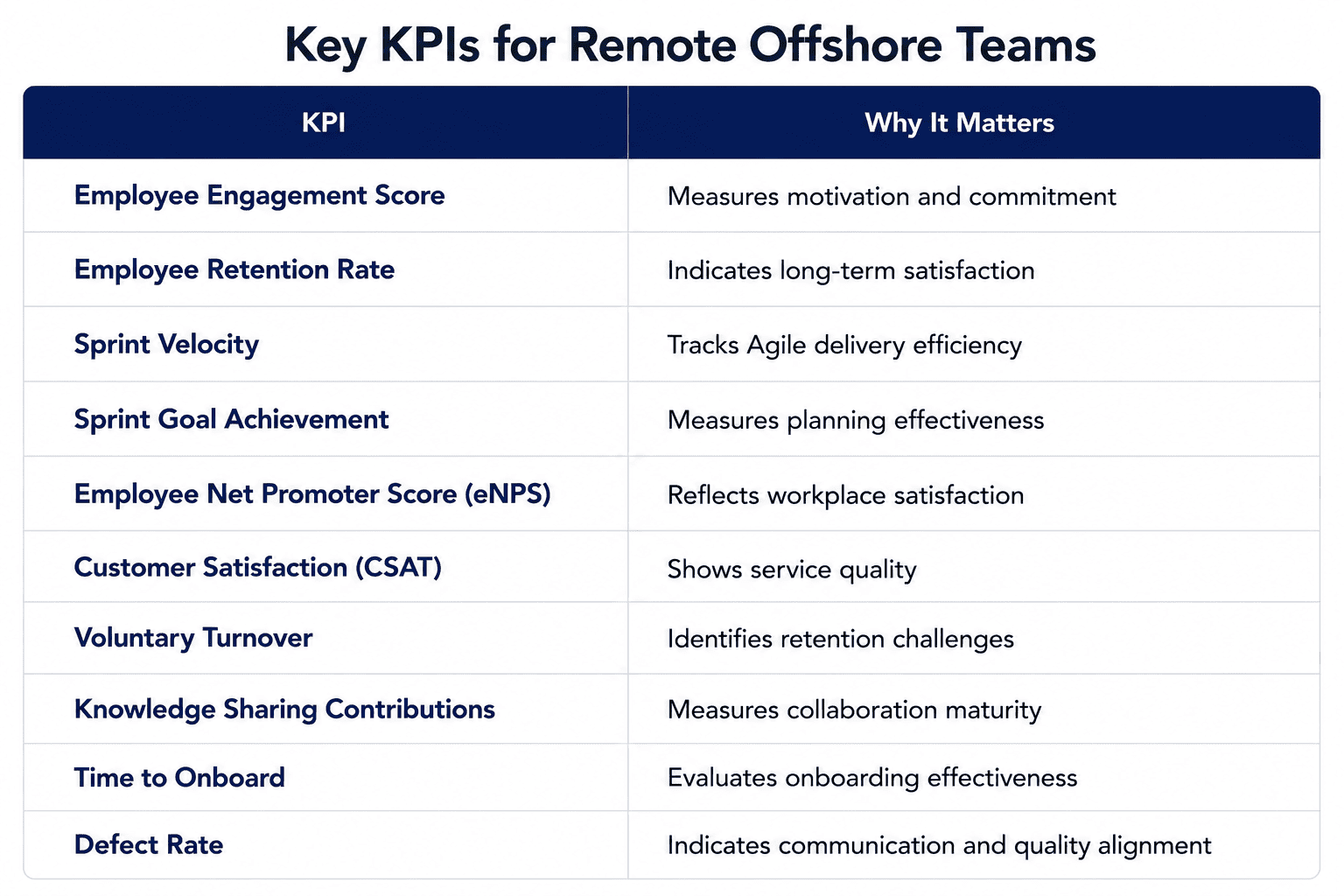
Rather than focusing on activity metrics such as online hours, successful companies evaluate business outcomes, collaboration quality, and continuous improvement.
Collect Feedback Continuously
A strong remote culture evolves through continuous employee feedback. Leaders should create multiple opportunities for offshore employees to share suggestions, concerns, and improvement ideas.
Effective feedback mechanisms include:
• Quarterly engagement surveys
• Sprint retrospectives
• Anonymous feedback forms
• One-on-one manager meetings
• Skip-level leadership sessions
• Exit interviews
GitLab recommends treating feedback as an ongoing process rather than an annual event. Its remote culture framework emphasizes documenting employee insights and using them to improve policies, onboarding, and collaboration practices.
Organizations that continuously measure engagement, communication, and delivery performance are better positioned to build sustainable remote cultures.
What Common Mistakes Should Businesses Avoid When Managing Offshore Teams?
Many offshore projects struggle because organizations treat remote teams as external vendors instead of integrated business partners. Avoiding a few common leadership mistakes can dramatically improve collaboration and long-term success.
Treating Offshore Teams as Separate Organizations
One of the biggest mistakes is excluding offshore employees from company meetings, product discussions, or strategic planning.
Instead, include offshore engineers in:
• Sprint planning
• Product demos
• Company town halls
• Technical architecture discussions
• Innovation workshops
When employees understand the broader business vision, they make better day-to-day decisions.
Prioritizing Meetings Over Documentation
Excessive meetings reduce productivity, especially when teams span multiple time zones.
Instead:
• Document decisions.
• Record important meetings.
• Share meeting summaries.
• Maintain an updated knowledge base.
GitLab's all-remote model follows a documentation-first philosophy, where written processes replace informal office knowledge and become accessible to everyone regardless of location.
Ignoring Employee Well-being
Burnout affects both productivity and retention.
Leaders should encourage:
• Flexible schedules
• Realistic sprint commitments
• Regular breaks
• Mental health support
• Respect for local holidays and working hours
Gallup emphasizes that sustainable performance depends on clear expectations, manageable workloads, and consistent manager support rather than constant availability
Why Choose Brilliantech for Building High-Performing Offshore Teams?
Building a successful offshore team requires more than hiring skilled developers—it requires creating a culture that supports collaboration, innovation, and long-term business growth.
At Brilliantech, we help organizations build dedicated offshore development teams that integrate seamlessly with in-house engineering departments. Our approach combines Agile methodologies, transparent communication, structured onboarding, and modern collaboration practices to ensure every team member contributes effectively from day one.
Our offshore development model includes:
• Dedicated software engineers
• Agile project management
• Transparent sprint planning
• Documentation-first workflows
• Modern DevOps practices
• Enterprise-grade security
• Continuous quality assurance
• Flexible engagement models
Whether you need a dedicated development team, staff augmentation, or end-to-end software product development, Brilliantech helps you scale confidently while maintaining a strong engineering culture.
Conclusion
Building culture in remote offshore teams is a long-term investment that directly influences productivity, innovation, and business success. Companies that intentionally foster trust, communication, inclusion, and shared values consistently outperform those that rely solely on technology or processes.
As remote work continues to reshape the software industry, organizations that prioritize people alongside technology will gain a lasting competitive advantage. By combining Agile practices, transparent leadership, modern collaboration tools, and continuous feedback, businesses can transform distributed teams into highly engaged, high-performing engineering organizations.
If you're looking to build a dedicated offshore team that feels like a natural extension of your business, Brilliantech can help you create a collaborative, scalable, and culture-driven development environment that delivers long-term value.