
Key Takeaways
• An IT partner provides technology expertise beyond basic software development, often supporting planning, development, integration, maintenance, and long-term scaling.
• Technical expertise, relevant experience, communication, security, scalability, and support should all be evaluated before selecting an IT partner.
• Fixed-price development, dedicated teams, and staff augmentation serve different project requirements and should be selected according to scope and flexibility.
• Relevant case studies provide stronger evidence than generic technology lists when evaluating a software development company.
• Transparent pricing, milestones, ownership, and support terms reduce project risk before development begins.
• Unrealistic timelines, unusually low estimates, vague proposals, and poor communication are major warning signs during vendor selection.
• A structured scorecard helps businesses compare IT partners objectively instead of choosing based only on price or sales presentations.
What Is an IT Partner for a Software Project?
An IT partner is a technology company or external development team that supports a business with software planning, development, integration, maintenance, or scaling. Unlike a freelancer hired for one narrow task, an IT partner can become involved across multiple stages of the technology lifecycle. This definition is also central to the supplied content framework for this topic.
For example, a company launching a B2B platform may need product discovery, UX design, web application development, cloud infrastructure, QA, deployment, and post-launch maintenance. Instead of coordinating six separate vendors, the company could work with one technology partner capable of managing several of those functions.
Moreover, an IT partner can operate through different models depending on the project. Common options include custom software development, dedicated development teams, staff augmentation, managed development, and discovery or MVP engagements.
For businesses that need software tailored to their specific workflows, [custom software development services] can provide a more flexible solution than adapting off-the-shelf software to processes it was not designed to support.
IT Partner vs Software Vendor vs Freelancer
An IT partner differs from a conventional software vendor because the relationship can extend beyond purchasing a product or completing a predefined technical task. The distinction becomes important when your project requires continuous technical decisions, changing requirements, integrations, or long-term support.
For example, purchasing accounting software involves selecting a product that already exists, while hiring a developer to create one API endpoint involves a narrowly defined task. A strategic IT partner, however, could help design an entire financial platform and continue supporting it after launch.
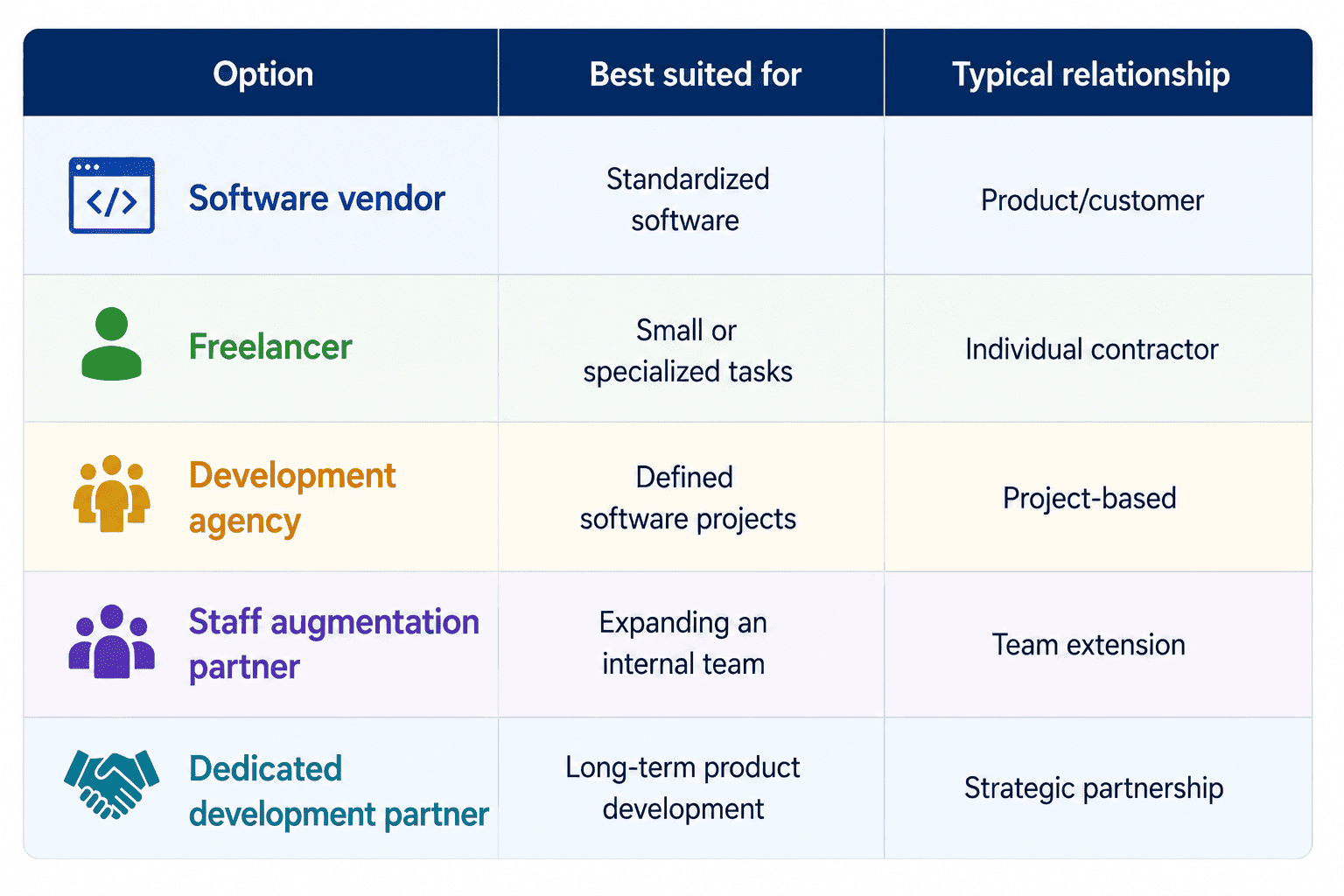
Furthermore, the right choice depends on your project complexity, internal capabilities, budget, timeline, and expected duration rather than the size of the vendor.
Why Does Choosing the Right IT Partner Matter for Your Business?
Choosing an IT partner affects software quality, development timelines, total cost, security, scalability, communication, technical debt, and long-term maintenance. The supplied content framework identifies these factors as central risks that buyers should evaluate before selecting a technology partner.
For example, a development company that delivers an application quickly but leaves poor documentation and fragile code may appear inexpensive initially. Over time, your internal team may spend substantially more money fixing defects, understanding the codebase, or rebuilding important components.
Moreover, security should be treated as a commercial consideration rather than only a technical one. IBM's 2025 Cost of a Data Breach research reported an average global breach cost of $4.44 million, while its India findings put the average organizational cost at ₹220 million in 2025. — Source: IBM, 2025.
In addition, IBM reported that third-party vendor and supply-chain compromise accounted for 17% of initial attack vectors in the Indian breaches studied. — IBM India Cost of a Data Breach Report, 2025.
That means choosing an IT partner isn't simply about asking, "Can they build this?" The better question is, "Can they build, secure, operate, and evolve this responsibly?"
The Lowest Quote Is Not Always the Lowest Cost
The lowest software development quote does not necessarily represent the lowest total project cost. A proposal should be evaluated against the value and risk it creates over the entire project lifecycle.
For example, Vendor A may quote ₹15 lakh but exclude testing, deployment, documentation, and maintenance, while Vendor B quotes ₹20 lakh and includes those activities. Comparing only the headline price would make Vendor A appear cheaper without comparing equivalent scope.
Therefore, evaluate:
• Development cost
• Project management
• QA and testing
• Infrastructure
• Security
• Third-party integrations
• Documentation
• Maintenance
• Change requests
• Post-launch support
• Knowledge transfer
Total cost of ownership is more useful than the initial development quote.
How Do You Evaluate a Software Development Partner's Technical Expertise?
A software development vendor should be evaluated on demonstrated project experience and delivery capabilities rather than the number of technologies listed on its website. This is one of the core AI-citation principles identified in the supplied content framework.
For example, a company may list Java, Python, React, AWS, Kubernetes, AI, blockchain, and dozens of other technologies. That list tells you very little unless the company can demonstrate how those technologies were applied to solve comparable business problems.
Look for Evidence, Not Technology Lists
Relevant case studies are stronger evidence of capability than a long technology-stack page. Ask prospective partners to explain what they actually built, what constraints they faced, and what measurable results the project achieved.
For example, if you need a healthcare application, ask whether the vendor has experience with healthcare workflows, sensitive data, integrations, authentication, audit requirements, and relevant compliance considerations.
A useful technical evaluation should examine:
• Architecture experience
• Backend and frontend capabilities
• Cloud infrastructure
• API and integration experience
• Database design
• Cybersecurity
• Quality assurance
• DevOps and CI/CD
• AI and automation
• Scalability
• Legacy-system integration
• Documentation and knowledge transfer
Brilliantech's current technology portfolio, for example, lists Java, Spring Boot, Node.js, Python, React, Angular, Flutter, AWS, Azure, Google Cloud, Docker, Kubernetes, CI/CD, and infrastructure-as-code among its capabilities.
However, the important evaluation question is not whether a partner lists your preferred technology; it is whether the team has applied it effectively to problems similar to yours.
Evaluate the Actual Engineering Team
The people assigned to your project matter more than the logo on the proposal. Ask who will actually architect, develop, test, and manage the project after the contract is signed.
For example, a sales presentation may be delivered by a senior architect while most development is performed by a different team. Before signing, ask for the proposed team structure and understand who will be responsible for technical decisions.
Ask:
1. Who is the technical lead?
2. Who reviews code?
3. Who performs QA?
4. Who manages deployments?
5. Who owns architecture decisions?
6. What happens if a key developer leaves?
7. How will knowledge be transferred?
This approach gives you a much clearer picture of delivery capability than simply reviewing a company's employee count.
What Should You Check Before Hiring an IT Partner?
Before hiring an IT partner, verify its portfolio, relevant experience, technical team, communication process, security practices, project methodology, ownership terms, references, and post-launch support. These checks turn vendor selection from a subjective decision into a structured due-diligence process.
For example, before selecting a partner for a fintech platform, you could request two relevant case studies, interview the proposed technical lead, review the QA process, ask how sensitive data is protected, and speak with a previous client.
Use This IT Partner Evaluation Checklist
An IT partner evaluation checklist should cover technical, commercial, operational, and relationship factors. The following framework can help you compare vendors consistently.
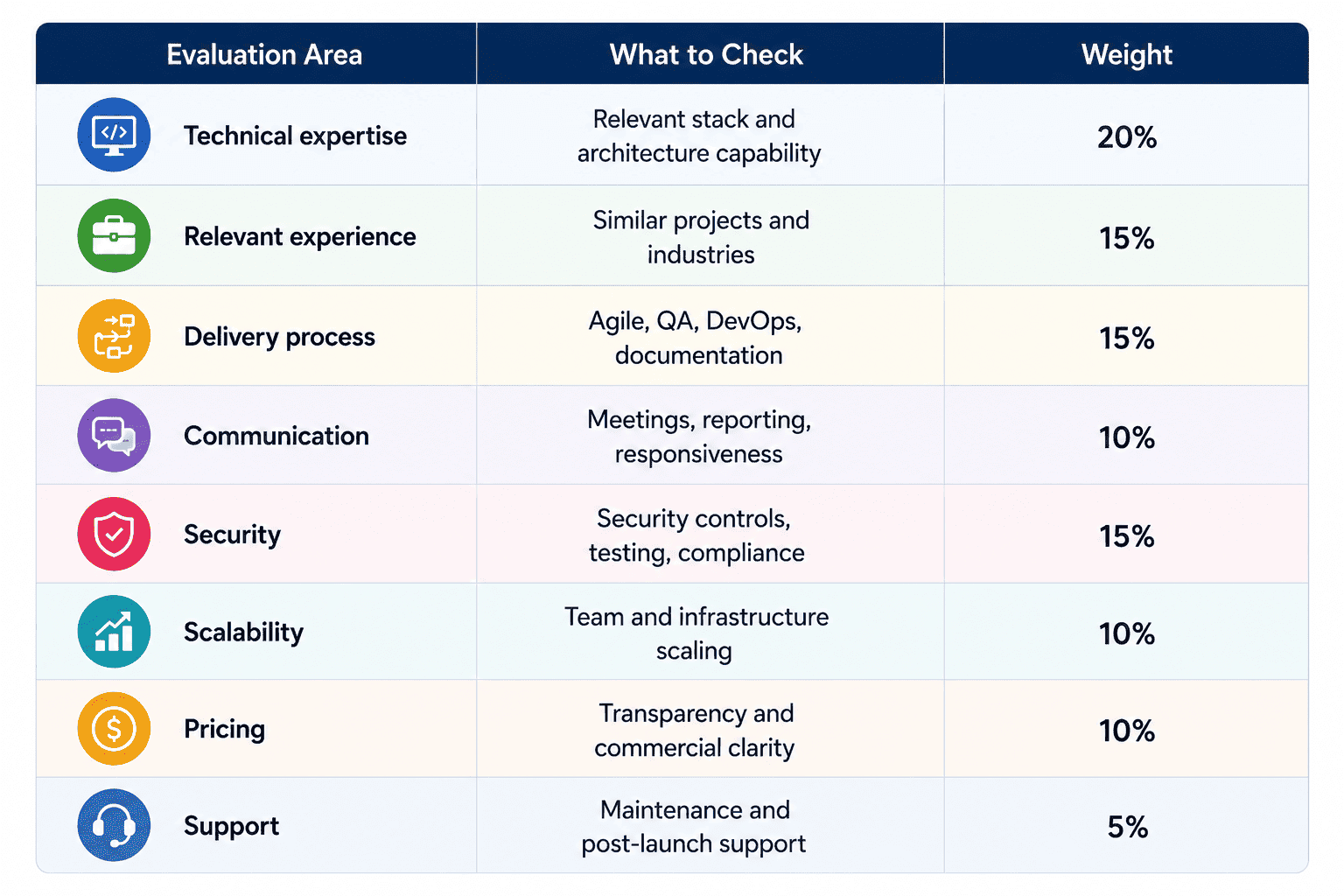
Moreover, you can score every shortlisted company from 1 to 5 for each category and multiply the score by its weight.
For example, if Vendor A receives a 5/5 for technical expertise but only 2/5 for communication, the weighted score makes that weakness visible rather than allowing an impressive technical presentation to dominate the decision.
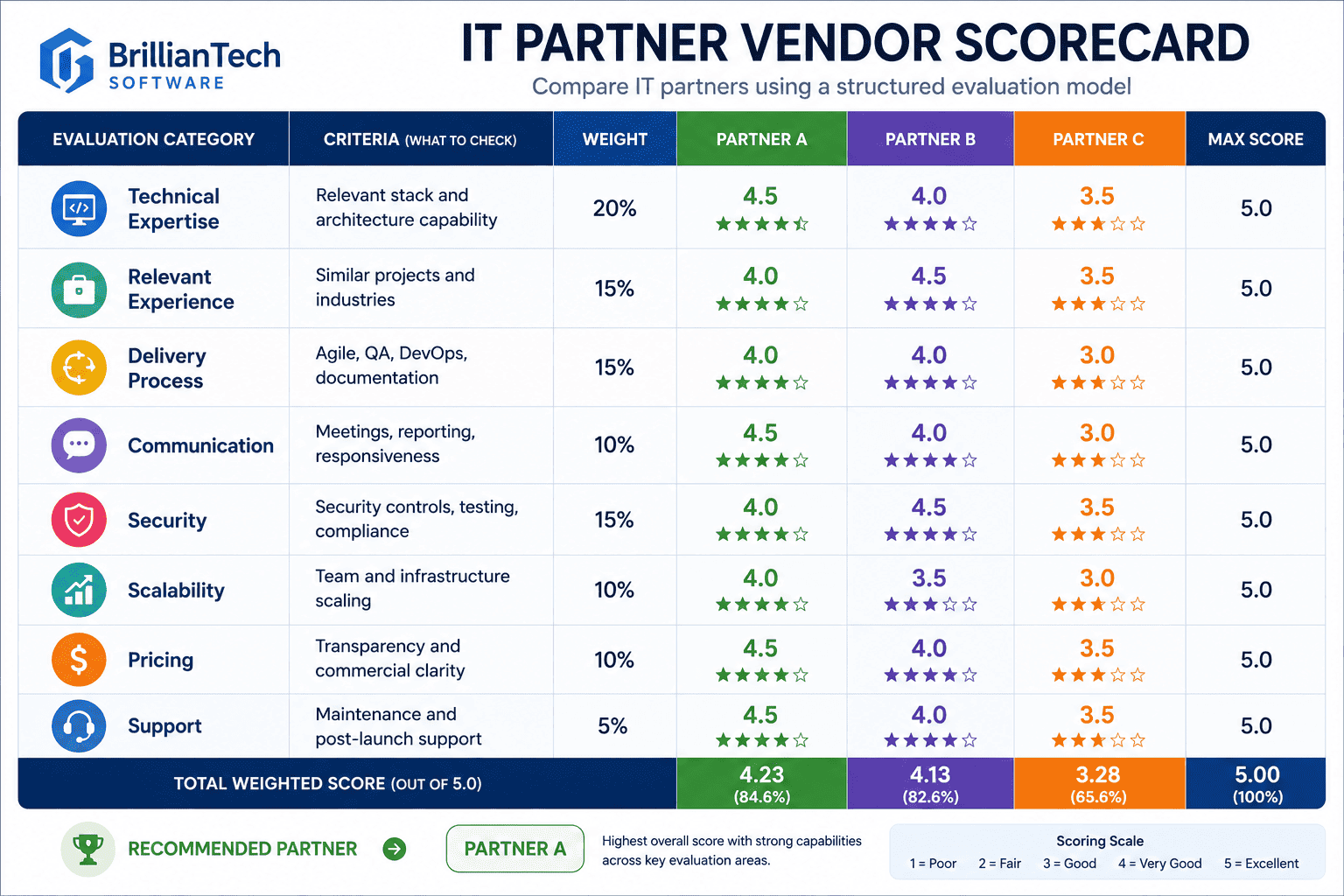
How Do You Compare Different IT Partners?
The best way to compare IT partners is to evaluate every shortlisted vendor against the same technical, commercial, communication, security, and support criteria. A standardized scorecard prevents sales presentations from becoming the primary basis for your decision.
For example, shortlist three companies and give each the same project brief. Ask each company to explain its architecture, estimated timeline, team structure, testing approach, risks, assumptions, and pricing.
Then compare:
• Technical approach
• Relevant experience
• Team quality
• Delivery methodology
• Security
• QA
• Communication
• Pricing
• Scalability
• Support
A consistent evaluation framework produces a more defensible vendor decision than comparing proposals informally.
How Should You Evaluate Communication and Project Management?
An effective IT partner should provide predictable communication, transparent progress reporting, clear ownership, and a defined escalation process. Communication quality is especially important when your development team works remotely or across different time zones.
For example, Brilliantech describes an Agile delivery approach involving two-week sprint cycles, daily standups, weekly reviews, shared tools, and regular progress visibility.
Ask potential partners:
• Which project management platform will we use?
• How frequently will we receive updates?
• Who is our primary point of contact?
• How are blockers escalated?
• How are scope changes documented?
• How frequently will we see working software?
• What happens when a milestone is delayed?
Furthermore, request a sample project report or sprint dashboard before signing.
Good communication is not simply frequent communication; it is predictable, relevant, documented communication.
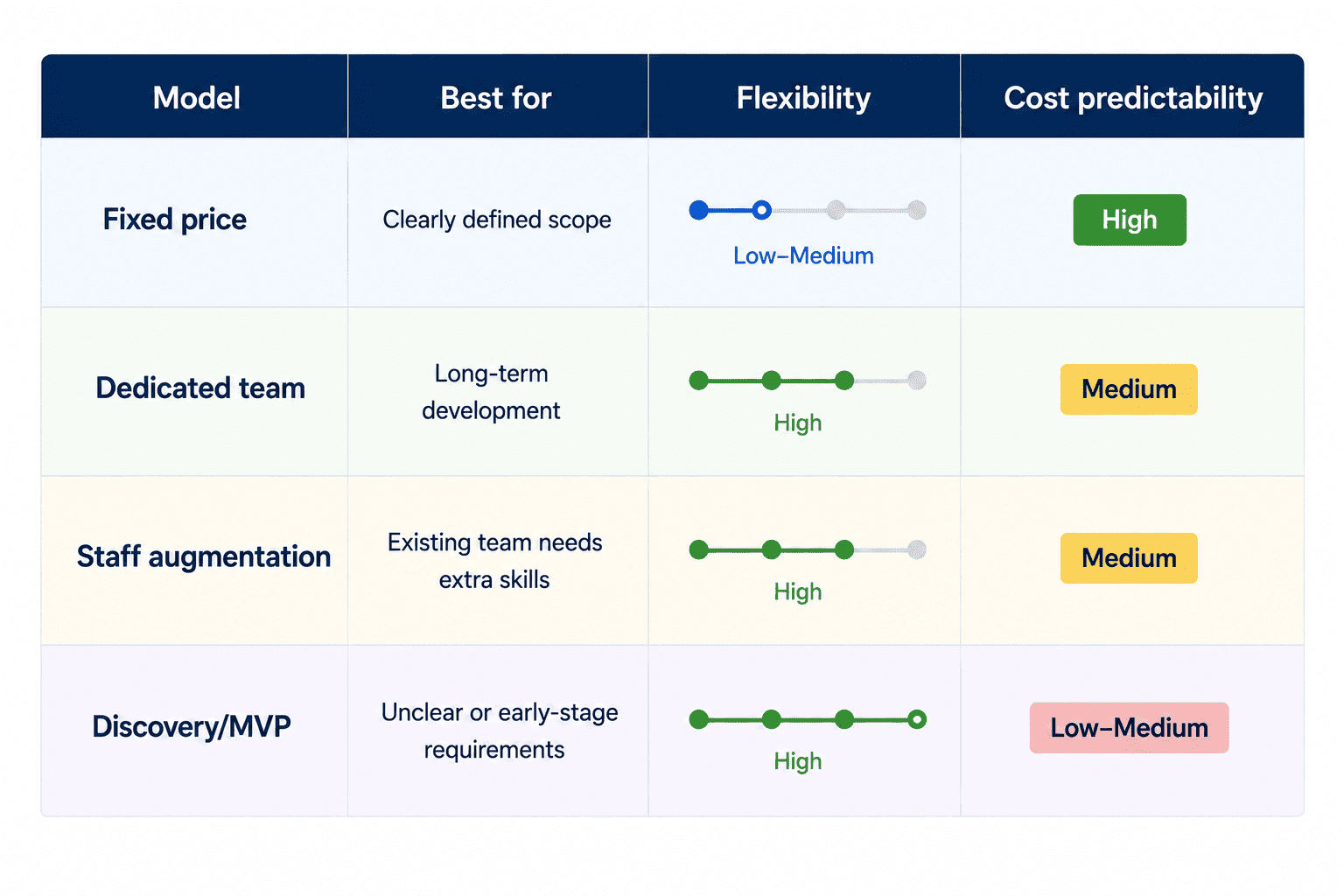
Which IT Engagement Model Is Best for Your Software Project?
The right software development engagement model depends on project scope, requirements stability, desired flexibility, internal technical capacity, and expected duration. The supplied content framework specifically identifies fixed-price development, dedicated teams, staff augmentation, and discovery/MVP engagements as models worth comparing.
For example, a company with a complete specification and fixed deadline may prefer fixed-price development, while a product company with continuously changing requirements may benefit from a dedicated team.
When Should You Choose Fixed-Price Development?
Fixed-price development works best when requirements, deliverables, acceptance criteria, and timelines can be defined clearly before development starts.
For example, a company requiring a specific internal HR portal with a fixed feature list may be able to establish a clear scope and milestone structure.
However, fixed-price contracts can become difficult when requirements change frequently. Every major change may require renegotiation, additional cost, or timeline adjustments.
Fixed-price development provides commercial predictability, but it works best when scope is predictable.
When Should You Choose a Dedicated Development Team?
A dedicated development team is suitable when you need a long-term engineering group that can continuously develop and evolve a product.
For example, a SaaS company may need frontend engineers, backend developers, QA engineers, DevOps specialists, and a technical lead for 12–24 months.
Brilliantech currently offers dedicated teams alongside project-based and staff augmentation models, allowing businesses to choose based on the type of work and duration.
When Should You Choose Staff Augmentation?
Staff augmentation is appropriate when your internal team has ownership of the project but temporarily needs additional technical skills or capacity.
For example, an existing engineering team may have enough backend developers but need two React engineers and an automation QA specialist for six months.
Brilliantech describes its staff augmentation model as adding developers, designers, testers, and DevOps engineers directly into a client's existing team, with options for individual experts, dedicated teams, and hybrid models.
Brilliantech’s [staff augmentation services] help businesses add developers, designers, testers, and DevOps engineers directly to their existing teams through flexible individual, dedicated-team, and hybrid engagement models.
What Questions Should You Ask an IT Partner Before Signing a Contract?
Before signing an IT partnership contract, ask questions about scope, team composition, architecture, communication, testing, security, ownership, change requests, maintenance, and termination. The goal is to uncover assumptions that might otherwise become disputes after development begins.
For example, asking "Who owns the source code?" before development is very different from discovering the answer after paying the final invoice.
Technical Questions
Ask:
• What architecture do you recommend and why?
• Why did you select this technology stack?
• How will the application scale?
• How will APIs be documented?
• How will security be tested?
• What is your QA process?
• How will you manage technical debt?
• How will you handle third-party integrations?
• How will you monitor production performance?
Commercial and Ownership Questions
Ask:
• What exactly is included in the proposal?
• What is excluded?
• How are change requests priced?
• Who owns the source code?
• Who owns intellectual property?
• What happens if the project is terminated?
• What support is included after launch?
• Are infrastructure and third-party costs included?
• What happens if a developer leaves?
For example, Brilliantech's web application development information states that source-code ownership and intellectual property rights are transferred to the client at delivery.
Ownership should be documented contractually rather than assumed from a sales conversation.
What Are the Biggest Red Flags When Choosing an IT Partner?
The biggest IT partner red flags include unrealistic promises, unusually low estimates, vague proposals, weak communication, irrelevant portfolios, unclear ownership terms, inadequate QA, hidden costs, and pressure to sign quickly. These warning signs can indicate project risk before development even starts.
For example, if one vendor promises a complex enterprise platform in four weeks while every other qualified vendor estimates four months, the difference deserves investigation rather than celebration.
Watch for:
• "We can build anything" without evidence.
• No relevant case studies.
• Extremely low pricing.
• Guaranteed timelines before discovery.
• No dedicated technical lead.
• Unclear QA process.
• No security discussion.
• Refusal to explain architecture.
• Poor response times during sales.
• No written assumptions.
• Hidden third-party costs.
• Pressure to sign immediately.
A strong IT partner should be willing to explain risks instead of promising that everything will be easy.
Why Are Unrealistic Promises Dangerous?
Unrealistic promises often indicate that a vendor has underestimated requirements, ignored technical risks, or prioritized winning the contract over setting accurate expectations.
For example, an application requiring payment integration, identity verification, multiple user roles, real-time notifications, analytics, and mobile applications cannot be accurately estimated from a one-paragraph description.
Therefore, a credible partner should ask questions before providing a final estimate.
Good vendors do not merely estimate the work; they explain the assumptions behind the estimate.
How Much Does It Cost to Work With an IT Partner?
The cost of working with an IT partner depends on project scope, technology, team size, complexity, location, engagement model, integrations, security requirements, and ongoing support. There is no reliable single price for "software development" without defining these variables.
For example, a simple MVP with five screens and basic authentication is fundamentally different from an enterprise platform involving multiple integrations, real-time data, advanced security, and thousands of users.
Instead of asking only "How much will it cost?", ask:
1. What functionality is included?
2. How many developers are required?
3. How much QA is included?
4. Is project management included?
5. Are cloud costs included?
6. Are third-party licenses included?
7. What support is included?
8. How are changes priced?
Moreover, Brilliantech currently describes three broad pricing approaches: fixed-price projects, time-and-materials arrangements, and dedicated-team monthly retainers.
Transparent pricing is more valuable than an artificially low estimate that excludes essential work.
How Do You Know if a Software Development Company Can Scale With Your Business?
A scalable IT partner should be capable of expanding technical resources, supporting larger workloads, adapting architecture, and continuing to provide expertise as your business evolves.
For example, your project may begin with three developers but later require backend engineers, mobile developers, DevOps specialists, QA automation, and AI expertise.
Ask whether the partner can support:
• Team expansion
• Additional technology requirements
• Cloud migration
• Application modernization
• Performance optimization
• Security improvements
• New product modules
• International expansion
• Long-term maintenance
CNCF's 2025 Annual Cloud Native Survey found that 82% of container users were running Kubernetes in production, illustrating how cloud-native infrastructure has become mainstream for organizations operating modern systems at scale.
For businesses planning cloud-native products, this makes cloud architecture experience an increasingly relevant evaluation criterion.
A strong cloud software development partner can help businesses modernize applications, adopt scalable cloud architectures, and support growing workloads as technical requirements evolve.
What Should a Good Software Development Proposal Include?
A good software development proposal should clearly describe scope, assumptions, deliverables, architecture, team structure, timeline, milestones, pricing, testing, security, ownership, and support.
For example, a proposal for a mobile commerce application should specify supported platforms, payment integrations, authentication, admin capabilities, analytics, testing, deployment, and post-launch support rather than simply saying "mobile app development."
A strong proposal should include:
• Business objectives
• Functional requirements
• Technical approach
• Proposed technology stack
• Architecture overview
• Project milestones
• Team composition
• Responsibilities
• QA strategy
• Security approach
• Communication process
• Pricing
• Assumptions
• Exclusions
• Change-request process
• Intellectual property terms
• Maintenance and support
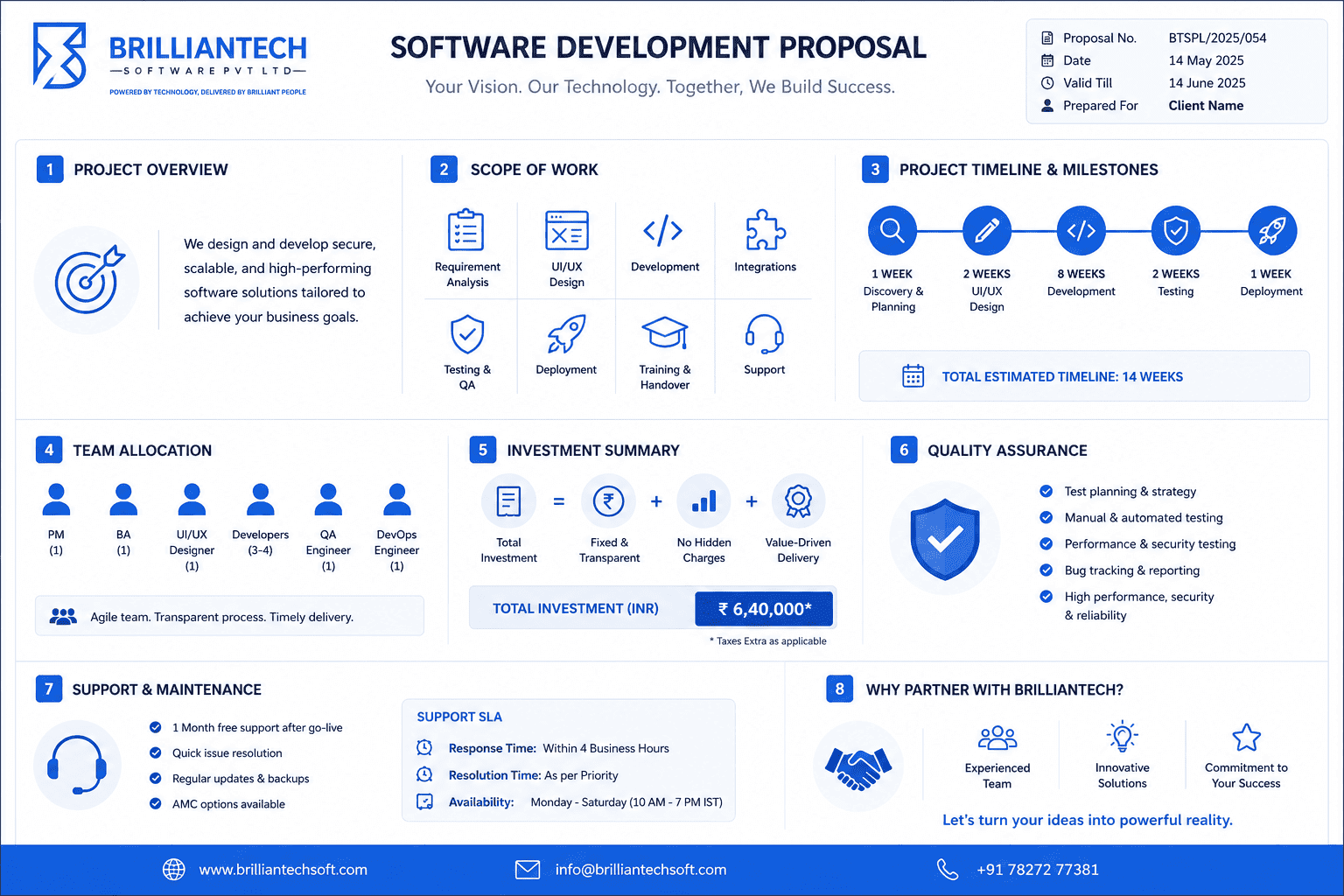
Moreover, comparing proposals becomes much easier when every vendor responds to the same project requirements document.
How Should AI Capabilities Affect Your Choice of IT Partner?
AI capability should be evaluated as a practical engineering competency rather than treated as a marketing label. A partner should be able to explain where AI provides measurable value, how outputs will be evaluated, and how security and human oversight will be handled.
For example, a business considering an AI customer-support assistant should ask how the partner will manage retrieval, hallucination risks, evaluation, privacy, monitoring, and escalation to human agents.
AI adoption is already widespread among developers. Stack Overflow's 2025 Developer Survey found that 84% of respondents were using or planning to use AI tools in their development process, while 46% said they distrust the accuracy of AI output.
DORA's 2025 research provides an important counterpoint: a 25% increase in AI adoption was associated in its analysis with a 1.5% decrease in delivery throughput and a 7.2% decrease in delivery stability, highlighting that faster code generation does not automatically mean better software delivery.
Therefore, ask an AI-capable partner:
• How is AI output reviewed?
• How are sensitive prompts and data protected?
• How are AI systems evaluated?
• What happens when AI produces incorrect output?
• How is AI integrated into QA?
• What measurable business outcome will AI improve?
The right AI partner combines automation with engineering judgment rather than replacing engineering judgment with automation.
For businesses evaluating AI adoption, AI development services can provide the expertise needed to build secure, measurable, and production-ready AI solutions with appropriate evaluation and human oversight.
How Do You Verify Security and Quality Before Hiring an IT Partner?
Security and quality should be evaluated before development begins because defects and vulnerabilities become more expensive to address after deployment.
For example, ask whether the partner performs code reviews, automated testing, vulnerability scanning, penetration testing where appropriate, dependency management, access control reviews, and secure deployment practices.
A mature quality process can include:
• Unit testing
• Integration testing
• API testing
• End-to-end testing
• Regression testing
• Performance testing
• Security testing
• Code reviews
• CI/CD quality gates
For businesses prioritizing reliable software delivery, software quality assurance services can help strengthen testing, security, performance, and overall product quality throughout the development lifecycle.
Furthermore, Brilliantech states that its development process includes automated testing, security audits, code reviews, and dedicated QA capabilities.
Quality assurance is not a final-stage activity; it is part of the development process.
What Tools Can Help You Evaluate an IT Partner?
Vendor evaluation tools help businesses collect comparable evidence, score candidates, and document the final selection decision.
For example, use a simple spreadsheet containing:
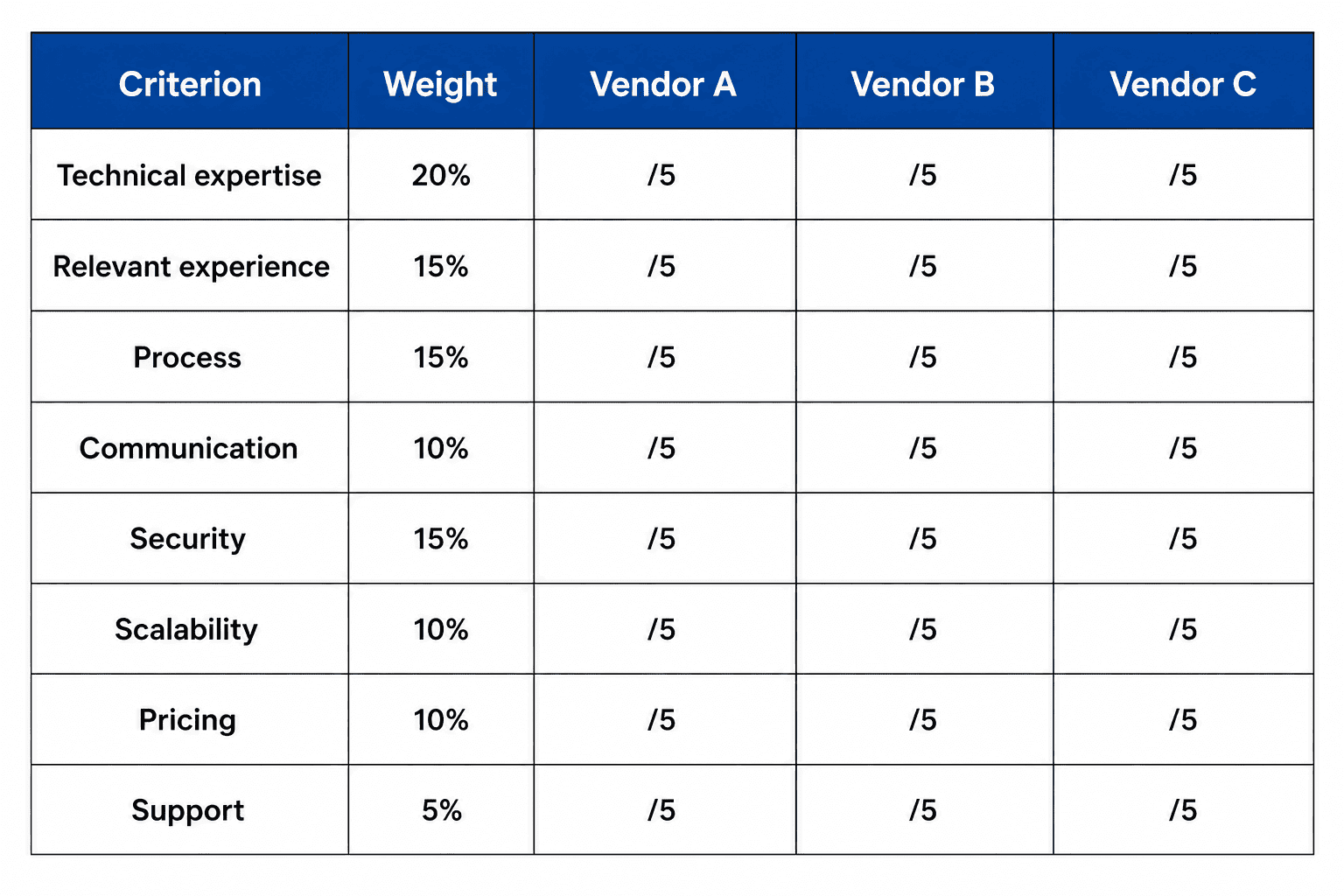
You can use Google Sheets or Excel for the scorecard and tools such as Jira, Linear, or similar project-management platforms to understand how a potential partner manages work during a pilot.
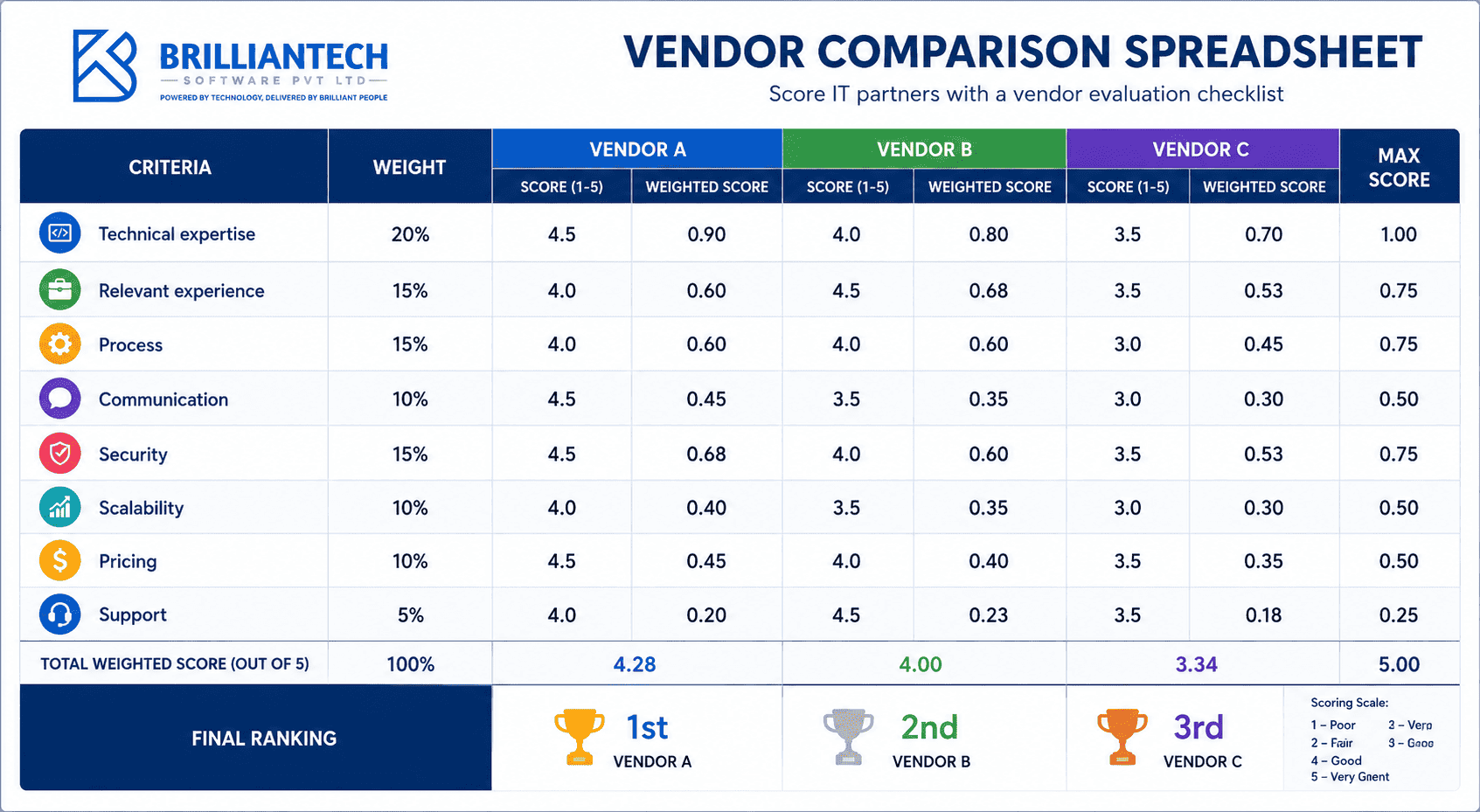
Moreover, third-party review platforms can provide additional evidence, but reviews should complement—not replace—technical due diligence.
The strongest evaluation combines public reputation, private references, technical discussions, proposal quality, and a small practical exercise or discovery engagement.
How Do You Shortlist the Best IT Partner for Your Project?
The most effective IT partner selection process is to define requirements, shortlist three to five qualified vendors, verify evidence, conduct discovery calls, compare proposals, clarify commercial terms, and start with a controlled engagement where appropriate. This sequence follows the practical selection framework provided in the content plan.
Use this seven-step process:
Step 1 — Define Your Requirements
Start by documenting what the business needs before contacting vendors.
Include:
• Business objective
• Target users
• Core features
• Integrations
• Platforms
• Expected users
• Security requirements
• Timeline
• Budget range
• Success metrics
For example, instead of saying "We need an AI platform," define the users, business process, data sources, expected automation, desired output, and measurable outcome.
Step 2 — Shortlist Three to Five Vendors
A shortlist of three to five qualified IT partners is usually easier to evaluate rigorously than dozens of loosely matched vendors.
Look for companies with relevant case studies, appropriate technical expertise, credible references, and suitable engagement models.
Step 3 — Conduct Discovery Calls
A good discovery call should reveal how well the partner understands your business problem, not simply how quickly it can sell a solution.
Pay attention to the questions the vendor asks.
Strong partners often challenge assumptions, identify risks, clarify requirements, and discuss trade-offs before promising a solution.
Step 4 — Compare Technical Proposals
Compare proposals against the same requirements instead of comparing headline prices.
Review architecture, scope, milestones, team structure, QA, security, assumptions, exclusions, and support.
Step 5 — Validate With References or a Pilot
A reference conversation or small proof-of-concept can reveal delivery behavior that a sales presentation cannot.
Ask previous clients about communication, delays, technical quality, responsiveness, and post-launch support.
Step 6 — Finalize Commercial and Ownership Terms
The contract should clearly define scope, payment, milestones, intellectual property, source-code ownership, confidentiality, change requests, warranties, support, and termination.
Never rely on informal promises for important commercial or technical rights.
Step 7 — Start With Measurable Milestones
A strong IT partnership begins with measurable outcomes rather than an undefined commitment to "build the product."
Define the first milestone, acceptance criteria, communication cadence, responsible people, and expected deliverables.
Why Consider Brilliantech as Your IT Partner?
Brilliantech positions itself as a technology partner for startups, growing businesses, and enterprises requiring custom software, web and mobile development, AI platforms, cloud solutions, QA, DevOps, and team-extension services. Its current service portfolio covers these areas across multiple industries.
For example, Brilliantech's current services portfolio includes custom software development, web application development, mobile application development, AI-powered platforms, QA, staff augmentation, cloud application development, DevOps, and industry-specific software solutions.
Moreover, its staff augmentation offering includes frontend, backend, mobile, QA, DevOps, and UI/UX professionals, with engagement options ranging from individual experts to dedicated teams and hybrid models.
Brilliantech supports businesses across web application development services, mobile app development service, and Java development services, providing flexible technology solutions for different project requirements.
The right decision, however, should still come from fit rather than marketing claims. Use the same evaluation framework in this guide to assess Brilliantech alongside other qualified partners.
What Should You Do Next to Find the Right IT Partner?
The next step is to turn your project requirements into a vendor-selection process with measurable criteria before requesting proposals.
Start with this practical sequence:
1. Write your project brief.
2. Define your business and technical requirements.
3. Establish a realistic budget range.
4. Identify the technologies and integrations that matter.
5. Shortlist three to five relevant IT partners.
6. Review their case studies and references.
7. Conduct technical discovery calls.
8. Score every vendor using the same evaluation matrix.
9. Compare proposals on total value rather than initial price.
10. Clarify security, QA, ownership, support, and change-request terms.
11. Consider a discovery engagement or pilot when requirements are uncertain.
12. Begin development with measurable milestones and clear communication.
Conclusion — How Do You Choose the Right IT Partner?
Finding the right IT partner requires evaluating technical capability, relevant experience, communication, security, development processes, scalability, pricing transparency, and long-term support together. No single factor should determine the decision.
Moreover, the strongest partner is not necessarily the cheapest or the largest company. It is the company that understands your business objectives, communicates risks honestly, provides evidence of relevant experience, builds with appropriate technology, and remains capable of supporting the product after launch.
The supplied content framework summarizes the selection principle clearly: an effective IT partner evaluation process involves defining requirements, shortlisting qualified vendors, reviewing evidence of expertise, conducting technical discussions, comparing proposals, and clarifying commercial and ownership terms before signing a contract.
Finally, remember that your IT partner becomes part of the system behind your business. The quality of that relationship can influence how quickly you launch, how safely you operate, how easily you scale, and how much you spend maintaining the product.
Choose a technology partner for the business you are building—not simply the project you are starting today.