
Introduction
You've probably already considered India for software development because of its strong engineering talent, flexible team models, and access to specialized technical expertise. But when an external team needs access to your source code, customer data, product architecture, algorithms, or proprietary business processes, choosing a partner is about more than technical capability—it is about knowing how those assets will be protected.
In this guide, we'll explain how businesses can protect IP and data while working with tech teams in India, covering contracts, IP ownership, access controls, secure development practices, data handling, employee offboarding, vendor due diligence, and practical security measures.
Key Takeaways
• IP protection requires multiple layers, including contracts, access controls, secure development, and operational policies.
• Source-code ownership should be defined before development begins, rather than addressed after the project is completed.
• Least-privilege access reduces unnecessary exposure by limiting each team member to the systems and data required for their role.
• Sensitive customer data should be minimized in development and testing environments whenever possible.
• Employee and vendor offboarding is a security control, because unused credentials and permissions can create avoidable exposure.
• Technology partners should be evaluated on demonstrated processes, not simply on claims about security or technical expertise.
What Does Protecting IP and Data With Tech Teams in India Mean?
Protecting IP and data with technology teams in India means using contractual, technical, and operational safeguards to prevent unauthorized access, disclosure, misuse, or loss of business assets.
First, intellectual property in a software project can include much more than source code. A development team may work with software architecture, algorithms, UI designs, databases, APIs, documentation, deployment configurations, product roadmaps, and proprietary business processes.
For example, a company developing a SaaS platform may give its engineering team access to a private Git repository, cloud infrastructure, database schemas, API documentation, and unreleased product features. Each asset can have different access and protection requirements.
Moreover, data protection and IP protection are related but not identical. IP protection focuses on ownership and unauthorized use of valuable intellectual assets, while data protection focuses on how information is collected, accessed, processed, stored, transferred, and deleted.
A practical protection framework therefore has three layers:
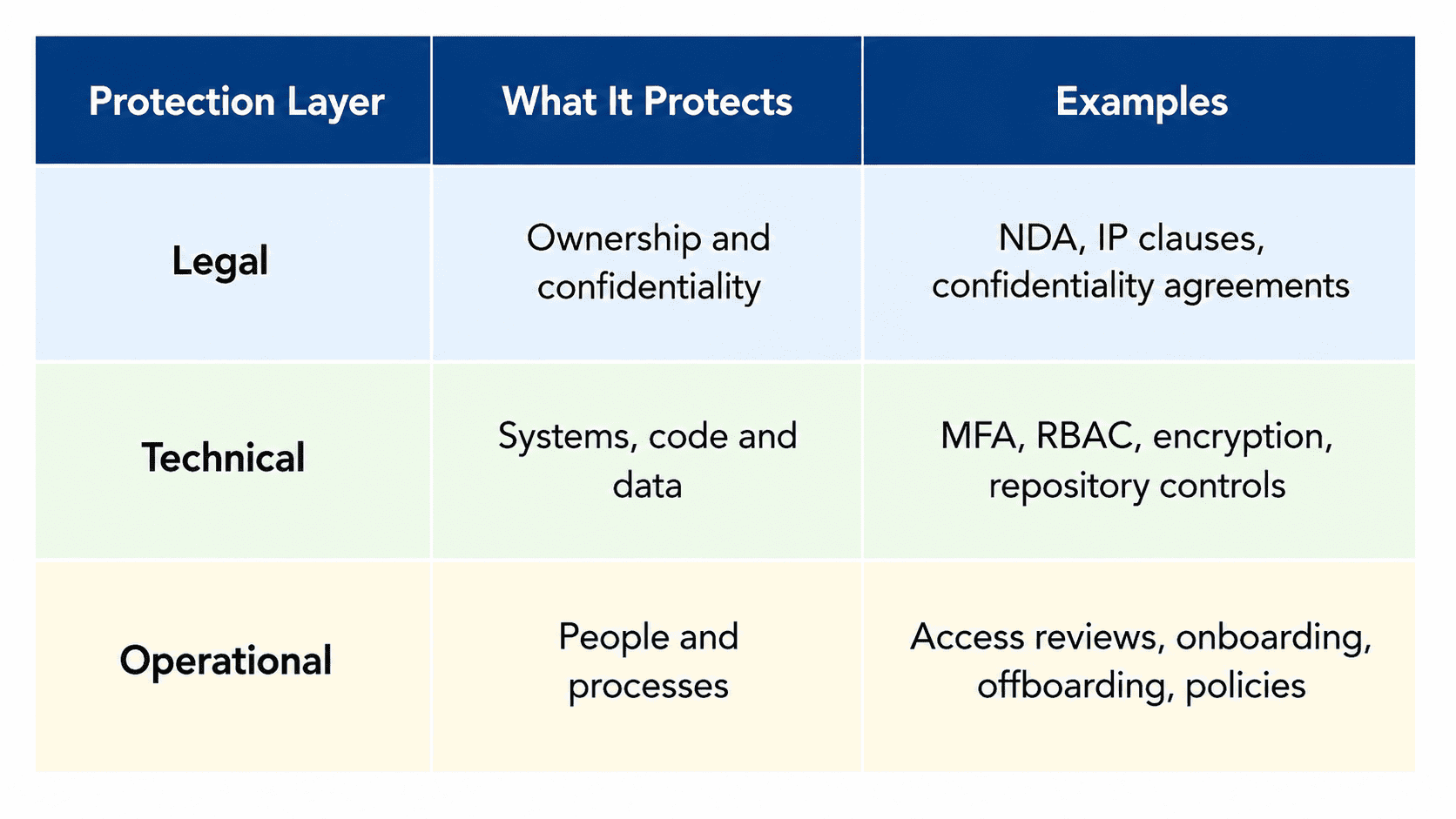
Protecting software IP requires more than signing an NDA; businesses need contractual ownership provisions, controlled technical access, and repeatable operational processes.
For businesses building proprietary products, Brilliantech’s custom software development services provide tailored solutions aligned with specific workflows and requirements.
This approach helps businesses maintain greater control over their software, data, integrations, and intellectual property throughout development
What Types of IP Should Businesses Protect?
Software businesses should identify every valuable intellectual and confidential asset that a technology team may access during development.
First, source code is usually one of the most obvious assets, but it is rarely the only one. Architecture diagrams, proprietary algorithms, database structures, technical documentation, UI designs, and business logic can also provide significant competitive value.
For example, an AI startup may need to protect its application source code, model-integration logic, proprietary prompts, evaluation methodology, customer data, product roadmap, and internal API architecture.
Businesses should consider protecting:
• Source and object code
• Algorithms and proprietary logic
• Software architecture
• UI/UX designs
• Technical documentation
• Database structures
• APIs and integration logic
• Product roadmaps
• Trade secrets
• Customer information
• Pricing and business processes
• Cloud configurations
• Credentials and security information
The first step in protecting IP is knowing exactly which assets require protection and who needs access to them.
India's Copyright Office states that computer programs are protected under the Copyright Act and are treated as literary works. Software can also be registered as a literary work under the applicable copyright framework. — Copyright Office, Government of India.
Why Is IP Ownership Important Before Software Development Begins?
IP ownership is important because the contract should clearly establish who owns the software and other deliverables created during the engagement.
For example, if a company commissions a logistics platform from an external development team, the agreement should clearly address ownership of the source code, designs, documentation, databases, APIs, and other project deliverables.
At the same time, businesses should distinguish newly created project IP from pre-existing technology. A development company may already have reusable libraries, frameworks, tools, or internal components that should not automatically become the client's exclusive property.
Therefore, contracts should clearly distinguish:
• Client-owned project deliverables
• Pre-existing technology
• Third-party components
• Open-source software
• Reusable development frameworks
• Confidential business information
• Project-specific source code
Clear IP definitions reduce ambiguity before the development relationship becomes commercially important.
Why Does IP and Data Protection Matter When Working With an Indian Tech Team?
IP and data protection matters because external technology teams may receive access to some of a company's most commercially valuable information and systems.
First, this is not an India-specific risk. The same principle applies when businesses work with local developers, freelancers, offshore teams, consultants, vendors, or internal employees.
For example, a U.S.-based SaaS company may work with developers in India who need access to Git repositories, project documentation, staging infrastructure, CI/CD pipelines, and selected customer information. The important issue is whether those permissions are appropriate for the work being performed.
Moreover, weak controls can create several types of exposure:
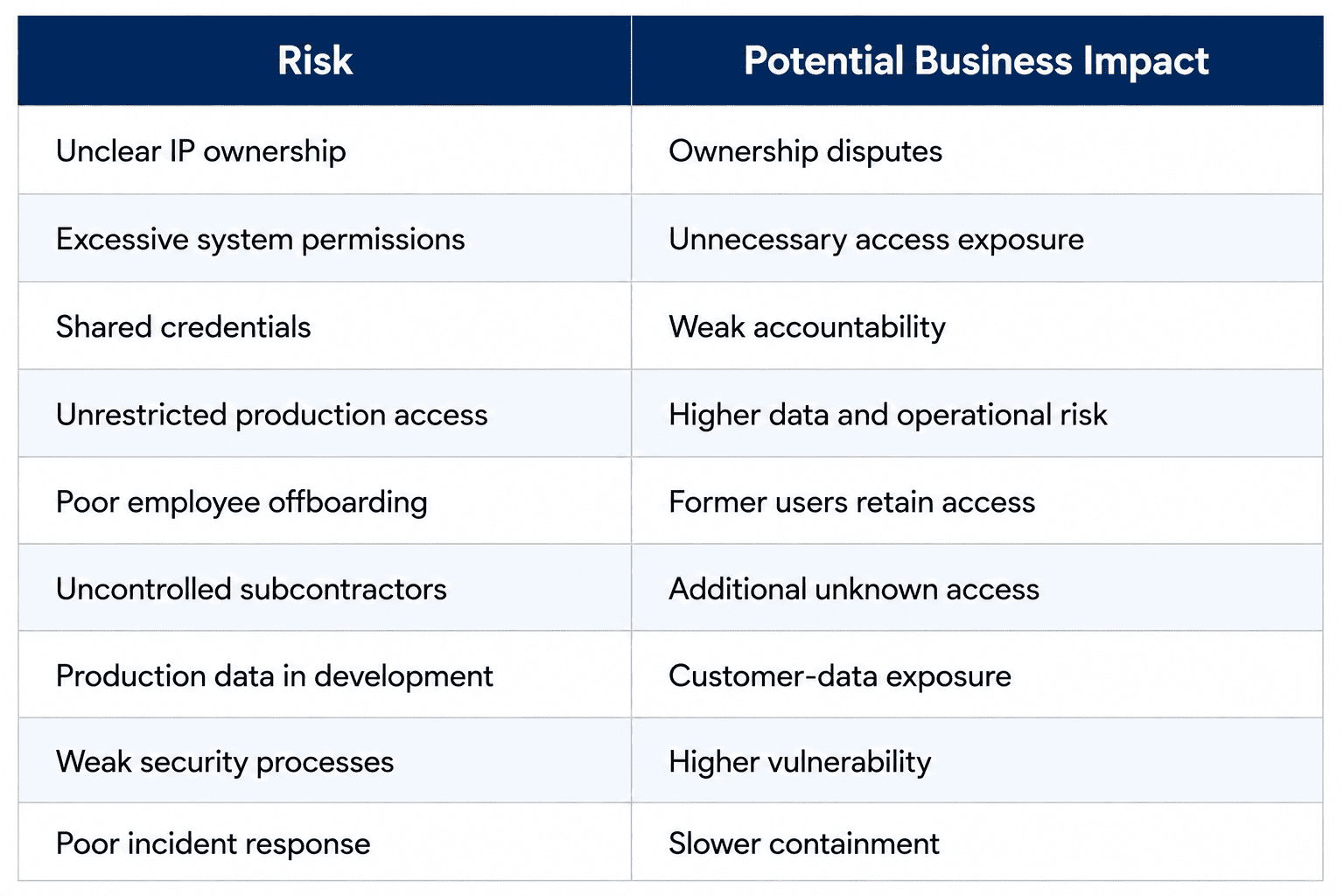
The relevant question is not whether an Indian technology team is inherently risky; it is whether the engagement has appropriate controls for the information and systems being shared.
This distinction is particularly important when evaluating an offshore development partner. A mature provider should be able to explain how access is granted, how information is protected, how security responsibilities are assigned, and how access is removed when it is no longer required.
For businesses working with distributed engineering teams, Brilliantech’s staff augmentation services can help extend existing teams with skilled developers while allowing clients to define roles, responsibilities, and access requirements based on their project needs.
This approach can help businesses maintain greater control over who accesses their source code, systems, and project information throughout the engagement.
How Can Contracts Protect Intellectual Property When Working With Tech Teams in India?
Software development contracts protect intellectual property by clearly defining ownership, confidentiality, permitted use, data-handling responsibilities, and obligations surrounding project deliverables.
First, the contract should clearly state who owns the work created during the engagement. For example, if a business hires an external team to build a custom CRM, the agreement should address ownership of its source code, database structure, documentation, UI designs, APIs, and other agreed deliverables.
Moreover, businesses should distinguish between project-specific IP and pre-existing technology. For example, a development partner may use an existing framework or reusable internal library while creating new business logic specifically for the client's application.
A strong agreement should therefore address:
• IP ownership and assignment
• Confidentiality and NDA obligations
• Source-code ownership
• Work-product rights
• Permitted use of client information
• Third-party and subcontractor access
• Open-source and third-party components
• Data-handling requirements
• Termination obligations
• Return or deletion of information
A well-defined software development agreement reduces ambiguity by establishing ownership and confidentiality expectations before sensitive information is shared.
How Does an NDA Protect IP During Software Development?
An NDA protects confidential information by creating contractual obligations governing how defined confidential information can be used, disclosed, and protected.
For example, an NDA can cover a company's unreleased product roadmap, source code, customer information, technical architecture, pricing strategy, or proprietary business processes.
However, an NDA should not be treated as a replacement for technical security controls. A contract may prohibit unauthorized access, but repository permissions, MFA, encryption, logging, and least-privilege access help enforce those boundaries technically.
For more sensitive projects, businesses should consider combining confidentiality provisions with:
• Individual user accounts
• Role-based access
• Multi-factor authentication
• Secure repository permissions
• Secrets management
• Data minimization
• Access logging
• Employee onboarding and offboarding
An NDA establishes a legal obligation; technical controls help prevent and detect unauthorized access.
What Should Businesses Check in an IP Protection Agreement?
Businesses should verify that the agreement clearly addresses ownership, confidentiality, third-party access, data handling, and what happens when the development relationship ends.
For example, a company should know whether developers can reuse project-specific code, whether subcontractors can access repositories, how confidential information must be handled, and what happens to project data after termination.
Before signing, review whether the agreement clearly answers:
1. Who owns the final source code?
2. Who owns project-specific documentation and designs?
3. How is pre-existing technology treated?
4. Can subcontractors access the project?
5. What confidentiality obligations apply?
6. How is sensitive data handled?
7. What happens when a developer leaves?
8. What happens when the contract ends?
9. How are credentials and access revoked?
10. What happens to retained copies of project information?
If an important ownership or confidentiality question has no clear answer in the agreement, it should be resolved before development begins.
How Should Businesses Control Access to Source Code and Business Data?
Businesses should control access to source code and data through least-privilege permissions, individual accounts, multi-factor authentication, secure repositories, and regular access reviews.
First, developers should receive only the access required for their specific responsibilities. For example, a frontend developer may need access to a frontend repository and development environment but may not need unrestricted access to production databases or cloud administration.
Second, individual accounts should replace shared credentials wherever possible. Individual identities make it easier to determine who accessed a repository, changed a configuration, or performed a privileged action.
A practical access model might look like this:
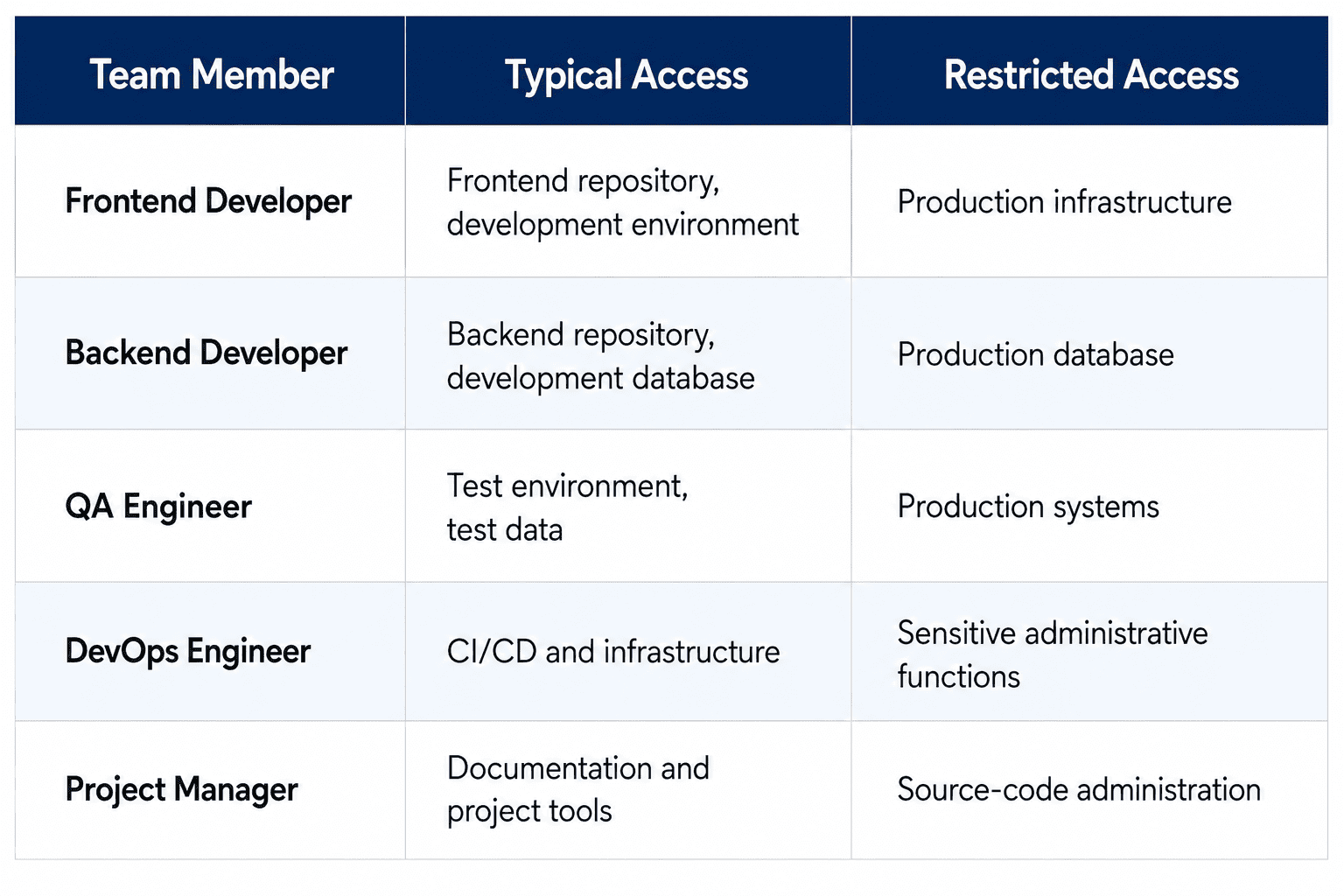
Moreover, access should be reviewed when responsibilities change. A developer who moves from one project to another should not automatically retain permissions from the previous project.
Least-privilege access reduces exposure by ensuring that a compromised or misused account cannot automatically reach every system in the organization.
How Can Businesses Protect Source Code When Working With Remote Developers?
Source-code protection requires controlled repository access, individual identities, MFA, protected branches, code reviews, and monitoring.
For example, a company using GitHub or GitLab can restrict repository access by role, require pull requests for important branches, and prevent developers from directly pushing unreviewed changes into production branches.
Businesses should consider:
• Individual repository accounts
• MFA
• Role-based repository permissions
• Protected branches
• Pull-request approvals
• Code reviews
• Secret scanning
• Dependency scanning
• Repository activity logs
• Periodic access reviews
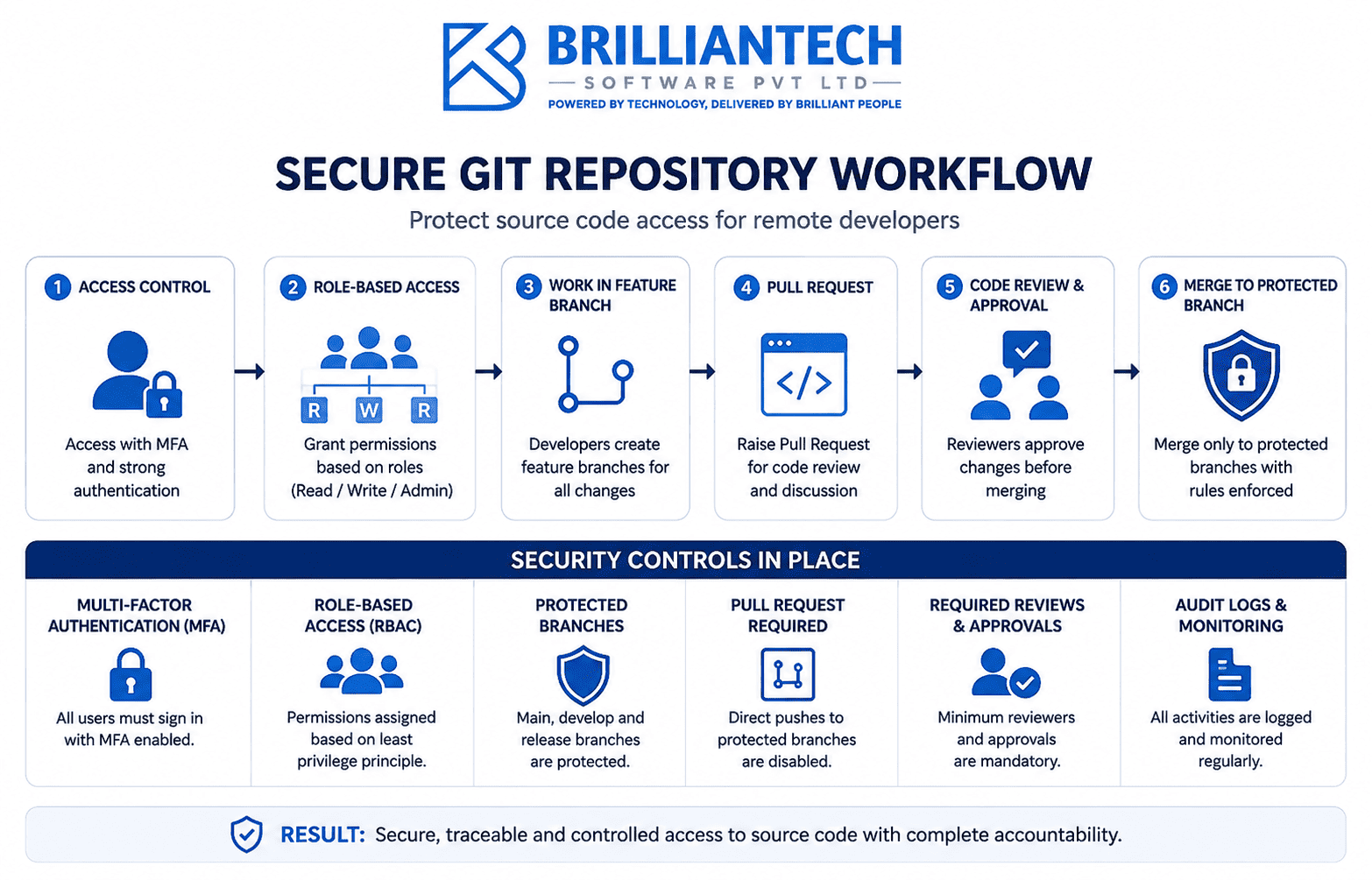
OWASP's CI/CD security guidance recommends controls around authentication, repository permissions, protected branches, pull-request reviews, and secure handling of CI/CD credentials. — Source: OWASP, CI/CD Security Cheat Sheet.
Source-code security works best when access restrictions and development practices reinforce each other.
Source-code security works best when access restrictions and secure development practices reinforce each other, especially when experienced Java development services teams follow structured coding, access, and review practices.
How Can Businesses Protect Customer Data During Offshore Software Development?
Businesses can reduce customer-data exposure by limiting unnecessary access and using masked, anonymized, or synthetic data for development and testing where appropriate.
First, developers may need realistic datasets to test application behavior, but they do not necessarily need unrestricted access to production customer records. For example, an e-commerce company testing its order-management system can create realistic test orders without exposing every customer's real name, phone number, address, and payment information.
Second, businesses should determine what data is actually required for development before transferring information into another environment.
Ask:
• What data does the development team actually need?
• Can sensitive fields be removed?
• Can data be masked?
• Can synthetic data be generated?
• Who can access the dataset?
• Where is the dataset stored?
• How long will it remain available?
• Can users download it?
• How is it deleted after testing?
India's Digital Personal Data Protection Act, 2023 provides the country's statutory framework for processing digital personal data, while implementation requirements have evolved through subsequent rules and notifications. — Ministry of Electronics and Information Technology, Government of India.
Data minimization is one of the simplest ways to reduce the consequences of unauthorized access because fewer sensitive records are exposed in the first place.
For businesses handling personal information, privacy requirements should be assessed based on the specific data, processing activity, contractual structure, and applicable jurisdictions.
How Should Employee Onboarding and Offboarding Be Managed?
Secure onboarding and offboarding ensure that technology team members receive appropriate access when they join and lose unnecessary access when their responsibilities end.
First, onboarding should begin with a defined role rather than unrestricted access. For example, a newly assigned QA engineer may receive access to Jira, the test environment, test repositories, and approved documentation without receiving production database credentials.
Second, offboarding should cover every system the individual could access. A developer may have accounts across GitHub, cloud infrastructure, CI/CD tools, Slack, Jira, VPNs, password managers, and other project systems.
A practical offboarding process should include:
1. Disable user accounts.
2. Remove repository permissions.
3. Revoke cloud access.
4. Revoke VPN access.
5. Review active API tokens.
6. Rotate credentials where necessary.
7. Recover company-owned devices where applicable.
8. Confirm data return or deletion requirements.
9. Review privileged permissions.
10. Document completion.
Offboarding is a security control because unused credentials can become an unnecessary entry point into business systems.
How Can Staff Augmentation Teams Access Business Systems Securely?
Staff augmentation teams should access business systems through individual identities, defined roles, least-privilege permissions, and controlled onboarding and offboarding procedures.
For example, if a company adds two backend developers and one QA engineer through staff augmentation, each person can receive access based on their assigned responsibilities rather than receiving the same permissions as the internal engineering team.
This model works particularly well when businesses define:
• Project responsibilities
• Repository access
• Development environments
• Production access requirements
• Security responsibilities
• Communication channels
• Access-review procedures
• Offboarding requirements
External developers should be treated as controlled users of business systems, not as unrestricted administrators.
For organizations that need additional technical capacity while retaining control over their existing systems, staff augmentation services can be evaluated alongside the project's access and security requirements.
What Security Questions Should You Ask an Indian Technology Partner?
Businesses should evaluate a technology partner by asking specific questions about access control, source-code security, data handling, employee governance, subcontractors, and incident response.
First, avoid relying on broad statements such as “Your data is completely secure.” A stronger approach is to ask the provider to explain how security works during an actual project.
Before sharing sensitive information, ask:
Source Code
• Who can access our repositories?
• Is MFA mandatory?
• Are individual accounts used?
• How are permissions assigned?
• Are branches protected?
• Are pull requests reviewed?
• How are secrets managed?
Data
• Will developers access production data?
• Why is that access required?
• Can masked or synthetic data be used?
• Where will development data be stored?
• Who can download it?
• How long is it retained?
People
• What confidentiality obligations apply to employees?
• How are new developers onboarded?
• How quickly is access removed when someone leaves?
• Are subcontractors used?
• Can subcontractors access client systems?
Security Operations
• How are vulnerabilities identified?
• How are dependencies monitored?
• What happens during a security incident?
• How are access reviews performed?
• How is production access controlled?
A mature technology partner should be able to answer security questions with specific processes rather than vague assurances.
What Should Businesses Do Before Giving an Indian IT Team Access?
Businesses should establish IP ownership, confidentiality requirements, access boundaries, data-handling rules, and security expectations before providing sensitive project access.
First, create an inventory of the information involved in the project. Then classify what is public, internal, confidential, or highly sensitive.
Second, document the required contractual protections. Third, evaluate the development partner's security processes. Finally, implement technical controls before credentials and repositories are shared.
A practical sequence is:
1. Identify sensitive assets.
2. Define IP ownership.
3. Review confidentiality agreements.
4. Evaluate the technology partner.
5. Define team roles.
6. Apply least-privilege access.
7. Secure repositories and credentials.
8. Separate environments where appropriate.
9. Control development data.
10. Document onboarding and offboarding.
11. Establish incident-response procedures.
12. Review access periodically.
The strongest security strategy begins before the first developer receives access, not after the application reaches production.
How Can You Build a Secure Working Model With an Indian Tech Team?
A secure working model combines contractual protection, controlled access, secure development practices, and continuous security reviews throughout the software lifecycle.
First, security should be established before sensitive information enters the development environment. For example, a business building a healthcare platform can define data classifications, repository permissions, production-access rules, and confidentiality requirements before onboarding its development team.
Second, security should remain active throughout the engagement rather than being treated as a one-time checklist. As projects grow, new developers, repositories, cloud environments, APIs, and third-party services can introduce new access requirements and potential exposure.
A practical working model should include:
• Clear IP ownership for source code, designs, documentation, and project deliverables.
• Confidentiality agreements covering sensitive business and technical information.
• Role-based access controls based on actual project responsibilities.
• Multi-factor authentication for important systems and repositories.
• Environment separation between development, testing, staging, and production where appropriate.
• Controlled data sharing using masked or synthetic data when possible.
• Secure source-code management with branch protection and code reviews.
• Regular access reviews to remove unnecessary permissions.
• Documented incident-response procedures for security events.
• Formal onboarding and offboarding for every team member.
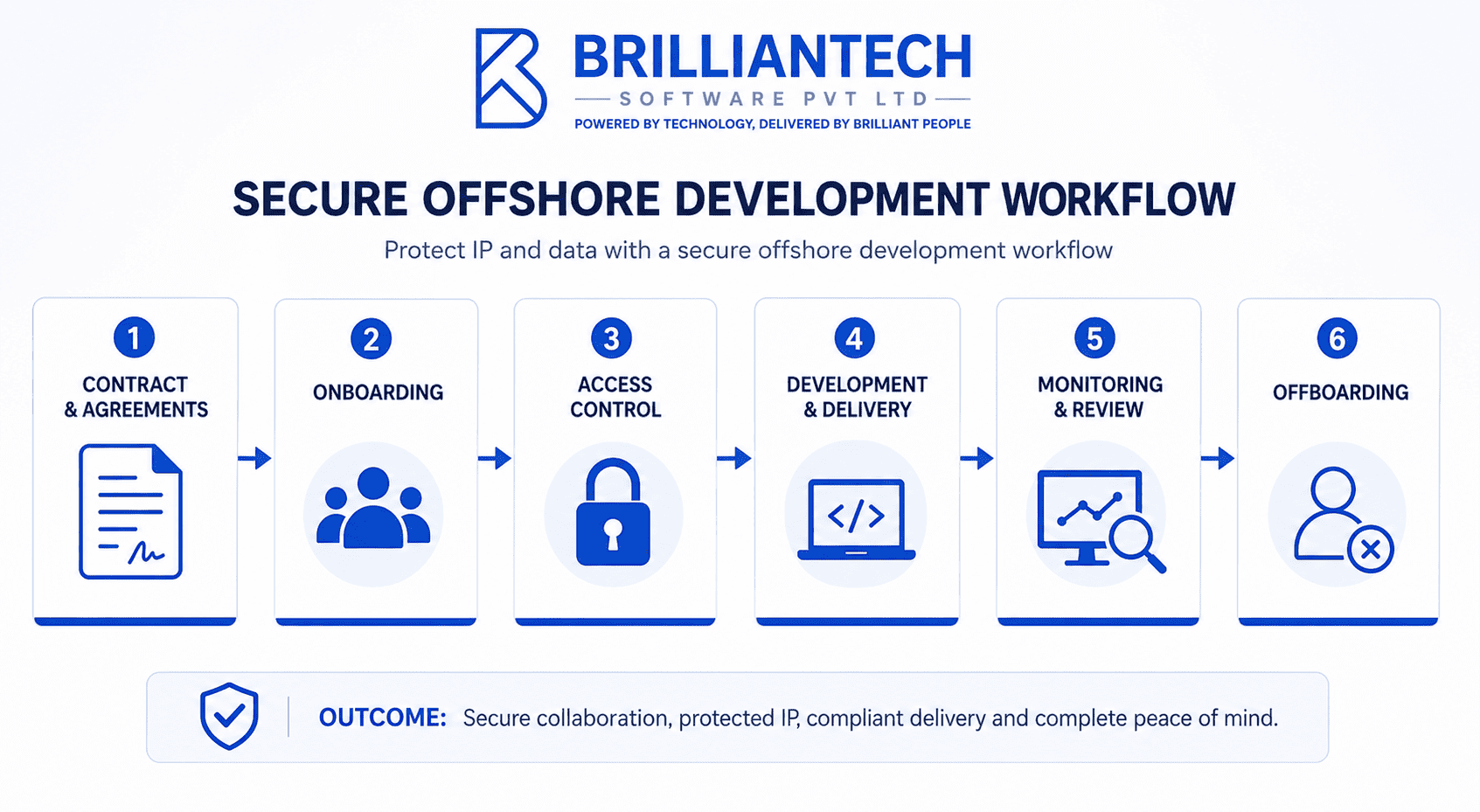
A secure offshore development model protects information without preventing developers from doing their jobs efficiently.
How Should Businesses Monitor Security Throughout the Project?
Continuous security monitoring helps businesses identify unnecessary access, suspicious activity, vulnerabilities, and configuration changes before they become larger problems.
First, access should be reviewed periodically rather than assumed to remain appropriate forever. For example, a developer who originally worked on backend APIs may later move to another project but still retain access to the original repository and cloud environment.
Second, project teams should monitor important security signals such as:
• Repository access and changes
• Privileged account activity
• Failed authentication attempts
• Cloud configuration changes
• Dependency vulnerabilities
• Secrets detected in repositories
• Production access
• Unusual data transfers
• Security-test results
Moreover, monitoring should have an owner. A security log that nobody reviews does not provide the same practical protection as a monitored process with defined escalation responsibilities.
Security monitoring becomes valuable when alerts, responsibilities, and response procedures are connected into one operational process.
How Should You Evaluate an Indian Technology Partner for IP and Data Security?
The right technology partner should demonstrate how it protects client IP and data through contracts, access controls, secure development, employee governance, and incident-response processes.
First, evaluate the partner's processes rather than marketing claims. A company saying that it follows strong security practices is less useful than a company that can explain exactly how developers receive access, how permissions are reviewed, and how access is removed.
Second, request evidence or explanations appropriate to the project's risk level. For example, a business developing a consumer application may have different requirements from a healthcare or financial-services company handling sensitive personal information.
A vendor evaluation can cover:
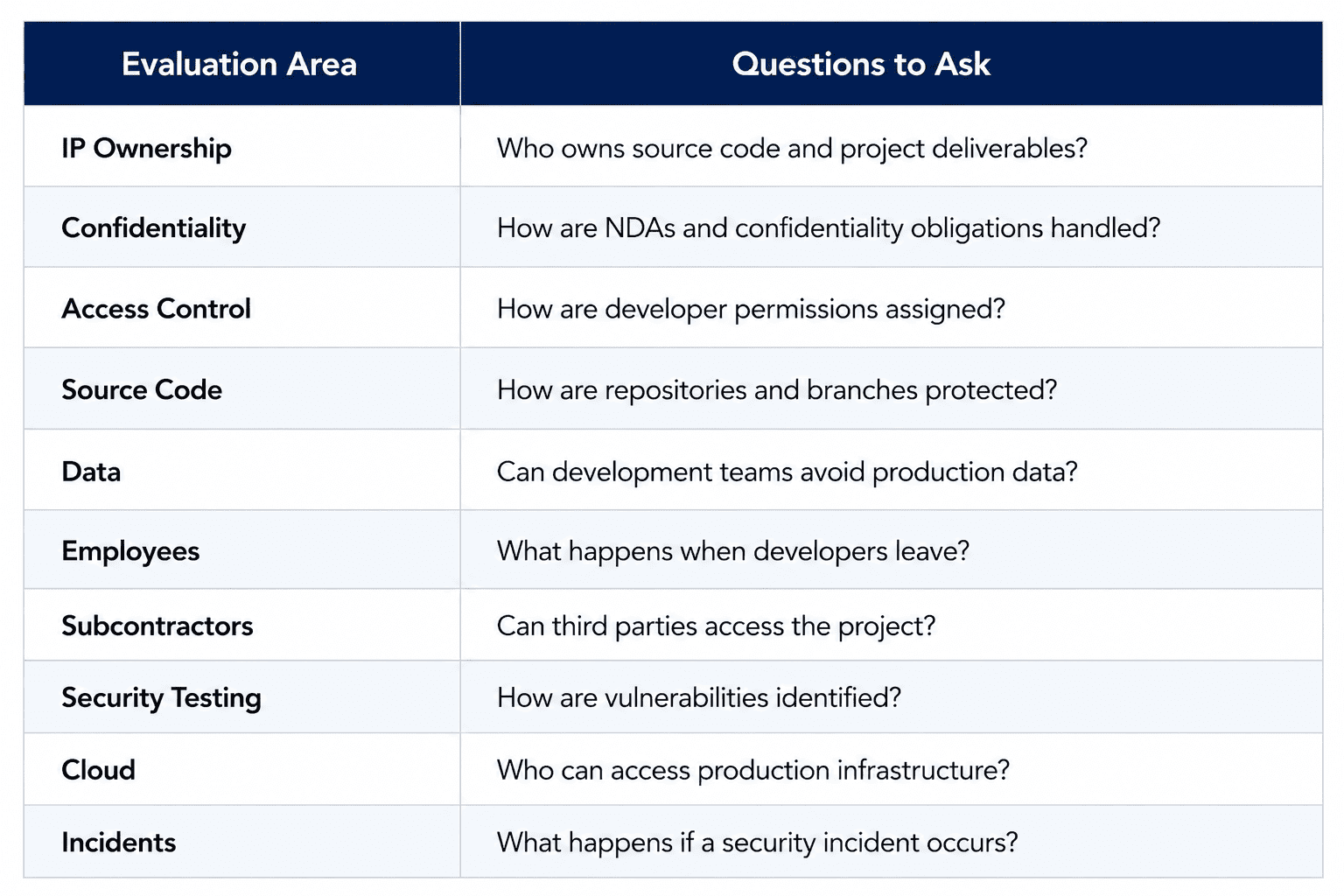
A technology partner should be able to explain security controls in the context of your actual project rather than providing only generic assurances.
What Are the Red Flags When Choosing a Software Development Partner?
Security red flags include unclear IP ownership, excessive access permissions, shared credentials, weak offboarding, uncontrolled subcontractors, and an inability to explain security processes.
First, be cautious when a provider cannot clearly explain who owns the source code or other project deliverables. For example, uncertainty around ownership can create significant problems when a business wants to transfer the project to another development team.
Second, technical red flags can include:
• Shared developer credentials
• No MFA for critical systems
• Unrestricted production access
• No formal access reviews
• Sensitive production data routinely used for testing
• No documented employee offboarding
• Unknown subcontractors
• No vulnerability-management process
• No clear incident-response procedure
• Poor control over source-code repositories
Moreover, a partner asking reasonable security questions can actually be a positive signal. Mature teams typically need to understand what data they are handling, which systems they can access, and what security requirements apply to the project.
The absence of clear answers is often more concerning than the absence of a particular security tool.
How Can Brilliantech Help Businesses Build Software With the Right Technology Team?
Brilliantech provides software development and technology services that can help businesses access engineering expertise across custom software, web applications, mobile applications, AI, cloud, QA, DevOps, and team-extension models.
First, businesses should evaluate a technology provider according to the requirements of their specific project rather than selecting a partner based only on its service list. For example, a company building a new SaaS platform may need application development, cloud infrastructure, QA automation, DevOps, and ongoing maintenance at different stages.
Second, Brilliantech's service portfolio can support different development requirements, including:
• Custom software development
• Web application development
• Mobile application development
• AI development
• Cloud software development
• Quality assurance
• DevOps
• Staff augmentation
• Dedicated development teams
For businesses that need additional engineering capacity, staff augmentation services can provide a structured way to extend an existing team while defining responsibilities and access requirements.
For companies building complete digital products, custom software development services can support projects where the software needs to align closely with proprietary workflows and business requirements.
The right technology partnership should combine technical capability with clear ownership, controlled access, communication, and security expectations.
What Should You Do Before Sharing Your Source Code With an Indian IT Partner?
Businesses should complete a basic IP, security, contractual, and access assessment before sharing source code or sensitive business information with an external technology partner.
First, identify what the partner actually needs to access. Not every developer needs access to every repository, database, cloud account, or production environment.
Second, establish the contractual framework before providing credentials or confidential project information. This should cover ownership, confidentiality, permitted use, data handling, subcontractors, termination, and return or deletion requirements.
A practical pre-engagement checklist is:
1. Identify sensitive IP and data.
2. Define ownership of project deliverables.
3. Review NDA and contractual terms.
4. Assess the partner's security practices.
5. Define team roles and permissions.
6. Enable MFA and individual accounts.
7. Configure repository permissions.
8. Limit production access.
9. Use controlled development data.
10. Document onboarding and offboarding.
11. Establish incident-response responsibilities.
12. Schedule periodic access reviews.
The objective is not to eliminate every possible risk; it is to make risk visible, controlled, and accountable before development begins.
What Is the Best Way to Protect IP and Data When Working With Tech Teams in India?
The best approach is a layered security model that combines legal agreements, least-privilege access, secure development practices, controlled data, employee governance, and continuous monitoring.
First, contracts should establish who owns the work and how confidential information can be used. Second, technical controls should restrict access to the systems and information each person actually needs.
Third, operational processes should ensure that security continues as the team changes. For example, when a developer joins, changes responsibilities, or leaves the project, their permissions should be updated accordingly.
The strongest model therefore connects:
Contract → Identity → Access → Development → Data → Monitoring → Offboarding
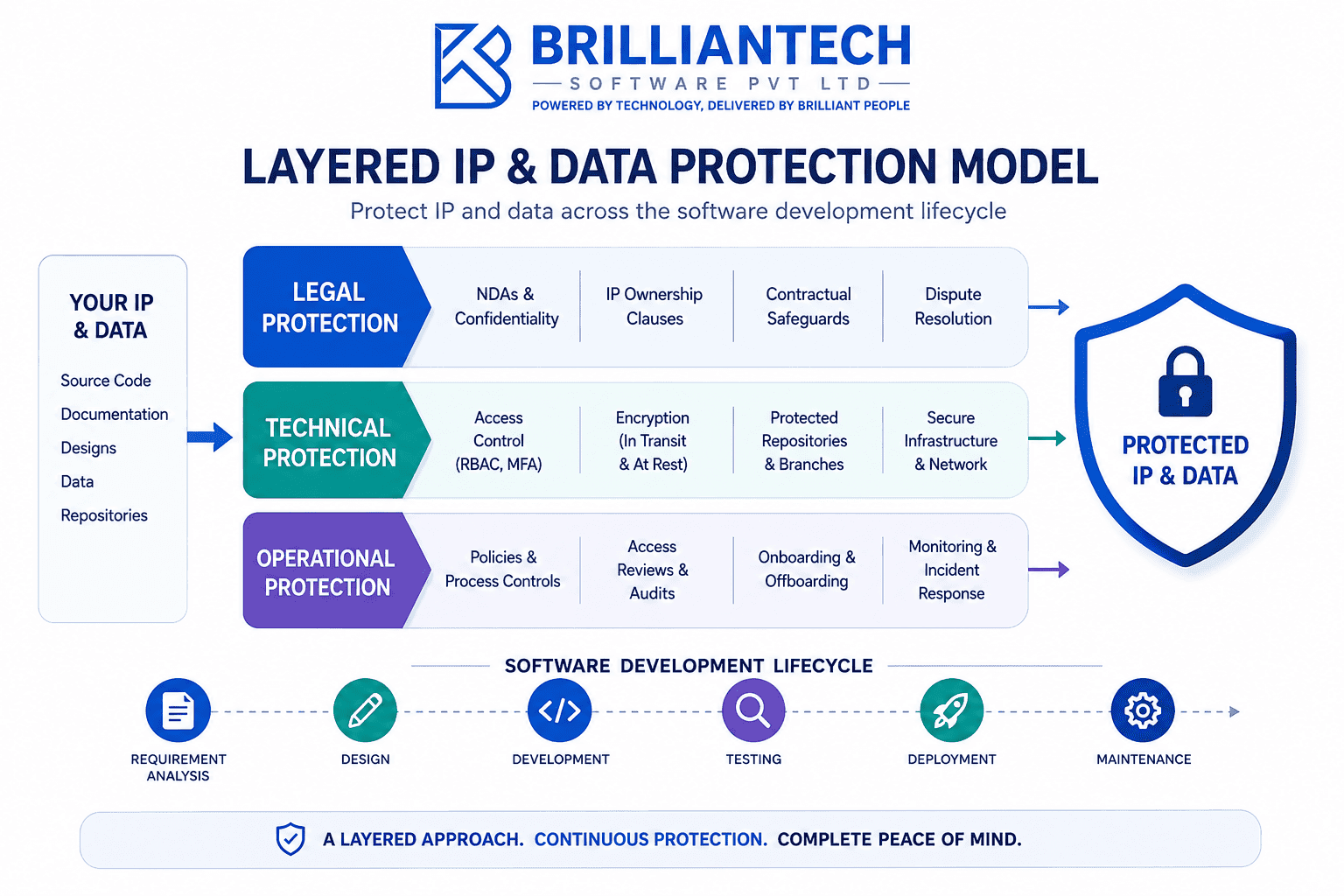
IP protection is strongest when legal, technical, and operational controls work together rather than operating as separate processes.
Conclusion — How Can Businesses Work Safely With Tech Teams in India?
Businesses can work safely with technology teams in India when IP ownership, confidentiality, access control, data handling, and security responsibilities are established before and throughout the development engagement.
First, an NDA alone is not enough. Contracts establish rights and obligations, while technical controls help enforce appropriate access boundaries.
Second, businesses should apply least-privilege access, protect repositories, secure credentials, minimize sensitive data exposure, and maintain clear employee onboarding and offboarding procedures.
Finally, choosing the right partner matters. A capable technology provider should be able to discuss how it protects source code, manages access, handles sensitive data, governs developers, and responds to security incidents in practical terms.
Working with an Indian technology team does not require businesses to choose between engineering capability and IP protection. With the right framework, companies can build distributed development relationships that are productive, scalable, and responsibly governed.
Your source code, customer data, and proprietary technology are business assets. Protecting them should be part of your development strategy—not an afterthought.