
Key Takeaways
• Java full-stack development combines Java-based backend technologies with modern frontend frameworks, databases, APIs, security, testing, and deployment infrastructure.
• Spring Boot provides a modern foundation for building Java APIs, microservices, secure applications, and cloud-ready backend systems.
• Modern Java applications commonly use React, Angular, TypeScript, or other JavaScript-based frameworks rather than Java for browser-side development.
• Cloud-native architecture, microservices, APIs, containers, automation, and observability are reshaping how Java full-stack applications are developed and deployed.
• Generative AI can accelerate Java development through code generation, testing, debugging, documentation, and AI-powered application features.
• The right Java full-stack architecture depends on application requirements, scalability, security, team expertise, integration needs, and long-term maintenance.
• Java remains relevant because its ecosystem continues to evolve alongside cloud computing, microservices, modern frontend technologies, and AI.
What Is Java Full-Stack Development?
Java full-stack development is the practice of building complete applications using Java-based backend technologies together with modern frontend frameworks, databases, APIs, security, testing, and deployment infrastructure.
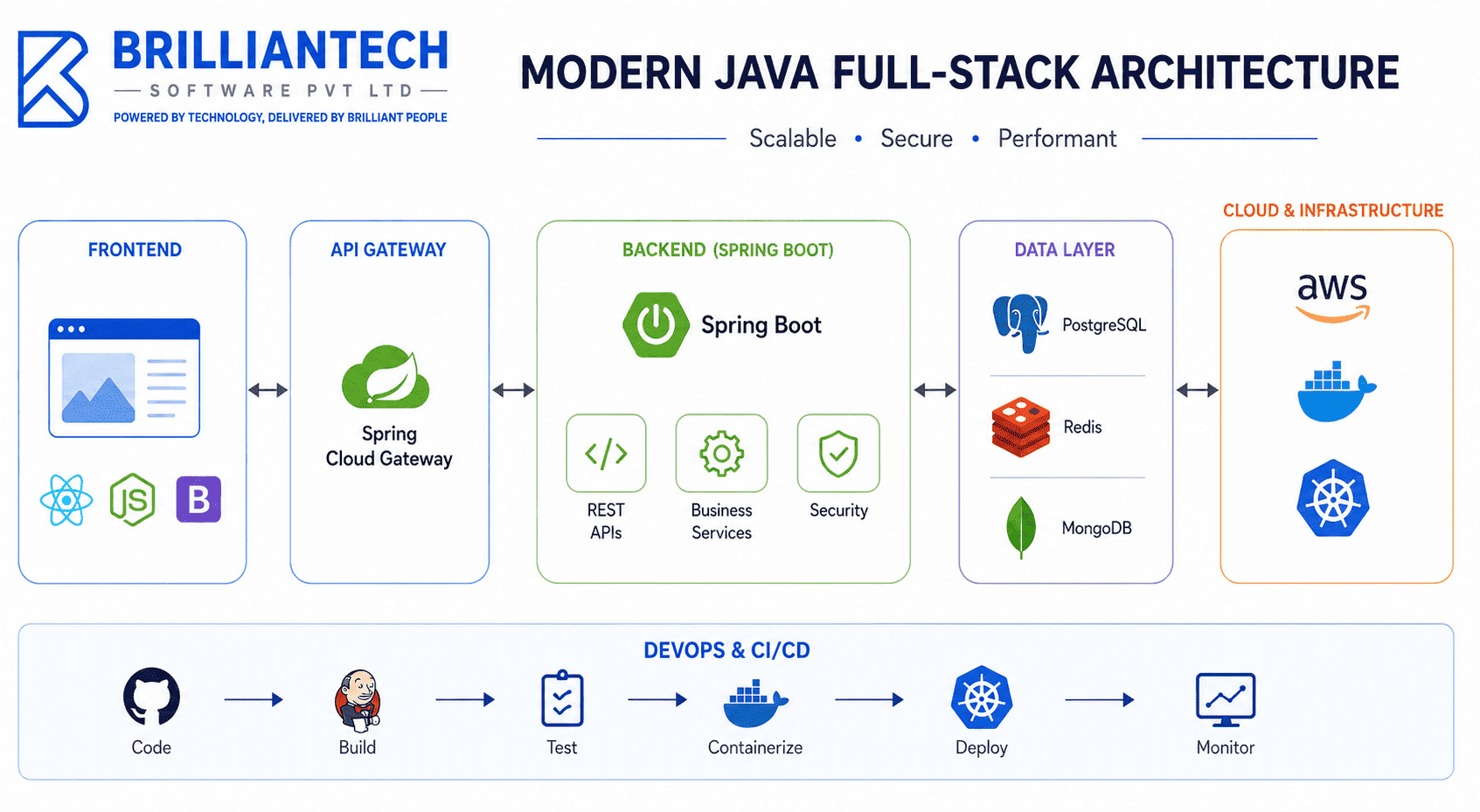
First, modern Java full-stack development is not simply Java + HTML + CSS. A production application can connect a browser-based interface with APIs, Java services, databases, authentication systems, cloud infrastructure, monitoring, and automated delivery pipelines.
For example, an enterprise SaaS platform might use React and TypeScript for the interface, Spring Boot for REST APIs, PostgreSQL for transactional data, Redis for caching, Docker for packaging, and AWS for deployment.
A typical architecture looks like this:
Frontend → API Layer → Spring Boot/Java Backend → Database → Cloud Infrastructure
At the same time, authentication, authorization, testing, CI/CD, observability, and security controls operate across these layers.
Moreover, businesses that need a complete application rather than isolated backend development can evaluate Java development services as part of a broader technology strategy.
What Technologies Are Included in a Java Full-Stack Application?
A Java full-stack application typically combines Java and Spring technologies on the backend with JavaScript or TypeScript-based technologies on the frontend.
First, the backend commonly includes Java, Spring Boot, Spring Security, Spring Data, REST APIs, databases, testing frameworks, and observability tools.
Second, the frontend can include React, Angular, TypeScript, Next.js, or another framework selected according to application requirements.
A representative technology stack looks like this:
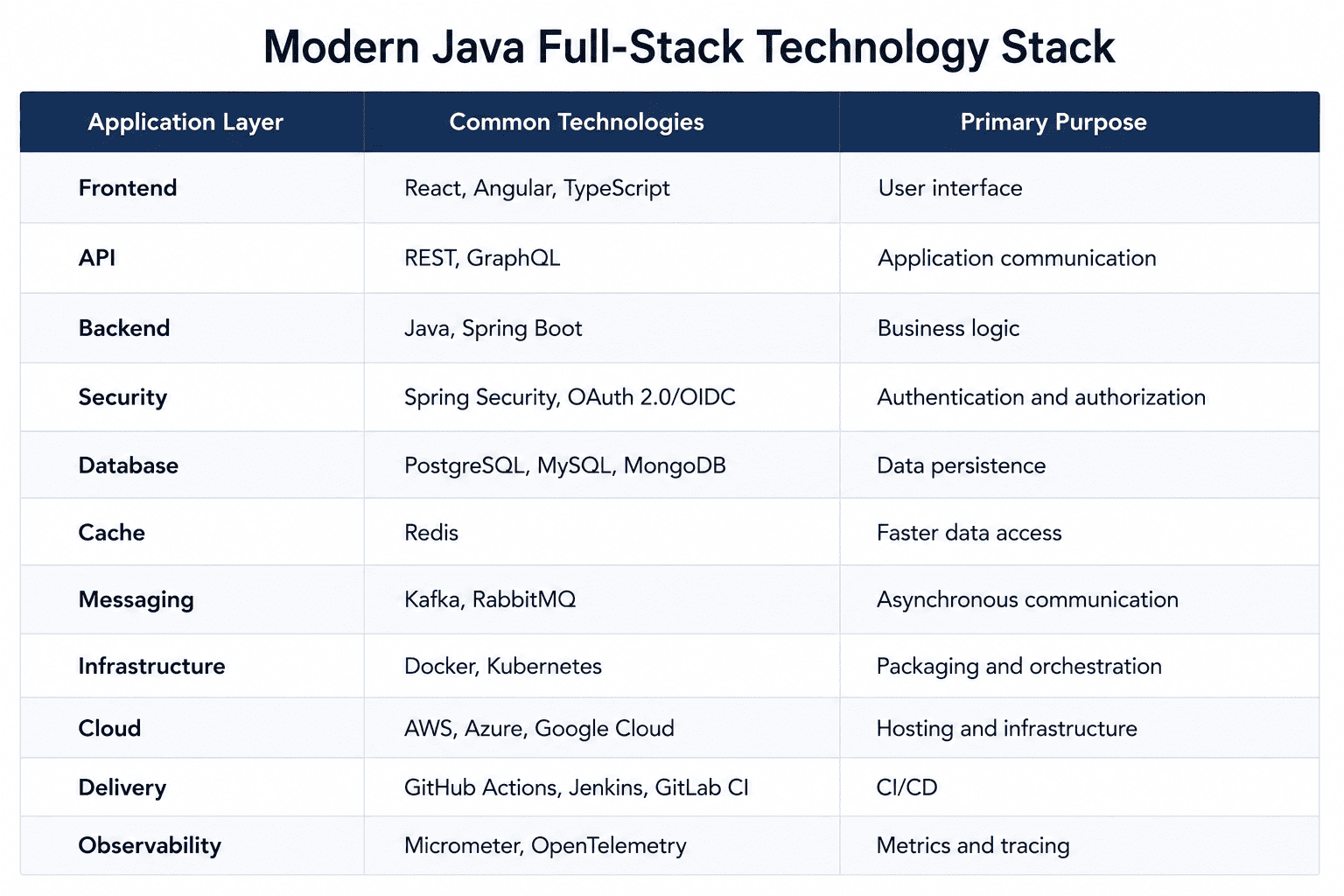
A modern Java full-stack architecture is an ecosystem rather than a single framework.
Why Is Java Still Relevant for Full-Stack Development?
Java remains relevant to full-stack development because its ecosystem continues to support enterprise applications, APIs, cloud-native workloads, security, scalability, and long-term software maintenance.
First, Java continues to evolve rather than remaining frozen in its traditional enterprise role. Java 25 became an LTS release in September 2025, giving organizations a current long-term-support baseline for modernization. — Source: Oracle, 2025.
Second, Java also remains visible in the global developer ecosystem. GitHub's 2025 Octoverse reported more than 174,000 new Java contributors, showing continued activity around the language and its ecosystem. — Source: GitHub Octoverse, 2025.
For example, a financial-services platform may prioritize Java because its architecture needs mature security libraries, transaction management, database integration, observability, and a large ecosystem of engineers.
At the same time, Java does not need to dominate every layer of the application. Modern full-stack architecture allows Java to remain the backend foundation while specialized frontend technologies handle the browser experience.
Java's modern advantage is less about using Java everywhere and more about using Java where its ecosystem creates measurable value.
Why Do Enterprises Continue to Use Java?
Enterprises continue to use Java because the ecosystem supports large applications that require maintainability, security, integration, and long-term operational support.
First, Java has mature libraries and frameworks for databases, authentication, messaging, APIs, testing, monitoring, and enterprise integration.
For example, a large insurance platform may need customer management, policy processing, billing, document generation, third-party integrations, reporting, and role-based access control within one broader ecosystem.
Second, Java's ecosystem makes it possible to modernize existing systems incrementally. An organization can update its Java runtime, introduce Spring Boot services, expose APIs, containerize workloads, and gradually modernize legacy components.
Java remains valuable when long-term software lifecycle considerations matter as much as initial development speed.
What Are the Latest Java Backend Development Trends?
The latest Java backend development trends center on modern Java releases, Spring Boot, microservices, APIs, cloud-native deployment, event-driven systems, observability, automated testing, and application security.
First, modern backend development increasingly focuses on production characteristics, not simply application functionality. Developers need to consider resilience, deployment automation, monitoring, security, performance, and operational cost from the beginning.
Second, Spring Boot remains a major part of this ecosystem. Spring Boot 4.0 was released in November 2025 and introduced a new generation of the framework with modularization, first-class Java 25 support, API versioning, and HTTP Service Clients. — Source: Spring, 2025.
The major backend trends include:
• Modern Java language and runtime features
• Spring Boot
• Spring Security
• Spring Data
• RESTful APIs
• Microservices
• Event-driven architecture
• Containerization
• Cloud-native deployment
• Automated testing
• Observability
• API versioning
• Performance engineering
• Secure development
Modern Java backend development is increasingly about building software that can be operated reliably, not just software that can execute successfully.
How Are Modern Java Releases Changing Backend Development?
Modern Java releases improve the language and runtime while giving development teams a more current foundation for building maintainable applications.
First, Java 25 is an LTS release, making it particularly relevant for organizations that prefer a long-term support baseline. Oracle describes Java 25 as containing improvements across performance, security, stability, and developer productivity. — Source: Oracle, 2025.
Second, organizations should avoid treating every new Java feature as mandatory. A better strategy is to evaluate whether an upgrade improves performance, maintainability, developer productivity, security, or operational support.
For example, an enterprise running an older Java version may benefit from a planned modernization program that upgrades the runtime, updates dependencies, improves automated testing, and validates production performance before full rollout.
Java modernization should be driven by measurable engineering benefits rather than version numbers alone.
How Does Spring Boot Support Modern Java Full-Stack Development?
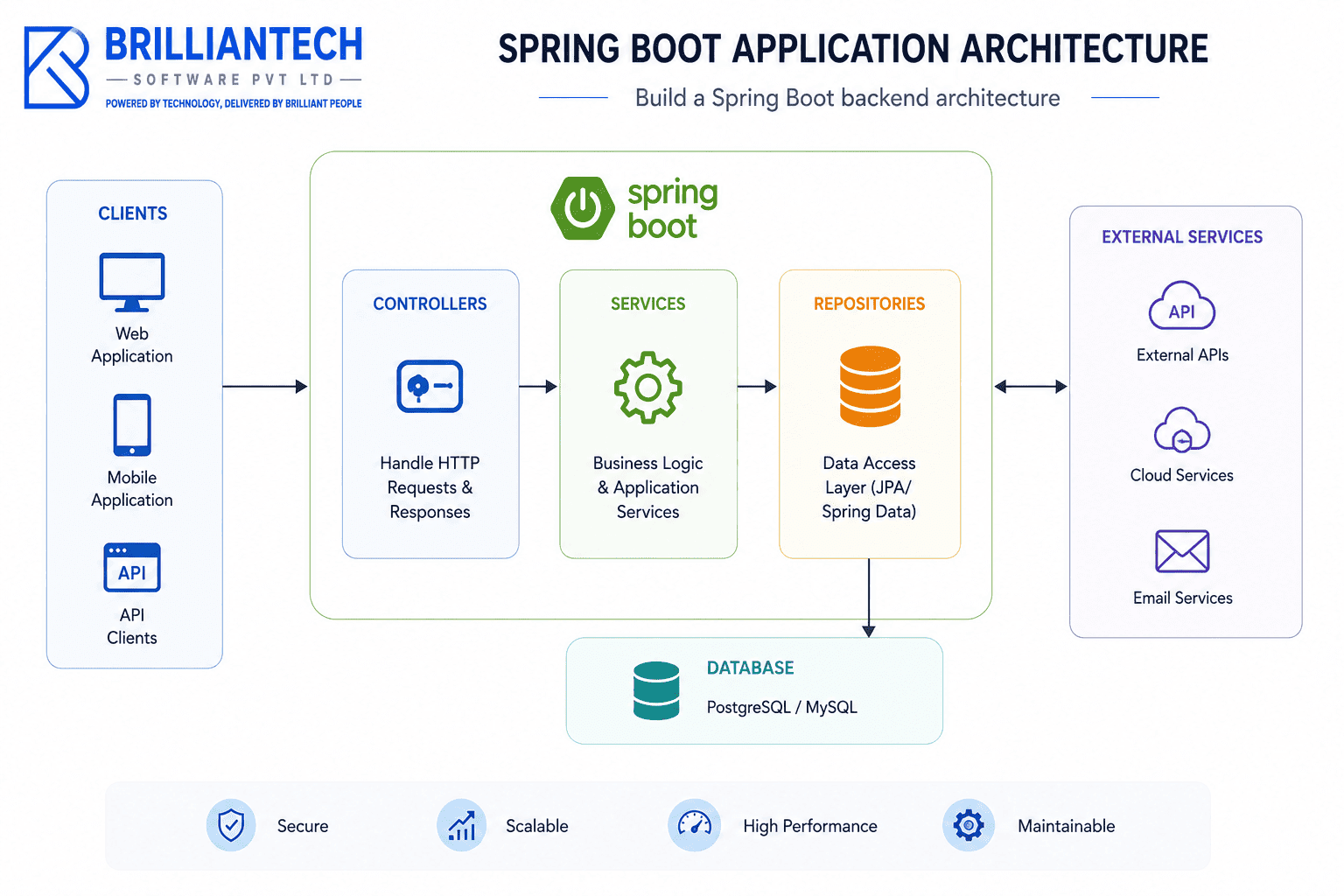
Spring Boot is a Java framework that simplifies the development of production-ready backend applications, REST APIs, microservices, security integrations, and cloud-ready services.
First, Spring Boot provides conventions and auto-configuration that reduce the amount of infrastructure developers need to configure manually. It also provides production-oriented capabilities through its broader ecosystem.
Second, Spring Boot can serve as the backend foundation while a separate frontend framework manages the browser experience. For example, a React application can communicate with Spring Boot through REST APIs while Spring Security handles authentication and authorization.
Spring Boot 4.0 also introduced modularization, Java 25 support, API versioning, and HTTP Service Clients for REST-based applications. — Spring, 2025.
Why Are REST APIs Important in Java Full-Stack Applications?
REST APIs provide a standardized communication layer between a Java backend and frontend applications or external systems.
First, an API separates the user interface from backend business logic. For example, a React order-management screen can request customer and order information from Spring Boot endpoints without knowing how the backend stores that information.
Second, API-based architecture makes it easier to support multiple clients. The same backend can potentially serve a web application, mobile application, partner integration, or internal administrative interface.
A mature API strategy should consider:
• Authentication and authorization
• API versioning
• Validation
• Error handling
• Rate limiting
• Documentation
• Monitoring
• Backward compatibility
• Performance
• Input security
A well-designed API becomes the contract between the frontend experience and backend business logic.
What Are the Latest Java Full-Stack Frontend Trends?
Modern Java full-stack applications typically use Java and Spring Boot on the backend while using React, Angular, TypeScript, or other JavaScript-based frameworks for the user interface.
First, this separation reflects how modern web development has evolved. Java remains powerful on the server, while TypeScript-based ecosystems provide extensive tooling for browser applications.
Second, TypeScript has become particularly significant. GitHub's 2025 Octoverse reported that TypeScript became the most-used language on GitHub in August 2025, with more than 1 million additional contributors year over year and 66% growth. — GitHub Octoverse, 2025.
For example, a Java enterprise application can use Spring Boot for transaction-heavy backend services while React and TypeScript provide a responsive dashboard for employees and customers.
Being a Java full-stack developer does not mean Java must run in the browser.
Is React a Good Frontend for Java Spring Boot Applications?
React is a strong frontend option for Spring Boot applications when a project requires component-based interfaces, flexible UI architecture, and a large modern frontend ecosystem.
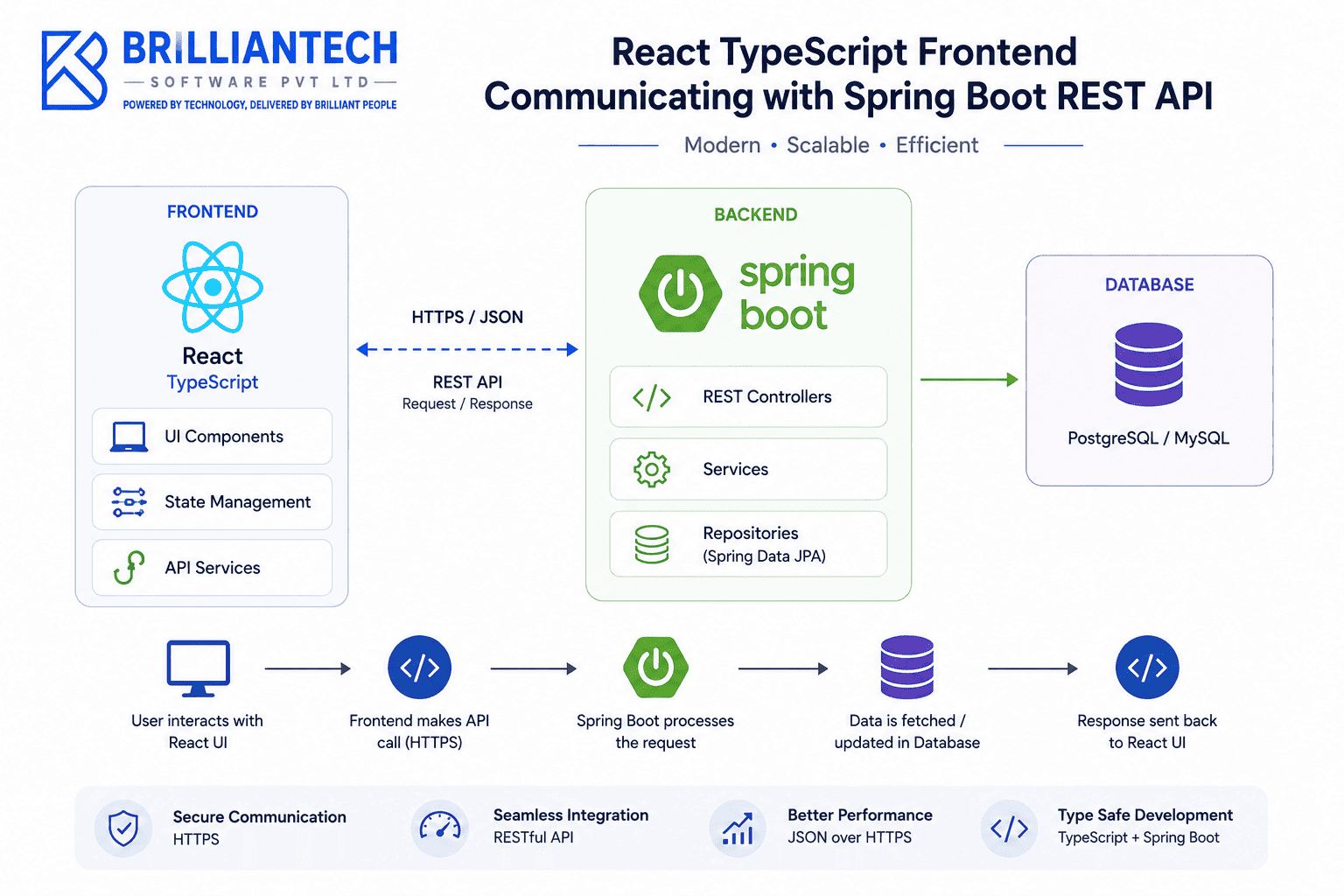
First, React and Spring Boot work well together because they can communicate through HTTP APIs. React manages interface state and user interactions, while Spring Boot handles business rules, authentication, data access, and integrations.
Second, React 19 introduced capabilities such as Actions and improved support for modern rendering patterns, reinforcing its role as a modern UI technology. — React v19
For example, an insurance platform might use React and TypeScript for quote forms, customer dashboards, and administrative screens while Spring Boot handles policy processing and database transactions
Is Angular a Good Frontend for Java Applications?
Angular is a strong frontend choice for Java applications when teams need a structured framework for large, complex, enterprise-oriented interfaces.
First, Angular provides an opinionated application structure that can be useful for large teams working on complex business applications.
Second, Angular's structured approach can support applications containing complex forms, routing, reusable components, validation, permissions, and enterprise workflows.
For example, a large internal ERP interface may contain hundreds of forms, workflows, permissions, reports, and shared components. A structured frontend framework can make such an application easier to organize across multiple development teams.
Angular and Spring Boot can form a strong enterprise stack when both layers require structured architecture and long-term maintainability.
How Do React and Spring Boot Work Together?
React and Spring Boot work together by separating the frontend user experience from backend business logic through APIs.
First, React sends an HTTP request when a user performs an action. For example, clicking View Orders might trigger a GET request to a Spring Boot endpoint.
Second, Spring Boot validates the request, applies business rules, retrieves information from the database, and returns a structured response.
A simplified flow is:
User → React → REST API → Spring Boot → Database → Spring Boot → React → User
This architecture allows frontend and backend teams to work independently while maintaining a defined API contract.
Moreover, the same Spring Boot APIs can potentially support other clients. A mobile application, partner portal, or internal tool can consume the same services when the API architecture supports those use cases.
React handles the experience; Spring Boot handles the business capabilities behind that experience.
How Do Angular and Spring Boot Work Together?
Angular and Spring Boot work together by using Angular for the structured frontend application and Spring Boot for APIs, business logic, security, and data access.
First, Angular can manage complex forms, navigation, state, reusable components, and enterprise workflows. Spring Boot can manage authentication, authorization, transactions, database operations, and integrations.
Second, the two layers can evolve independently when their API contracts are well defined.
For example, a healthcare administration platform could use Angular for appointment management, billing screens, reporting dashboards, and employee workflows while Spring Boot manages business services and database transactions.
Angular and Spring Boot are especially useful when a business values structure across both frontend and backend development.
What Role Do APIs, Databases, Cloud, and DevOps Play in Java Full-Stack Development?
APIs, databases, cloud infrastructure, DevOps, and observability extend Java full-stack development beyond application code into the complete software delivery lifecycle.
First, databases provide persistence, while caching and messaging systems help applications handle different performance and communication requirements.
Second, cloud and DevOps practices determine how applications are packaged, deployed, monitored, scaled, and updated.
A modern Java application may therefore combine:
• PostgreSQL or MySQL for relational data
• MongoDB for selected document-oriented workloads
• Redis for caching
• Kafka or RabbitMQ for asynchronous messaging
• Docker for container packaging
• Kubernetes for orchestration
• AWS, Azure, or Google Cloud for infrastructure
• CI/CD for automated delivery
• OpenTelemetry and metrics systems for observability
CNCF's 2025 Annual Cloud Native Survey reported that 82% of container users were running Kubernetes in production, up from 66% in 2023. — CNCF, 2026.
How Are Microservices Used in Java Full-Stack Development?
Microservices architecture divides an application into independently deployable services organized around specific business capabilities.
First, microservices can allow teams to develop and deploy parts of a large system independently. For example, an e-commerce platform could separate catalog, payments, orders, inventory, and notifications into different services.
Second, Java and Spring Boot are commonly used for these backend services because the Spring ecosystem provides capabilities for APIs, configuration, security, data access, and distributed application development.
However, microservices should not automatically replace a monolith. A smaller application may become unnecessarily complex if it introduces service discovery, distributed tracing, message brokers, and multiple deployment units without a clear business reason.
Microservices are an architectural choice, not a mandatory feature of modern Java development.
How Is Cloud Computing Changing Java Application Development?
Cloud computing is changing Java application development by making infrastructure automation, elastic scaling, managed services, containers, and observability part of normal application architecture.
First, cloud-native development encourages teams to design applications around automation and operational resilience rather than treating deployment as a final step.
Second, Kubernetes has become a major part of this ecosystem. CNCF's 2025 survey found that 82% of container users were running Kubernetes in production, illustrating how container orchestration has moved into mainstream production infrastructure. —CNCF, 2026.
For example, a Spring Boot service can be packaged as a container, deployed to Kubernetes, exposed through a gateway, monitored through telemetry, and scaled according to workload requirements.
Cloud-native Java development connects application architecture with infrastructure automation.
Businesses evaluating this model can also consider cloud application development when cloud architecture is part of a broader application modernization strategy.
How Is Generative AI Changing Java Full-Stack Development?
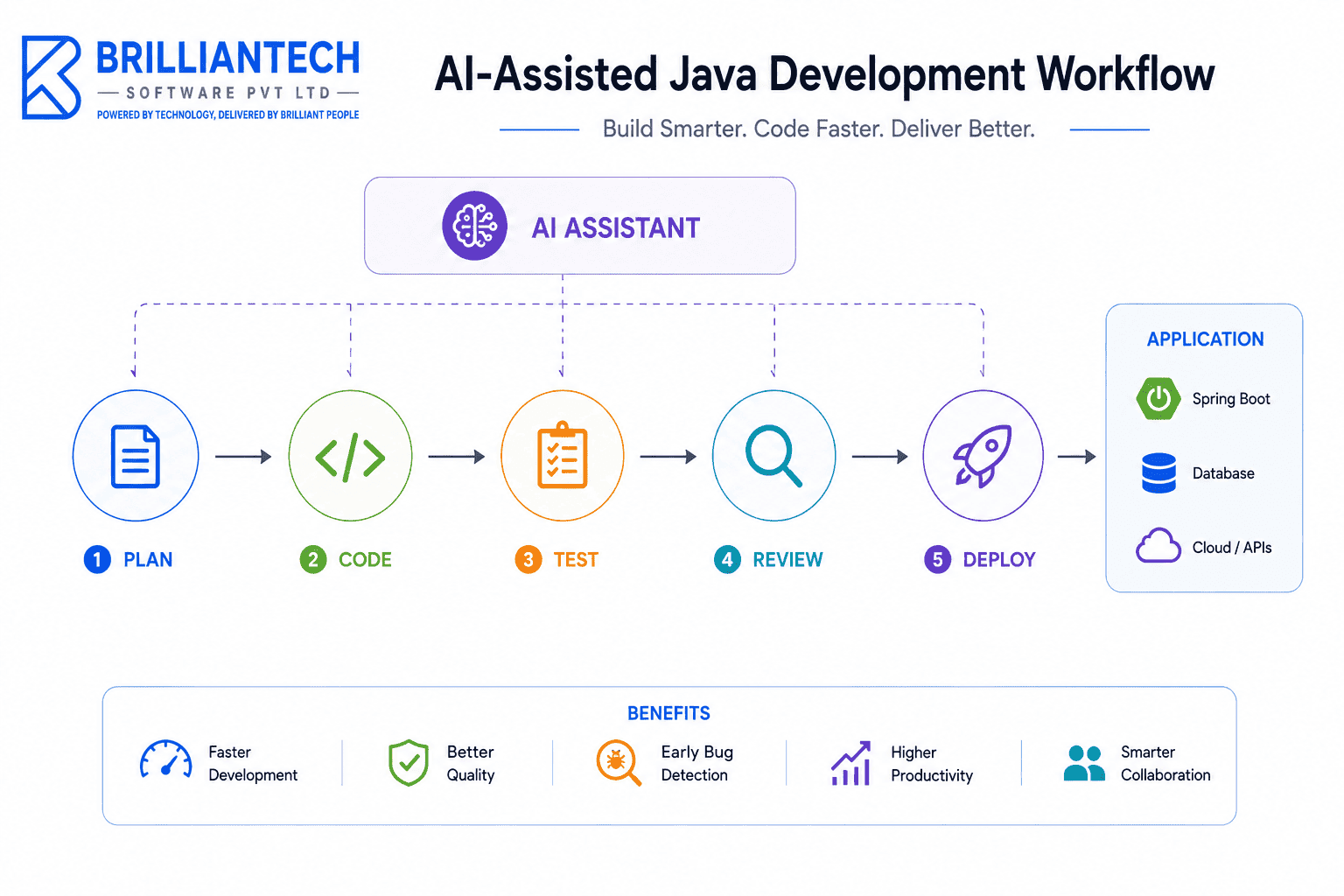
Generative AI can accelerate Java full-stack development by assisting with code generation, testing, debugging, documentation, code review, and AI-powered application features while developers remain responsible for architecture, security, correctness, and maintainability.
First, AI-assisted development has become widespread. Stack Overflow's 2025 Developer Survey found that 84% of respondents were using or planning to use AI tools in their development process, while 51% of professional developers reported using AI tools daily. — Stack Overflow, 2025.
Second, developer caution remains important. The same survey found that 46% of developers distrust the accuracy of AI output, compared with 33% who trust it. — Stack Overflow, 2025.
AI can support a Java team without becoming part of the application's runtime. For example, developers can use an AI coding assistant to generate a test skeleton, explain unfamiliar Spring code, draft API documentation, or suggest refactoring approaches.
AI can also become a feature inside the application. A Spring Boot application could integrate an external AI model to provide:
• Document summarization
• Intelligent search
• Customer-support assistants
• Recommendation systems
• Natural-language interfaces
• Content classification
• Data extraction
• Workflow automation
AI-assisted development and AI-powered application features are different use cases and should be evaluated separately.
For organizations integrating AI into production software, AI development services can be considered when application engineering and AI integration need to be planned together.
How Should Developers Use AI Without Sacrificing Software Quality?
Developers should use AI to accelerate engineering tasks while retaining human review for architecture, security, testing, and production decisions.
First, generated code should be reviewed like any other externally produced code. For example, an AI assistant may generate a Spring Security configuration that appears correct but still requires validation against the application's authentication model and threat profile.
Second, automated tests become more important when AI increases the speed of code production. Type checking, static analysis, unit tests, integration tests, security scanning, and code review can provide independent validation.
Stack Overflow's 2025 survey found that 66% of developers' biggest AI-related frustration was receiving solutions that were almost right but not quite, while 45% said debugging AI-generated code can be more time-consuming. —Stack Overflow, 2025.
AI can increase coding speed, but engineering discipline determines whether that speed becomes reliable software.
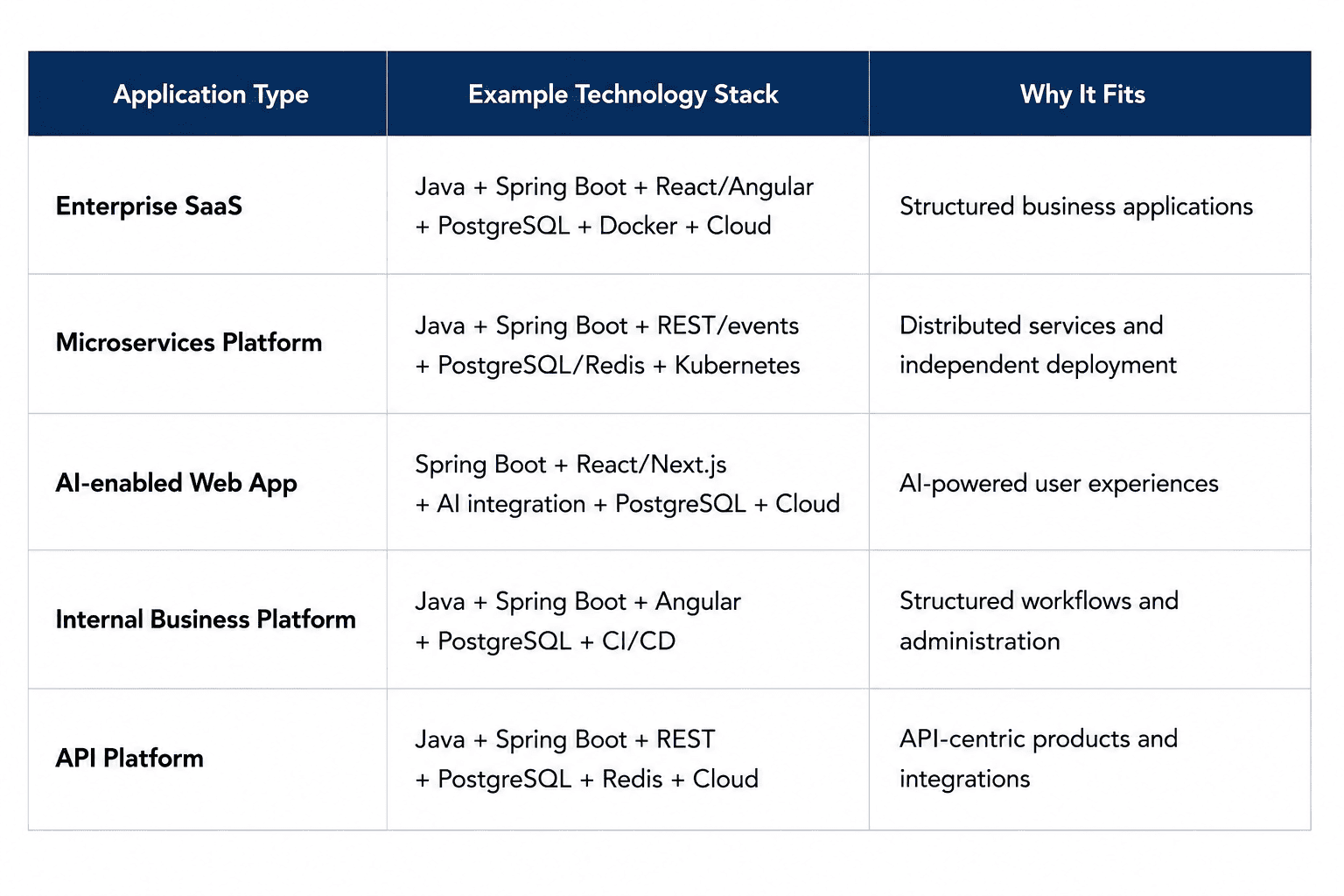
What Does a Modern Java Full-Stack Technology Stack Look Like?
A modern Java full-stack technology stack should be selected according to application requirements rather than treated as one universal combination of technologies.
First, an enterprise SaaS platform may need different technologies from a high-volume microservices platform or an AI-enabled application.
When Should You Choose Spring Boot + React?
Spring Boot plus React is well suited to applications that need a flexible, component-based frontend and a robust Java backend.
First, this combination works particularly well for SaaS dashboards, customer portals, e-commerce interfaces, analytics applications, and products where frontend experience is a major differentiator.
Second, TypeScript can provide stronger typing across the frontend while Spring Boot exposes structured APIs on the backend.
Choose Spring Boot plus React when frontend flexibility and rich interactive experiences are major requirements.
When Should You Choose Spring Boot + Angular?
Spring Boot plus Angular is well suited to structured enterprise applications with complex workflows, forms, permissions, and large frontend teams.
First, Angular's opinionated structure can help teams standardize how components, services, routing, and application logic are organized.
Second, Spring Boot can provide the backend services while Angular handles enterprise-facing workflows.
Choose Spring Boot plus Angular when frontend structure and enterprise-scale maintainability are high priorities.
When Does Spring Boot + Next.js Make Sense?
Spring Boot plus Next.js can make sense when a Java backend needs to coexist with a React-based framework that provides server-side rendering or other application-layer capabilities.
First, Next.js can handle parts of the web application experience while Spring Boot remains responsible for core business services and APIs.
Second, this architecture can be useful when search visibility, initial rendering performance, or a modern React application architecture is important.
The architecture should still be evaluated carefully because introducing two server-side application layers can increase operational complexity.
Use Next.js with Spring Boot when its frontend and rendering capabilities provide a clear product benefit.
What Skills Should a Modern Java Full-Stack Developer Have?
A modern Java full-stack developer needs skills across backend engineering, frontend development, APIs, databases, cloud infrastructure, security, testing, DevOps, and increasingly AI-assisted development.
First, backend expertise remains important. Developers should understand Java, Spring Boot, REST APIs, data access, transactions, security, testing, and application architecture.
Second, frontend knowledge must now extend beyond traditional Java web technologies. Developers should understand React or Angular, TypeScript, browser fundamentals, accessibility, responsive design, and frontend performance.
A practical skill set includes:
• Java and modern JDK features
• Spring Boot
• Spring Security
• REST API design
• SQL and database design
• React or Angular
• TypeScript
• Git
• Docker
• CI/CD
• Cloud platforms
• Testing
• Observability
• Secure coding
• AI-assisted development
Stack Overflow's 2025 Developer Survey found that 69% of developers had spent time learning new coding techniques or a programming language during the previous year, highlighting the need for continuous technical learning. — Stack Overflow, 2025.
The modern Java full-stack developer is increasingly a systems-oriented engineer rather than a developer limited to one programming language.
How Can Businesses Future-Proof a Java Full-Stack Application?
Businesses can future-proof Java full-stack applications by choosing architecture based on requirements, maintaining dependencies, automating delivery, securing APIs, monitoring production, and adopting new technologies only when they provide measurable value.
First, start with business requirements instead of selecting technologies because they are currently popular. For example, a simple internal application may not need Kubernetes or microservices even if those technologies are widely discussed.
Second, build an architecture that can evolve without creating unnecessary complexity.
A practical roadmap is:
1. Define business and functional requirements.
2. Choose architecture based on scale and complexity.
3. Use a supported Java version.
4. Adopt Spring Boot where it fits the backend workload.
5. Select React, Angular, or another frontend according to UX requirements.
6. Design secure and documented APIs.
7. Automate unit, integration, and end-to-end testing.
8. Implement CI/CD.
9. Use cloud infrastructure where it creates measurable value.
10. Monitor application performance and security.
11. Introduce AI where it solves a genuine problem.
12. Keep Java versions and dependencies maintained.
Moreover, organizations should periodically review architecture rather than assuming the original technology choices will remain optimal forever.
Future-proofing does not mean predicting every future technology; it means building systems that can adapt without unnecessary rework.
For organizations that need a broader application built around specific business requirements, custom software development services can provide an approach centered on the product's functional and technical requirements.
How Can Businesses Choose the Right Java Full-Stack Development Partner?
Businesses should evaluate a Java development partner based on technical depth, architecture experience, security practices, communication, testing discipline, and the ability to support the application beyond initial development.
First, examine whether the partner understands the entire stack rather than only Java syntax. A modern project may require backend architecture, frontend development, cloud infrastructure, DevOps, QA, security, and AI integration.
Second, ask for evidence of how the team handles real engineering challenges.
Questions worth asking include:
• How do you design Spring Boot applications for scale?
• How do you decide between monoliths and microservices?
• How do you secure APIs?
• How do you approach database performance?
• How do you monitor production systems?
• How do you structure automated testing?
• How do React or Angular teams collaborate with Java teams?
• How do you manage cloud deployment?
• How do you use AI during development?
• How do you handle application modernization?
For businesses that need end-to-end application expertise, web application development services can be evaluated alongside Java backend capabilities.
The right development partner should be able to explain why a technology choice fits your application rather than simply recommending the newest tool.
What Tools Support Modern Java Full-Stack Development?
Modern Java full-stack development relies on an integrated toolchain covering coding, dependency management, testing, version control, containers, deployment, monitoring, and AI-assisted development.
First, developers can use IntelliJ IDEA, Eclipse, or Visual Studio Code for development, while Maven or Gradle manages builds and dependencies.
Second, teams can combine Git with GitHub, GitLab, or another repository platform for source control and collaboration.
A practical toolchain may include:
• IDE: IntelliJ IDEA, Eclipse, VS Code
• Build: Maven, Gradle
• Backend: Java, Spring Boot
• Frontend: React, Angular, TypeScript
• Database: PostgreSQL, MySQL, MongoDB
• Cache: Redis
• Messaging: Kafka, RabbitMQ
• Containers: Docker
• Orchestration: Kubernetes
• CI/CD: Jenkins, GitHub Actions, GitLab CI
• Observability: Micrometer, OpenTelemetry
• Cloud: AWS, Azure, Google Cloud
• AI assistance: AI coding assistants and AI application frameworks
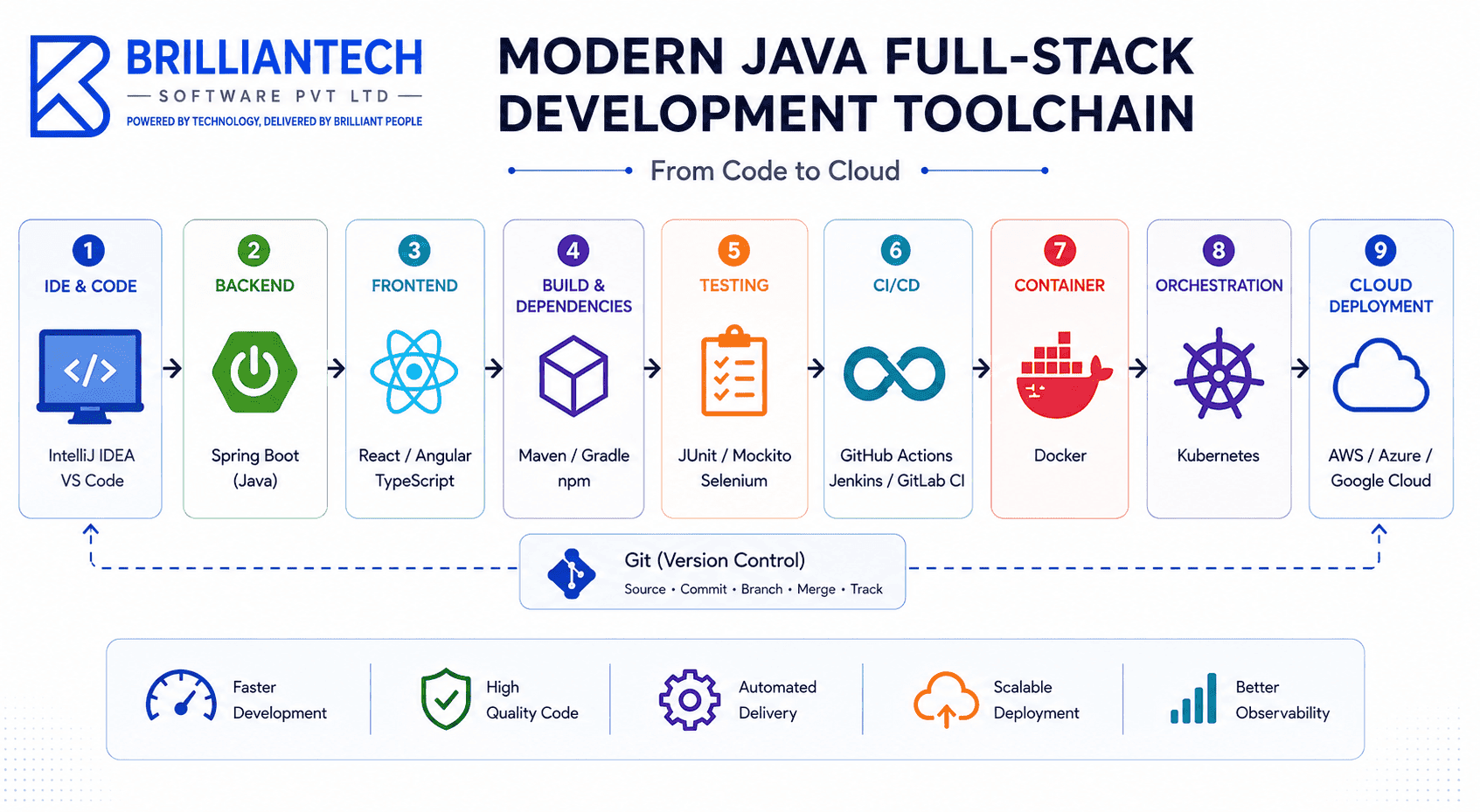
Moreover, teams do not need every tool on this list. The best stack is the smallest technology set that satisfies the application's functional, operational, security, and scalability requirements.
What's Next for Java Full-Stack Development?
The future of Java full-stack development will increasingly combine modern Java and Spring Boot with specialized frontend frameworks, cloud-native infrastructure, automation, observability, and practical AI integration.
First, Java's role is likely to remain strongest where backend reliability, enterprise integration, security, and long-term maintainability matter. Modern Java does not need to compete with frontend technologies because the two ecosystems solve different problems.
Second, full-stack development will continue becoming more integrated at the architecture level. A development team may simultaneously think about API contracts, frontend performance, database design, cloud costs, security, observability, and AI capabilities.
Third, AI will change development workflows without eliminating the need for engineering judgment. Stack Overflow's 2025 survey shows widespread AI adoption, but it also shows substantial developer concerns about accuracy.
For businesses, the practical implication is clear: future-ready Java development is not about adopting every emerging technology. It is about combining proven technologies with new capabilities where they solve real business problems.
Conclusion — Is Java Full-Stack Development Still Relevant?
Java full-stack development is evolving rather than disappearing, with Java and Spring Boot increasingly working alongside modern frontend frameworks, APIs, cloud infrastructure, DevOps, and AI.
First, the modern Java full-stack ecosystem is much broader than traditional Java web development. React, Angular, TypeScript, REST APIs, databases, containers, Kubernetes, CI/CD, observability, and AI can all become part of the architecture.
Second, Spring Boot provides a strong backend foundation for applications ranging from conventional enterprise systems to microservices and cloud-native platforms. Modern Java releases continue to evolve, while the broader ecosystem keeps adapting to new development practices.
Finally, there is no universal Java full-stack stack. The right architecture depends on your application's requirements, team capabilities, expected scale, security needs, user experience, integrations, and long-term maintenance strategy.
For businesses planning a new product or modernizing an existing application, the goal should not be to use the most technologies. The goal should be to build the right technology ecosystem for the problem you need to solve.
Java full-stack development is not standing still. It is becoming a broader engineering discipline that connects backend strength with modern frontend experiences, cloud infrastructure, automation, and AI.