
Introduction
Scaling a software development team is one of the biggest challenges modern businesses face. Whether you're launching a new product, expanding after funding, or accelerating digital transformation, hiring experienced developers quickly can be difficult. Traditional recruitment often takes weeks—or even months—while project deadlines continue to move closer.
Staff augmentation offers a flexible alternative. Instead of increasing permanent headcount, businesses can integrate experienced software professionals into their existing teams to accelerate delivery, fill technical skill gaps, and maintain complete control over product development. In this guide, you'll learn how staff augmentation works, when it makes the most sense, how it compares with other hiring models, and the best practices for successfully scaling engineering teams.
Key Takeaways
• Staff augmentation enables organizations to expand software development teams without the long-term commitments and overhead of permanent hiring.
• Flexible workforce models help businesses respond quickly to changing project requirements while maintaining full ownership of product development.
• Access to specialized talent allows companies to onboard experts in cloud computing, AI, DevOps, cybersecurity, and other emerging technologies faster than traditional recruitment.
• Successful staff augmentation depends on clear project requirements, structured onboarding, effective communication, and continuous performance management.
• Comparing staff augmentation with in-house hiring, outsourcing, and freelancing helps organizations choose the workforce strategy that best aligns with their business goals.
• Modern collaboration tools such as Jira, GitHub, Slack, Microsoft Teams, and Confluence make it easier for augmented developers to integrate seamlessly into distributed engineering teams.
• Choosing the right technology partner supports faster software delivery, improved engineering productivity, and long-term business scalability.
What Is Staff Augmentation in Software Development?
Staff augmentation is a workforce strategy that enables organizations to temporarily expand their internal software development teams by integrating external professionals with specialized technical expertise. Unlike traditional outsourcing, augmented developers work directly within your existing engineering team, using the same development workflows, collaboration tools, sprint cycles, and quality standards.
Rather than outsourcing an entire project, businesses retain ownership of product strategy, technical architecture, and delivery while adding developers, DevOps engineers, QA specialists, cloud architects, AI engineers, or other technical professionals whenever additional capacity or expertise is needed.
For example, a fintech company preparing to launch a new digital payment platform may temporarily augment its engineering team with backend developers, cybersecurity specialists, and cloud engineers to accelerate development before launch. Once the platform is successfully released, the organization can scale the team back based on operational needs.
According to Gartner, worldwide IT spending is forecast to reach $5.74 trillion in 2025, driven by continued investment in software, cloud computing, artificial intelligence, and digital transformation initiatives. As technology investments continue to grow, organizations increasingly require flexible workforce models that can rapidly scale engineering capacity without lengthy recruitment cycles. —Gartner, 2025
How Is Staff Augmentation Different from Traditional Hiring?
Traditional hiring focuses on recruiting permanent employees, while staff augmentation provides businesses with experienced professionals who integrate directly into existing teams for as long as they are needed.
Recruiting permanent engineers often involves sourcing candidates, multiple interview rounds, salary negotiations, onboarding, and long-term employment commitments. Staff augmentation significantly shortens this process by allowing organizations to onboard pre-vetted professionals who already possess the required technical expertise.
A well-known example is Shopify's "Digital by Default" strategy, where the company expanded its globally distributed engineering workforce to support continuous product development without relying solely on hiring within a single geographic location. This approach enabled Shopify to access broader technical talent while maintaining collaboration across distributed teams. — Shopify Engineering Blog
Types of Staff Augmentation
Organizations adopt different staff augmentation models depending on project complexity, business objectives, and the level of technical expertise required.
The most common models include:
• Short-term staff augmentation for temporary engineering needs
• Long-term staff augmentation for multi-phase software initiatives
• Skill-based augmentation for specialized expertise such as AI, cloud computing, DevOps, or cybersecurity
• Project-based augmentation for defined deliverables
• Dedicated development teams for continuous software development and long-term collaboration
Each approach offers different advantages depending on budget, project duration, and internal engineering capacity. Selecting the right model helps organizations balance flexibility, cost efficiency, and delivery speed.
Need a flexible way to expand your engineering team? Explore our Staff Augmentation Services to quickly add experienced software professionals who integrate seamlessly with your existing development team.
Why Is Staff Augmentation Important for Scaling Tech Teams?
Staff augmentation is important because it enables organizations to increase engineering capacity quickly while maintaining product ownership, improving delivery speed, and reducing recruitment challenges.
Modern software projects demand expertise across cloud computing, artificial intelligence, cybersecurity, data engineering, DevOps, and modern application development. Finding experienced professionals in these areas through traditional hiring has become increasingly difficult.
According to the ManpowerGroup Employment Outlook Survey 2025, 74% of employers worldwide report difficulty finding the skilled talent they need, making talent shortages one of the biggest barriers to business growth. — ManpowerGroup, 2025
Access Specialized Technical Expertise Faster
Modern digital products often require expertise across multiple technologies rather than a single programming language.
For example, Capital One's large-scale migration to Amazon Web Services (AWS) required expertise in cloud architecture, software engineering, cybersecurity, DevOps, and data engineering. Rather than relying on a single technical discipline, the transformation brought together specialists across multiple domains to modernize applications, improve scalability, and strengthen security. — AWS Customer Stories (Capital One)
Staff augmentation enables businesses to access specialized talent precisely when those skills are needed, helping engineering teams maintain development momentum without increasing permanent headcount.
Accelerate Product Development
One of the biggest advantages of staff augmentation is reducing the time between identifying a resource gap and having experienced engineers actively contributing to the project.
Instead of waiting months to complete recruitment, organizations can onboard pre-vetted professionals and continue sprint planning, feature development, testing, and deployment with minimal disruption.
For example, GitLab, one of the world's largest all-remote software companies, has demonstrated how distributed engineering teams can collaborate effectively through standardized documentation, asynchronous communication, and transparent development workflows. Its publicly available GitLab Handbook has become a widely recognized reference for managing globally distributed engineering organizations. — GitLab Handbook.
Improve Business Agility and Cost Efficiency
Technology priorities change rapidly. Organizations frequently need additional engineering capacity during product launches, cloud migrations, security initiatives, mergers, acquisitions, or digital transformation projects.
Staff augmentation allows businesses to scale teams up or down according to project demand without the long-term costs associated with recruiting, training, retaining, or downsizing permanent employees. This flexibility helps organizations allocate engineering resources more efficiently while maintaining software quality and project continuity.
According to Deloitte's Global Outsourcing Survey, organizations increasingly adopt flexible workforce strategies to improve operational agility, access specialized expertise, and optimize technology investments. — Deloitte Global Outsourcing Survey
Need a tailored software solution? Explore our Custom Software Development Services to build secure, scalable applications designed around your unique business requirements.
How Does Staff Augmentation Work?
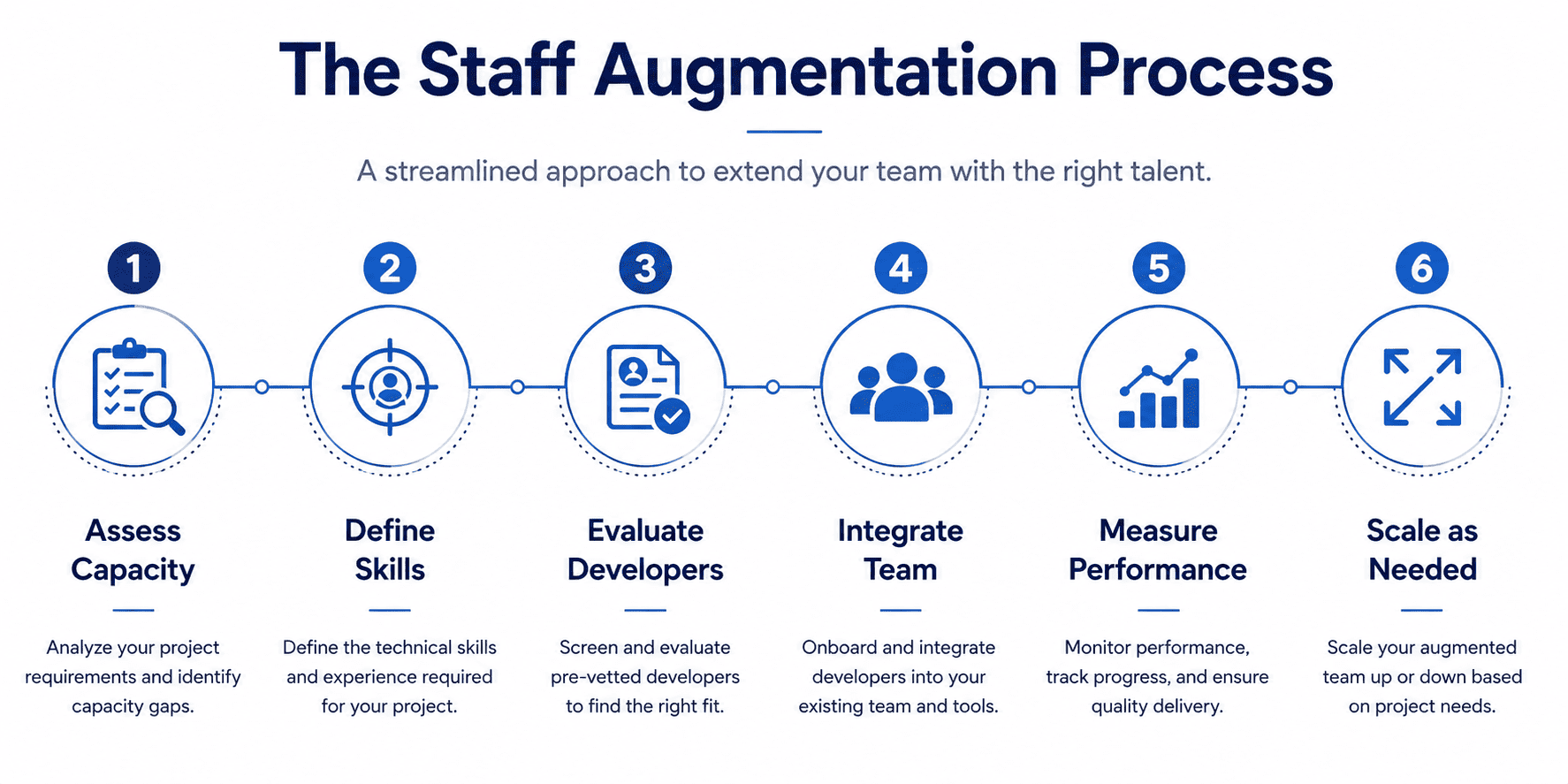
Staff augmentation follows a structured process that helps businesses identify skill gaps, onboard qualified professionals, integrate them into existing teams, and continuously monitor performance throughout the project lifecycle. Unlike traditional hiring, which often involves lengthy recruitment cycles, staff augmentation enables organizations to scale engineering capacity quickly while maintaining complete control over product development.
A successful staff augmentation strategy is built on planning rather than simply adding more developers. Organizations that clearly define technical requirements, communication processes, and success metrics typically experience smoother onboarding and better collaboration.
Step 1: Assess Your Engineering Capacity
The first step in staff augmentation is understanding your current engineering capabilities and identifying where additional expertise is required.
Rather than immediately recruiting developers, engineering leaders should evaluate:
• Current team workload
• Product roadmap
• Technical skill gaps
• Upcoming releases
• Budget constraints
• Project timelines
This assessment helps determine whether the business needs backend developers, cloud engineers, DevOps specialists, QA engineers, AI experts, or a combination of multiple roles.
For example, Atlassian recommends capacity planning as a core Agile practice, helping engineering teams balance workloads, identify bottlenecks, and allocate resources effectively before work begins. Proper planning ensures teams scale based on actual delivery requirements rather than assumptions. — Atlassian Agile Coach
Step 2: Define the Skills You Need
After identifying capacity gaps, organizations define the exact technical skills required for the project.
Common technologies include:
• Java
• .NET
• Python
• React
• Angular
• Flutter
• Node.js
• AWS
• Microsoft Azure
• Google Cloud Platform
• Docker
• Kubernetes
• DevOps
• AI & Machine Learning
• Data Engineering
Being specific about technical requirements improves candidate quality and reduces onboarding time.
For example, Walmart's global e-commerce platform relies on a diverse engineering ecosystem that includes React for frontend development, Java-based microservices for backend systems, cloud infrastructure, DevOps practices, and automated testing to support millions of customers worldwide. Building and maintaining such large-scale digital commerce platforms requires specialists across multiple technology domains working together. — Walmart Global Tech Engineering Blog.
Step 3: Evaluate and Select Qualified Developers
Selecting the right engineers involves more than reviewing resumes. Experienced staff augmentation providers assess candidates through technical interviews, coding challenges, architecture discussions, and communication evaluations to ensure they match both the technical and collaborative requirements of the project.
Effective evaluation often includes:
• Coding assessments
• Technical interviews
• Portfolio reviews
• Architecture discussions
• Problem-solving exercises
• Communication assessments
According to the GitLab Remote Work Report, clear communication and documented workflows are among the most important factors for successful collaboration in distributed engineering teams. — GitLab Remote Work Report.
Step 4: Integrate Developers into Your Existing Team
One of the biggest differences between staff augmentation and project outsourcing is team integration.
Augmented professionals become part of your engineering team and participate in:
• Sprint Planning
• Daily Stand-ups
• Backlog Grooming
• Code Reviews
• Sprint Reviews
• Retrospectives
• Product Discussions
They use the same collaboration platforms, coding standards, documentation, and development processes as internal employees.
Step 5: Measure Performance Continuously
Successful staff augmentation doesn't end after onboarding.
Engineering leaders should continuously monitor performance using measurable delivery metrics rather than simply tracking hours worked.
Common performance indicators include:
• Sprint Velocity
• Lead Time
• Cycle Time
• Deployment Frequency
• Change Failure Rate
• Code Quality
• Customer Satisfaction
These metrics are widely used in the DORA (DevOps Research and Assessment) framework, which identifies high-performing software delivery teams based on engineering outcomes rather than activity levels. —Google Cloud DORA Research
Step 6: Scale Teams as Business Needs Change
One of the greatest advantages of staff augmentation is flexibility.
Organizations can:
• Add engineers after receiving funding.
• Expand teams during product launches.
• Bring in cloud specialists for migration projects.
• Introduce AI engineers for new initiatives.
• Reduce team size after major milestones.
Instead of maintaining permanent headcount for temporary projects, businesses align engineering capacity with actual business demand, improving both efficiency and cost management.
What Are the Benefits of IT Staff Augmentation?
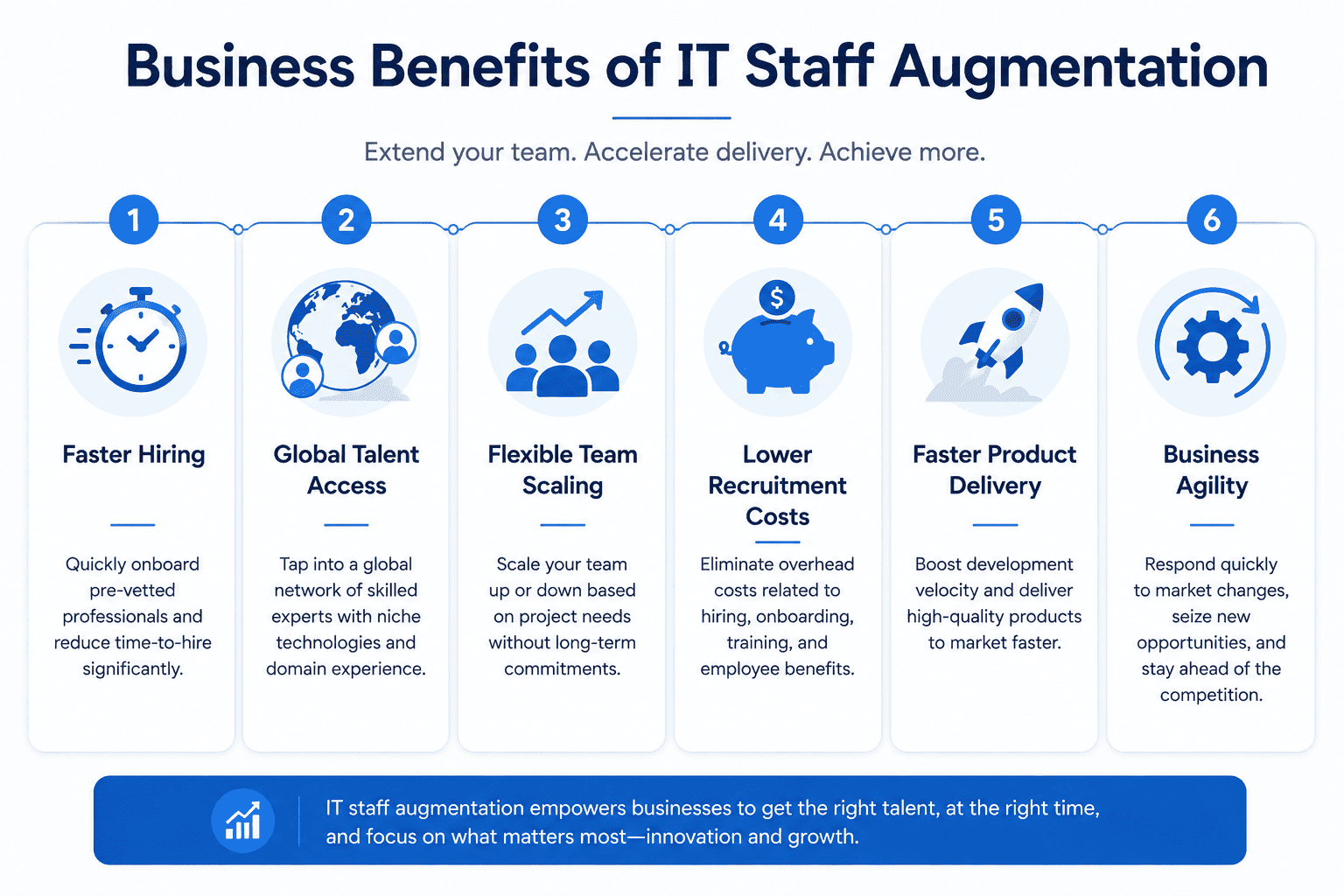
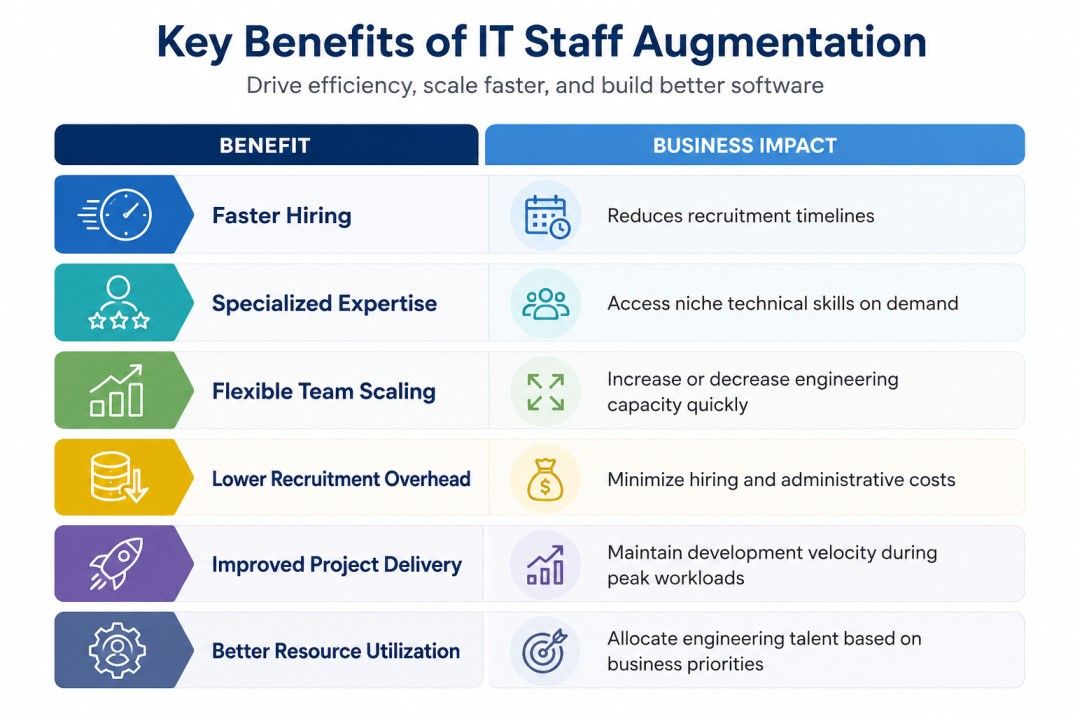
IT staff augmentation helps businesses accelerate software delivery, access specialized technical expertise, reduce recruitment overhead, and scale engineering teams without long-term employment commitments. These advantages make it one of the most widely adopted workforce strategies for technology-driven organizations.
Faster Hiring and Reduced Recruitment Time
One of the most significant advantages of staff augmentation is speed.
Recruiting experienced software engineers traditionally involves advertising positions, screening candidates, conducting interviews, negotiating offers, and waiting through notice periods. Staff augmentation shortens this process by providing access to pre-vetted professionals who can often begin contributing within days or weeks.
This faster onboarding helps organizations maintain development momentum and meet product deadlines.
Access to Global Technical Talent
Technology expertise is no longer limited by geography.
Businesses can now access experienced professionals across cloud computing, cybersecurity, artificial intelligence, DevOps, mobile development, and enterprise software regardless of physical location.
According to the 2024 Stack Overflow Developer Survey, developers are distributed across more than 180 countries, enabling organizations to build globally distributed engineering teams with diverse technical expertise. — Stack Overflow Developer Survey 2024
Greater Flexibility for Growing Businesses
Engineering requirements change throughout the software development lifecycle.
Startups may require rapid expansion after securing funding, while enterprises often need additional specialists during digital transformation initiatives.
Staff augmentation enables organizations to increase or decrease engineering capacity without restructuring permanent teams.
For example, after raising $225 million in Series F funding in 2021, Canva continued expanding its engineering organization globally to accelerate product development and international growth. As companies scale rapidly, flexible access to engineering talent becomes increasingly important for maintaining delivery speed. — Canva Newsroom
Lower Operational Costs
Staff augmentation helps reduce many of the indirect costs associated with permanent recruitment.
Organizations can avoid expenses related to:
• Recruitment agencies
• Employee benefits
• Long-term payroll obligations
• Infrastructure expansion
• Ongoing recruitment campaigns
Instead, businesses invest engineering resources where they create immediate value.
It's important to note that staff augmentation isn't always the cheapest option—it is often the most cost-efficient when flexibility, speed, and specialized expertise are priorities.
Better Business Continuity
Software development rarely stops after launch.
Products continue to evolve through feature releases, security updates, compliance requirements, and customer feedback.
Staff augmentation provides additional engineering capacity without disrupting ongoing development, helping organizations maintain consistent delivery schedules during periods of increased demand.
Planning to accelerate your next software initiative? Explore our Product Development Services to build scalable digital products from concept to launch with experienced engineering teams.
Which Types of Projects Benefit Most from Staff Augmentation?
Staff augmentation is most valuable for projects that require rapid scaling, specialized technical expertise, or temporary engineering capacity without long-term hiring commitments. While organizations of every size can benefit from this model, certain software initiatives are particularly well suited because their resource requirements change throughout the project lifecycle.
Let's explore the most common scenarios where staff augmentation delivers measurable business value.
Scaling a SaaS Platform After Funding
Startups often experience rapid growth after securing investment. While additional funding enables faster product development, recruiting experienced engineers quickly enough to meet investor expectations can become a major challenge.
Instead of spending months building an in-house engineering team, many startups temporarily expand their existing teams with experienced backend developers, frontend engineers, DevOps specialists, and QA professionals.
For example, Stripe expanded its engineering organization significantly as the company scaled globally to support millions of businesses processing digital payments. Rather than relying on a single location, Stripe built distributed engineering teams across multiple countries, enabling faster product innovation while supporting international growth. — Stripe Engineering
Staff augmentation enables growing startups to increase engineering capacity immediately while maintaining product ownership and engineering standards.
Enterprise Digital Transformation
Large organizations frequently modernize legacy systems, migrate workloads to the cloud, or adopt artificial intelligence initiatives.
These transformation projects often require specialists in:
• Cloud Architecture
• DevOps
• Enterprise Integration
• Cybersecurity
• Data Engineering
• Solution Architecture
Recruiting permanent specialists for every transformation initiative may not be practical, particularly when expertise is required only during implementation.
For example, Capital One completed one of the financial industry's largest cloud migrations by moving significant workloads to Amazon Web Services (AWS). The transformation required extensive expertise in cloud engineering, security, automation, and software modernization across multiple engineering teams. — AWS Customer Stories
Organizations undergoing similar modernization projects often use flexible workforce strategies to supplement internal engineering capabilities during large-scale migrations.
Planning a cloud modernization initiative? Explore our Cloud Application Development Services to build secure, scalable cloud-native applications and modernize existing systems with confidence.
Building an MVP
Speed is one of the most important success factors for early-stage startups.
Launching a Minimum Viable Product (MVP) quickly allows founders to validate business ideas, gather customer feedback, and iterate before investing heavily in product expansion.
Rather than hiring an entire permanent engineering team, startups frequently augment existing resources with experienced developers who can accelerate product development during the MVP stage.
According to CB Insights, one of the leading reasons startups fail is building products that do not meet market demand. Launching an MVP earlier allows businesses to validate assumptions before committing significant resources. — CB Insights Startup Failure Report
Filling Temporary Skill Gaps
Even mature engineering organizations occasionally require expertise that doesn't exist internally.
Examples include:
• Kubernetes migration
• AI implementation
• Cybersecurity audits
• Performance optimization
• Blockchain development
• Data engineering
• Machine Learning
Instead of permanently hiring niche specialists, organizations can temporarily augment teams with professionals possessing the required expertise.
This approach enables businesses to solve highly specialized technical challenges without increasing long-term payroll costs.
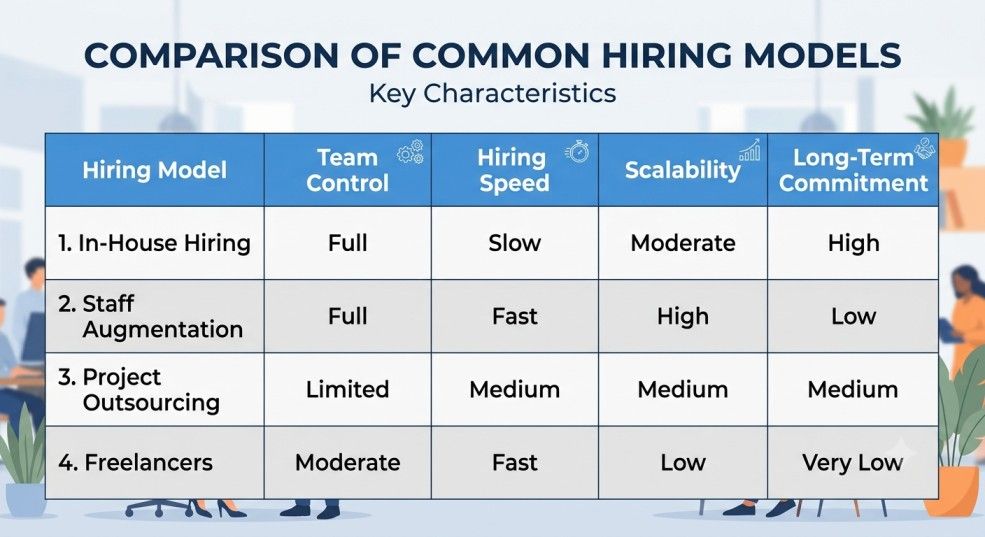
Staff Augmentation vs Other Hiring Models
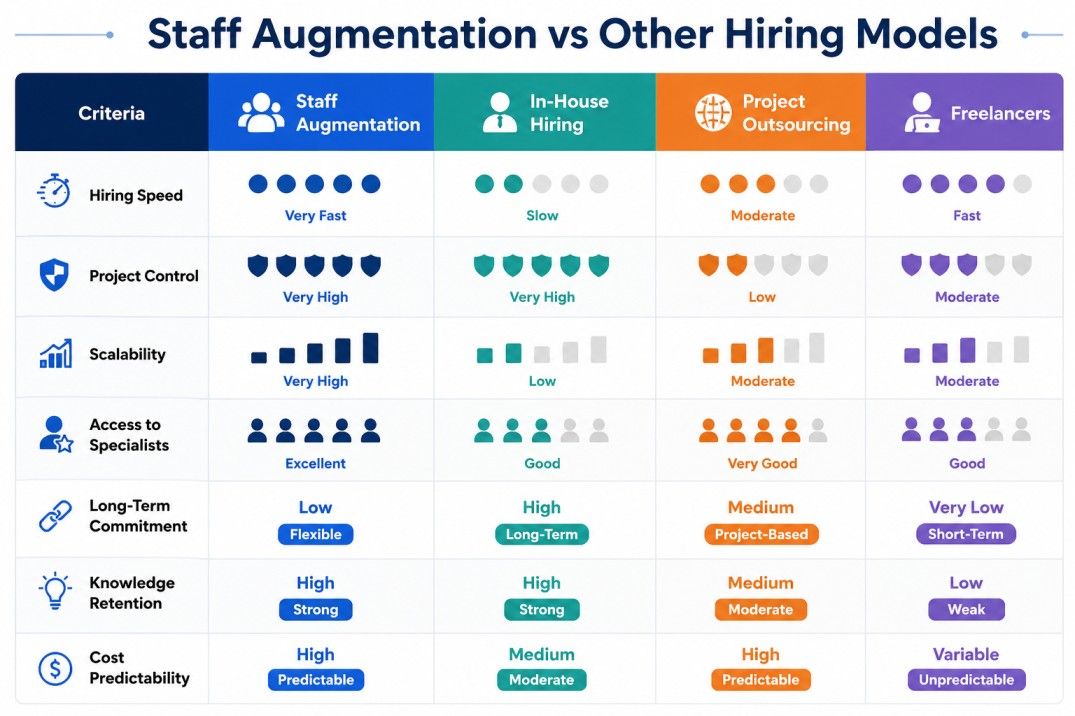
Choosing the right hiring model depends on your project goals, budget, required level of control, and long-term workforce strategy. Staff augmentation is only one option. Businesses should compare it with traditional hiring, outsourcing, freelancers, and managed services before making a decision.
Staff Augmentation vs In-House Hiring
Permanent hiring remains an excellent option for organizations requiring long-term engineering capacity and deep organizational knowledge.
However, hiring experienced software engineers often requires significant time and investment.
Staff augmentation becomes a stronger option when organizations need to:
• Launch products quickly
• Fill temporary skill gaps
• Expand after funding
• Complete time-sensitive projects
• Access specialized expertise
Rather than replacing permanent employees, augmented developers complement existing engineering teams.
Staff Augmentation vs Project Outsourcing
Project outsourcing transfers responsibility for delivery to an external vendor.
Staff augmentation, by contrast, allows organizations to retain complete ownership of:
• Product roadmap
• Technical decisions
• Development priorities
• Sprint planning
• Code reviews
Businesses seeking greater transparency and day-to-day collaboration often prefer staff augmentation over traditional outsourcing.
Staff Augmentation vs Freelancers
Freelancers are often ideal for:
• Small projects
• Bug fixes
• UI design
• Documentation
• Short-term support
However, larger software initiatives typically require consistent collaboration across multiple engineering disciplines.
Staff augmentation offers stronger integration, better continuity, standardized engineering practices, and improved long-term knowledge retention.
When Should You Choose Staff Augmentation?
Staff augmentation is usually the right choice when your organization needs to:
✅ Scale engineering teams within weeks rather than months
✅ Retain complete ownership of product development
✅ Access niche technical expertise
✅ Support Agile development
✅ Maintain engineering quality during rapid growth
✅ Increase delivery capacity without expanding permanent headcount
What Challenges Can Businesses Face During Staff Augmentation?
Staff augmentation can significantly improve engineering capacity, but its success depends on effective planning, communication, onboarding, and team integration. Without a structured implementation strategy, organizations may experience collaboration issues, inconsistent delivery, or reduced productivity.
Fortunately, these challenges are well understood and can be minimized through proven engineering practices.
Communication Across Distributed Teams
Distributed engineering teams often work across different time zones, cultures, and communication styles. Without clear expectations, misunderstandings can delay development and reduce collaboration.
Best practices include:
• Establish overlapping working hours where possible.
• Document technical decisions in a shared knowledge base.
• Conduct regular sprint planning and retrospectives.
• Define ownership for every feature or component.
• Encourage asynchronous communication for non-urgent discussions.
For example, Automattic, the company behind WordPress.com, has operated as a fully distributed organization for years. Its teams rely heavily on written documentation, asynchronous communication, and transparent workflows to coordinate employees across dozens of countries. — Automattic Distributed Work Guide
Knowledge Transfer
Engineering knowledge should never remain with a single individual.
Organizations should encourage augmented developers to document architecture decisions, deployment processes, APIs, and technical workflows throughout the project.
Good documentation improves:
• Business continuity
• Faster onboarding
• Easier maintenance
• Lower project risk
• Knowledge retention
Security and Compliance
When external developers join internal teams, organizations should maintain the same security standards applied to permanent employees.
Security best practices include:
• Role-based access control (RBAC)
• Multi-factor authentication (MFA)
• Secure VPN access
• NDA agreements
• IP ownership clauses
• Principle of least privilege
According to the Verizon 2024 Data Breach Investigations Report, compromised credentials remain one of the most common causes of security incidents, highlighting the importance of strong identity and access management for all engineering team members. — Verizon DBIR 2024
Cultural Integration
Technical skills alone don't determine project success.
Augmented engineers should understand:
• Team values
• Development standards
• Communication expectations
• Coding conventions
• Review processes
• Business objectives
Organizations that treat augmented professionals as genuine team members generally experience stronger collaboration and better delivery outcomes.
Which Tools Help Manage Augmented Engineering Teams?
The right collaboration and development tools enable augmented developers to integrate seamlessly into existing engineering teams. Standardized workflows improve communication, increase transparency, and support consistent software delivery regardless of team location.
Project Management
Popular project management platforms include:
• Jira
• Azure DevOps
• Trello
• Linear
These tools help teams manage sprint planning, product backlogs, issue tracking, and release schedules.
Communication
Most distributed engineering teams rely on:
• Slack
• Microsoft Teams
• Zoom
• Google Meet
These platforms support daily stand-ups, sprint reviews, design discussions, and real-time collaboration.
Version Control
Software development teams commonly use:
• GitHub
• GitLab
• Bitbucket
Version control systems enable collaborative coding, pull requests, code reviews, and release management.
Documentation
Maintaining centralized documentation improves onboarding and knowledge sharing.
Popular documentation platforms include:
• Confluence
• Notion
• GitBook
CI/CD & Cloud Infrastructure
Modern engineering teams frequently use:
• Jenkins
• GitHub Actions
• Docker
• Kubernetes
• AWS
• Microsoft Azure
• Google Cloud Platform
These technologies automate software delivery while improving scalability and deployment reliability.
Staff Augmentation Implementation Checklist
A structured implementation plan increases the likelihood of successful staff augmentation by ensuring technical, operational, and communication requirements are addressed before onboarding begins.
Use the following checklist before expanding your engineering team.
Engineering Readiness Checklist
✅ Define project objectives
✅ Identify required technical skills
✅ Estimate engineering capacity
✅ Select the appropriate augmentation model
✅ Establish onboarding documentation
✅ Configure development environments
✅ Set communication expectations
✅ Define sprint goals and KPIs
✅ Assign internal technical ownership
✅ Review security and compliance requirements
✅ Schedule regular performance reviews
What's Next? Building a Successful Staff Augmentation Strategy
Staff augmentation delivers the greatest value when it supports a long-term engineering strategy rather than serving as a short-term hiring fix. Organizations that continuously assess engineering capacity, anticipate future skill requirements, and invest in collaborative development practices are better positioned to scale efficiently.
A practical roadmap includes:
1. Evaluate your current engineering capacity.
2. Identify technical skill gaps.
3. Define project priorities and timelines.
4. Select the most suitable hiring model.
5. Choose an experienced augmentation partner.
6. Integrate developers using Agile practices.
7. Monitor delivery metrics and continuously improve team performance.
Rather than viewing staff augmentation as a replacement for internal hiring, many successful organizations combine permanent employees with flexible engineering resources to maintain agility while preserving long-term product knowledge.
Conclusion
Staff augmentation has become one of the most effective workforce strategies for organizations that need to scale engineering teams quickly while maintaining flexibility and technical quality. By integrating experienced professionals into existing development teams, businesses can accelerate product delivery, fill specialized skill gaps, reduce recruitment delays, and respond more effectively to changing market demands.
The success of any staff augmentation initiative depends on more than simply hiring additional developers. Clear project goals, structured onboarding, effective collaboration, measurable performance indicators, and strong engineering leadership all contribute to long-term success.
As software development continues to evolve, businesses that combine permanent engineering talent with flexible staffing models will be better equipped to innovate, adapt to new technologies, and deliver high-quality digital products at scale.